


BC Modules for Your Project Orders
We supply LONGi BC solar panels to EPCs, installers, project developers and distributors. Our selection includes 420–440W and 445–455W single glass modules, 490–505W premium black and 495–510W dual glass options, plus 665–685W and 665–690W large format modules. You can compare compact rooftop formats with higher power options for larger layouts.
Tell us your required wattage, project location, quantity and delivery schedule. We help you compare dimensions, electrical ratings and warranty terms before requesting your preferred model. Orders start from one pallet, with FOB Shanghai quotations. If your project also requires inverters or HBOWA energy storage, our technical team can help coordinate component selection and system design for you.
BC Solar Panels By Pallet
Choose a power range to review the full specifications.


BC Solar Panels By Container
Choose a power range for container supply planning.


665W-690W
MOQ: One Container
More Light Reaches the Cell Surface
BC solar panels place both positive and negative electrical contacts on the rear of each cell, removing front metal gridlines that shade part of the light receiving surface. The cell absorbs light, generates charge carriers and collects them through the rear contacts. Passivation and contact design also influence electrical losses.

Fit More Rated Power Into Limited Roof Area
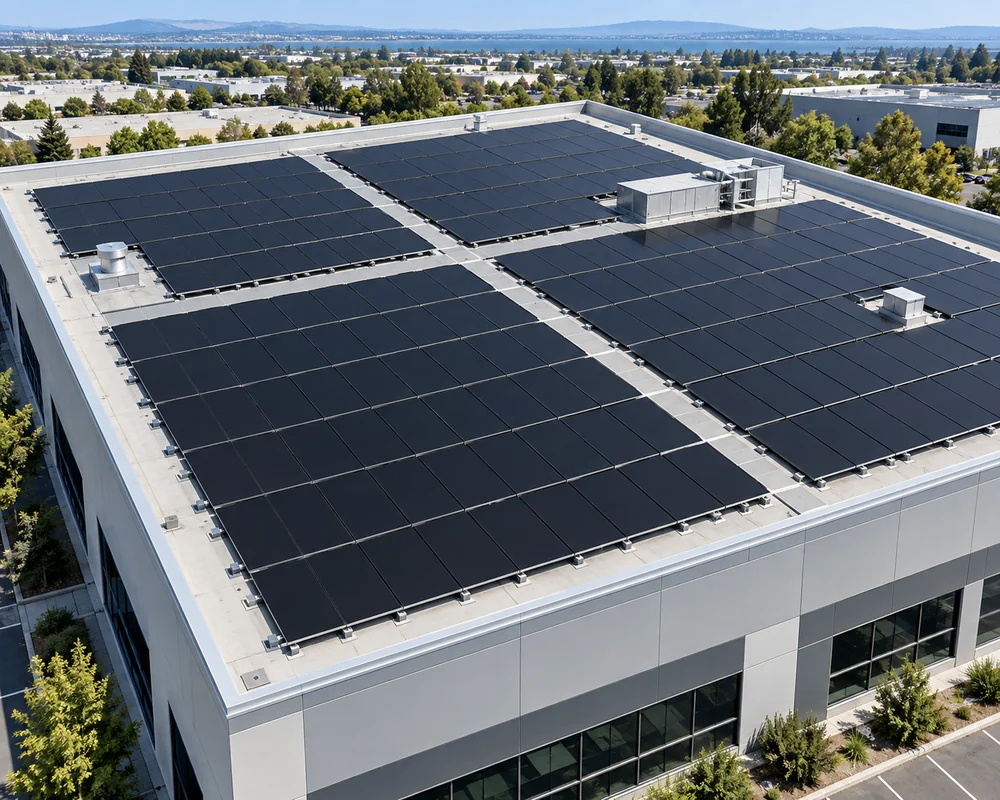
Higher efficiency BC solar panels can help you increase installed capacity where usable roof area is limited. Compare watts per square metre together with access paths, setbacks and mounting gaps. Our 420–440W and 445–455W LR5-54HTH options share the same dimensions, making this comparison straightforward.
Compare Heat Losses Before Selecting Your Module
For hot sites, check the maximum power temperature coefficient of your BC solar panels. The listed LR5-54HTH sheets specify −0.29%/°C, while the listed LR7-54HJBB and LR7-72HJD sheets specify −0.24%/°C. A coefficient closer to zero means less temperature related power loss for the same cell temperature rise.


Make Rear Side Generation Work for Your Layout
Bifacial BC solar panels can use light reaching the rear surface, but the gain depends on ground reflectance, clearance, row spacing and rear shading. The listed LR7-72HJD sheets specify 60 ± 5% bifaciality; this describes relative rear and front response under test conditions, not a 60% energy bonus. We recommend modelling your mounting arrangement before paying for a bifacial option where the rear receives little light.
Coordinate Your Module and System Procurement
We supply the LONGi modules listed above and help you work through product selection, technical documents and delivery requirements. Our own PP solar module range and HBOWA storage systems also support broader solar plus storage procurement. We keep each manufacturer’s model identity and warranty terms clear, so you know which product you are specifying.
For project developers, our technical team supports system design, installation guidance, commissioning and technical training. Share your inverter requirements and load profile if storage is included. We can help you assess a coordinated solution.
Choose BC Modules Around Your Installation

For warehouse and commercial rooftop projects, we help you compare BC solar panels around the usable mounting area and electrical design. Compact modules can offer more layout flexibility around obstacles, while larger formats may suit open roof sections.

For ground mounted arrays and elevated structures, consider the large format bifacial BC solar panels alongside your mounting and inverter requirements. Check handling arrangements, clamp zones, design loads and string current before choosing a power bin. Where rear illumination is available, your energy model should include local ground conditions and row geometry to assess whether bifacial generation justifies the installed cost.
Understand the Technology Before Comparing Quotations
- Compare BC With TOPCon HJT and PERC
- Compare BC With TOPCon HJT and PERC
| Term | What It Means for Your Selection |
|---|---|
| BC and IBC | BC means back contact. IBC uses interdigitated positive and negative contacts on the cell rear. |
| HPBC and ABC | LONGi HPBC and AIKO ABC are branded BC technology names. Check the generation and exact product specification. |
| TBC and HBC | These describe BC approaches combined with TOPCon or heterojunction technology. LONGi also uses the HIBC designation. |
| Poly ZEBRA | Another back contact approach encountered in technical comparisons; it is not a model in our LONGi selection. |
| P type and N type | These describe the silicon base. BC describes contact placement, so it does not by itself specify the silicon type. |
| 0BB | Zero busbar describes an interconnection approach. A 0BB label alone does not identify a BC module. |
BC describes contact placement. PERC means passivated emitter and rear cell, TOPCon means tunnel oxide passivated contact, and HJT means heterojunction technology. These describe cell structures and passivation approaches; some can be combined with BC. Compare purchasable modules under the same project assumptions.
| Purchase Decision | What to Compare |
|---|---|
| Limited installation area | Module efficiency, dimensions and the capacity that fits your actual layout. |
| Hot climate | Pmax temperature coefficient and expected operating temperature for each model. |
| Bifacial installation | Rear response, mounting clearance, ground reflectance and simulated energy yield. |
| Project economics | Delivered price, racking, handling, electrical design, degradation and lifetime energy. |
Ask us to compare your shortlisted BC and TOPCon solar panels against the same layout and order quantity. We recommend evaluating installed cost and expected energy together; no technology label guarantees the lowest project cost.
FAQ
BC describes back contact cell technology, not a standard panel size. For example, LONGi LR5-54HTH 420–440W modules measure 1,722 × 1,134 × 30 mm, while Hi-MO S10 LR7-72HJD 665–690W modules measure 2,382 × 1,134 × 30 mm. We recommend confirming the exact model and mechanical drawing before ordering.
Yes, where the selected module and array match the inverter requirements. For telecom, irrigation or remote power projects, provide your daily load, location and required autonomy. We can help assess modules, power conversion and HBOWA storage together.
We provide OEM and ODM services for our PP solar module business. For a BC requirement, send your target power, dimensions, electrical specifications, branding and quantity so we can assess feasibility before making a commitment.
BC modules can be worth considering where higher module efficiency improves capacity within a limited installation area, but the better purchase depends on the specific products and project. Compare module price, dimensions, temperature coefficient, expected energy yield, and installation costs under the same assumptions.
Warranty terms depend on the exact brand, model, and specification version. The LONGi LR5-54HTH 420–440W datasheet specifies 15 years for materials and processing and 25 years for linear power output. The Hi-MO S10 LR7-72HJD 665–690W option specifies a 15-year product warranty and 30-year performance warranty. We recommend reviewing the applicable warranty document, exclusions, and claim procedure before ordering.
For our LONGi Hi-MO S10 LR7-72HJD 665–690W option, the minimum order is one pallet of 36 modules. This requirement does not automatically apply to every BC model. The same option has a packing specification of 720 modules per 40-foot high-cube container.
Related Product




Low light performance varies by model and operating conditions. Ask for irradiance-dependent performance data when it materially affects your yield estimate. Internal quantum efficiency measures how effectively absorbed photons generate collected charge, but a favourable value alone does not establish annual energy output. For cloudy sites, use local weather data and suitable module performance inputs when comparing your shortlist.
No. Back contact describes where the cell’s electrical contacts sit; bifacial describes whether a module generates power from light reaching both sides. Our LONGi Hi-MO S10 LR7-72HJD 665–690W option supports bifacial generation and specifies 60 ± 5% power bifaciality. This is a test ratio, not a 60% energy gain. We recommend assessing ground reflectance, mounting clearance, and rear shading before including additional rear-side energy in your project forecast.
The effect depends on the cell design, module circuit, bypass diodes, and shading pattern. Some BC models have features intended to reduce local overheating or shading losses, but you should compare tests for the specific model. Share the location of nearby obstructions with your designer. Shading assessment, string layout, and electrical protection remain necessary even when a module has anti-shading features.
Review mechanical load ratings alongside the installation manual, clamp positions, and your project’s design loads. Cell and interconnection design can affect microcrack behaviour, but BC alone does not establish durability. Plan inspections for damage, cable connections, and soiling. Follow the manufacturer’s cleaning instructions; rear contacts do not remove the need to maintain the exposed glass surface and mounting system.