

Introduction
Choosing the right solar inverter is key to your system’s efficiency, reliability, and performance. Among the Deye solar inverter and Growatt solar inverter are two renowned inverter brands that have acquired a strong foothold in the solar inverter market due to the features and benefits they offer. Both brands offer equally competitive features, but the different efficiencies, durability, and monitoring capabilities differentiate one solar inverter from the other brand.
Quick Answer: Deye or Growatt?
Choose Deye if you need advanced hybrid features, generator integration, high battery charge/discharge current, or a 48V low-voltage battery platform for demanding hybrid and C&I projects. Choose Growatt if you want a cost-effective inverter for residential grid-tie or simpler hybrid systems, or a high-voltage battery platform for a new home storage setup.
Key Differences at a Glance:
– Efficiency: effectively equal — current models of both brands sit in the same 97.6% max-efficiency class (datasheet comparison below).
– Hybrid features: Deye offers generator input, six charge/discharge time periods, and parallel expansion (up to 16 units, model-dependent).
– Price: Growatt is generally the more budget-friendly option.
– Three-phase battery platform: Deye = 48V low-voltage; Growatt SPH TL3 BH-UP =high-voltage (100–550 V). Decide the battery platform first.
Overview of Deye and Growatt Inverters
Deye and Growatt are both Chinese-based companies that have gained significant traction, and both brands cater to different market segments. Growatt is widely adopted for its affordability and ease of integration. It is mostly used for residential solar. On the other hand, Deye is custom-made and follows the latest technology and thermal management, and it works best in compatibility with high-capacity energy storage systems. These serve the target commercial and industrial users.

Efficiency and Performance Comparison
Manufacturer datasheets show both brands operating in the same efficiency class. The Deye SUN-5K-SG03LP1-EU is rated at 97.6% max efficiency (Euro efficiency 96.5–97.0%), while the Growatt SPH 5000TL3 BL is rated at 97.6% max (Euro efficiency 97.1%). At system level the difference is marginal —string design, temperature derating and battery round-trip losses matter
more than the last decimal point. The table below compares the two models directly from official datasheets.
Spec Comparison: Deye SUN-5K-SG03LP1-EU vs Growatt SPH 5000TL3 BL
| Specification | Deye SUN-5K-SG03LP1-EU | Growatt SPH 5000TL3 BL |
|---|---|---|
| Rated AC output power | 5,000 W (max 5,500 W) | 4,999 W |
| Max. efficiency | 97.6% | 97.6% |
| Euro efficiency | 96.5–97.0% (varies by datasheet revision) | 97.1% |
| Battery voltage range | 40–60 V (48 V class) | 42–59 V (48 V class) |
| Max. charge / discharge current | 120 A / 120 A | 66 A / 66 A |
| Max. PV input power | 6,500 W | 8,000 W (recommended array) |
| Max. PV voltage | 500 V | 550 V |
| MPPT voltage range | 150–425 V | 150–550 V |
| MPPT trackers | 2 | 2 |
| BMS communication | RS485 / CAN (self-adaption to BMS) | RS485 / CAN / RS232 |
| Operating temperature | −40 to +60 °C, derating >45 °C | −25 to +60 °C |
| Ingress protection | IP65 | IP65 |
| Warranty | 5 years (10-year option per policy) | 5 years standard, 10-year option |
Source: Deye SUN-5K-SG03LP1-EU official datasheet (deyeinverter.com) and Growatt SPH 3000–6000TL3 BL datasheet, accessed September 2026. Specs are model-specific — other models in each range differ.

Build Quality & Durability
Solar inverter’s durability is the lifespan it’ll be serving as well as how well it can handle the harsh outdoor environments. Deye hybrid inverters have a very well-built feature, metal casing, improved cooling system, and superior heat elimination.
They can deal with extreme conditions daily and are a great option for high capacity residential and industrial setups. Growatt mainly focuses on producing compact and lightweight models which are easy to install if the installation is not on the hostile terrains and climate overall.
According to a South-African case study, the efficiency of the Deye micro inverters and the Growatt inverters were tested for around two years in high-temperature circumstances. The Deye model provided the regular efficiency while few of the Growatt models showed a slight drop in the efficiency output because of the overheating problem.
Deye 5KW Hybrid Solar Inverter | Deye 10KW Hybrid Solar Inverter |
 |  |
The brand has advanced thermal management defined in the Deye 12KW hybrid inverter manual pdf, preventing overheating and extending the life of the system. When the setup is around high heat, the output efficiency decreases along with increment in the price of the hardware.
Deye hybrid inverters are a perfect choice if your installation is said to be on the premises subjected to harsh heat and humidity. Growatt inverters including the Growatt battery inverter are a good option in moderate climates. If the installation of Growatt is made in the areas that are like deserts, then extra ventilation and cooling solution will be required. A Deye hybrid inverter model shall be chosen when ‘how harsh your environment will be’ and ‘how long your inverter’s life is needed’ are two main priorities.
Features & Smart Technology
Modern solar inverters are equipped with monitoring and connectivity along with battery integration. Solar inverters by Deye Sun include Wi-fi, RS485 and cloud monitoring for tracking the energy production besides its performance of the system. This solar inverter also provides diagnostic to know problems remotely. Hybrid inverters by Growatt such as Growatt 15 kW hybrid inverter have a local and cloud monitoring system. Some models support Growatt inverter parallel connection, enabling multiple inverters to work together in large-scale installations.
Growatt battery inverters support both lithium-ion batteries and lead-acid batteries. Deye hybrid inverters, on the other hand are designed to match the needs of a LiFePO4 battery. LiFePO4 battery has a longer life and better thermal stability.
A specimen case study considered the Deye 20 kW hybrid inverter and compared the performance with Growatt 15kW hybrid inverter. The Deye hybrid is a better and efficient way of managing the storage and charge- discharge cycle of energy and thus resulting in fewer degradation of the battery bank in 3 years in a commercial farm in Spain. It also managed the power more efficiently by having the perfect MPPT algorithm. Lowest optimization of the energy management system for managing the load fluctuation was observed in Growatt.
If you need a smart energy management system, Deye hybrid inverters are the correct choice for you while growatt is better when least prioritized features are wanted and cost-efficient.
Cost & Value for Money
The price is one of the key factors. Apparently, the Growatt inverters are more affordable. Hence, many budget conscious buyer prefers the Growatt inverters.
Growatt 24V hybrid inverter or a Growatt 48V inverter is the most cost-effective option for small to medium residential setups. Meanwhile, if you have a solar system with three-phase power, opting for the Growatt 3 phase hybrid inverter is more economical than the higher-end models.
But when it comes to the long-term efficiency, a higher cost upfront is more reliable.
The Deye inverters have a higher sticker price than a Growatt inverter. For example, a Deye 5kW hybrid inverter has better thermal management systems, and built well and is less prone to premature failure. So, you can expect the inverter to last longer.
Hence, you will spend money over maintenance and replacement less often, hence in a long run you can save money from a Deye inverter than a cheaper and less robust a Growatt inverter.
Warranty, Customer Support & Availability
To identify the best solar inverter to use, warranty cover is essential. The Deye solar inverter warranty standard is five years. However, their warranty is extendable up to ten years. Growatt warranty is similarly around 5-10 years but will differ due to region wise service centers. The company has a warranty claim period globally and proper documentation, and warranty-wise are also mentioned in detailed with the user. Various resources of the inverter can also found online as Deye 12kW Hybrid inverter manual PDF Deutsch. The Deye solar inverter is also chosen due to quicker response opened systems if you experience any issues or problems with the inverter.
The faster response and replacement of the inverter make it more valuable to the customer. Deye inverters are more common in Europe, so you can always count on better service for your product. Growatt inverters are more common in Asia and Africa. However, there are few local technical support teams and distribution networks. They face issues depending on the service center when a Chinese built-in inverter used in other countries.
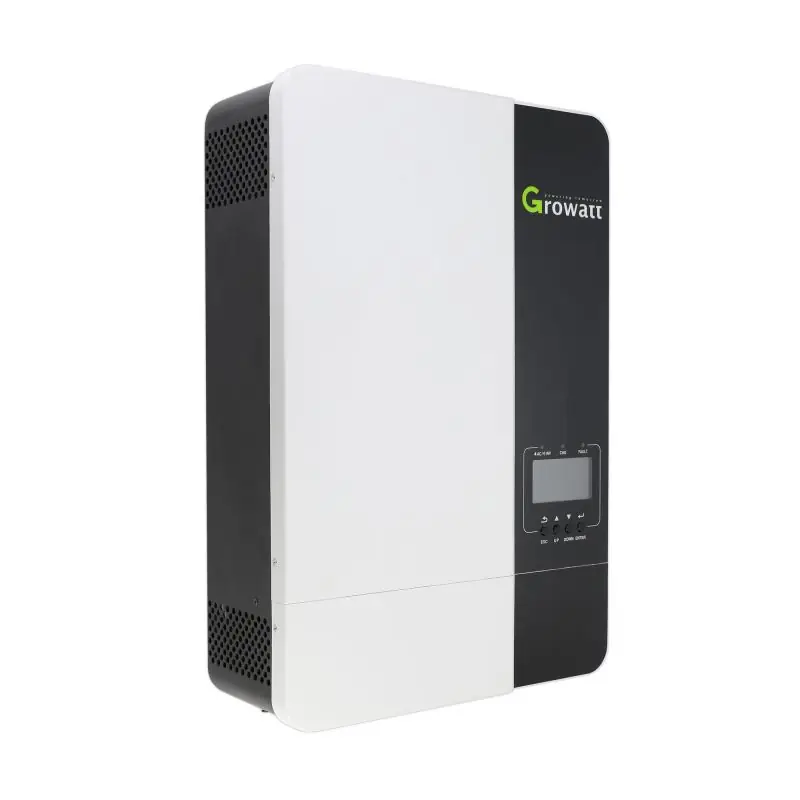
Growatt 5KW Off Grid Solar Inverter | Growatt 3-15KW On Grid Solar Inverter |
 |  |
Ideal Use Cases: Which One Should You Choose?
It primarily depends on the specific application. Use the battery platform and load profile as the first filter:
Choose Deye if you want:
– Advanced hybrid energy management with generator integration
– A 48V low-voltage battery platform — easy to mix and expand lead-acid or lithium banks
– High charge/discharge current (up to 240 A on the Deye 12kW 3-phase hybrid inverter)
– Parallel expansion of up to 16 units (model-dependent)
Choose Growatt if you want:
– A cost-effective residential system — Growatt inverters remain the most budget-friendly option for most homes
– A high-voltage battery platform for a new ARK storage setup
– Simple app-based monitoring via ShinePhone
– UPS switchover in under 10 ms on the SPH TL3 BH-UP series
Common Mistakes When Choosing
– Choosing by brand instead of battery platform. In three-phase storage, the first decision is 48V low-voltage (Deye) vs high-voltage (Growatt SPH TL3 BH-UP) — it determines which batteries you can use later.
– Ignoring charge/discharge current when sizing batteries. Comparable 5 kW models range from 66 A to 120 A; this directly affects how fast your bank can charge and what loads it can carry.
– Comparing marketing efficiency numbers instead of model datasheets. Current models of both brands sit in the same ~97.6% class.
– Assuming warranty terms are identical everywhere. Both brands start at 5 years standard; extension options differ by region and distributor — verify the terms for your country before purchase.
Final Thoughts
Both Deye and Growatt build reliable inverters — the right choice depends on your battery platform, load profile and budget. Explore our Deye solar inverters and Growatt inverters, or contact HBOWA for a tailored proposal for your project any time.
Frequently Asked Questions
The type of Growatt inverter for a 5kW solar system depends on someone’s energy needs, and future scaling-ability. The 2kW Growatt inverter will be perfect if someone is looking for a small-scale application. On the other hand, if someone wants better grid-tie ability with integrated batteries, then the Growatt 5kW hybrid inverter will be the best for residential use.
Neither brand is automatically “better” for off-grid — suitability depends on
the specific model. Deye’s hybrid inverters support generator input and up to
16 units in parallel, which helps larger off-grid systems with heavy loads.
Growatt’s off-grid models cover common home loads at a lower price. Match the
inverter’s continuous and surge power ratings to your load list, and check
that the model supports the battery voltage class you plan to use.
Both Deye and Growatt hybrid inverters work with standard LiFePO4 battery
banks. Deye’s SUN series communicates via CAN/RS485 with self-adaptation to the
battery BMS and covers a broad list of battery brands. Growatt’s hybrids also
support lithium batteries via CAN/RS485, with the tightest integration on
Growatt’s own ARK range. Before buying, confirm your battery’s BMS protocol is
on the specific inverter model’s supported list — without closed-loop
communication, the inverter falls back to voltage-based charging.
The two are different as the Growatt 15kW inverter has less power output. It is designed for medium-sized commercial installations. On the other hand, the Growatt 20kW inverter model is designed for larger installations as it has higher output and parallel connection support.

