Introduction
Green energy, especially solar power becoming one of the fastest-growing energy sources in the world. There has been a rising interest in solar farms among small investors and owners of land. How much does a 1 acre solar farm cost? That is a crucial question, very common for anyone interested in investing in the renewable energy sector. The cost per acre is a factor that determines whether a project is technically possible or not, and it also determines its payback period and long-term profitability. By the end of this article, we will have discussed all the costs and will show the costs with the 2025 data point included, will consider why we had to spend the installation so much, and then we will go through some examples around the globe, and you can decide whether or not you should think about solar farming on your land.
What Is a Solar Farm & Why Focus on “1 Acre”?
A Solar farm – sometimes referred to as a solar energy field, which is a vast group of photovoltaic solar panels, mostly located in open land, installed to generate electricity for private consumption or the grid. Unlike the rooftop solar systems, it doesn’t have to be located on the roof of its owner’s property. It can range from a few acres to a few hundred. Moreover, it helps the owner of the land and the investor install solar power systems on the open land, which is not widely used to generate a constant income.
A 1-acre solar farm can be used as a measure to evaluate the costs and output of the project. Of course, the figure of 1-acre in particular can generate merely around 400 to 600 KW units of energy, based on how productive the solar power panels are, and their location. This is a smaller standard to allow investors to compare investment needs in places where the cost of land, the human resources, and the solar energy conditions differ. The exploitation of solar energy per acre or solar energy output per acre also provides farmers, or investors, mitigate the need to start a complete megawatt worth project for cultivation.
Global Benchmarks: Cost per Acre & Cost per Watt
However, that global average of $0.98 per W does not include the cost of land to set up around a 1-acre solar farm.
According to SolarReviews in 2025, the global average cost is $0.98 per W for setting up a solar farm in countries like India, America, etc. HBOWA New Energy finds the cost of a U.S. utility-scale installation each watt at $0.85 to $1.10. Installation cost depends on original equipment, permitting costs, and labor. Genie & Solar Energy states the breakdown of a typical solar farm: 75% on equipment and other total costs, 20% on labor, and permitting and engineering divide the remainder.$0.98* 500000= $490000.
1 acre of land has approximately 0.4-0.6 MW of capacity, generally. Installation Watt/1000 disturbances are calculated by each MW approximately 1000 W.’Tilt’, module size, and farms’ design are all factors which can affect the capacity to produce power.
| REGION/COUNTRY | COST PER WATT | 1-ACRE CAPACITY | ESTIMATED TOTAL COST | NOTES |
|---|---|---|---|---|
| Global Average | $0.98 | 500 kW | $490,000 | Excludes land purchase |
| United States | $0.85 – $1.10 | 400-600 kW | $400,000 – $680,000 | Varies by state regulations |
| India | $0.75 – $0.95 | 500 kW | $375,000 – $475,000 | High sunlight, lower labor costs |
| Europe (avg) | $1.00 – $1.30 | 450 kW | $450,000 – $585,000 | Higher permitting costs |
| Australia | $0.80 – $1.05 | 550 kW | $440,000 – $577,500 | Excellent solar resources |
| Japan | $1.20 – $1.50 | 400 kW | $480,000 – $600,000 | Limited land, high labor costs |
Solar farms in the cost per acre market for solar farms, the Sumter Solar Farm in Donalsonville, having around 1 M acres of land, would cost somewhere near $5,000,000 to ~$8,500,000, as it fits the cost 1 M/W, a benchmark stated by CompareElectricity, an electricity comparison site. Land costs, other expenses can change the cost to a sum between $400,000 to ~$680,000acre. Such uplift costs can be seen in Japan, Europe, Canada, and Alabama, where the chances of getting more sunlight are less. In solar farm cost per acre, countries like India or Australia, which have a huge amount of sunlight, are expected to have good sunlight hours per annual. So, the potential value of the micro-watt of energy generated in high sunlight countries can surely be the producer seeing cost benefits.
Cost Components Breakdown
When finding out the cost of a solar farm, it’s beneficial to break down the entire amount into different cost components. One of the main factors is land, whether through lease or purchase, particularly when access to the site is limited or the land is further from the transmission. In most of the U.S. and world solar projects, the equipment (solar panels, inverters, racking) is typically considered the primary capital expense. Genie Solar states the equipment to be around 75 % of the total project’s cost, whereas labor and installation are around 20%, and the engineering, interconnection, and permit costs are smaller percentages.

Additionally, next to those essential costs, balance-of-system (BOS) things (mounting, wiring, connectors), and inverter hardware are also significant portions of non-module expenses. Also, overhead cost items (contingency, legal, insurance, project management, etc.) have to be included in the budget to cover timeline extensions or unexpected price increases.
These proportions can be changed dramatically in different areas. In the areas with high import charges, tough terrains, or rigorous permitting, the soft-cost component (indirect, permitting, and grid fees) might go higher than usual. Hence, the above estimation shall provide an excellent guideline, but the accurate budgeting should always depend upon the local conditions, supply chain realities, and the regulatory environment.
HBOWA provides new and second-hand N-type TOPCon and PERC solar panels from Tier-1 brands like Risen, Longi, Jinko, Trina, JA, and Canadian Solar—options in bulk that can reduce costs without compromising efficiency.
Estimated Total Cost for 1 Acre (Scenarios)
How much does a 1-acre solar farm cost? This can be estimated according to the region, labor, and grid conditions. According to the modeling, a 1-acre farm can yield 500 kW of installed capacity. Usually, for a typical 1-acre site, the estimated cost is $490,000 at a pricing of about $0.98 per watt. This amount is only for leased land and not for purchased land. This is to be assumed as fast logistics, low permitting fees, and locally sourced material.
| COST COMPONENT | PERCENTAGE | ESTIMATED COST | DETAILS |
|---|---|---|---|
| Solar Panels | 45% | $220,500 | N-type TOPCon or PERC modules |
| Inverters | 12% | $58,800 | SunGrow, Huawei, Growatt |
| Mounting & Racking | 10% | $49,000 | Ground-mount structures |
| Electrical Components | 8% | $39,200 | Wiring, connectors, transformers |
| Labor & Installation | 20% | $98,000 | Site preparation, installation team |
| Permits & Engineering | 3% | $14,700 | Local permits, inspections |
| Grid Interconnection | 2% | $9,800 | Utility connection fees |
| TOTAL | 100% | $490,000 |
In the higher-cost region with strict interconnection rules or imported components, the same 500 kW system can reach $650,000–$700,000. Especially when land purchase is mandatory and mounting structures are needed. Thus, it is estimated that an acre of solar farming can cost very high.
| Scenario | Description | Approximate Total Cost |
| A | -Low-cost region -Leased land -Efficient supply chain | $490,000 |
| B | -High-cost region -Purchased land -Higher labor & permitting | $650,000–$700,000 |
Revenue & Income Potential per Acre
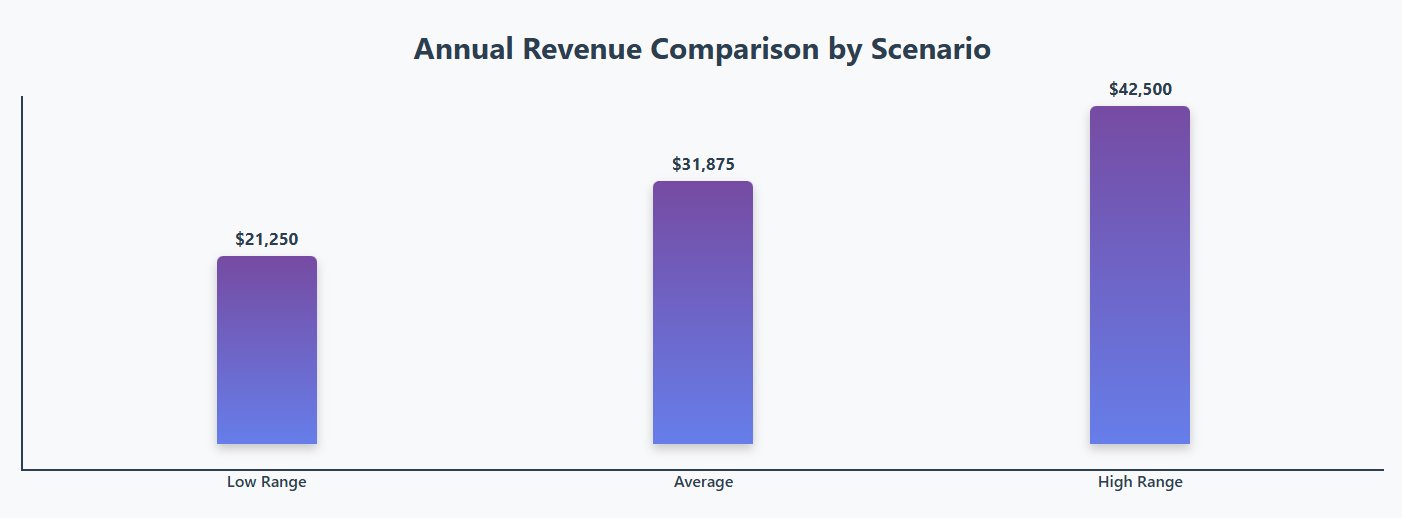
According to SmallBizTrends, annual solar farm income per acre is usually between $21,250 and $42,500, depending on local rates, sunlight, and system efficiency. In some areas, landowners who lease their land for solar get a more modest income — estimates in global market reports range from $250 to $3,000 per acre per year for land leases.
| MODEL TYPE | ANNUAL INCOME RANGE | UPFRONT INVESTMENT | RISK LEVEL | BEST FOR |
|---|---|---|---|---|
| Land Lease | $250 – $3,000/acre | Minimal | Low | Passive income seekers |
| Owner-Operated | $21,250 – $42,500/acre | $400,000 – $700,000 | Medium | Active investors |
| Community Solar | $15,000 – $35,000/acre | $300,000 – $500,000 | Medium | Shared investment groups |
| Agrivoltaics | $25,000 – $50,000/acre | $450,000 – $750,000 | Medium-High | Dual-use operations |
Those big differences show how much it matters who owns and operates the system, what the local solar energy per acre possibilities are, and what the contract terms are. And for anyone investing in solar farming, the conclusion is clear: To reach strong income levels, get on high-yield sites and optimize operations.
ROI, Payback & Sensitivity Analysis
A project’s estimated payback period depends on various variables, including the initial cost of the project, also known as the CapEx, maintenance and operational costs, and tax and depreciation rates. The annual revenue per unit area and maintenance costs will be used to compute the project’s profits.
Most of a solar farm’s CapEx will be utilised in buying or leasing the land and installing and maintaining the panels. The OpEx will consist of the insurance, lease payments, and maintenance costs, and a solar farm that occupies 1 acre and generates 500kw a day would cost around $500,000. It has an annual maintenance cost of $10,000. The interest on the loan is 5%, and the electricity tariff per unit is $10. They should evaluate whether a total profit earns $30,000 a year is earned.
Typical Solar Farm Investment Timeline

Thus, the estimated time for the project’s payback is between 10-11 years. Once the entire payment is paid, the profit that is obtained will be collected. Sometimes, the taxes and depreciation allowances can reduce the payback period. For doing the same work, if the price of the panel falls by 20%, then the payback period will be two years less.
| VARIABLE CHANGED | CHANGE AMOUNT | IMPACT ON PAYBACK PERIOD | NEW PAYBACK PERIOD |
|---|---|---|---|
| Baseline Scenario | — | — | 10-11 years |
| Panel Cost Reduction | -20% | -2 years faster | 8-9 years |
| Electricity Price Increase | +10% | -1 year faster | 9-10 years |
| Panel Efficiency Decrease | -10% | +1.5 years slower | 11.5-12.5 years |
| Lease Rate Increase | +3% annually | +0.5 years slower | 10.5-11.5 years |
| O&M Cost Increase | +25% | +0.8 years slower | 10.8-11.8 years |
If the price per unit of the power produced from the panels is reduced by 10% instead, the rate of return on investment will increase only after one year. Suppose, if the solar farm lease is also aborted and then a lease price will be. A 0.25% rise in solar farm lease rates per acre per month or 1% reduction in the panels’ output and efficiency will cause a slight decrease in the total profit amount.
Real-World Case Studies & Comparisons
In the United Kingdom, Ecowise Installations states that setting up a 1-acre solar farm costs around £174,000, according to a structure and grid tie-in. This amounts to high building costs, labour, and paperwork in the country. The steady feed-in tariff is also among the positive aspects of setting up a solar gold mine in the region.
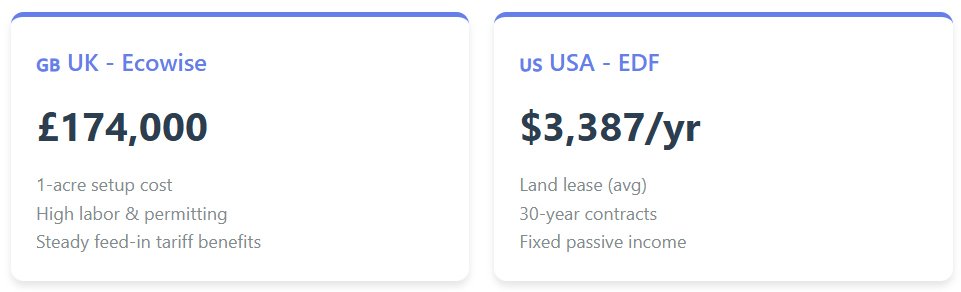
As stated by EDF Power Solutions North America in the United States of America, the power company states that the lease of land for long-term, over 30 years, pays $2,949 to $3,824 per acre per year for solar farming that reaps a fixed income for the landowners.

Comparatively, the main difference between building a solar farm in the North and the southern part inconclusively in Europe is pricing. According to the Moura Solar Plant, located in Portugal is a whopping 62 MW for a total cost of approximately €700/KW and has a cost somewhere near €250 million; among them, the solar field has the lowest cost per watt to be built, but even at smaller scales, a 1-acre solar farm profit remains achievable.
Tips to Optimize Profit & Reduce Cost
Solar farming is a business in which new and smart ideas and technologies need to be explored to make it more profitable. N-type TOPCon modules with high efficiency help to increase the yield. The technology should be up to date, and we must focus on N-type silicon and heterojunction (TOPCon) modules for increased collection and electricity output.
A LiFePO4 battery in storage systems for reaching to make the maximum amount of money per acre or otherwise for solar farms in markets where revenues depend on the time of day or basis paid for regulated energy
Profit Optimization Strategies
| STRATEGY | IMPLEMENTATION COST | REVENUE INCREASE | PAYBACK IMPACT | COMPLEXITY |
|---|---|---|---|---|
| N-type TOPCon Panels | +5-10% upfront | +15-20% efficiency | Reduces by 1-2 years | Low |
| LiFePO4 Battery Storage | + $50,000-$100,000 | +20-30% revenue (peak pricing) | Neutral to +1 year | Medium |
| Solar Trackers | + $30,000-$60,000 | +10-20% output | Reduces by 0.5-1 year | Medium |
| Premium Inverters | + $10,000-$20,000 | +3-5% efficiency | Minimal impact | Low |
| Agrivoltaics (Dual Use) | + $20,000-$40,000 | + $5,000-$15,000/year | Reduces by 1-2 years | High |
| Optimized Tilt Angle | Minimal (design phase) | +5-8% output | Reduces by 0.5 year | Low |
| Bulk Equipment Purchase | -10-15% upfront | Indirect (cost savings) | Reduces by 1-1.5 years | Low |
Investors have to install as many solar panels as possible on their land for energy production. Over-sizing can lead to loss of electricity, so they have to use the right inverter, like SunGrow, LG, Huawei, and Growatt, onboard. Our expert advice is to lay more panels than required, and electricity can be stored. You should use solar trackers as they increase the electricity yield by 10 to 20% per year.
Investers can grow nearly all the crops in a strip shaded by modules and thereby allowing fruit trees to blossom under the panels. We can also use an area and rent it to people who use it for grazing. It allows a farmer to make income in a few ways after installing solar power on their land.
Risks & Challenges
Learning how to start a solar farm, one needs to understand the risks and challenges. These are a few challenges listed below:
| Category | Risk / Challenge | Description |
| Grid & Interconnection | Interconnection Delays | Multi-year project delays and increased costs. |
| Resource & Technology | Generation Variability | Unpredictable energy output due to weather and seasons. |
| Panel Degradation | Annual efficiency loss reduces long-term revenue. | |
| Regulatory & Permitting | Regulatory/Permit Uncertainty | Changes in incentives (e.g., ITC step-down) and protracted local permit approvals. |
| Financial & Operational | Operational Costs | O&M (including inverter replacement) and insurance typically cost $15-25/kW-year, impacting profit. |
| Site & Land Issues | Land & Zoning Issues | -Securing rights -Soil tests -Local disputes cause setbacks. |
| Management & Strategy | Inadequate Due Diligence | Poor planning leads to underperformance and financial loss. |
| Poor Stakeholder Engagement | Leads to public opposition and legal challenges. |
Conclusion
The cost of a 1-acre solar farm may vary all over the world. Rural real estate prices differ from state to state drastically. Generally, the total cost of setting up one range of about $400,000-$700,000 for solar farms of 1 acre. Although a solar farm can produce much annual income between $21,250-42,500 per acre, for a better return, we can instead invest the same in agriculture and other businesses.
The viability of a solar farm significantly depends on the system efficiency, electricity prices, and financing system. So, a professional feasibility study should be conducted before deciding anything. For high solar farm performance and low lifetime costs, HBOWA provides branded tier-1 solar panels, LiFePO4 batteries, and inverter solutions that can be customized according to different solar farm projects.
Frequently Asked Questions
Annual net income per acre generally falls between $20,000 and $40,000, depending on many other factors, which are mentioned above.
Key drivers include system efficiency, solar energy per acre, local electricity tariffs, maintenance costs, and financing terms. Land acquisition, permitting, and grid interconnection can also impact overall ROI.
Yes. Lease agreements can generate steady income, typically $250 to $3,000 per acre per year, depending on location and contract terms. This option reduces upfront capital expenditure while providing passive revenue.
Using high-efficiency N-type or TOPCon panels, integrating LiFePO4 battery storage, deploying Growatt inverters, optimizing tilt, or using tracking systems can all increase solar farm revenue per acre, and HBOWA can provide you with all the solutions under one umbrella. We provide all the hardware and technical expertise to you, so feel free to contact our experts!
With proper planning, cost control, and efficient design, small-scale solar farms can achieve positive net returns within 8–12 years, and they can provide you with long-term stable income streams.