Série & Calculadora de bateria paralela
Apenas aritmética nominal. Confirme os limites de tensão, compartilhamento atual, equilíbrio, proteção, dimensionamento do condutor e regras do fabricante antes da montagem.
Introdução
Sabendo como baterias em série vs paralelo O trabalho é igualmente importante quando você está conectando baterias para um Inversor Growatt, construindo um sistema solar fora da rede, atualizando a configuração do seu RV, ou qualquer outro uso. A maneira como você conecta suas baterias decide a voltagem total, capacidade, e energia que você pode extrair de um sistema. Escolhendo o direito série vs bateria paralela configuração determina o desempenho do sistema, segurança, vida útil da bateria, e eficiência de custos. Os usuários de energia solar e os instaladores de armazenamento de energia devem saber a conexão correta para evitar problemas de energia.
O que significa conexão de bateria em série vs paralela?
Quando estamos discutindo o conexão de baterias em série vs paralelo, estamos falando sobre como as múltiplas baterias são interligadas em um sistema para atingir a tensão e o nível de capacidade desejados. Por exemplo, série ou paralelo a conexão da bateria difere no tratamento da tensão e da corrente, o que afeta o desempenho, eficiência, e adaptabilidade a equipamentos como inversores e controladores de carga.
Mas, em um conexão de bateria em série, o terminal positivo de uma bateria está conectado ao terminal negativo de outra bateria. Aumenta a tensão total, enquanto a capacidade de amp-hora permanece a mesma. Por exemplo, dois 12Baterias V 100Ah conectado em série a um 24Bateria V 100Ah. No entanto, a tensão mais alta da bateria em série é ideal para inversores de maior potência, veículos elétricos, e maiores sistemas de energia solar, que requerem uma tensão mais alta constante.
No entanto, em um conexão paralela da bateria, todos os terminais positivos são conectados entre si e conectados de forma semelhante aos negativos. Esta conexão garante o 12V, e a capacidade também dobra para 200Ah. O conexão paralela é o método ideal para duplicar o tempo de execução de um sistema, como trailers ou barcos, ou Sistemas solares fora da rede.

Dos fatos acima mencionados, podemos concluir que conectar baterias em série ou paralelo com base em nossa demanda. Se precisarmos de uma alta tensão, então devemos conectar as baterias em série. Por outro lado, se quisermos uma alta capacidade, então devemos conectar as baterias em paralelo.
Diferenças elétricas explicadas: Tensão, Atual, e capacidade
Entendendo como baterias em série vs paralelo afetar a tensão, atual, e a capacidade é crucial para projetar um sistema energético eficiente e confiável. A forma como as baterias são configuradas determina como o inversor, configuração solar, ou cargas conectadas funcionam em condições reais.
O principal diferenças entre conexões de bateria em série e paralelas são a tensão total, corrente total, e capacidade total do combo.
Em um conexão de bateria em série, as tensões se somam, e o atual (capacidade de amperes-hora) permanece o mesmo. Por exemplo, duas baterias 12V 100Ah HBOWA LiFePO₄ conectadas em série produzirão 24V a 100Ah. Uma saída de tensão mais alta torna as configurações em série adequadas para alimentar sistemas que precisam de mais tensão de entrada, como um inversor Growatt de 24V, ou grandes instalações solares industriais.
Por outro lado, em um conexão paralela da bateria, a tensão permanece a mesma de uma única bateria, mas a capacidade dobra. Por exemplo, dois 12V 100Ah baterias em paralelo fornecerá 12V a 200Ah. Mais capacidade significa maior tempo de execução, mantendo a mesma tensão em configurações paralelas. Configurações paralelas são ideais para RVs, barcos, Configurações solares fora da grade, ou qualquer aplicação onde a disponibilidade de energia por um período prolongado é mais importante do que tensão mais alta.
Potência total (WH) Fórmula de comparação
Ambas as configurações podem fornecer a mesma energia total em Wh quando dimensionadas corretamente, e a tabela abaixo mostra isso:
| Tipo de conexão | (V) | (Ah) | Exemplo de configuração | (WH) |
| Série (2×12V 100Ah) | 24V | 100Ah | Tensão mais alta, mesmo tempo de execução | 2400WH |
| Paralelo (2×12V 100Ah) | 12V | 200Ah | Mesma tensão, tempo de execução mais longo | 2400WH |

Série vs Bateria Paralela: Prós, Contras, e casos de uso ideais
Existem diferenças no série versus. fiação paralela de baterias. Tanto o conexões de bateria em série e paralela tem muitas vantagens e desvantagens, e tudo isso só é possível usar quando a bateria está conectada no caso de uso correto. Aqui, discutiremos as vantagens da conexão em série, conexão paralela da bateria, e seu caso de uso esperado.
A conexão em série aumenta a tensão da bateria. Quando a tensão aumenta na bateria, a espessura do fio diminui. A principal vantagem a conexão em série de baterias é isto, e quando aumentamos a tensão, no caso de todos os dispositivos alimentados, menos corrente é consumida, e reduz a perda de energia. Essa é a razão pela qual as séries, a fiação da bateria é usada em indústrias e comerciais, e também em sistemas solares de grande escala. A 48V BOWA LiFePO₄ banco de baterias é conectado em série para fornecer tensão suficiente para usar um Inversor Growatt para uma produção eficiente. Isto economiza o aquecimento do cabo e também proporciona uma saída estável. Mas não podemos conectar duas baterias em série que não tenham a mesma voltagem e carga. Todas as baterias devem ter a mesma voltagem e devem ser carregadas igualmente. Portanto, há pontos negativos em usar a conexão em série da bateria.
O conexão paralela da bateria é outro tipo de fiação na bateria. Este é o completo oposto da conexão em série; quando usamos uma conexão paralela, a tensão em todas as baterias é mantida constante. Este caso de uso é mais ideal para casas de marinheiros e também no orçamento para o viajante que adora viver fora da rede elétrica. As baterias HBOWA nos fornecem uma fonte de alimentação mais longa do que a conexão serial em pequenas residências ou pequenos celulares após serem conectadas em paralelo. Quando a bateria é colocada em série, parte da uniformidade é perdida à medida que a fonte de alimentação é fornecida na tensão, e todos os fios da bateria devem fornecer uma carga igual. Para tensões mais altas, use inversores mais avançados como Growatt, uma célula é colocada em série porque a fiação de um número maior de baterias em paralelo será mais complexa.
| Tipo de conexão | Vantagens | Desvantagens |
| Série | ✓ Saída de tensão mais alta ✓ Menor fluxo de corrente ✓ Podem ser usados fios mais finos ✓ Perda de energia reduzida ✓ Melhor para compatibilidade com inversores | ✗ Requer baterias idênticas ✗ É necessário balanceamento de tensão complexo ✗ Uma célula fraca desativa todo o sistema ✗ É necessário um monitoramento mais complexo ✗ Maior risco de segurança se estiver desequilibrado |
| Paralelo | ✓ Tempo de execução estendido (capacidade) ✓ Redundância (uma falha não para o sistema) ✓ Processo de carregamento mais simples ✓ Tensão mais estável sob carga ✓ Manutenção e solução de problemas mais fáceis | ✗ Maior fluxo de corrente ✓ Mais grosso, são necessários cabos mais caros ✗ As baterias devem ter a tensão balanceada antes de serem conectadas ✗ Risco de desgaste irregular ao longo do tempo ✗ Limitado à voltagem de uma única bateria |
Guia prático de fiação: Como conectar baterias com segurança
Esteja você configurando um banco solar, um sistema de backup doméstico, ou para ligar um RV, correto fiação de bateria em série vs paralela é essencial para desempenho e segurança. Um pequeno erro de fiação pode causar um curto-circuito, superaquecimento, ou a bateria falhando prematuramente. Essa é a razão pela qual é obrigatório que você entenda como se conectar da maneira certa.
As baterias estão conectadas em série conectando o terminal positivo ao terminal negativo. Os dois terminais livres restantes devem ser conectados ao seu inversor ou carga em sua van ou sistemas solares. Isso aumenta a tensão sem aumentar a capacidade. Por exemplo, dois 12V HBOWA 100Ah LiFePO₄ baterias conectadas em série fornece saída de 24V e 100Ah, por isso, é ótimo para 24Inversores V Growatt ou sistemas solares maiores. Sempre verifique novamente a polaridade antes de energizar o circuito.
Se os terminais positivos de todas as baterias estiverem conectados entre si e seus terminais negativos estiverem conectados entre si, as baterias estão em paralelo. Isso sempre mantém a tensão igual e aumenta o total de amp-hora. Para grandes bancos de baterias, como 12 × baterias de 100Ah, certifique-se de usar condutores grossos como 2/0 Cabo de cobre AWG para lidar com correntes mais altas com segurança. Cada cabo da bateria deve ter um fusível ou disjuntor instalado para proteção extra.
É obrigatório nunca casar duas marcas diferentes de baterias; eles devem ter a mesma idade e capacidade semelhante. Sempre use correspondência Baterias HBOWA LiFePO₄, tenha cuidado para que os níveis de tensão correspondam antes de conectar, e conte com um BMS de qualidade para manter seu sistema seguro.
Aplicações da vida real
Saber onde aplicar cada série vs bateria paralela determina a eficácia do sistema de energia.
Melhor para sistemas de energia solar
Quando se trata de sistemas de energia solar, baterias geralmente são selecionados em série ou paralelo para que sua tensão sirva como tensão de entrada do inversor.
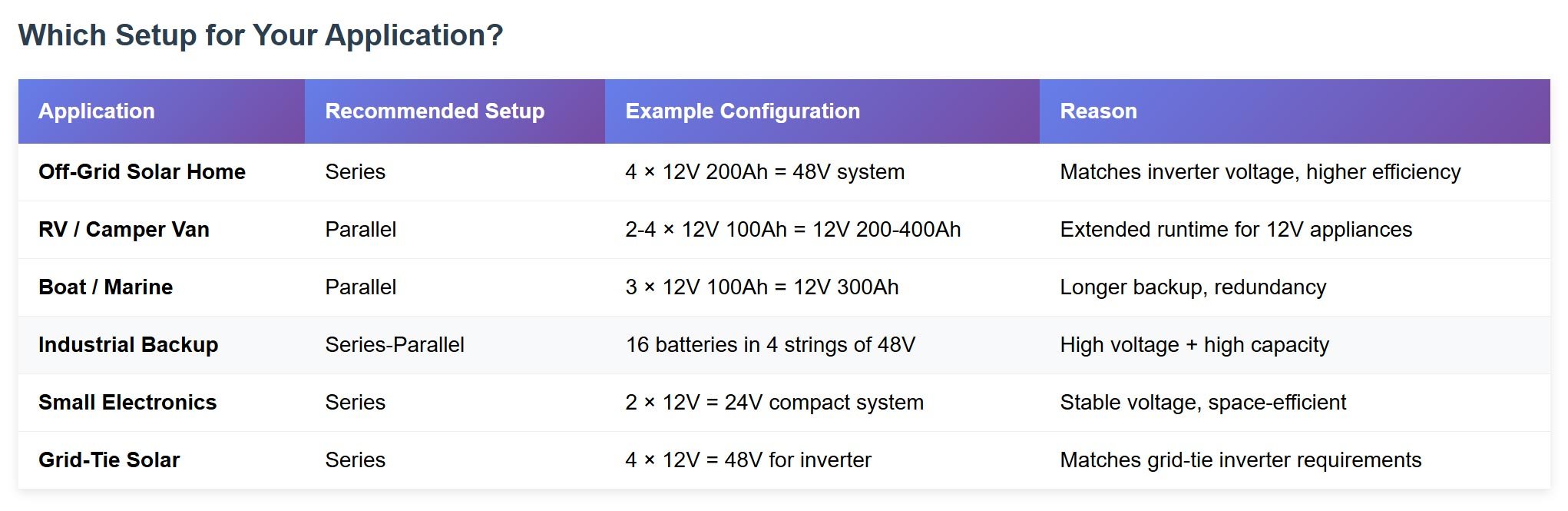
Por exemplo, uma casa fora da rede que usa Inversores Growatt obtém os melhores resultados em séries como 4 × Baterias 12V HBOWA 200Ah equivalem a um sistema de 48V. Isso ajudará a obter mais eficiência, maior ganho de tensão sem usar uma engrenagem de redução, maior eficiência geral do sistema menor fluxo de corrente através dos cabos menor perda durante a conversão de energia.
Melhor para trailers, Barcos, e casas fora da rede
Baterias RV em paralelo ou em série confie na voltagem da configuração. A maioria dos aparelhos de 12 V em trailers e barcos precisam de conexões paralelas para maior autonomia. Um banco paralelo de 12V de baterias HBOWA 100Ah pode fornecer refrigeração, luz, e suporte para pequenos inversores por períodos mais longos. Para cabines fora da rede, é necessário um sistema mínimo de 12 V para carga básica.
Armazenamento de energia industrial e comercial
Quando você torna a instalação mais proeminente, você combina os dois bateria série e paralela sistemas. Por exemplo, um usuário comercial pode conectar o modelo de bateria dezesseis 12V 200Ah HBOWA LiFePO₄ em série para fazer quatro séries de strings de 48V e, em seguida, conectar em paralelo para desligar o inversor de 50KW Growatt. A configuração híbrida equilibra velocidade e capacidade em grande escala.

Manutenção, Carregamento, e diferenças de longevidade
Baterias da série de carregamento
O grande desafio quando carregando uma série de baterias em oposição a baterias paralelas é manter o equilíbrio de tensão entre cada célula ou bateria. No caso de carregar uma série de baterias, a tensão total da configuração é igual à soma de todas as unidades, e portanto, mesmo um pequeno desequilíbrio pode levar a uma cobrança desigual. Por exemplo, se duas baterias de 12 V estiverem presentes em um configuração de bateria em série, a tensão total formada é 24V. Portanto, se uma das células pegar a carga mais rápido que a outra, corre o risco de estresse por sobretensão. É essencial ter um carregador de alta qualidade projetado para a tensão total do sistema ou um BMS. As baterias HBOWA LiFePO₄ integram sofisticados unidades BMS inteligentes que equalizam a tensão para evitar problemas de sobrecarga e prolongar a vida útil do sistema.
Carregando baterias paralelas
Carregando um conexão paralela é mais fácil do que carregar baterias conectadas em série. Você pode carregar baterias com tensões semelhantes ao mesmo tempo. Se dois 12V baterias conectadas em paralelo são carregados até seu pico V, use um carregador de bateria de 12 V para carregá-los. Por isso, substituir a tensão por 12 V garante que a corrente flua uniformemente através de ambas as baterias.
Qual configuração dura mais?
Baterias paralelas geralmente sofrem menos estresse quando carregadas ou descarregadas e, portanto, têm um ciclo de vida mais longo. As baterias da série dependem do equilíbrio correto de tensão, bem como da proteção BMS, para oferecer seu melhor desempenho por um período mais longo. Com uso adequado e garantindo o melhor cuidado, baterias em série e paralelas geralmente podem durar mais de 10 anos, mas geralmente, sistemas paralelos mantêm melhor saúde do banco.
Erros comuns e como evitá -los
Quando as baterias são conectadas em série versus paralelo, pequenos erros podem causar grandes problemas no sistema ou problemas de segurança em geral, esses são alguns problemas, e suas soluções são mencionadas abaixo na tabela:
| Problema | Causa provável | Solução |
| Desequilíbrio de tensão em série | -Baterias incompatíveis -Envelhecimento desigual das baterias | -Use baterias idênticas (mesma idade/modelo) -Instale um BMS -Verifique as tensões das células individuais(regularmente) |
| Superaquecimento de cabos | -Calibre de fio subdimensionado para a corrente. | -Atualize para o medidor adequado (por exemplo, 2/0 AWG para alta corrente) -Certifique-se de que as conexões estejam firmes -Adicionar fusíveis. |
| Curto tempo de execução em paralelo | -Desequilíbrio no banco porque uma bateria tem tensão muito menor. | Sempre pré-carregue as baterias com uma distância de 0,1-0,2 V uma da outra antes de conectá-las em paralelo. |
| O sistema não cobra | -BMS desarmado -Fiação incorreta -Carregador com defeito | -Verifique a polaridade correta -Reinicialize o BMS (se possível) -Verifique se o carregador é compatível e funcionando. |
| Capacidade reduzida ao longo do tempo | -Descarga/carregamento irregular ou uma bateria com falha em uma configuração paralela. | -Use baterias correspondentes -Verifique periodicamente a tensão de cada bateria -Teste e primeiro isole, e depois remover unidades com baixo desempenho. |
| O inversor não inicia | -A tensão do sistema está muito baixa (ou muito alto). | -Confirme se a tensão do banco de baterias está dentro da faixa de entrada do inversor -Verifique se há conexões em série soltas ou corroídas. |
Usar diferentes tipos de baterias ou tensões é o principal problema. Sempre use baterias idênticas e do mesmo lote. Pode haver incêndio e superaquecimento em aplicações de alta corrente se fusíveis ou disjuntores adequados não forem usados. A transferência de grandes cargas de corrente através de cabos subdimensionados pode causar problemas de queda de tensão, dano pesado. Antes de conectar qualquer unidade em série ou paralelo, você deve verificar se tem o mesmo nível de tensão. De outra forma, haverá um desequilíbrio na corrente entre as baterias durante o carregamento/descarregamento.
Comparação resumida: Qual configuração funciona melhor para você?
Comparando, qual configuração será mais benéfica para você? A resposta a essa pergunta está em muitos fatores, mas o principal fator é que a tensão e a capacidade que seu sistema precisa, você pode escolher a configuração mais adequada para você. A escolha prática entre série versus. configurações de bateria paralela depende inteiramente da tensão e da capacidade de Amp-hora que seu sistema precisa. Se o seu sistema precisar de uma tensão mais alta, diga depois de mudar de 12V, você precisará de 24V ou 48V, então um configuração de série é o melhor. Tensão mais alta significa menor fluxo de corrente para a mesma potência, o que pode reduzir os custos do seu inversor, reduzir perdas de cabos, e tem muito mais vantagens, para os quais as vantagens da configuração paralela são insignificantes.
Se você precisar de um tempo de execução mais longo ou apenas de mais capacidade de Amp-hora, você usaria um paralelo com o melhor armazenamento total de energia e nenhum aumento de tensão para fazer isso. Se você tiver aplicações que exijam maior tensão e capacidade, como aqueles em indústrias ou sistemas solares em grande escala, um combinação série-paralelo será o melhor, pois aumenta a tensão enquanto mantém um tempo de execução substancial.
As baterias HBOWA LiFePO₄ podem funcionar em todas as posições e também em todos os tamanhos e formatos, que pode ser empilhado ou montado em diferentes ângulos. Estes são feitos em todos os tipos de configurações e verticais. Essas baterias são configuradas de forma que usem cada centímetro de espaço disponível. Baterias HBOWA LiFePO₄ são altamente dinâmicos e podem ser montados em qualquer veículo conforme a necessidade do cliente, resultando em um volume e espaço muito baixos, que são usados principalmente para carregar veículos elétricos leves. Essas baterias são melhores para aplicações EV e são melhor usadas com Dizer e Inversores Growatt.
Resumo lógico:
Tensão mais alta → Configuração em série
Tempo de execução mais longo → Configuração paralela
Tensão mais alta + maior tempo de execução → configuração série paralela
Conclusão
A conclusão que se pode tirar conexão de bateria série vs paralela pode diferir dependendo puramente de para que você precisa de energia. Com potência em série, a voltagem foi amplificada para ser usada em aparelhos pesados, e com o uso de energia paralela, o tempo de execução durou mais para a aplicação de baixa tensão. Usando um adequado Bateria HBOWA LiFePO₄ para alimentar o sistema garante uma tensão estável, bateria de longa duração, e compatibilidade com inversores, como Growatt e Deye. A aplicação de uma bateria em série vs paralela pode ser uma configuração eficiente para um sistema de energia de qualquer tipo, como solar, RV, ou fora da rede.