Introdução
O termo horários de pico de sol refere-se à quantidade de energia solar disponível em um local, expresso como um número equivalente de horas em 1,000 Com m². Um incidente diurno não pode ser exposto às horas noturnas. Entendendo o horas de pico do sol uma área recebe pode fornecer informações sobre quanta energia painéis solares pode receber. É um bom ponto de partida para estimar a produção solar.
Quais são os horários de pico do sol?
O que significa “horas de pico de sol”?
Horário de pico de sol e Horas solares de pico são usados indistintamente para quantificar o recurso solar para irradiação solar. Isso significa que a soma das horas de sol dos raios solares do dia é igual a 1000w/m². NREL descreve horas solares como sendo iguais a horas (ou alguma fração dela) de pico de luz solar de 1000w/m².
5 horas de pico do sol não significa cinco horas de luz solar 1.000w/m² para um apartamento de 6 sol; a irradiância solar muda com a hora do dia. Isso muda porque a posição do sol, alguns devido às nuvens, e um pouco mais devido à atmosfera. Agora, as horas de pico do sol transportam a variação da energia solar do dia para um único valor equivalente.
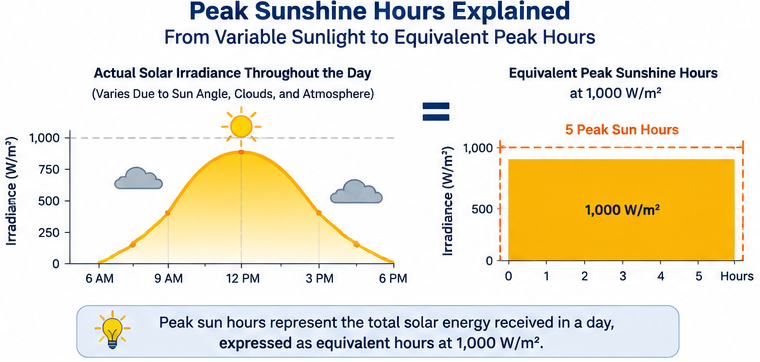
De acordo com este sistema, um lugar pode receber fraqueza, sol desfavorável no início da manhã e à noite ou sol comparativamente mais forte por volta do meio-dia, mas a energia total recebida é igual 5 horas de pico solar. Por isso, as horas de pico solar são uma medida da recepção de energia solar em vez da contagem de horas de sol.
Horário de pico do sol versus horário de verão
Horário de pico de sol também precisa ser diferenciado do horário diurno. As horas do dia são o número de horas entre o nascer e o pôr do sol, Considerando que as horas de pico solar referem-se ao número de horas de energia solar necessárias para atingir um determinado valor de irradiância.
| Medição | O que mede | Unidade comum | Relevância do planejamento solar |
| Horário de verão | Tempo entre o nascer e o pôr do sol | horas | Mostra a duração da luz do dia |
| Irradiância solar | Energia solar recebida em um determinado momento | Com m² | Indica intensidade instantânea |
| Irradiação solar | Energia solar recebida durante um período | Wh/m² ou kWh/m² | Indica recurso solar total |
| Horário de pico do sol | Irradiação solar normalizada para 1,000 Com m² | horas | Útil para estimativas básicas de energia fotovoltaica |
Como são calculados os horários de pico do sol?
Fórmula das horas de pico do sol
O cálculo dos horários de pico de sol é quando a irradiação solar diária é convertida no número equivalente de horas em 1000 Com m². NREL fornece a relação como luz solar diária total em Wh/m² porque Wh/m² é uma unidade para medir a irradiação dividida por 1000 Com m².
Horas de pico de sol = Irradiação solar diária ÷ 1 kW/m²
Quando o recurso solar é expresso em Wh/m²/dia, o mesmo cálculo pode ser escrito como:
Horas de pico de sol = Irradiação solar diária (Wh/m²/dia) ÷ 1,000 Com m²
Unidades são extremamente importantes. A irradiância solar é medida como potência por unidade de área, como W/m², enquanto a irradiação solar é a energia acumulada ao longo do tempo, normalmente expresso como Wh/m² ou kWh/m². As horas de pico solar são derivadas de Wh/m² em vez de uma única leitura de irradiância.
Cálculo trabalhado
Suponha que um local receba 5,000 Wh/m²/dia de irradiação solar diária.
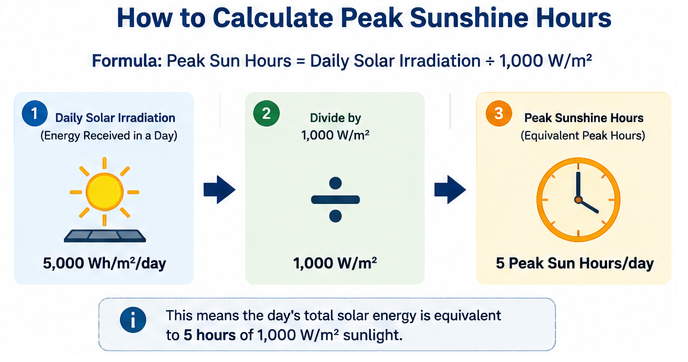
Isto implica que a energia total da luz do dia é de cinco horas de radiação em 1,000 Com m². Isto não implica que o local específico tenha experimentado cinco horas constantes de 1,000 Radiação W/m².
Este é um cálculo ilustrativo, não é uma estimativa significativa dessa área. As informações reais sobre ativos orientados para o sol precisam ser coletadas a partir de um conjunto de dados específicos da área ou de uma ferramenta de avaliação baseada no sol.
Irradiância vs Irradiação
Você pode notar que há um erro comum na compreensão dos conceitos de irradiância solar e irradiação solar. Irradiância refere-se à energia solar que atinge uma superfície em um determinado momento. Por outro lado, irradiação denota a energia solar que é acumulada durante um período. Para calcular as horas de pico do sol, o último fator é considerado.
As diferenças de irradiância e irradiação foram explicadas pelo Atlas Solar. Expressa parâmetros de recursos solares como GHI e DNI como quantidades de energia durante um período definido; também fornece estimativas de produção de eletricidade fotovoltaica. O banco de dados do Atlas Solar diferencia claramente entre medições de recursos solares e produção fotovoltaica modelada.
O recurso solar deve ser diferenciado da produção fotovoltaica modelada. Uma única medição de irradiância ao meio-dia não pode representar totalmente o recurso solar durante um dia inteiro. Um diário totalmente (ou mensalmente) valor de irradiação é necessário para um bom cálculo de horas de pico do sol.
Como encontrar os horários de pico do sol para sua localização
Por que os dados específicos do local são importantes
Nem todas as cidades de um país têm o valor específico de horários de pico de sol por local. Devido à diferença de características geográficas, clima e tempo, inclinação e lugar, estação e superfície, cada local tem energia solar diferente. Uma média específica de um país nunca corresponde aos dados de todas as cidades.
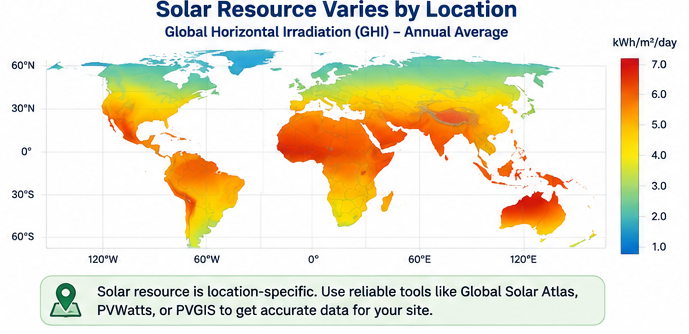
Os desenvolvedores usam mapas de recursos solares e ferramentas de modelagem de painéis solares de localização específica para planejamento solar eficiente. Global Solar Atlas tem dados sobre mapas de recursos solares para todo o mundo. Normalmente inclui a irradiação horizontal global (TOMA NOTA), irradiação normal direta (DIAS), a irradiação do plano inclinado, e a produção de eletricidade do PV. Os seus conjuntos de dados de recursos solares são muito mais específicos em comparação com os níveis de energia médios do país..
Ferramentas para encontrar horários de pico do sol
O Global Solar Atlas é útil ao comparar recursos solares entre diferentes locais ou realizar uma avaliação detalhada específica do local. É um mapa gratuito e recurso de informação sobre irradiação solar e energia fotovoltaica. (VP) potencial energético.
Além disso, o NREL PVWatts contém uma saída de energia para o sistema fotovoltaico usando estimativa específica do local. Inclui dados para download ou mapas de informações sobre recursos solares com um pequeno clique.
No entanto, para projetos europeus, o usuário pode considerar PVGIS do Centro Comum de Investigação da Comissão Europeia. Baseia-se na radiação solar e na energia fotovoltaica (VP) informações de saída para locais em todo o mundo, excluindo as regiões polares.
| Dados | O que representa | Uso principal |
| TOMA NOTA | Irradiação horizontal global | Comparação geral de recursos solares |
| DIAS | Irradiação normal direta | Aplicações de feixe direto |
| POA/GTI | Irradiação em um plano inclinado | Planejamento fotovoltaico |
| PVOUT | Produção estimada de eletricidade fotovoltaica | Avaliação de produção |
Para encontrar o horas de pico de sol na minha área, usar o recurso solar específico do local em vez de usar uma média nacional, que pode servir como uma estimativa aproximada da observação solar.
Como o horário de pico do sol afeta a produção do painel solar
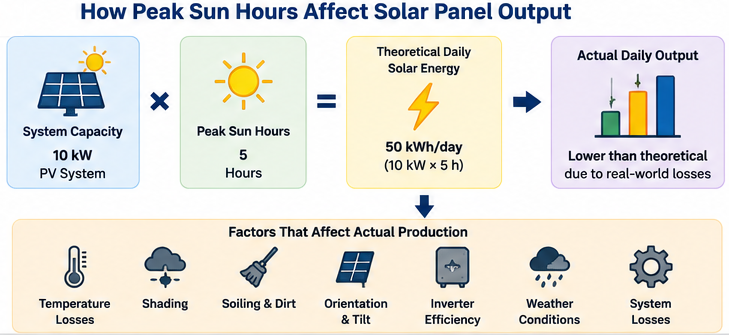
A relação entre as horas de sol e o saída do painel solar pode ser usado para fornecer uma estimativa aproximada da energia produzida. Por exemplo, um cálculo simples sugere:
Energia fotovoltaica diária estimada ≈ Capacidade do sistema × Horas de pico de sol × Fator de desempenho
Como cada projeto tem seu fator de desempenho (que também é a porcentagem de energia teórica que o sistema criará depois que as perdas do sistema e operacionais forem eliminadas; e, portanto, multiplicar o tamanho do sistema pelas horas de pico do sol deve sempre ser visto como uma estimativa e nunca como produção garantida.
Por exemplo, considere uma hipótese 10 Sistema solar KW:
| Horário de pico do sol | Energia diária teórica antes das perdas |
| 3 horas | 30 kWh |
| 4 horas | 40 kWh |
| 5 horas | 50 kWh |
| 6 horas | 60 kWh |
Cálculo apenas ilustrativo. A produção real depende das condições do local e do sistema.
O verdadeiro produção de energia solar provavelmente será muito menor do que o previsto. O modelo PVWatts do NREL considera categorias de perdas que incluem sujidades, sombreamento, incompatibilidade de módulo, fiação, e mais. A presente calculadora assume um valor modelado de perda do sistema de 14%. Isto não deve ser tomado como a taxa de perda universal, já que os projetos reais diferem.
Podemos medir o efeito de sujidade. De acordo com IEA PVPS, pó, contaminação, e materiais biológicos depositados em módulos fotovoltaicos são estimados em, em média, responsável por 4–7% das perdas globais de energia fotovoltaica. No entanto, pode variar substancialmente de acordo com o local e as condições de operação.
Então, evidentemente, cálculo de produção de energia solar deve ir além dos horários de pico do sol quando um projeto necessita de uma estimativa de produção mais realista. Em vez de assumir que todas as horas de pico de sol disponíveis se tornam eletricidade CA utilizável, um modelo fotovoltaico detalhado incorpora localização, configuração do sistema, e perdas relevantes.
Quais fatores afetam os horários de pico do sol?
O número de horas de pico do sol é afetado pela quantidade de energia solar presente em um local e pela capacidade de um painel solar de produzir energia.. Diversos fatores afetam os horários de pico de sol; estas são as principais razões para explicar que dois locais podem ter recursos solares muito diferentes, mesmo na mesma latitude.
A latitude e a geometria solar sazonal influenciam os recursos solares
As horas de sol de um local são afetadas pela posição latitudinal. A latitude afeta a altura em que o sol aparece no céu e o ângulo em que a radiação solar atinge a superfície da Terra.. A posição relativa do Sol muda ao longo do ano à medida que a posição da Terra em relação ao Sol muda.
Além da latitude, existem vários outros fatores que ajudam a determinar o número de horários de pico de sol. Um local próximo ao equador não precisa necessariamente resultar em um alto recurso solar. Todo o céu poderia estar coberto de nuvens, ou pode haver poeira na atmosfera para reduzir a radiação solar.
As condições climáticas e atmosféricas afetam a irradiação solar
A radiação solar que atinge a superfície da Terra pode ser reduzida devido às nuvens. A passagem da radiação solar pela atmosfera pode ser ainda afetada pelos aerossóis e pela umidade presente na atmosfera. Modelos de recursos solares usam múltiplos fatores, não apenas localização geográfica, estimar irradiação solar. A avaliação de recursos na metodologia Global Solar Atlas incorpora observações de satélite com informações atmosféricas e meteorológicas.
As condições sazonais e do local também são importantes
Uma média anual pode disfarçar grandes diferenças na disponibilidade. A quantidade de energia disponível para um Sistema de energia solar pode variar com as mudanças sazonais na geometria solar, cobertura de nuvens, e clima.
O contexto local também é importante. A irradiação recebida por um arranjo fotovoltaico específico pode ser alterada devido a edifícios, árvores, terreno, orientação da matriz, e inclinar. Por esta razão, horários de pico de sol são um indicador do recurso solar mais amplo, mas a energia real recebida depende do local e do design do sistema.
Como o horário de pico do sol afeta o dimensionamento do sistema solar
Conhecendo o horários de pico de sol para um local permite uma estimativa preliminar da capacidade fotovoltaica necessária para atingir uma quantidade alvo de eletricidade. Um relacionamento mais simples é:
Capacidade fotovoltaica necessária ≈ Demanda diária de energia ÷ Horário de pico de sol
Se um site estiver usando 30 kWh de eletricidade por dia e recebendo uma média de 5 horas de pico do sol, então o cálculo simples dará:
30 kWh÷ 5 horas = 6 kW
Esta figura de 6 kW é apenas um ponto de partida teórico. Um cálculo útil de dimensionamento do sistema solar precisa levar em conta a diferença entre a energia solar teórica e a eletricidade recebida do sistema fotovoltaico. Adicionalmente, o projeto deve levar em consideração a necessidade mensal de energia do local e os períodos de menor disponibilidade solar.
Um sistema projetado em torno de uma média anual pode parecer ter um bom desempenho no papel. No entanto, gerará menos energia em meses com recursos solares mais fracos. O impacto dos sistemas de elevada procura de energia é mais pronunciado num cenário de consumo sazonal.
Exemplo do mundo real: Do recurso solar ao armazenamento de energia
Um exemplo prático pode ilustrar por que os dados de recursos solares devem ser considerados em conjunto com o projeto de armazenamento. A HBOWA forneceu um 100 kW / 500 sistema de armazenamento de energia kWh para um projeto em Bohol, Filipinas. Dois 50 kW Inversores híbridos Deye e 500 kWh de armazenamento de bateria são usados no projeto. A HBOWA reconhece essa aplicação como armazenamento de energia solar para autoconsumo insular.
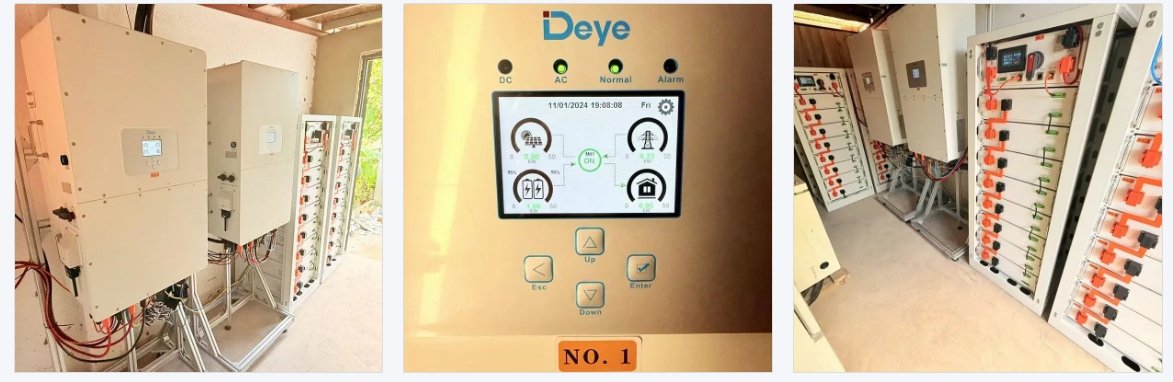
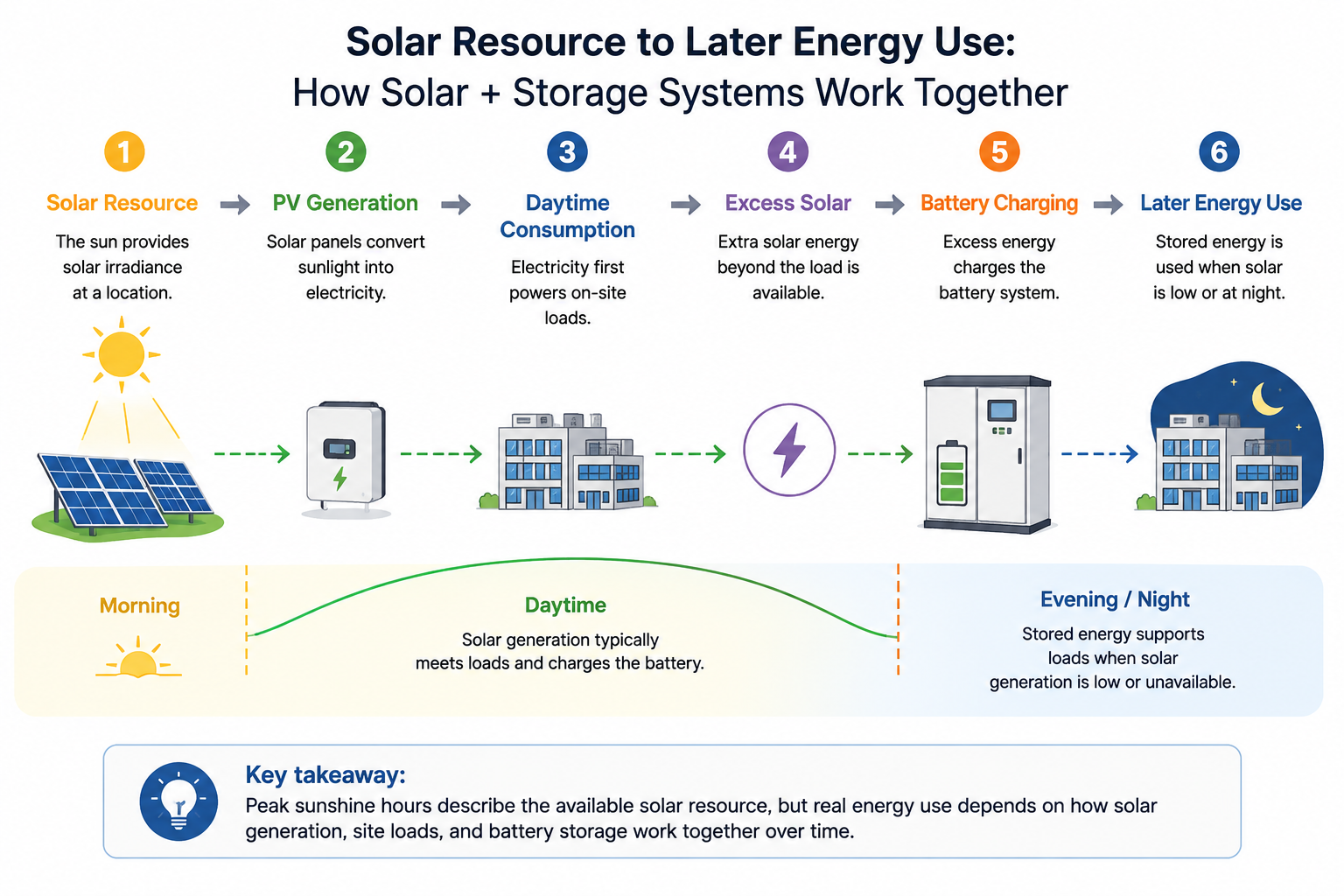
O projeto foi pensado para favorecer o autoconsumo solar direto, consumir parte do excesso de energia solar diurna, e fornecer eletricidade à noite ou durante períodos de baixa energia solar. O sistema também permite o fornecimento de carga local, onde o cliente queria mais autossuficiência energética.
Horário de pico de sol e planejamento de armazenamento de energia da bateria
As horas médias de luz solar determinam a energia solar disponível para carregar uma bateria. No entanto, não determina a capacidade necessária da bateria. O tamanho da bateria depende da necessidade de eletricidade, o momento desse requisito, a duração do backup necessária, a capacidade útil da bateria, o profundidade de descarga, os limites de carga e descarga, e a produção fotovoltaica esperada.
Por exemplo, Um edifício comercial pode produzir a maior parte da sua eletricidade solar durante o dia e depois utilizá-la após o pôr do sol.. Um sistema que armazena energia pode transferir parte dessa geração diurna para períodos posteriores. O tamanho necessário da bateria dependerá da quantidade e do horário da carga noturna, e não apenas do horário de pico do sol..
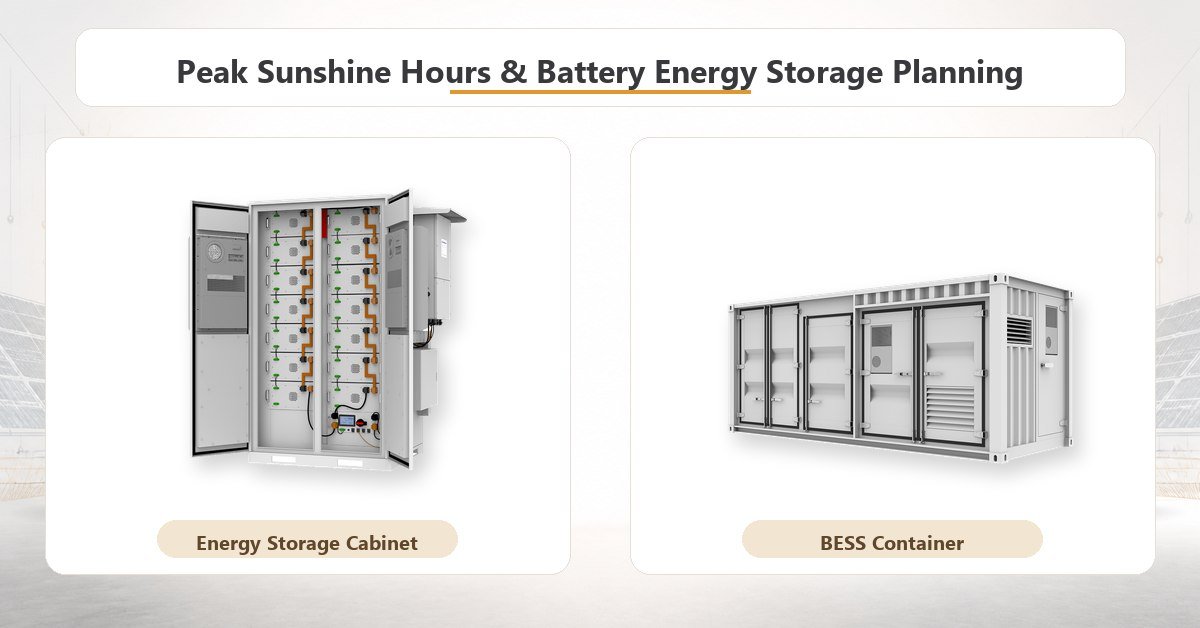
Esta diferença tem implicações para o design de ESSs. Um armário de armazenamento de energia ou Recipiente BESS pode atender a vários requisitos operacionais, dependendo se suporta o autoconsumo, backup, demanda de pico, ou operação fora da rede. O PVPS da IEA implica que, para sistemas de baterias fotovoltaicos confiáveis, desempenho, monitoramento, e a manutenção deve ser adequada.
Como usar corretamente os horários de pico do sol
Utilize o horários de pico de sol para a questão do planejamento. TOMA NOTA, ou irradiação horizontal global, descreve a luz do sol do sol. O uso dos horários de pico do sol pode auxiliar em uma estimativa rudimentar de PV. Por outro lado, A modelagem fotovoltaica fornece uma indicação mais clara da maioria dos números de produção.
Dados mensais podem ajudar nesta avaliação de geração sazonal. Para dimensionar uma bateria, um requer carga, Saída fotovoltaica, e autonomia. As tarifas e os custos do sistema também são necessários. Como tal, horas de pico de sol são uma contribuição útil, mas não um completo Sistema de energia solar abordagem de design.
| O que você quer saber | O que usar |
| Recurso solar | TOMA NOTA / irradiação solar |
| Estimativa básica de PV | Horário de pico do sol |
| Produção fotovoltaica esperada | Modelagem fotovoltaica |
| Geração sazonal | Dados mensais de recursos solares |
| Tamanho da bateria | Carregar + VP + autonomia |
| Economia do projeto | Produção + tarifas + custos do sistema |
Conclusão
A radiação solar diária pode ser expressa como um número de horas equivalente a 1,000 Com m² (aquilo é, ao redor do horário de pico do sol). Eles ajudam você a fazer uma estimativa rápida do potencial solar e da energia fotovoltaica. O planejamento preciso exige site- e informações específicas da estação, bem como as características reais do sistema do projeto. HBOWA pode ajudá-lo a analisar e projetar todo o sistema de armazenamento de energia; sinta-se à vontade para entrar em contato conosco para discutir seus requisitos detalhados.
Perguntas frequentes
Claro. Ao longo do tempo, dias com eventos climáticos diferentes têm horários de pico solar quando maximizam sua geração de energia solar. O geoposicionamento solar é o cálculo desses valores de tempo em relação a um local especificado. Com o propósito de planejar, as médias de longo prazo são geralmente mais úteis do que o valor de um único dia, enquanto os dados mensais podem indicar mudanças sazonais importantes na energia solar disponível.
A irradiação geralmente varia significativamente ao longo do ano, é por isso que os dados mensais são muito mais úteis para dimensionamento do sistema solar. Ao longo do ano, irradiação solar pode apresentar períodos de carência. Para sistemas que possuem cargas sazonais, necessidades de backup, ou acesso limitado à rede, um recurso solar mensal pode fornecer uma base melhor para estimar a produção fotovoltaica esperada.
Sim, mas apenas como uma avaliação preliminar da disponibilidade de energia solar. A capacidade da bateria ou os requisitos de carregamento não podem ser determinados por horários de pico de sol sozinho. Uma variedade de fatores de carga elétrica diurna afetam o carregamento da bateria, incluindo produção de painéis solares e condições sazonais. Esses fatores devem ser considerados para uma completa armazenamento de energia solar avaliação.
Para analisar um projeto fotovoltaico comercial, horas de pico do sol são combinados com dados de produção e recursos solares do local. GHI pode dar uma ideia geral do recurso solar, enquanto a irradiação no plano de coleta e a modelagem fotovoltaica podem fornecer estimativas de produção mais relevantes. Cargas de perfil, tarifas, perdas do sistema, e as condições de operação devem ser levadas em conta.