
Insira os dois preços na mesma moeda. Esta comparação apenas de energia exclui o custo do equipamento, manutenção, degradação da bateria, combustível de inicialização do gerador, carregamento mínimo, encargos de demanda e custo de oportunidade solar.
Introdução
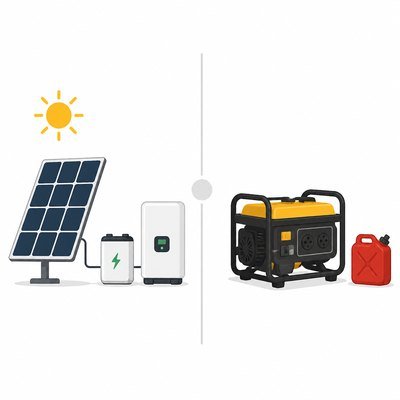
Uma comparação de painéis solares vs.. um gerador não é simples, já que os painéis solares normalmente não fornecem backup em caso de falha da rede. A avaliação compara um inversor com armazenamento de bateria e solar com gerador. A energia solar pode gerar eletricidade todos os dias, enquanto um gerador pode fornecer backup contínuo quando há combustível.
O que é realmente necessário para comparar entre painéis solares e um gerador?
Os sistemas de energia solar oferecem uma nova resiliência contra a perda de energia da rede elétrica graças aos inversores e painéis integrados à bateria solar. O Sistema de energia solar converte luz solar em eletricidade usando painéis em DC. Um inversor vem com a unidade de geração de energia de um sistema solar para converter eletricidade DC em eletricidade AC, capaz de atender à demanda em uma nova casa ou escritório.
O inversor e o sistema de backup de bateria devem ser configurados para permanecerem on-line/ativos mesmo quando a energia for desligada. O Departamento de Energia dos EUA (CORÇA) diz que os painéis solares podem desligar quando a rede elétrica cair, mesmo que estejam produzindo eletricidade. Eles precisam de um sistema de backup de bateria e de um inversor capaz de suportar operações ilhadas que permitam ao sistema operar de forma autônoma em relação à rede..
Como um gerador fornece energia reserva
Um gerador funciona de maneira diferente: combustível alimenta um motor, o motor impulsiona um gerador elétrico, e a fonte de energia elétrica fornece energia às cargas conectadas. Normalmente, unidades portáteis são operadas manualmente, enquanto as unidades de reserva são usadas com equipamento de transferência automática que fornece energia para a carga selecionada ou para toda a nossa casa quando a rede principal falha.
O que significa “gerador solar”?
O termo gerador solar vs painéis solares pode ser confuso. “Gerador solar” é frequentemente e comumente referido como um tipo de estação de energia de bateria portátil que pode ser recarregada via painéis solares. Aquilo é, ao contrário de um sistema solar fotovoltaico e de bateria, que geralmente é instalado em residências ou edifícios comerciais.

Solar vs Gerador:
Comparação entre painel solar e gerador
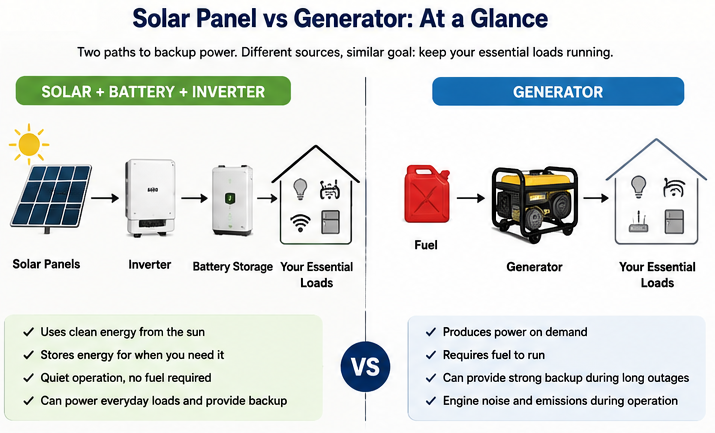
As necessidades de backup são geralmente atendidas de forma diferente por energia solar e geradores. Combinar energia solar e armazenamento é diferente de um gerador, que gera eletricidade conforme necessário. A escolha depende do tempo de execução, acesso ao combustível, requisitos de carga, custo operacional, barulho, e se o sistema deve fornecer valor quando a rede estiver disponível.
| Fator | Solar + Bateria | Gerador |
| Investimento inicial | Geralmente mais alto | Geralmente mais baixo |
| Combustível | Nenhum | Obrigatório |
| Energia diária | Sim | Não |
| Duração do backup | Depende do armazenamento e da disponibilidade solar | Depende do combustível e da capacidade |
| Barulho | Muito baixo em operação | Ruído do motor |
| Manutenção | VP, bateria e inversor | Motor e sistemas elétricos |
| Interrupção prolongada | Depende de armazenamento e recarga | Mais forte quando há combustível disponível |
Não é correto dizer que os geradores são melhores que os painéis solares em todos os tipos de casos. Solar versus. gerador é uma pergunta baseada em aplicativo, enquanto gerador versus. painéis solares depende se o sistema solar tem armazenamento adequado para atender sua carga e tempo de execução ou não.
Painel Solar vs Custo do Gerador: Despesas iniciais e de longo prazo
O custo de backup de bateria solar excede o custo dos painéis e da bateria. Uma comparação justa deve incluir toda a configuração e custos associados ao período de serviço.
O primeiro investimento para solar mais armazenamento normalmente é o painéis solares, inversor, armazenamento de bateria, equipamento de montagem, proteção elétrica, instalação, e licenças ou interconexão, se aplicável. A capacidade da bateria e a potência do inversor também influenciam o preço, como maior capacidade e potência será capaz de armazenar mais energia e fornecer uma carga maior.
Os custos dos geradores adotam uma estrutura diferente. Os custos de compra podem incluir o gerador e a chave de transferência, trabalho elétrico, e instalação, e geralmente não são incluídos em determinados sistemas de espera. As despesas contínuas dependem do uso de combustível, número de horas de funcionamento, reparos, e substituição de peças.
Isso faz sentido porque um número de manchete para o custo de painéis solares com armazenamento de bateria pode ser enganoso. Uma solução para as necessidades de energia de um refrigerador durante uma curta interrupção será diferente daquela para uma instalação comercial que pode precisar de energia por horas. O tipo de gerador, carregar, execução anual, e os preços locais dos combustíveis também afetam a economia do gerador.
Uma maneira benéfica de comparar custos é usar o custo total de propriedade, ou TCO, abordagem: custo inicial + custo operacional + manutenção + custos de reposição - economias ou incentivos aplicáveis. Ao considerar a energia solar, fator no transporte e degradação da bateria e do inversor. Tenha sempre combustível dependendo do seu gerador.
Armazenando energia solar pode fornecer valor mesmo se a grade estiver disponível, pois a energia armazenada ainda pode ser usada posteriormente. Um gerador geralmente cria valor enquanto está funcionando, então o preço de compra por si só não oferece os mesmos benefícios.
Artigos mais antigos nos EUA. pode indicar um crédito fiscal residencial para energia limpa de 30% correndo 2032; no entanto, o IRS diz que o crédito não se aplica a imóveis colocados em serviço depois de dezembro 31, 2025. Porque os incentivos fiscais variam de acordo com o mercado, as regras mais recentes devem ser consultadas antes de calcular a economia do projeto.
Painel solar vs gerador para energia reserva
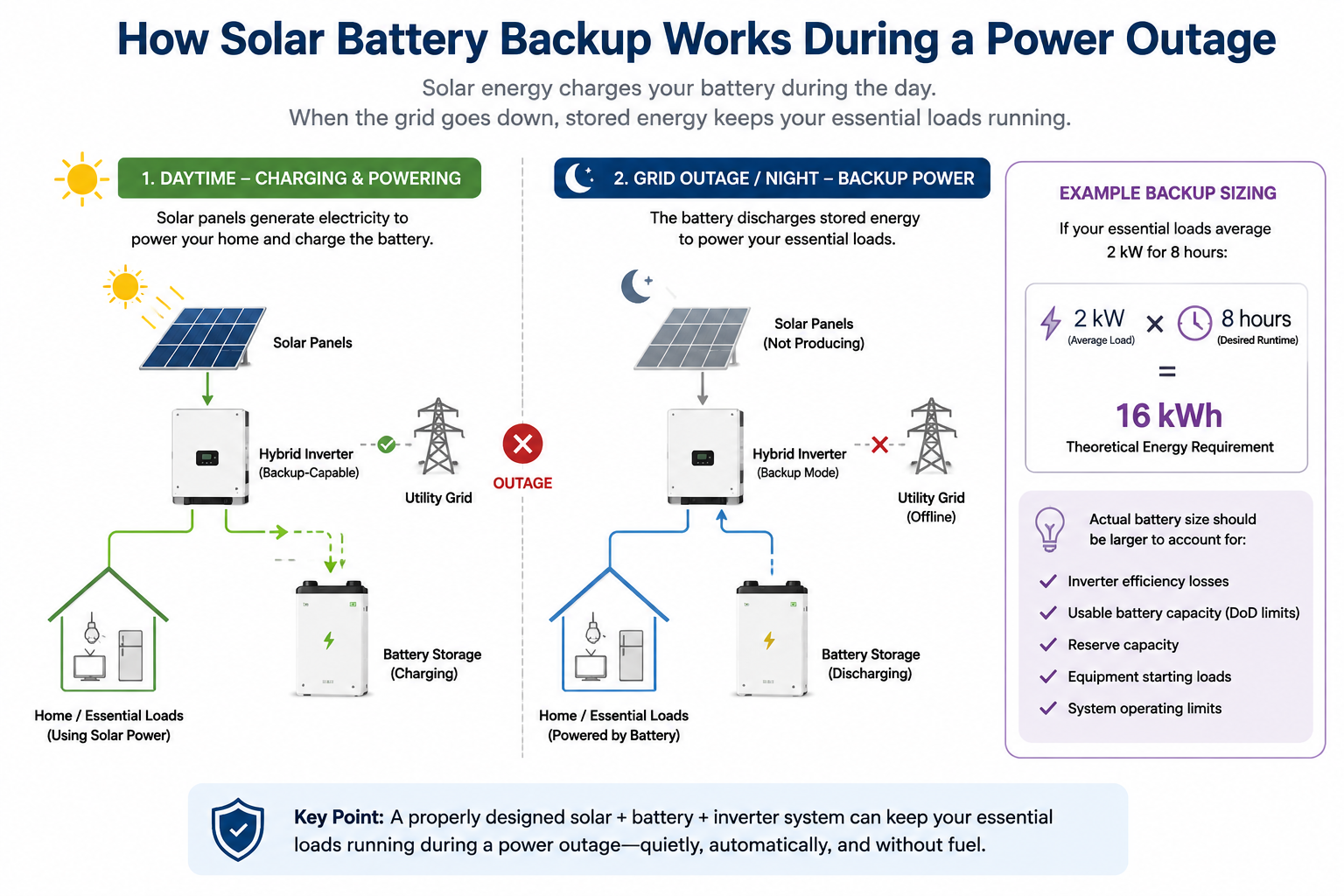
Se houver uma breve interrupção, um sistema de armazenamento solar bem configurado pode fornecer backup sem a necessidade de ligar o motor ou trazer combustível. A energia alimentada por bateria é armazenada pelo inversor, com transferência automática ou funções de controle para mover cargas selecionadas para energia de reserva. Quando os cortes de energia ocorrem com bastante frequência, mas não são tão longos, backup de bateria solar para casa pode se beneficiar.
A capacidade da sua bateria é mais crucial do que o número de painéis para uma interrupção noturna. Cargas críticas podem ser explicadas com o seguinte exemplo. Digamos que a média das cargas críticas 2 kW para 8 horas. Portanto, o requisito teórico de energia é 16 kWh. O dimensionamento do sistema real também levará em conta as perdas de conversão, capacidade de reserva, limites de operação da bateria, e equipamentos como cargas de partida de bombas ou compressores.
Para interrupções que duram dias, não é mais simples. Contanto que tenha tamanho adequado e haja combustível suficiente disponível, um gerador pode continuar produzindo eletricidade. O armazenamento solar mais pode ser recarregado instantaneamente à luz do dia, conforme as condições solares permitirem, reduzindo a logística de combustível. Alguns dias podem estar nublados ou com carga elevada, e/ou armazenamento pode ser limitado.
De acordo com o DOE, configurações adequadas de energia solar e armazenamento podem fornecer resiliência. Então, não é só comparar painéis solares VS gerador para uma casa. Você também precisa saber quanta energia precisará, por quanto tempo, e como você recarregará o sistema. Antes de dimensionar a bateria, cargas críticas devem ser priorizadas porque alimentar tudo pode exigir muito mais armazenamento do que manter serviços críticos.
Solar vs Gerador: Confiabilidade, Vida útil e manutenção
Uma comparação justa entre módulos fotovoltaicos e painéis solares deve separar a vida útil dos módulos fotovoltaicos da vida útil das baterias e da eletrônica de potência. De acordo com o DOE, Acredita-se que os módulos fotovoltaicos de silício durem 25 anos ou mais e continuar produzindo mais de 80% do seu poder original.
Existem muitos fatores que podem alterar a vida útil da bateria, como química, temperatura, profundidade de descarga, frequência de ciclismo, taxas de carga e descarga, projeto, etc.. Por exemplo, HBOWA avalia sua bateria LiFePO4 de 51,2 V 100Ah em 5 kWh, com mais de 6,000 ciclos a 25°C e 80% Departamento de Defesa, e uma garantia de 5 anos. Estas são especificações para HBOWA e não para desempenho geral do LiFePO4.
Os geradores requerem manutenção diferente de outros equipamentos de energia devido aos seus motores e sistemas de combustível. A disponibilidade pode ser afetada pelo serviço de óleo e filtro, verificações do sistema de combustível, testes periódicos, e manutenção. Diferentes geradores vêm com requisitos específicos dependendo do tipo, ambiente, e fabricante.
De acordo, a confiabilidade deve ser avaliada no nível do sistema. Nrel avaliou geradores de emergência, solar PV, e íon de lítio Bess para interrupções de 1 hora para 2 semanas. Ele ressalta que se você assumir que o recurso de backup é 100% confiável porque o combustível está disponível, as estimativas obtidas podem ser imprecisas, especialmente para interrupções mais longas. Ao escolher entre uma bateria solar e um gerador, há vários fatores importantes a serem considerados.
Painel Solar vs Gerador: Segurança e Impacto Ambiental
Em um comparação entre energia solar e gerador, uma das principais considerações é a segurança. Sistemas solares mais armazenamento incluem equipamentos elétricos DC ou AC, um sistema de gerenciamento de bateria, dispositivos de proteção, controles térmicos, e instalação adequada. O equipamento precisa ser selecionado e instalado com base nas regulamentações e requisitos exigidos pela segurança elétrica e contra incêndio..
Geradores apresentam perigos relacionados à combustão. Geradores portáteis representam perigo de monóxido de carbono. É incolor, insípido, e inodoro e pode levar à morte súbita. Esses geradores portáteis devem ser colocados ao ar livre com segurança. De acordo com os EUA. EPA, nunca use um gerador portátil dentro de casa, a garagem, o galpão, ou ao ar livre, ou mesmo no espaço de rastejamento ou outras áreas fechadas. Também, os residentes devem manter o gerador portátil pelo menos 20 metros de distância do prédio.
Há também o ruído a considerar; os sistemas de bateria são muito silenciosos, enquanto os geradores produzem muito ruído mecânico e exaustão, então se a tranquilidade é uma necessidade, sistemas de bateria devem ser uma escolha mais prática. Ambientalmente, há um perfil mais restrito. Os sistemas de energia solar fotovoltaica não produzem emissões diretamente da combustão durante a geração de energia, enquanto os geradores de combustível.
Solar do mundo real + Exemplos de armazenamento de projetos HBOWA
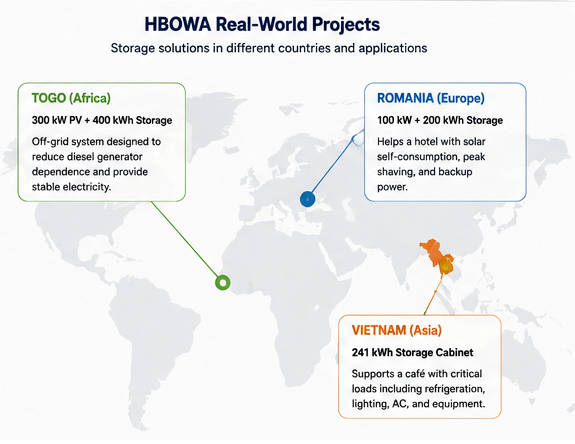
O portfólio de projetos da HBOWA fornece exemplos originais de como um sistema de armazenamento de energia pode ser usado em diferentes aplicações.
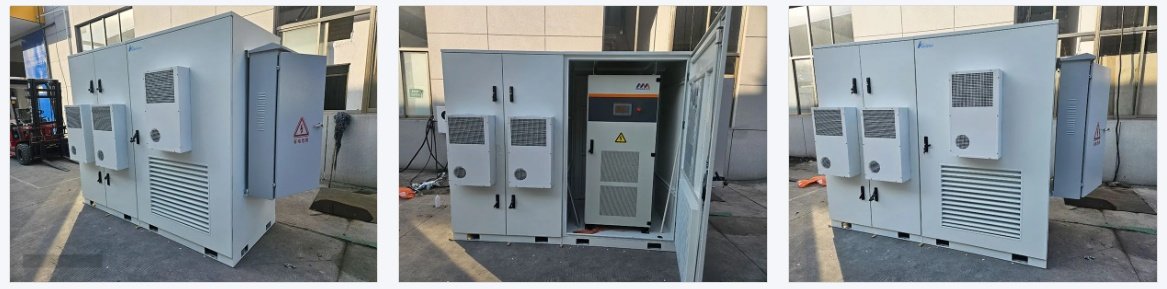
Quando uma empresa precisa de gerenciamento de pico com suporte solar ou energia de reserva, um armário de armazenamento de bateria comercial é um formato de projeto para avaliar usando requisitos verificados de carga e autonomia.
Ir:
No Togo, HBOWA entregou um 300 kW sistema fotovoltaico com 400 kWh de armazenamento de bateria para uma aplicação fora da rede. Solar fornece cargas diurnas, com o excesso de energia disponível para armazenamento à tarde e períodos noturnos e chuvosos. Fora da rede reserva de bateria solar a decisão nesta aplicação dependerá do custo do combustível, manutenção, barulho, e logística.
Romênia:
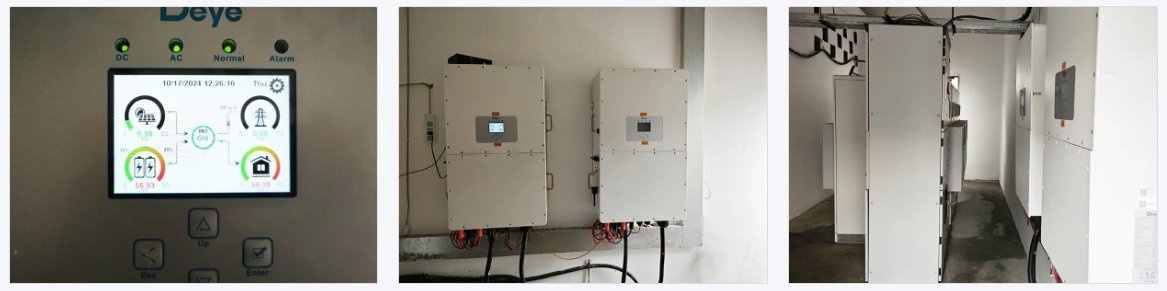
Na Romênia, A HBOWA forneceu um 100 Inversor KW Megarevo junto com um 200 Sistema de armazenamento kWh LiFePO₄ para um hotel. Seria usado para autoconsumo fotovoltaico, bem como para Pico de barbear e fornecer energia de backup. A energia armazenada no Megarevo pode ser usada para suportar cargas importantes, como iluminação, a área de recepção, segurança, e bombas durante pequenas interrupções. Aqui, demonstramos que os sistemas de armazenamento podem agregar valor além do backup de energia, gerenciando o uso diário de eletricidade.
Vietnã:
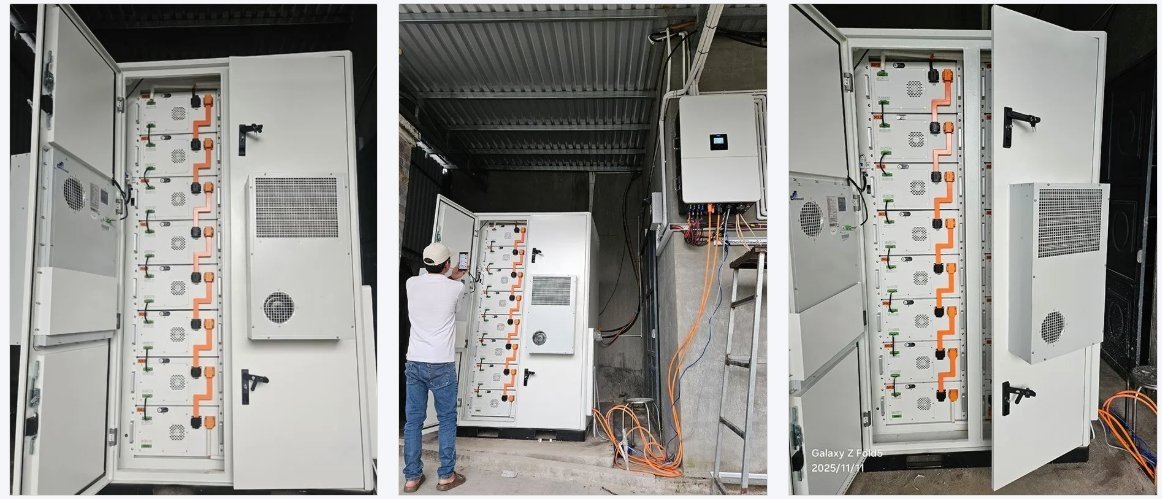
De acordo com o fornecedor, HBOWA, eles entregaram um 241 Gabinete de bateria kWh junto com um 80 inversor kW Deye para um café no Vietnã. Seria usado para fornecer a carga de AC, sistemas de resfriamento, iluminação, uma cafeteira, e equipamentos de pagamento. Ilustra uma aplicação adicional de armazenamento de energia, mas não indica necessariamente que solar mais armazenamento é econômico em todos os mercados.
Painel Solar vs Gerador: O que é melhor para sua situação?
A direita solar vs gerador a decisão depende do padrão de interrupção, Perfil de carga, capacidade de acessar combustível, e exigência de geração de eletricidade para uso diário. Nenhuma opção é vencedora. Uma curta interrupção favorecerá a energia solar mais a bateria porque a energia armazenada pode ser acessada sem ligar o motor. Quando o sistema é frequentemente usado diariamente para se conectar à energia solar, uma interrupção pode ser armazenada em favor. Em casos de interrupções prolongadas quando o combustível está disponível de forma confiável, um gerador pode ganhar.
Uma decisão sobre painéis solares ou um gerador também pode ser um sistema conjunto. De acordo com o Departamento de Energia (CORÇA), recursos energéticos distribuídos, como a energia solar, armazenamento de bateria, e geradores de emergência podem trabalhar em coordenação em microrredes. Esta metodologia é benéfica para locais remotos como hotéis, Telecom, e locais industriais, onde surgem diferentes requisitos para interrupções curtas e interrupções longas.
A resposta para sua pergunta, ‘se eu tiver painéis solares, eu preciso de um gerador,'depende totalmente da capacidade da bateria, recurso solar, cargas críticas, e autonomia necessária. Muitas vezes, a energia solar existente pode ser combinada com armazenamento compatível, em vez de substituição. Backup crítico de vários dias pode ser mais flexível com energia solar, armazenar, e um gerador do que solar ou um gerador sozinho.
Como escolher entre energia solar e um gerador
Antes de escolher um painel solar vs gerador solução, considere os fatores que determinam os requisitos reais do sistema, em vez de apenas comparar os preços dos equipamentos.
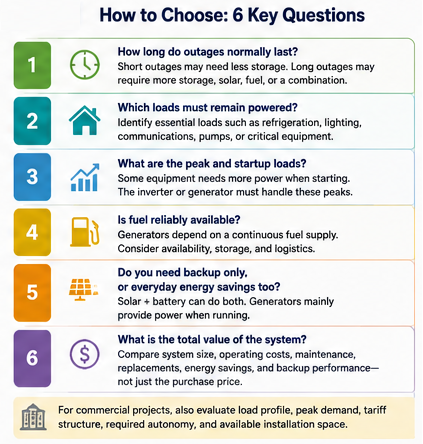
Também, verifique o perfil de carga e a demanda de pico, estrutura tarifária, requisito de autonomia, e área de instalação para projetos comerciais. O dimensionamento do sistema e o valor a longo prazo da energia solar, armazenamento de bateria, um gerador, ou uma combinação deles são significativamente afetados por esta.
Conclusão
Se a energia de reserva for apenas um objetivo e o sistema tiver que produzir eletricidade todos os dias, bateria solar plus torna-se atraente. Um gerador pode ser mais potente para backup prolongado baseado em combustível. Para aplicações com altas demandas, o projeto adequado de um sistema que combina energia solar, armazenar, e um gerador permite maior flexibilidade. Se você ainda tiver alguma dúvida, sinta-se à vontade para entrar em contato HBOWA para discutir suas necessidades de energia solar.
Perguntas frequentes
Não obrigatório. Os painéis solares devem ter armazenamento de bateria adequado e controles de inversor para operar durante uma interrupção. Ter energia solar com armazenamento de bateria pode ser silencioso e recarregável pela luz solar porque a energia solar é abundante. Por outro lado, um gerador pode fornecer energia por um período prolongado, enquanto tiver combustível disponível.
Não necessariamente. A resposta depende da capacidade da bateria, cargas críticas, duração da interrupção, disponibilidade solar, e se o sistema pode funcionar independentemente da rede.
Vários fatores determinarão o preço de um projeto, incluindo custo do sistema e preços de eletricidade, custo de combustível, horário de funcionamento, manutenção, substituição da bateria, e condições locais do projeto. Uma comparação justa requer suposições realistas em relação a ambas as tecnologias.
Um tamanho de bateria não cabe em todas as casas. O armazenamento necessário depende do consumo de carga crítica, período de backup desejado, capacidade do inversor, energia útil da bateria, e iniciar cargas de equipamentos.
Sim, existem sistemas que podem unir um gerador com energia solar e bateria. O inversor, controles do gerador, equipamento de transferência, projeto elétrico, e os requisitos de instalação podem não ser compatíveis.