
Introduction
What exactly is the daisy chain meaning when you refer it to a solar panel setting? The daisy chain is referred to as connecting devices in a sequence. It is a way of wiring used for electrical systems, solar arrays and more. Daisy chaining is a direct connection of one item to the other related item. In solar energy, daisy chain involves directly joining panels one after the other to form a circuit. The daisy chaining technique can help in decreasing the requirement of additional expensive wiring. Daisy chaining and its power flow, as well as maintenance and minimum overall system efficiency, is essential to understand for preparing the effective, safe and profitable solar and storage solutions.
What Does Daisy Chain Mean?
The origin of the term, daisy chain comes from the type of flower linked together in the chain. In technology, it means connecting devices in a chain-like manner. Instead of all devices being attached to one centre, they are attached one after another to form a system or a process. It is the best when it comes to electronics, data network, and power. Daisy-chaining in general, means passing out signals or power from one unit to the other. Daisy chaining definition is given by engineers based on the degrees of the setup involving a single signal and power source configuration connected in a chain-like system.
The meaning of daisy chaining is a topology to minimize the cabling and provide a simple or easy setup. So, what’s a daisy chain? It’s a functional connection method with wide applications. Origin of the daisy chain method is mainly in peripheral devices connections like computer USB or speakers audio which are linked in a chain-like manner. Engineering explains the concept of daisy chaining as a direct link to one power/degree of a device to another in a chain-like manner. In simple manner, to daisy chain devices or components is a method to link the connections to the system straightforwardly, adding further devices without wiring back and forth. The daisy chain is used in main industrial systems and energy connections.
Understanding Daisy Chain Connection in Solar Panel Wiring
Daisy Chain connection in solar power refers to connecting solar panels in a linear sequence, i.e., the output of one panel is connected with the input of another panel. Daisy chain solar panels are utilized for series connected configuration. First, let us understand the wiring of solar panels in daisy chain configuration.
Technically speaking, the solar panel connection is set up with the help of solar panel cables available in the market. The positive terminal of one solar panel is connected to the negative terminal of the others to connect the solar panels in a daisy chain. The daisy chain helps in traffic routing in a series circuit setup. Here goods are of solar cells, and paths are of wires. One can imagine the complete circuit like a chain, where all the solar panel cells are arranged as a string, and the current flows as goods through them before reaching the two junctions, namely charger or inverter.

The daisy chain is convenient to be used in the solar setups where space is limited, or if the solar panels are arranged in a sequence or in a row, wither on the narrow roofing top or aligned with the fencing, etc. Installing solar panels in a daisy chain manner would help reduce the number as well as length of cables needed. Also, it reduces the number of rackets and junction boxes needed for pv panel wiring.

Even in terms of design, chain-link string connection is useful with daisy chain connected solar panels for optimizing voltage requirements for the hybrid solar inverter. By daisy chaining, solar panels make the required voltage range suitable for the inverter’s operation efficiently, avoiding excessive components. It is cost-effective with minimum panel installation cost. For the linear setup of solar panels in daisy chain configuration to obtain electrical efficiency as well as for visual clarity, a chain or daisy solar panel connection setup diagram can be used where the design of solar panels installed is depicted.
How Daisy Chaining Works in a Battery Management System (BMS)
A daisy chain bus is used in a Battery Management System to connect multiple battery modules. In a daisy chain bus, each module connects to the next, thereby allowing the data to be passed through all the battery units or modules one after the other to the central controller. This allows monitoring data like voltage, temperature or state of charge to pass through each battery module in the sequence for proper monitoring without having to connect each module directly to the central controller.
The use of a Daisy chain in BMS also reduces the overall cost of the System. It also allows the BMS to be modular i.e., new battery modules can be added to the daisy chain. For lithium battery systems like LiFePO₄ solar battery, electric vehicle (EV) pack, the daisy chain wiring cuts the complexity of the BMS. Since we would be needing fewer cables, the setup becomes much easier and lightweight.

In case of a fault, the battery BMS would help identify the faulty module. The daisy chain wiring would result in data from each module to be collected in real time for easy diagnostics. With so many advantages and much more like lower cost, lightweight, BMS will help businesses and houses become energy efficient.
Real-Life Application: Daisy Chain Wiring in Solar + Storage Projects

The 5kW residential solar system from HBOWA is wired in a daisy chain in both the solar panels and the batteries and demonstrates the practicality of such wiring in real life situations.
The solar panel wiring has the panels arranged linearly in a series circuit on the rooftop of the building. There are six panels total, and each one follows the previous one in a chain linked way. This allows the power to flow through each of them and not the other panels. These panels need less wiring and installation time.
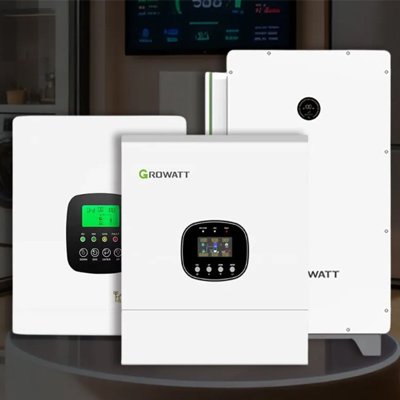
The inverter used is a hybrid one that is very efficient and manages both the solar generation and grid input. According to both production and consumption, the hybrid inverter such as Deye Hybrid Inverter and Growatt Inverter determines the energy flow.
When the solar panel is to be wired in a daisy chain formation, chaining the solar panels helps to reduce cable loss and also some of the best layout for very narrow rooftops. The battery management system for the batteries is knitted in a daisy chain pattern that maximizes the communication. When coupled with a battery management system with a daisy chain topology, the solar power wiring and installation become flexible and practical.
The batteries are lithium-ion units with a BMS. When powering from a solar panel installation, a BMS with daisy chain topology ensures that the BMS monitors the batteries individually. The modules are connected through a common bus for communication. This helps the BMS monitor each battery’s health and balance the charge cycle effectively.
When combining a wiring daisy chain pattern with some intelligent power systems, such as this 5kWh solar power system, it provides a practical way to install and wire solar power at a residential building.This case shows how to wire solar panel using the daisy chain method in modern energy solutions.
Comparison Table: Daisy Chain vs. Leapfrog vs. Star Wiring
Wiring architecture has a significant impact on solar and battery applications. Different methods are used and most notable among them are the daisy chain, leapfrog, and star wiring.
Daisy Chain Wiring – Daisy chaining the components is a sequential connection where each section is attached to a single line. It is majorly used in solar array wiring where the panels are aligned in rows. With few cables to handle, diagnostics become simpler. It is perhaps the most straightforward method of solar array configuration, suitable for roof-tops or in a compact layout.
Leapfrog Wiring – With this method, we create alternate connections to the cells or panels to distribute the voltage while reducing accumulated resistance. Although a bit more wiring than the daisy chain is used, it provides a better electrical balance. It is at times used to wire PV panels when the panel voltage needs to be more consistent throughout the string.
Star Wiring – With this configuration, every module could be routed openly to the central node, which increases usage of cables but has its boon. The circuit configuration becomes much more complex and has high-end would be more helpful to develop entirely new battery management system designs. In real-time, centralized data collection will be possible, and precise monitoring and control of each individual component, which is essential for critical applications like industrial BESS.
The following comparison clarifies the distinctions:
| Method | Wiring Complexity | Cable Length | Maintenance | Best Use Case |
| Daisy Chain | Low | Medium | Easy to diagnose | Linear panel arrays |
| Leapfrog | Medium | Low | Medium | Better voltage balance |
| Star Wiring | High | High | Complex | Centralized control systems |
Choosing between daisy chain vs star wiring or daisy chain vs leapfrog depends on system goals, layout constraints, and monitoring needs.
Pros and Cons of Daisy Chaining in Solar Installations
Advantages of daisy chain wiring in solar installations are many, but it has limitations too.
| Feature | Daisy Chain (Series) | Leapfrog (Series and Hybrid) | Star Wiring (Parallel) | Parallel |
| Wiring Complexity | Low | Medium (if series-parallel) | High | Medium |
| Cable Length Required | Medium (long series paths) | Medium (shorter paths) | High (individual runs) | High (parallel connections) |
| Voltage Output | High (Cumulative) | High (Cumulative in series) | Same as individual panel | Same as individual panel |
| Current Output | Same as individual panel | Depends on setup (if hybrid) | Cumulative | Cumulative |
| Impact of Panel Failure | Affects entire string | Affects sub-string (if hybrid) | Only affects single branch | Minimal system impact |
| Shade Tolerance | Poor | Moderate (if hybrid) | Good | Good |
| Installation Time | Quick | Moderate | Time-consuming | Moderate |
| Scalability | Good for linear arrays | Flexible for layouts | Excellent for complex layouts | Excellent for expansion |
| Monitoring Complexity | Simple | Moderate | Complex but precise | Moderate |
| Best Use Case | Residential rooftops | Commercial | Large industrial systems | Systems needing redundancy |
| Space Efficiency | High | High | Medium | Medium |
| Typical Voltage Drop | 2-5% (series resistance) | 1-3% | 1-2% (parallel runs) | 0.5-1% (lower current per path) |
| Cost of Installation | $$ | $$$ (if hybrid) | $$$$ (more cables) | $$$ |
One of the limitations of daisy chain connections is the occurrence of voltage drop. This is especially likely in large systems, as the number of solar panels increase. It bears a critical aspect when solar panels are connected in series, where the voltage accumulates with each panel.
For systems with long cable runs or several panels, there are chances that these voltage drops might lead to inefficiency and system failure without proper management.
Even if daisy chain wiring is efficient for smaller arrays, the size of the system, distance, and type of the panel must be considered before deciding if this kind of construction would be the best fit.
When to Use Daisy Chain in Solar Systems: Best Practices
To gain advantage of limited space for larger installations, the daisy chain method can be applied. Daisy chaining solar panels can be very effective to deploy in the small and medium-sized set of solar panels linked together. The following techniques are best to try while using the daisy chain in solar panels systems.
Using daisy chain in solar panels are preferred when the solar panel wiring is straightforward and linearly sequenced within the perfect series. Using this method of daisy chaining solar panels allows quick installation, and it also simplifies wiring, maintaining order and tidiness all in bounded spaced.
Here, the solar panels are daisy chained in such a way that all solar panels in a series are connected to the same circuit. In case if they are arranged in different directions, then they require an individual wire and connection.
However, the method can not be recommended for use at large when the large solar array system is going to be handled. The length of the cable becomes an issue and trouble in wiring solar panels further from each other and when dealing with panels subjected to shadows from structures or other obstacles nearby. This is because the solar array fails to perform when wired using the daisy chain method, as each solar panel’s performance depends on the weakest link. For mixed orientation panels, daisy chaining may not be as effective due to inconsistent voltage levels.
It is essential to consider NEC/IEC from the rectifier’s point of view. As safety standards are checked in daisychaining, especially fault detection and wiring against overloads. By keeping in mind daisy chaining helps us in preventing an electrical hazard by wiring a solar array properly and to achieve its maximum performance.
Common Mistakes and How to Avoid Them in Daisy Chain Solar Wiring

Certain mistakes can hinder your installation’s effectiveness and safety when working with a daisy chain solar panel. The table below summarize the common mistakes and prevention of those mistakes and issues while solar panel cabling such 6kW hybrid solar system.
| Mistake | Description | Potential Consequences | Prevention/Solution |
| Incorrect Polarity | Reversing positive and negative terminals | System failure, damage to panels and inverter | Carefully check and verify terminal connections before connecting |
| Overextended Wire Runs | Using excessively long or improperly sized wiring | Increased resistance, voltage drops, reduced performance | Use appropriately sized wires, minimize wire length, choose correct wire gauge |
| Unsecured Cabling | Improper securing of solar panel wires | Wire damage, disconnections due to environmental factors | Use cable clips, conduits, and mounting hardware; secure cables away from stress points |
| Lack of Bypass Diodes | Missing protection for shaded or underperforming panels | Energy loss, reduced system efficiency | Install bypass diodes to redirect current around shaded or damaged panels |
Conclusion
Understanding “what does daisy chain means” is very important for optimizing the modularity and performance of a residential or industrial solar system. Daisy chaining solar panels simplifies wiring and reduces complexity, especially in tight spaces. However, you should always be mindful of voltage drop, cable length, and proper system design when installing them. If you need more clarification you can send queries directly to our experts and they will promptly answer. HBOWA provides one-stop solutions for your energy needs.