Introduction
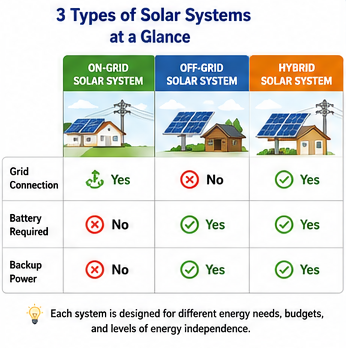
On-grid solar system, off-grid solar system, and hybrid solar system are the three types of solar systems. Different energy needs, budgets, and levels of energy independence all entail each of the designs. The choice of system impacts installation costs, backup power availability, long-term savings, and system performance.
What Are the 3 Types of Solar Systems?
On-grid, off-grid, and hybrid systems are the 3 Types of Solar Systems. An on-grid solar system functions through the utility network; an off-grid solar system functions independently via battery storage, while a hybrid solar system leverages the utility grid and battery storage. Every option has different advantages for cost, reliability, and energy security.
Overview of the Three System Types
Modern solar power systems commonly fall into three categories. The on-grid solar is the first solar system that is connected to the local electricity grid. This type of solar system is installed in residential & commercial buildings where utility services are reliable.
The second type is an off-grid solar system designed for places where grid connection is impossible. These systems produce and keep their own electricity, so users can run independently of suppliers.
The final type is a hybrid solar system. In this, the generation of electricity from the sun is done, along with battery storage and a grid connection. This method offers enhanced flexibility as it allows users to use solar energy, store excess production, and draw electricity from the grid when needed.
How Does an On-Grid Solar System Work?
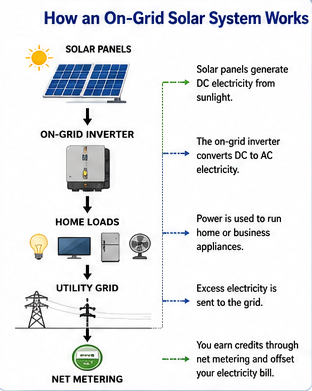
An on-grid solar system (grid-tied system) generates electricity from the solar panels installed on any part of the house. Further, it uses the energy produced to run the home appliances. Also, the system remains connected to the already established utility network. Solar modules create DC electricity in daylight hours, and a solar inverter changes this into AC electricity (to the home).
Main Components
An on-grid system basically consists of solar panels, an on-grid inverter, and the utility grid. The electricity is made available throughout the grid and runs in sync with the local grid.
Advantages
One of the main advantages of an on-grid setup is that it costs less upfront than battery-based systems. Because energy storage is not necessary, installation is usually easier and cheaper. In areas where net metering is also possible, users can export excess solar electricity to the grid instead, for credits for energy use to offset other electricity costs.
Limitations
The biggest limitation of an on-grid system is that it will not supply power during a utility outage for safety reasons and to avoid damage to the utility infrastructure. This means that if there is a blackout, solar generation alone will not supply backup electricity.
Real-World Example
Imagine an urban homeowner who has dependable utility service and can net meter. For most of the day, the system powers domestic appliances and sends electricity to the grid. At night, the energy brought in from the grid aids in reducing annual energy charges with no battery storage.
How Does an Off-Grid Solar System Work?
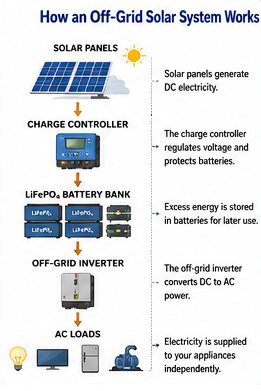
An off-grid solar system is a system that does not connect to the utility or power network for electric supply, storage, and generation. Also called a stand-alone solar system, this is usually used in off-grid locations where extending the grid is technically difficult or economically unviable.
Main Components
An off-grid system normally employs a solar panel, an off-grid inverter, charge controllers, and a battery energy storage system. The electricity creation of the solar panels will only take place when there is sunlight. The battery will store excess energy for the night. An inverter controls electrical energy and produces a matching current compatible with the devices connected.
Advantages
An off-grid system’s biggest benefit is complete energy independence. User experience is unaffected by the utility outage, electricity tariff changes, and limited grid access. Off-grid systems stand out for serving remote communities, farms, research, and telecom stations.
Limitations
The availability of energy depends on solar generation and storage capacity. Energy management becomes essential if the available battery reserves are undersized or if the weather impacts solar generation for long periods. Consequently, careful design of the system is essential for obtaining reliable data yearly.
Real-World Example
A telecom tower in a remote location may function with an off-grid solar system with battery storage. Producing electricity at the site, rather than relying on diesel generators and fuel deliveries, will not only cut operating costs but also ensure continuous connectivity.
How Does a Hybrid Solar System Work?
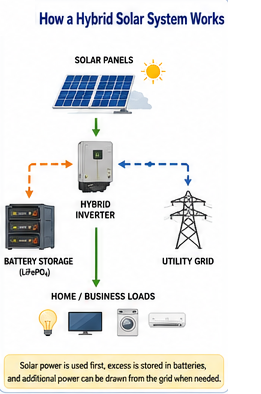
A hybrid solar system contains solar generation capacity, battery storage, and a link to the grid all in one system. Different from purely grid-connected or standalone systems, a solar hybrid system can utilize solar energy directly, stockpile surplus power for later use, and tap into the grid when needed.
For commercial hybrid projects, an outdoor energy storage cabinet can integrate the storage, conversion, control, thermal-management, and protection functions required by the site design.
Main Components
The main elements consist of solar panels, a hybrid solar inverter, battery storage, and grid connectivity. The hybrid inverter manages energy flows between this equipment system.
Advantages
A hybrid system is both resource independent and cost-effective. You can rely on the power stored in this system during peak electricity pricing periods or during a short interruption. Conventional grid-connected systems have less operational flexibility compared to these.
Limitations
Incorporating batteries and advanced energy management equipment complicates the system and increases capital costs. Return on investment largely depends on the price of electricity, the cost of batteries, local rules, and daily use.
Real-World Example
Think of a factory that pays a lot for power when demand peaks. While there is daylight, solar generation supports production activities. Any excess electricity will charge the battery system for use when rates are higher. Using this approach, operational costs may be lowered further while enhancing energy resilience.
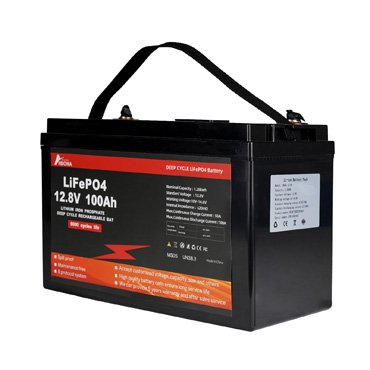
Many commercial projects are now using modern LiFePO4 batteries because they offer lower life cycle costs, high safety characteristics, and lower maintenance than older generation batteries.
Key Components Required for Each Solar System Type
Although all solar systems harness electricity from sunlight, not all solar equipment is the same. The difference lies in each solar system’s relationship with the electricity grid and the way they handle stored energy. When project owners understand these differences, they can evaluate installation, operational flexibility, and future expansion.
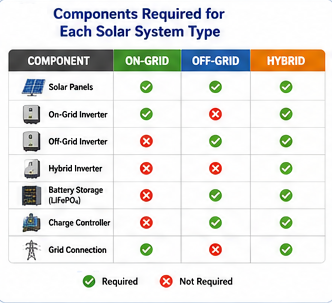
Among these options, solar panels are the main electricity-producing component in all systems. The key distinction is the presence of battery storage as well as grid connection. Off-grid and hybrid systems depend on stored energy, whereas on-grid systems utilize direct energy consumption and focus on the grid. Many modern applications increasingly deploy LiFePO4 battery technology when battery storage is required, thanks to its robustness and efficiency suited to long-term energy storage applications.
On-Grid vs Off-Grid vs Hybrid Solar Systems: Side-by-Side Comparison
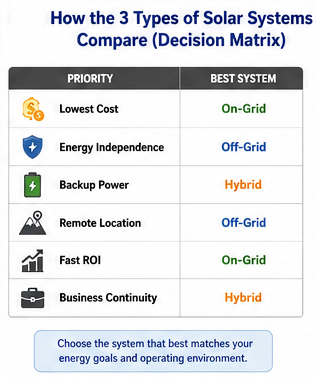
Choosing among the 3 Types of Solar Systems requires an analysis of everything and not just one thing, as per the goals of the project. Some users want the installation cost as low as possible, while energy independence or functioning during grid failure matters for others. Grasping the real-world contrasts between these solar power systems can streamline the selection process and avoid expensive design errors.
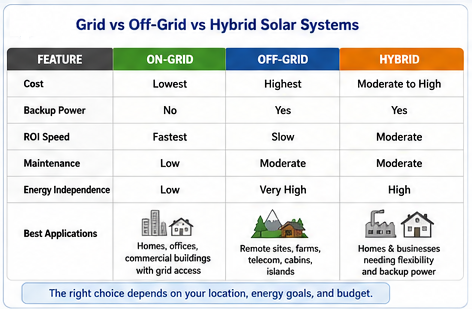
In the battle between on-grid vs off-grid solar, neither has a clear advantage. There is the fastest payback with an on-grid solar system; the off-grid design gives complete independence. The hybrid solar system range lies between the two, making it increasingly popular in residential and commercial projects due to operational flexibility and energy security.
Cost Comparison and Typical ROI of Different Solar Systems
The cost of the whole solar system is not just the price of solar panels. The project’s economics can be affected by inverter type, battery capacity, installation complexity, energy consumption pattern, and local electricity rates. As published by the International Renewable Energy Agency (IRENA), battery storage accounts for one of the largest contributions to system cost in energy independent design projects.
Why On-Grid Systems Usually Cost Less
Due to not needing a battery bank, on-grid systems usually require the lowest upfront investment. Fewer components lead to reduced installation cost and simplified system design. In several markets, access to net-metering or similar compensation systems can also improve project payback periods.
Why Off-Grid Systems Require Higher Investment
Off-grid systems must generate and store enough energy to provide power while functioning during the day and night. As a result, spending on batteries, storage management equipment, and sizing will increase. Often, energy planning and not generation capacity will determine long-term reliability.
When Hybrid Systems Offer Better Long-Term Value
A hybrid solar power system delivers strong long-term benefits in a place with variable electricity prices (and regular outages).
Key Cost Drivers by System Type
| Cost Driver | On-Grid | Off-Grid | Hybrid |
| Solar Panels | High Impact | High Impact | High Impact |
| Inverter Equipment | Moderate | Moderate | High |
| Battery Storage | Not Required | Major Cost Factor | Major Cost Factor |
| Installation Complexity | Lower | Higher | Higher |
| Grid Connection Fees | Applicable | Not Applicable | Applicable |
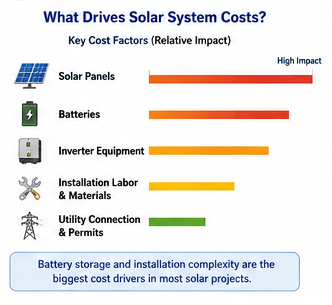
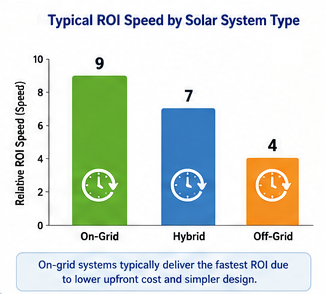
In planning any project, organizations and agencies such as IEA, NREL, IRENA, and SolarPower Europe suggest the evaluation of lifecycle costs rather than only the primary investment. Operational costs and energy savings impact overall solar ROI significantly.
Which Solar System Provides the Best Backup Power?
The capacity to backup is one of the key differences between the 3 Types of Solar Systems, yet it is most overlooked at the planning stage.
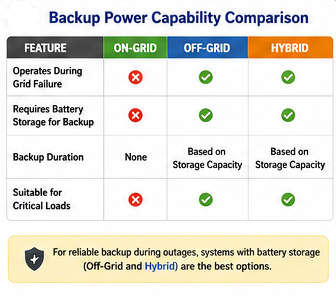
A grid-connected system usually ceases operation when the utility grid is down. Off-grid systems, on the other hand, are built to work with stored energy. Hybrid systems are capable of providing backup power. However, this backup power is dependent on the battery storage capacity that is available and the electrical loads in the backup circuit.
Which Solar System Is Best for Different Projects?
Choosing one of the 3 Types of solar systems depends on operational conditions, consumption pattern, and reliability requirements. Just because a system works well for an urban household doesn’t mean it is appropriate for a telecom tower in the bush or an industrial site.
Project Recommendation Matrix
| Project Type | Recommended System | Why |
| Urban Home | On-Grid | Reliable utility access and lower installation costs |
| Rural Home | Hybrid | Balances grid access with energy security |
| Farm | Hybrid | Supports essential equipment during outages |
| Telecom Site | Off-Grid | Operates independently in remote locations |
| Commercial Building | Hybrid | Reduces peak electricity expenses and improves resilience |
| Factory | Hybrid | Supports business continuity and energy management |
| Remote Research Station | Off-Grid | No dependence on utility infrastructure |
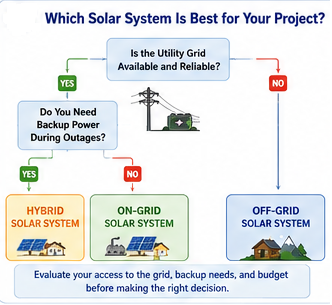
For a standard residential solar system, an on-grid arrangement usually offers the most affordable solution when utility servicing is reliable. But users who face frequent outages will benefit from a hybrid. The hybrid system is increasingly being adopted due to the operational continuity and demand management it provides to the customers. In many commercial/industrial solar system applications, energy resilience and cost control are just as important, which is why, throughout the world, hybrid designs are increasingly deployed in manufacturing, logistics, and processing facilities.
Real-World Scenarios: Choosing the Right Solar System
Although theoretical comparisons are useful, real projects show us why different types exist. The most sophisticated solar energy system available is not always the best one. The system is one whose specification aligns with the project’s location, energy profile, and priorities.
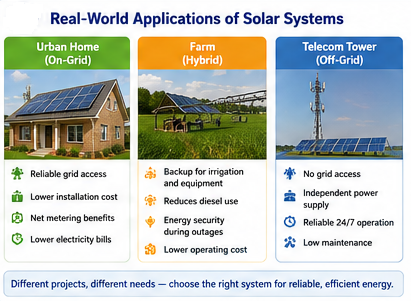
Homeowner Example
Think of a homeowner living in a city with dependable utility service and an increasing electricity bill every year. By using an on-grid system, the homeowner is able to benefit from a larger return on investment as they do not need to purchase battery storage and can offset daytime consumption. The principal aim is to lower electricity bills, not attain complete energy independence.
Agricultural Example
Power cuts can happen at times during peak seasons on farm run irrigation pumps and livestock gear. In this case, a hybrid system can sustain essential operations without relying on the utility network. Having batteries with the grid helps maintain continuity when the electricity rises and falls.
Industrial Example
A manufacturing facility that works in multiple shifts incurs high power consumption charges during peak hours. A solar project that blends solar generation with commercial battery storage can reduce demand-related costs and enhance operational resilience in a thoughtful way. Today, businesses use LiFePO4 battery systems from specialists like HBOWA for long-duration commercial energy storage applications with high cycle life and safety.
Common Mistakes When Choosing a Solar System
Solar projects fail to deliver expected performance largely because of planning errors and not because of equipment quality. For many people, the first mistake we’ll see is opting for a system based on cost rather than value.
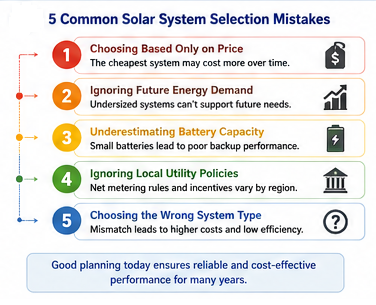
You need to match the technology for effective solar system design. A remote location may require a facility to be completely self-sufficient, while one located in a city may deliver better results through grid interconnection. Careful planning prior to the solar installation will remove any unnecessary costs and will be beneficial for the system performance in the long run.
Conclusion
When project owners know the 3 Types of Solar Systems, they can pair technology with real energy needs. Usually, the lowest-cost systems are on-grid; off-grid systems help you achieve total energy independence, and hybrid systems allow you to keep the option of backup. No matter what type of system you choose, picking the right combination of panels, inverter technology, and battery storage systems, especially a modern LiFePO4 system from the likes of HBOWA, is often a more vital decision than brand choice.
Solar Products for Your Project
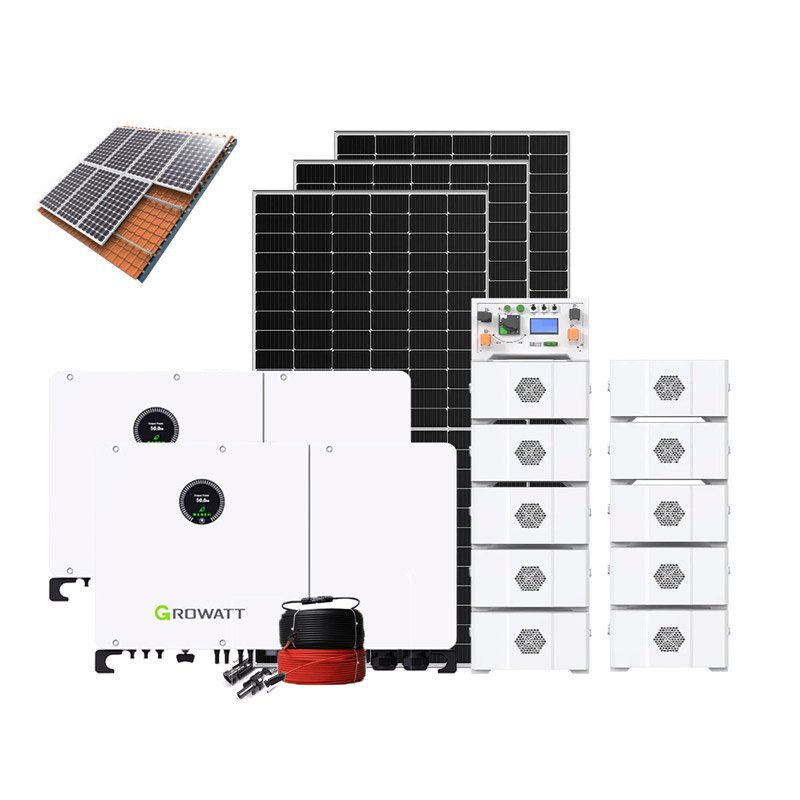 Hybrid Solar System | 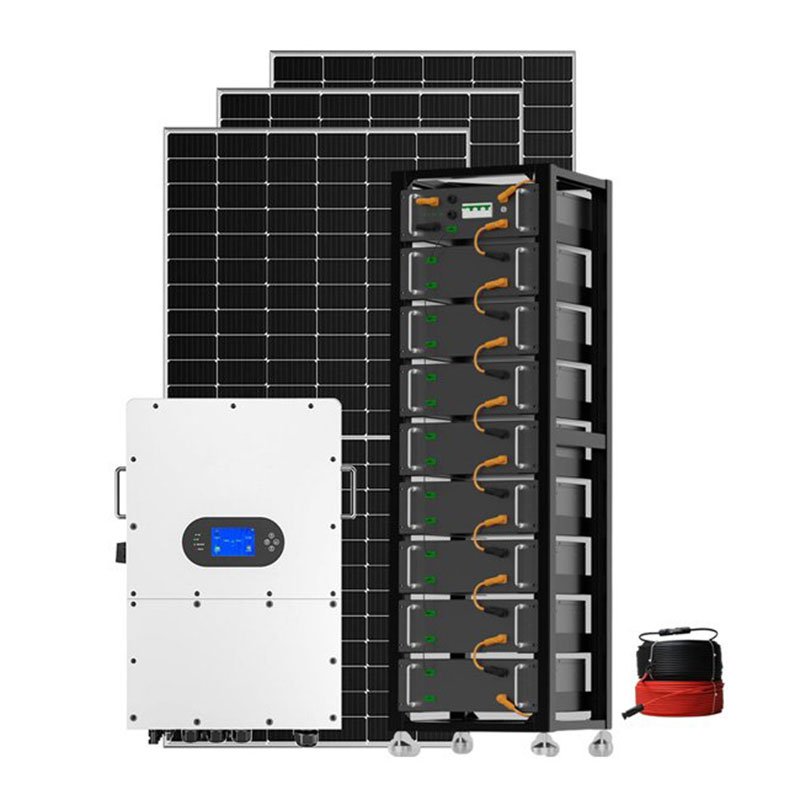 Off Grid Solar System Off Grid Solar System | 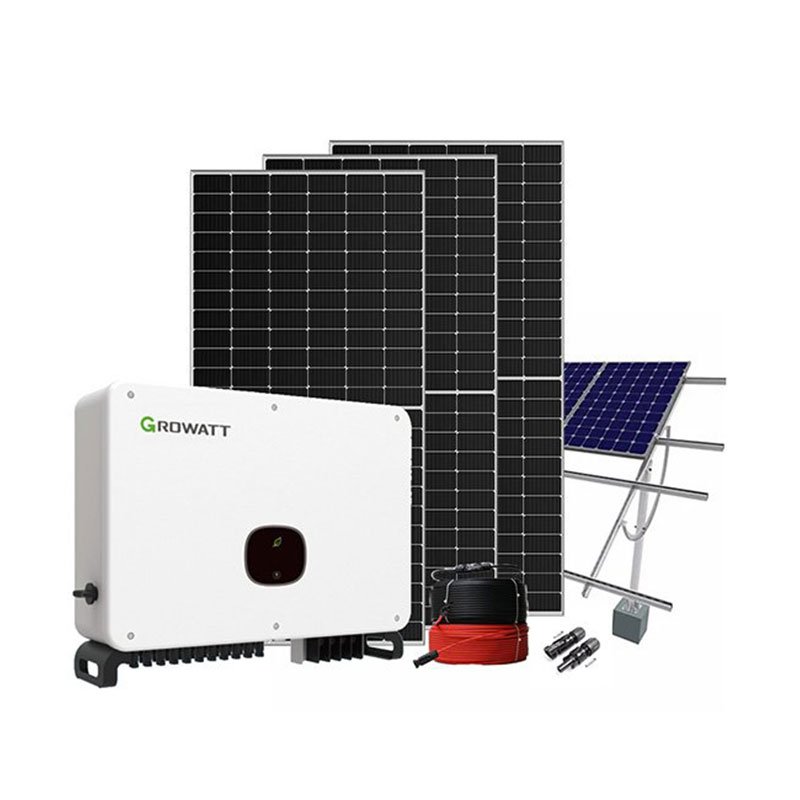 On Grid Solar System |
Frequently Asked Questions
There is no one answer for every homeowner, because in areas where utility service can be counted on, an on-grid solar system is often the cheapest solution, whereas, those homeowners who suffer from frequent blackouts may consider benefiting from a hybrid system with supplemental energy security.
Not every hybrid solar system is better than an off-grid solar system. Hybrid systems strike a balance by aiming for energy independence while supporting the grid. On the other hand, off-grid systems entirely remove all reliance on utility infrastructure. The more optimal solution depends more on the site conditions, electricity access and operating priority than on technology.
Most typical grid-connected systems cease working during an outage. The utility worker is protected as he repairs damaged lines. Don’t let an inconvenient power outage stop you from receiving treatment. With a backup system, you need battery storage and backup functionality, which are mostly found in hybrid and off-grid systems.
On-grid systems usually provide the quickest solar ROI in most markets as they require lesser components and lower upfront cost. Hybrid systems can provide robust returns in regions with elevated electricity prices or recurrent power outages. Usually selected for energy access and independence rather than financial return. Off-grid systems.
Yes obviously! A hybrid system is characterized by the combination of battery storage. Batteries allow you to store excess solar electricity and use it at another time. The system behaves like a conventional grid-connected installation without storage.
For many commercial facilities, hybrid systems provide the highest operational flexibility, as they enable energy management and demand reduction, as well as limited backup capacity. For more questions, please contact HBOWA experts, and we are happy to assist you.