Introduction
Choosing the right business model, understanding startup costs, building supplier relationships, and having a long-term growth strategy drive success. This guide looks at how to start a solar business today with everything you need to know about opportunities, business models, costs, profitability factors, and expansion strategies that are influencing the solar sector today.
Why the Solar Industry Remains a Strong Business Opportunity in 2026
According to the International Energy Agency, solar photovoltaic energy is one of the fastest-increasing electricity generation technologies on the globe as of now. The association believes that the addition of renewable energy capacity will continue to be led by solar technology.
The sales of solar panels are not the only way the business owners can grow their firm. Many more products and services play significant roles in the solar panel market, like battery energy storage, energy management services, EV charging systems, operation, and maintenance contracts, commercial energy solutions, etc. These individual products and services not only diversify the portfolio of businesses but also create multiple streams of revenue for companies in the renewable energy market.
There have been many technological advancements that have taken place in the solar panel market, leading to solar investments. Modern TOPCon solar panels, advanced PERC solar panels, high-efficiency inverters, LiFePO4 batteries that last longer, and energy-efficiency improvements in power conditioning units have made the energy system based on solar.
What Type of Solar Business Should You Start?
Various solar business models exist to cater to entrepreneurs who wish to get into the solar business. Picks in terms of a business model include a company’s available capital, technical expertise, market demand, etc. Solar sales, solar installation contracting, solar equipment distribution, and large-scale project development are famous solar business models.

How Much Does It Cost to Start a Solar Business?
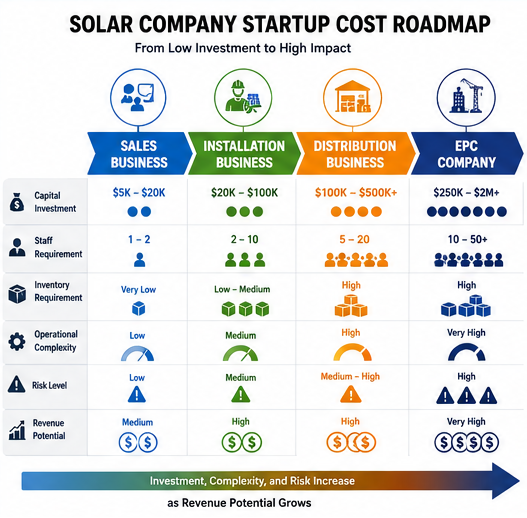
The question “how much does it cost to start a solar company?” is one of the most searched things about how to start a solar business. The answer varies significantly based on the business model. If the company is involved in a sales and lead generation business, you might have to spend less upfront cost compared to a distributor or solar EPC company.
Low-Cost Entry Models
The brokers, sales agencies, solar consultants, lead-generation businesses, and websites enjoy lower barriers to entry among various business models. Registering the business, developing the website, software, CRM, marketing, and advertising are the primary expenses. These businesses don’t buy or maintain equipment, have dedicated installation crews, and, typically, can launch faster compared to other solar ventures.
Mid-Investment Models
A solar installation business is expected to have a moderate solar business startup cost. The expenses include adding the cost of installation tools, necessary safety equipment, CAD engineering software, transportation, training the employees, and purchasing insurance coverage.
It may also require hiring experienced electricians, project coordinators, or technical employees. Here, the startup cost will be higher than that of a sales company. However, the solar installers gain more control over the executed projects as well as customer relationships.
Capital-Intensive Models
Solar Distribution business and EPC contractors will need the highest solar business startup cost. The companies indulging in the business manage inventory, warehousing, logistics, procurement, and delivery of large-scale projects. The inventory may demand Tier-1 solar panels, solar inverters, mounting systems, and battery energy storage products. Appropriate working capital is of utmost importance as most of the equipment purchases and project expenses occur before the customer payments.
The table below illustrates how startup expenses can differ across business models.
| Expense Category | Sales Business | Installer | Distributor |
| Business Registration | Low | Low | Low |
| Insurance | Low | Medium | Medium |
| Equipment & Tools | Very Low | Medium | High |
| Marketing & Lead Generation | Medium | Medium | Medium |
| Staffing Requirements | Low | Medium | High |
| Working Capital Needs | Low | Medium | High |
For instance, if an electrician expands his or her business to include solar power for residential purposes, he could start a small local installation business. If, on the other hand, the owner started a company offering TOPCon, PERC solar panels with LiFePO4 batteries to regional installers.
Are Solar Businesses Profitable?
Solar companies can be profitable. For these companies, profit from the solar business comes from more than the sale of equipment. Overall, the way a company acquires customers, its efficiency when creating projects, how operations are managed, and the number of services provided by the company, among other things, often influence their long-term performance more significantly than revenue alone.
The solar company’s profit margin averages based on this type of business and location. Installation companies earn money through labor, design, project management, and markup on equipment.
On the other hand, distributors earn a margin from different types of supplier sales and supply relations. Those businesses involved in backup energy storage solutions will typically make more profit from both divisions.
The table below highlights the difference between one-time and recurring revenue opportunities.
| Revenue Stream | One-Time Revenue | Recurring Revenue |
| System Installation | Yes | No |
| Maintenance Services | No | Yes |
| Battery Upgrades | Yes | Limited |
| Monitoring Services | No | Yes |
| Energy Management Consulting | Yes | Possible |

For entrepreneurs considering starting a solar business, the most profitable solar businesses set up customer relationships beyond initial data.
Licensing, Certifications and Legal Requirements
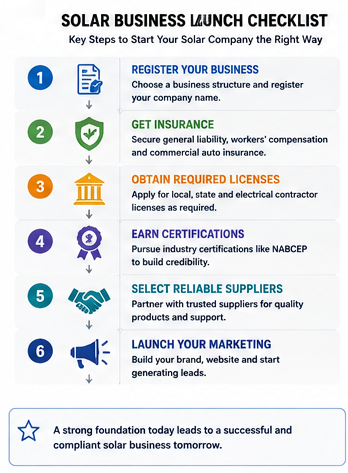
We often fail to think about licensing & compliance while planning for a successful business from scratch. But licensing & compliance are important elements that will help to establish a legal company. Every country, State, province, and municipality has a set of regulations, and hence, no universal checklist will help while entering the market.
For example, if a company wants to focus on installation services, then they might need to have an electrical contractor credential, a construction license, or a specialized solar contractor license to work as per local regulations.
Besides this, insurance, coverage for employees, registration fees, tax payments, and local permit requirements must be considered before accepting projects. If a company doesn’t strictly set up rules and regulations, it may fall into project delays and fines.
Professional certifications can further inspire confidence in the customer’s mind. Although one isn’t always necessary, a certified person knows the technicalities and standards. One of the well-recognized credentials in North America is NABCEP certification. It is issued if the person is fit to install solar equipment by the North American Board of Certified Energy Practitioners.
Building a Solar Business Plan That Attracts Customers and Investors
A solar business should show in clear terms how the business will get revenue, serve the customer, manage risks, and grow the company over time. When investors or lenders go through any company, they check with the market focus, financial expectations, and the competitive advantage of the company. For someone who doesn’t know how to start a solar business, a well-documented plan will be helpful to start their business.
Define Your Target Market
More companies fail because they are intended to serve every kind of customer. A better way is to focus on a few of the market segments. Residential customers who use solar panels are considered about energy saving and backup power options.
Commercial and industrial clients using solar energy are interested in operating efficiency and long-term electricity cost management.
The agricultural customers who use solar energy are interested in various things, such as irrigation, cold storage, and processing facilities. The companies should focus on the client’s needs.
Select Reliable Suppliers
The quality of the suppliers determines the satisfaction of the customer and the reputation of the business. The superior suppliers offer the consistent availability of the goods, and the warranty support, technical documentation, and long-term service support are critical. You should evaluate suppliers offering Tier-1 solar panels, TOPCon solar panels, PERC solar panels, solar inverters, and LiFePO4 batteries.
However, you should not choose these suppliers on the basis of the product price but on the quality of the products offered. For the wholesale suppliers like HBOWA, they give you access to the goods from the reputed manufacturers, like in-house LiFePO4 batteries, Growatt inverters, Longi, Jinko, Trina, JA Solar, Canadian Solar, Risen, Tongwei, and LESSO. Thus, you can match the goods to the different project requirements.
Create Revenue Forecasts
Revenue forecasting has to be based on realistic sales assumptions instead of optimistic growth projections. You estimate the monthly project volume, the average contract value, the average customer acquisition costs, and forecast the monthly operating expenses.
Generally, investors care a lot less about your potential to access the market than your ability to achieve cash flow stability. Thus, the companies that develop practical financial forecasts are the ones that get to raise the financing, attract the partners, and also scale efficiently.
How to Get Your First Solar Customers
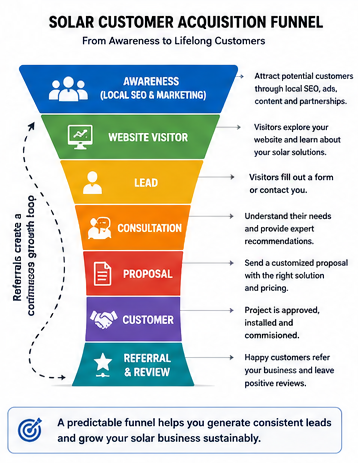
One of the major challenges that the solar business faces when it is at the beginning stage is identifying the customers who would be willing to buy it. You must view customer acquisition as your core business function and not as an afterthought.
Local SEO
Local search visibility is vital because customers these days begin their buying journey online. You are more likely to show up in the local search results if you maintain an updated website, correct and expired business listings, and have verified customer reviews.
Often, the most effective solar company marketing starts with local relevance because potential clients generally look for solar services providing companies in their location. To boost the search ranking, the educational page, location-specific pages, and customer reviews are also significant.
Partnerships
Partnership programs are a way to access some qualified prospects without having to depend completely on paid advertising of any kind. Several service companies (electricians, roofers, construction companies, architects, property developers, facility managers, etc.) also have access to customers who may have a need for solar solutions. Have a good business relationship with such companies to start getting referrals.
Referrals
The best businesses always come from referrals. A customer is committed to the person who has gotten them results. Someone’s positive experience with a reliable provider leads them to spread the word to their family, friends, business owners, property managers of the neighboring territories, and so on.
Growth Strategies Used by Successful Solar Companies
Setting up a company is only the beginning. A solar company needs to be able to expand sustainably.
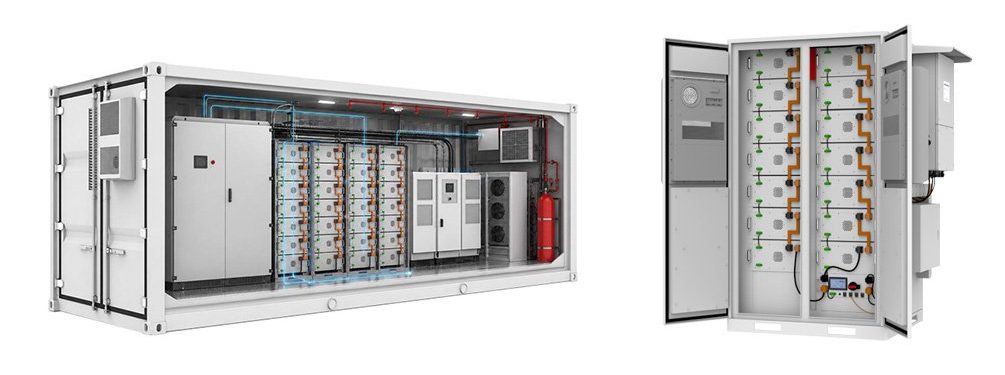
Another proven approach to maintain is through service diversification. As an organisation meets the needs of the customer for services different from that of the initial installation of solar, the company can expand. Solar installation nowadays includes many things like battery energy storage cabinets or BESS containers, monitoring platforms, service and maintenance contracts, EV charging infrastructures, and many other energy-related services.
Many organizations will start with private solar establishments and then move to business solar activities where agreement value and long-term customer relationships are commonly bigger than in private undertakings. Extension into other geographic regions can likewise uphold development on the off chance that large scale manufacturing cycles and brand recognition have been set up in the first market.
 Many successful solar companies expand gradually, adding services and larger projects over time.
Common Mistakes New Solar Business Owners Make
Many organizations start when the market grows, before they make particular operational and strategic errors. The company does not usually experience a lack of demand for solar power. The mistakes are from poor planning and expectation; weak administration can also be an issue.
The table below highlights common challenges and practical solutions.
| Mistake | Impact | Better Approach |
| Choosing the wrong business model | Slow growth and resource strain | Match the business model to available capital, expertise, and local demand |
| Ignoring working capital needs | Cash flow shortages during active projects | Maintain adequate financial reserves and monitor cash flow closely |
| Depending on one supplier | Inventory delays and pricing risks | Develop relationships with multiple qualified suppliers |
| Weak customer education | Lower conversion rates and unrealistic expectations | Provide clear information throughout the sales process |
| Poor after-sales service | Fewer referrals and reduced customer retention | Establish structured support and communication procedures |
| Underestimating permitting timelines | Project delays and scheduling issues | Research approval requirements before committing to timelines |
For entrepreneurs starting a solar company, avoiding these mistakes can significantly improve long-term stability and growth potential.
Conclusion
Starting a solar business means much more than entering a rapidly soaring business. The odds are that if you just know everything you need to know about beginning a solar power company. From the appropriate organisations to understand how much it will cost for a fresh solar enterprise, you have come to the correct site if you want to run this kind of business. It isn’t something to start every day, but it is an increasing business every day.
Frequently Asked Questions
The business model determines startup requirements. A solar sales business can generally be started with less capital. However, installation, distribution and EPC businesses usually require a more considerable investment in staff, plant, inventory and operations.
Due to increasing demand of solar, energy storage and energy management services around the world, many solar companies remain profitable. Yet, profitability relies on the extra expense of attaining customers, the efficiency of operations, service quality, participation, and good management of finances.
Of course. A lot of entrepreneurs enter through services like sales, consulting, project management, distribution and acquisition. Contractors or installation teams with experience can perform the technical installation work.
It depends upon local market conditions and the objectives of the business. Short sales cycles are typical for residential systems. In contrast, commercial projects offer more valuable contracts and longer-term business relationships.
Starting a solar sales business is the easiest option for a lot of entrepreneurs because it usually needs less capital and fewer operational resources than installation, distribution, or EPC operations.