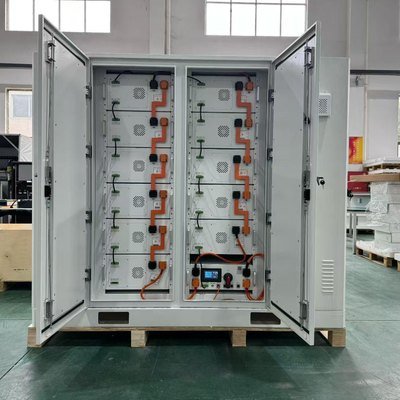
A calculator for kVA to W is set to convert apparent power, that is known as the input in kilovolt-amperes (kVA), to power in kilowatts. This calculator is helpful for electricians, solar designers, generator planners, and engineers who want to determine fast and accurately the real watt value to properly size and check the systems. Only the input of kVA and the power factor, and the value of wattage that can be put to use, will be shown for assessing equipment support true electrical loads easily. This calculator works for both single-phase and three-phase electrical systems, and users are advised to select the correct one.
Formula & Variable Definitions
Single and Three Phase system formula:
Single Phase System Formula:
W = KVA x PF x 1000
Use: Residential, small commercial application
Three Phase System Formula:
W = KVA x PF x 1000 x √3
Use: Industrial electrical stations, Data center, solar station.
The conversion from kVA to W depends on the electrical systems in use, whether single-phase or three-phase, and the relationship relates to kVA (kilo-volt-amps) and not to kW (kilowatts), where kVA represents apparent power in an AC (alternating current) circuit that signifies the combination of the usable and reactive portions of the circuit in the form of current and voltage. The power factor of a power source is defined as a dimensionless number having a range from 0 to 1, which gives the ratio of real power output to apparent power. The higher the value of the power factor, the greater will be the share of the apparent power converted to real power. The value of 1000 is a multiplier that changes kilovolt-amperes into volt-amperes, which is compatible with the watts.
The equation assumes that the AC (alternating current) system is facing steady-state conditions such that the power factor is known and remains constant. However, the equation does not take into account the transient loads, harmonic content, phase imbalance, or the actual power and reactive powers. The wattage value obtained from the equation represents the expected value of the real power along with its geometry at the load terminals. The calculator assumes a balanced state in both single-phase and three-phase systems.
Example Calculation
This scenario looks at a backup power system in a small medical clinic where the supply of electricity is vital. The clinic has a generator of 12.5 kVA, also known as the “nameplate rating.” Nameplate ratings are the maximum apparent energy that can typically be handled by a generator. However, compressors, electronic diagnostic, and medical refrigerators are found to be exclusively used in such clinics.
12.5 kVA x 1000 = 12500 W
With Power factor:
12.5kVA x 0.82(PF) x 1000 = 10250W (Real Power)
Reactive components are introduced into the electrical load with the introduction of such equipment.
A generator can convert energy between a power factor of 13 to 10 kilowatts and can be used to do useful work when the reactive current is circulated within the system. To confirm that all the useful systems can be run at the same time without exceeding the generator’s (real) capacity, the above-watt value is being used by professional engineers and those responsible for checking the capacities; they never use the kVA value.
When to Use This Calculator
Throughout electrical system planning, when you have to translate rated power equipment into the actual operational capacity, it is most useful. Generators, inverters, or UPS systems will be able to carry your actual load requirement or not; this can be verified using this calculator. By engineers during regular system auditing, they cross-verify the specification given by the manufacturer with the power factor value measured. In renewable energy projects, you cross-verify if the inverter output is loaded with the downstream load demand. You will quickly identify whether the available real power is insufficient or not while troubleshooting.


Reference Table (Typical Values)
These reference values represent the actual power that comes from a rated power operating under realistic conditions. For each set of working conditions, the tables show how the ideal conditions for an example motor perform less work per kilovolt-ampere (kVA). Finally, power in watts, like the motor above, is reduced from a matching generator or inverter.
| kVA | PF | Real Power (W) | Single-Phase 230V | Three-Phase 400V |
|---|---|---|---|---|
| 5 kVA | 0.80 | 4,000 W | 27.2 A | 9.0 A |
| 7.5 kVA | 0.85 | 6,375 W | 38.3 A | 12.7 A |
| 10 kVA | 0.85 | 8,500 W | 51.1 A | 17.0 A |
| 15 kVA | 0.85 | 12,750 W | 76.6 A | 25.5 A |
| 20 kVA | 0.80 | 16,000 W | 108.7 A | 36.1 A |
| 25 kVA | 0.85 | 21,250 W | 127.8 A | 42.4 A |
| 30 kVA | 0.85 | 25,500 W | 153.3 A | 50.9 A |
| 40 kVA | 0.80 | 32,000 W | 217.4 A | 72.2 A |
| 50 kVA | 0.85 | 42,500 W | 255.5 A | 84.9 A |
| 100 kVA | 0.80 | 80,000 W | 543.5 A | 180.4 A |
| 200 kVA | 0.80 | 160,000 W | 1,087.0 A | 360.8 A |
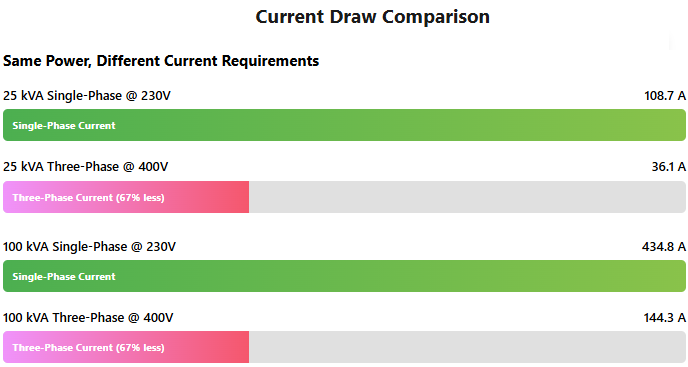

These values also clearly demonstrate why one should not rely on kVA when selecting a piece of equipment. Two systems that have the same kVA rating can operate in entirely different loads and have several kilowatts of real output differences. These tables help to get an estimation during the project planning, bidding, and comparison stages, but they should not finalize a project.
Accuracy & Limitations
Its output assumes constant power factor and stable operating conditions. In real systems, efficiency losses in wiring, transformers, and power electronics reduce the actual overall output. The starting currents of electric motors, the characteristic values, and the effect of reduced Temperatures are not taken into account. Its output for the three-phase systems is an equivalent value of any one phase. For total three-phase systems, the capacity of all phases should be checked together using a detailed load. It doesn’t replace the detailed estimation of any phase. With this output, better planning can be done instead of actual operational degree with the loads.
Case Study
A regional cold storage planned to upgrade its emergency power system to support temperature-controlled rooms, monitoring equipment, and the circulation fans. The proposed generator had a rated capacity of 25 kVA. It is always better to evaluate the real power availability for the system by measuring load data taken from similar facilities than to approve the specification directly.
According to the historical records, they have been operating with an average power factor of 0.82 as there exists a high proportion of motor-driven compressors and inductive loads. The real power of the system can be calculated using the assessments:
25 × 0.82 × 1000 = 20,500 W
The comprehensive load analysis shows the maximum continuous demand to be 18,900 W during normal operation, with the compressor starting demand slightly more in peaks of short durations. Thus, from this analysis, it was clear that the generator was continuous in operation with sufficient headroom but lacked expansion capacity.
Thus, the contingency plan of the facility was revised, but instead of oversizing the generator, it reduced the upfront expenses of the generator while maintaining the full value of operational reliability. Thus, one can see how converting kVA to watts allows engineers and others to make accurate decisions by using the correct equipment names according to their load performances rather than based on their nominal names.
Quick Watt Conversion Chart
| kVA Rating | Watts Equivalent |
|---|---|
| 5 kVA | 5,000 W |
| 10 kVA | 10,000 W |
| 25 kVA | 25,000 W |
| 50 kVA | 50,000 W |
| 100 kVA | 100,000 W |
Conclusion
The kVA to W calculator is a reliable and quick way to convert apparent power into practical wattage using power factor. The calculator removes guesswork from electrical planning and helps to ensure correct sizing and verification of systems. By understanding the relationship between kVA, power factor, and watts, users can make wise decisions to improve system reliability, performance, and safety in a less complicated way.
Solar Products for Your Project
Solar Panels | Solar System | C&I Battery Storage |
 |  |  |