A solar panel string calculator is used to determine how many solar panels can be connected together in series based on the voltage limit of the inverter, the electrical specifications of the panel, and the present atmospheric temperature (according to region), so this tool assists consumers, installers, and dealers in calculating safe string length, avoiding overvoltage, etc. The combination of panel open-circuit voltage (Voc) and inverter constraints allows the calculator to essentially provide an accurate means of solar system design prior to installation.
Formula & Variable Definitions
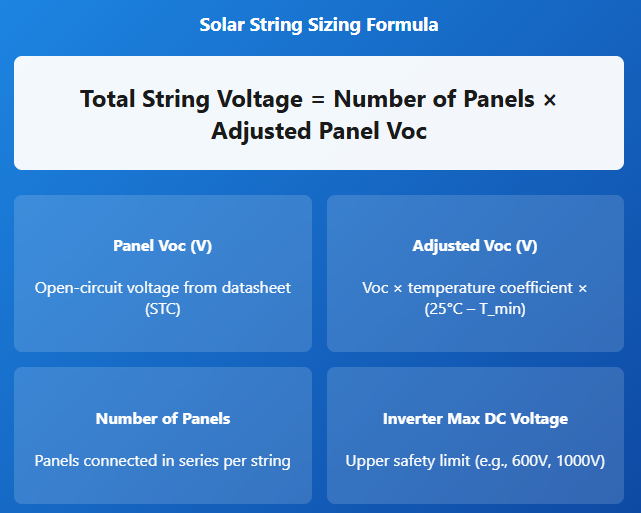
The total voltage of a string of solar panels relies heavily on the quantity of panels aligned in series connection and the voltage produced by each individual panel under specific conditions. Panel Voc is the maximum output voltage from a module when left open. Nonetheless, temperature alters this value. When the weather is colder, voltage increases, which raises total string voltage. This explains why the Voc always needs to be adjusted for the lowest expected temperature.
The safe operating range is determined by inverter constraints. The max DC input voltage defines the upper limit of the safety domain. The MPPT voltage range describes the operating window of the equipment. A string is correctly sized if it remains below the maximum voltage while operating normally in the MPPT range. In real-world scenarios, the addition of extra panels results in a progressive rise in voltage; nevertheless, for a system to be considered safe, this must not lead to the inverter operating in excess under the worst-case scenarios.

Example Calculation
A residential system in Madrid reduces grid electricity use and supports evening loads and optional HBOWA battery storage. The configuration connects a Longi solar panel and a Growatt inverter, a happening pair at mid-size rooftop setups in cities. The chosen panel has a rated Voc of 49.5V. In lower winter conditions, voltage rises associated with the adjusted Voc of about 54.8V. The inverter is able to accommodate a maximum DC input voltage of 600V, setting the upper safety limit for string design
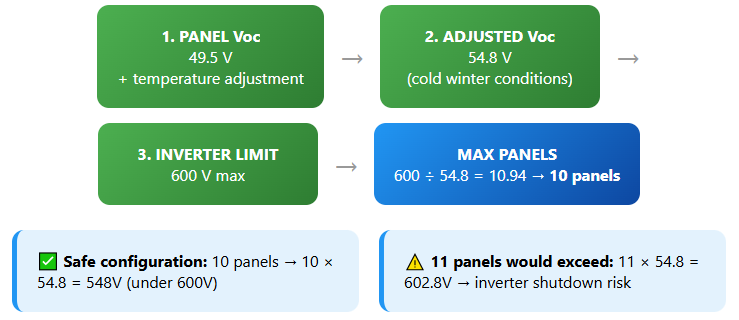
To find the max panels per string, the system calculates using adjusted voltage. 600 ÷ 54.8 = 10.94. Extrapolated to 10 full panels. The configuration is restricted to 10 panels per string because only whole panels are workable. At this level, it operates within a safe zone within inverter constraints, even at temperatures when voltage peaks. If as many as 11 panels were to be installed, then the total string voltage would exceed 600V, thus the inverter would trip. Moreover, it would also cause long-term stress on hardware.
By practical operation, the above system is stable with the change of the seasons and converts energy efficiently. Under normal conditions during the day, the operating voltage stays within the inverter’s MPPT range. This helps residential users in safety in installation, predictability of output, and compatibility of Longi panels with the Growatt inverter, and HBOWA battery storage is optional.
How to Use a Solar Panel String Calculator
A solar panel string calculator helps make string sizing easy, translating panel and inverter specifications into a manageable maximum and minimum panel count. Homeowners, distributors, and installers use this process to verify the system design before installing it.
To begin, find the panel Voc from the datasheet of the manufacturer. Then, adjust that quantity for the lowest expected temperature at the installation location. In places like Berlin or Toronto, the winter voltage can go much higher. Thus, the adjustment is important for safety design. Check the maximum DC input voltage of the inverter, which defines the upper safety limit of the string.
To calculate the maximum number of panels per string, divide the inverter’s max voltage by adjusted Voc. It is necessary to always round down the result so as not to exceed the limit of voltage, after that check the inverter’s MPPT voltage range and compare it to the expected operating voltage of the string under normal conditions, because this helps the machinery to run smoothly and safely.
This methodical process corresponds to the actual use of a solar string sizing calculator in the real world, allowing residential users and commercial installers to quickly determine safe configurations without needing complex software.
Minimum and Maximum String Size Explained
An approach for sizing PV strings is complete when the maximum number of panels per string and the minimum number of panels per string have been defined. Conventional designs only focus on maximum voltage limits. The minimum string size is equally important for enhancing system performance.
The temperature-adjusted Voc is divided by the inverter’s DC voltage limit to determine the maximum string size. This stops excessive voltage levels in cold weather. The inverter’s MPPT minimum voltage serves as the basis of the minimum string size. That means the minimum voltage needed for tracking.
Let’s take a real-life example, in Porto solar design engineer designs a system:
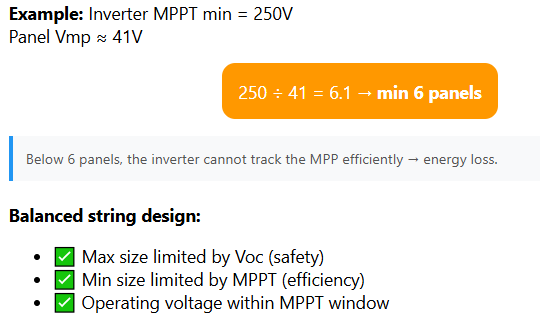 When the battery becomes less than this level, the inverter may not work efficiently. Although the system may continue to work, the energy output may be lower.
The system can only experience voltages that are between a maximum and minimum limit because using too many panels can create safety issues, but using too few panels will reduce performance, so it’s a double-edged sword. Thus, the correct sizing of inverter strings in both a residential layout and a commercial layout is very important because it dictates the return on investment.
When to Use a Solar Panel String Calculator
Whenever the design of a system involves matching the voltage limits of the solar panels or inverter, a solar panel string calculator is used. Safety and performance, not panel count, govern selections in actual practice and applications.
A calculator assists homeowners in keeping rooftop solar systems safe without overloading inverter limits. This is especially true for selecting different panel models presenting different voltage behaviour.
In industrial and commercial systems, string sizing becomes more significant due to higher system voltages and larger systems. Even small mistakes can result in performance degradation or system failure.
The HBOWA LiFePO4 battery systems need proper string sizing to ensure a stable flow of energy from generation to conversion to storage.
The calculator is for distributors and installers and can be used to check system setups. It reduces design errors and ensures compatibility across projects.
String Sizing Checklist for Inverters
Below is a structured checklist that helps with the string sizing decisions for different system types and sizes:

| Mistake | Consequence | Solution |
|---|---|---|
| Using STC Voc without temperature adjustment | Underestimated voltage → overvoltage in winter | Always apply temperature coefficient for lowest local temperature |
| Ignoring MPPT minimum voltage | Inverter operates below optimal range → reduced yield | Check Vmp of string stays above MPPT min |
| No safety margin | Voltage spikes may exceed inverter limit | Add 10–15% safety margin or round down aggressively |
| Mixing different panel models in one string | Current mismatches, power loss | Use identical panels per string |
Reference Table (Typical String Voltage Scenarios)
| Panels in String | Panel Voc (STC) | Adjusted Voc (Cold) | Total String Voltage | Status (600V inverter) |
|---|---|---|---|---|
| 8 | 49.5 V | 54.8 V | 438.4 V | ✅ Safe |
| 9 | 49.5 V | 54.8 V | 493.2 V | ✅ Safe |
| 10 | 49.5 V | 54.8 V | 548.0 V | ✅ Safe (max recommended) |
| 11 | 49.5 V | 54.8 V | 602.8 V | ❌ Exceeds 600V |
| 12 | 49.5 V | 54.8 V | 657.6 V | ❌ Overvoltage |
| 13 | 49.5 V | 54.8 V | 712.4 V | ❌ Overvoltage |
| 14 | 49.5 V | 54.8 V | 767.2 V | ❌ Overvoltage |
| 15 | 49.5 V | 54.8 V | 822.0 V | ❌ Overvoltage |
B2B Insight: How Distributors Use String Calculators
For distributors, a solar panel string calculator is a system planning and standardization tool rather than merely a technical calculation.
In large orders, the distributor often has fixed combinations of panel and inverter. By predefining the string sizes for these combinations, we can reduce design complexity and produce better consistency.
| Inverter Max Voltage | Panel Voc (adjusted) | Max Panels per String | Recommended String (with margin) | Typical Project Size |
|---|---|---|---|---|
| 600 V | 55 V | 10 | 9 panels (10% margin) | Residential / small rooftop |
| 1000 V | 55 V | 18 | 16–17 panels | Commercial / industrial |
| 1500 V | 55 V | 27 | 24–25 panels | Utility-scale / ground mount |
Simplifying inventory management and standardized string configurations. When certain panel counts are matched, the inverter voltage range will be more predictable, reducing misfits and stock excesses.
By combining Longi panels (or any Tier-1 panels), Growatt/Deye inverters, and HBOWA LiFePO4 batteries, distributors can create complete, pre-validated system packages. The deployment at several locations is made easy due to this reliability and sales simplification.
Accuracy & Limitations
A solar panel string calculator gives a useful baseline, but the real-world performance will vary.
The temperature variations significantly affect the panel voltage. When temperatures get cold, an increase in voltage occurs. When temperatures rise, there is a decrease in voltage. Both safety limits and operational efficiency are affected by this. A solar inverter’s function is subject to its MPPT range. Any system that works beyond this range may function, but produce less energy.
Ultimately, the system’s performance isn’t significantly affected due to other aspects such as wiring losses, panel degradation, manufacturing tolerances, and so on. Basic calculations do not fully account for these variables. For this reason, the sizing of strings must always involve safety margins and conservative assumptions. The calculator should be used a design tool rather than being used as a final validation without any technical review.0
Case Study
A mid-sized commercial facility in Karachi invests in a hybrid solution for its solar power system to limit its reliance on the grid, stabilize energy costs, and reduce electricity fluctuations due to high demand in the region. The system generates using Longi solar panels, converts using a Growatt inverter, and stores backup energy using HBOWA LiFePO4 battery.
The panel chosen by the engineer has a Voc of 50.2V, but in the winter morning, with temps less than STC, it will rise to about 55.6V, and the inverter can take a maximum DC input voltage of 1000V, and its MPPT operating range is 520V to 850V.
Calculating the safe size of a string, we take the voltage that was adjusted:
| Category | Details & Calculations |
|---|---|
| System Parameters | • Panel Voc: 50.2 V → Adjusted (cold): 55.6 V • Inverter Max: 1000 V • MPPT Range: 520 – 850 V |
| String Calculation | 1000 ÷ 55.6 = 17.98 → 17 panels per string |
| Operating Voltage (Vmp) | 17 × 50.2 = 853.4 V ✓ Within MPPT range (upper end) → efficient conversion |
| Components Used | 🔧 Longi solar panels 🔧 Growatt inverter 🔧 HBOWA LiFePO₄ battery |
*Even though 853.4V is slightly above 850V, the system operates safely and efficiently under real conditions (temperature variations).
Under standard operation conditions, the string voltage is 17 × 50.2 = 853.4V, which places the system at the upper range of MPPT. As a result, all the energy is converted during peak solar hours, which is an essential requirement in a commercial load. HVAC systems, machinery, and 24/7 office functioning consume energy at peak hours. As a result of this, under cold situations, the design stays under the maximum inverter voltage and prevents overvoltage.
In terms of system performance, this design allows the plant to remain stable all day, while surplus energy is stored in the HBOWA battery for use in the evening and to protect against outages, so the standardized configuration enables quick replication of systems across similar commercial projects by distributors and EPC contractors operating in a specific geographic location with similar climate and load profiles.
Conclusion
Solar panel string calculator refers to a tool structured in a way to make sure safe solar string configurations. Utilizing panel voltage characteristics with inverter limits ensures the system works under real-world conditions. When applied, whether to private installations or large commercial projects, string sizing improves performance and reduces failures, allowing for long-term reliability. The use of a standardized system design facilitates error reduction and increases scalability efficiency across various deployments for distributors and installers.
Solar Products for Your Project
 Solar Panels | 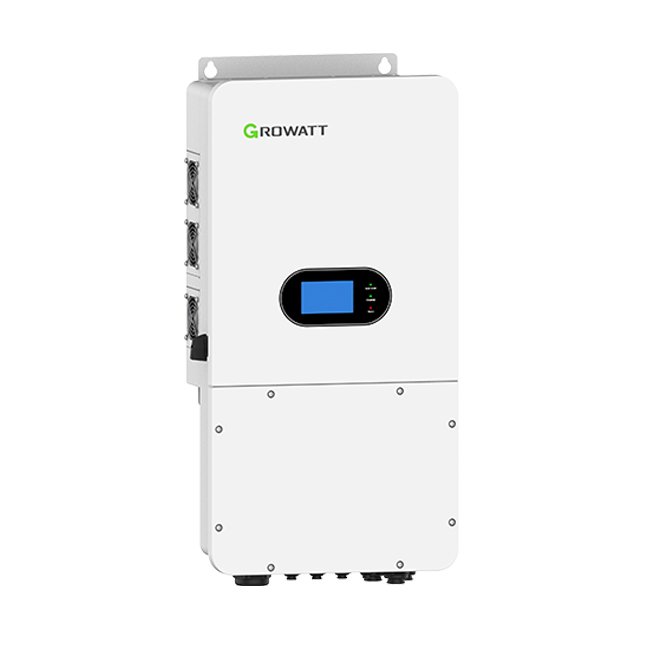 Solar Inverter |  C&I Battery Storage |