

Key Takeaways
Solar panels absorb sunlight, not reflect heat—most energy converts to electricity or controlled thermal output.
Panel heat is normal and designed-in, with safe operating temperatures and predictable efficiency impacts.
Rooftop solar can reduce roof peak temperature by shading it and creating airflow beneath the modules.
Solar energy cuts emissions—any local heat effects are minor compared to avoided fossil-fuel impacts.
Introduction
Do solar panels reflect heat? To sum up, they reflect some sunlight, but their main job is to absorb sunlight, create electricity, and in the process, solar panels generate excess heat as a result of the conversion of sunlight to electricity, not because they reflect sunlight like mirrors. When reflection of light, heat buildup, or surface temperature has caused confusion. In this article, we bust these myths and assist you in skipping the small talk and getting right into the science of solar radiation, how hot panels can get, and whether solar systems have an impact on homes, cities, or the climate.

What Actually Happens When Sunlight Hits a Solar Panel?
Solar Radiation Basics: Light vs Heat vs Electricity
The energy from the Sun that reaches Earth is essentially electromagnetic radiation (light), although some of this energy is infrared and ultraviolet radiation. Solar irradiance is the term given to the solar energy incoming, and it is important to note that sunlight itself is not heat, but heat is generated when solar radiation interacts with a substance.
When sunlight shines on a solar power module, part of the energy is transformed into electricity, while another part is absorbed and gradually released as thermal energy, and some is reflected. Because we need to disconnect the source of energy from the manner in which materials respond to it, discussions surrounding solar panel heat should not mix the two up. Solar heating effects happen after absorption, not because sunlight is incident on the surface.
Reflection, Absorption, and Conversion Explained
Newer photovoltaic panels are designed to capitalize on all possible usable light. Reflected light is wasted energy from an efficiency point of view. Manufacturers utilize ceramic coatings on glass that reduce glare and minimize losses from reflected heat for that reason. These coatings help the solar cells trap more photons rather than allow them to bounce off, and because of that, the panels do not act like mirrored surfaces that emit heat back into their surrounding environment.

Most incoming energy is absorbed instead, with some becoming electricity and the rest dissipating as heat. This equilibrium between absorption and conversion is often referred to as the solar panel heat reflection versus absorption, which explains why reflection is purposely reduced in solar designs that are highly efficient.
Do Solar Panels Reflect Heat or Absorb It?
Easy Explanation of Panel Surface Materials and Albedo
The amount of solar energy reflected or absorbed by a surface depends on the albedo of that surface, which is the amount of incoming radiation that is reflected, and not absorbed. Unlike many common roof materials, solar panels have a relatively low albedo. For instance, a dark asphalt roof absorbs a major share of sunlight, which is why it heats up rapidly. Concrete surfaces reflect slightly more light than asphalt; however, they still store more heat in the day.
Albedo Comparison: Solar Panels vs Common Surfaces
What this means: Lower albedo = more absorption, less reflection, Solar panels are designed to capturelight, not bounce it away.
Vegetation is different because the plants use some of the energy that comes in for biological processes. Further, they lose additional heat by means of the process of evapotranspiration. Amidst this, photovoltaic modules are designed with surfaces. Their purpose is to absorb light effectively and avoid being a reflective layer. For practical purposes, do solar panels absorb heat is a more interesting question than do solar panels reflect heat. Solar panels capture most incoming solar energy and convert some of it to electricity while releasing the rest gradually as heat.
Why Modern Panels Reflect Less Than You Think
New solar panels do not glare as much as people think. A major factor is anti-reflective glass treatments applied to the front surface. The coatings decrease the amount of light reflecting away, and therefore allow more photons to reach inside the cells. The presence of glare, which can be seen at given angles, does not reflect considerable heat. This is not a thermal effect; it is an optical effect. Reflection is undesirable from an engineering standpoint since it decreases energy output. The efficiency-driven design logic of photovoltaic modules explains the real-world preference for absorption over reflection in the thermal behaviour of solar panels.
How Hot Do Solar Panels Get in Real-World Conditions?
Typical Operating Temperatures: What’s Normal
To determine how hot do solar panels get before jumping to answer the question, it is necessary to pinpoint three different temperatures. The ambient temperature is the air temperature. The panel surface temperature is the temperature of the external glass, depending on the sunlight, wind, mounting style, etc.
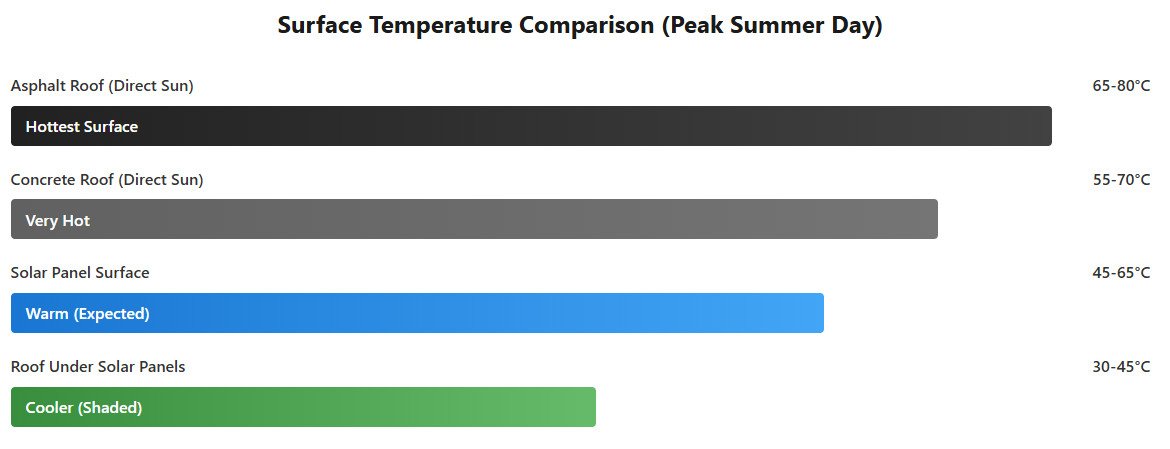
Note: Temperatures vary based on ambient conditions, wind, and mounting configuration.
Cell temperature is one of the most important parameters, affecting electrical performance. In the situation of sunny conditions, the panels can get hot to the touch, and it leads many people to question does solar panels get hot in a damaging way. In fact, warmer temperatures are anticipated and are part of the system design.
The temperature of the cells is usually greater than the temperature of the ambient air. This does not indicate a fault. It just shows how the absorbed solar energy has been redirected in the module.
What Recent Industry Research Shows (2024–2025)
Recent studies on photovoltaics published in the years 2024 and 2025 show an industry trend toward better thermal stability, innovative cell architectures, and materials that are being optimized to minimize performance losses at high temperatures.
According to various studies, enhancing efficiency reduces the heat impact of solar panels regardless of the ambient temperature. Today’s solar panels are more consistent than older generations due to lower temperature coefficients and better heat dissipation of modern designs. It is clear that large-scale deployments, using the latest modules, such as Jinko solar panels in high irradiance areas, also pay attention to their thermal stability.
Does Temperature Affect Solar Panel Performance?
What is Temperature Coefficient?
Will heat affect solar output – a common question. This relationship is characterized in technical terms as a gauge of the temperature coefficient. It states how much the power output of a panel increases when its cell temperature rises above the standard test conditions. This is why real installations often ask whether temperature can alter solar panels. Yes, it is possible, but in a controlled and predictable way, because as temperatures rise, voltage drops a little, and so efficiency slowly reduces. The manufacturers, installers, and grid planners understand this change well, and it is linear.
Temperature Coefficient by Panel Technology
How to read: Lower negative coefficient = better heat tolerance. Power loss is calculated from 25C to 65C cell temperature.
It does not necessarily mean the solar panels will stop generating electricity or be unreliable. The existence of the solar panel efficiency temperature coefficient allows for designs that will not experience unexpected performance losses in hot, cold, and mixed climates.
Why Newer Panel Technologies Handle Heat Better
Older photovoltaic technologies were more sensitive to heat because of material limitations and less advanced cell structures, so therefore, recent design innovations target enhanced charge transport and diminished electrical resistance, curtailing heat-induced losses.
The latest designs of cell architecture and packaging materials enable modern modules to perform more consistently at high temperatures. This happens because a system will work very reliably; nevertheless, people often ask how hot do solar panels get in summer. Present-day module designs reflect these advancements in technology, with well-documented cases of Trina solar panels or most of the tier-1 solar panels that guarantee the same output even at elevated temperatures.
Do Solar Panels Make Homes Hotter or Cooler?
How Solar Panels Impact Roof Temperature
Solar panels installed on roofs alter the interaction of solar energy with the building envelope. Sunshine is not hitting the roofing materials directly as much of this radiation is intercepted by the panels. It creates an effect that casts shade and protects the roof surface from the sun.
Research indicates that shaded roofs have lower peak temperatures than exposed roofs, according to building energy performance studies. Gaps between the panels and the roof provide ventilation so that warm air can escape the building. This is why studies into the impact of solar panels on roof temperature regularly mention the cooling benefits solar panels can provide, especially in warm weather, where a cool solar panel system stops heat from getting into the building.
Real-World Residential Scenario
A standard house in Porto is equipped with a dark asphalt roof that gets exposed to full sun all day. Before solar installation, the roof absorbs heat directly from the sun, causing heat buildup in the attic and increased cooling demand indoors. With Risen solar panels with HBOWA solar batteries installed, the roof experiences partial shading, while air can flow beneath the array to mitigate heat build-up.
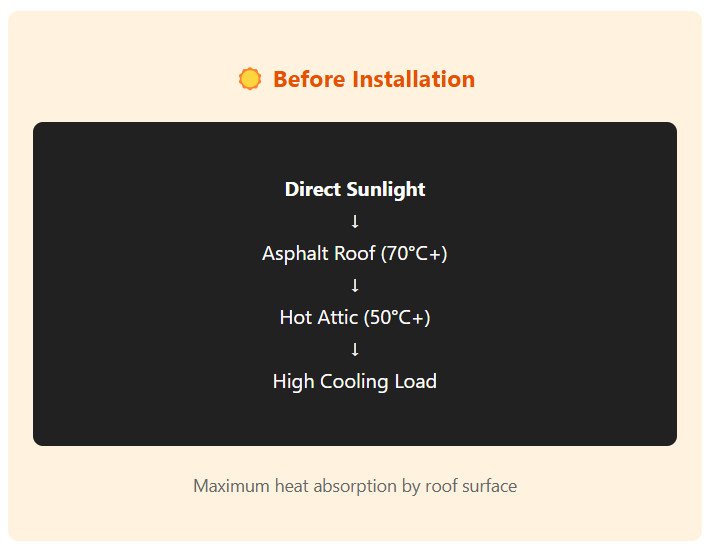

What happens is not a dramatic cooling, but a measurable reduction in roof surface temperature. The efficiency of cooling systems will be reduced, and it will not speak highly of energy saving. In this situation, worries about heat from solar panels are insignificant as the latter helps to lower the heat exposure on rooftops.
Do Solar Farms Create Heat or Change Local Climate?
What is the Phenomenon of PV Heat Island Effect (PVHI)
The question of whether solar farms create heat is usually asked about large-scale utility sites. The Photovoltaic Heat Island Effect, or PVHI, will be covered here. Localized surface warming measured near large solar farms, particularly in arid or semi-arid areas, is referred to as PVHI. Size is very important.
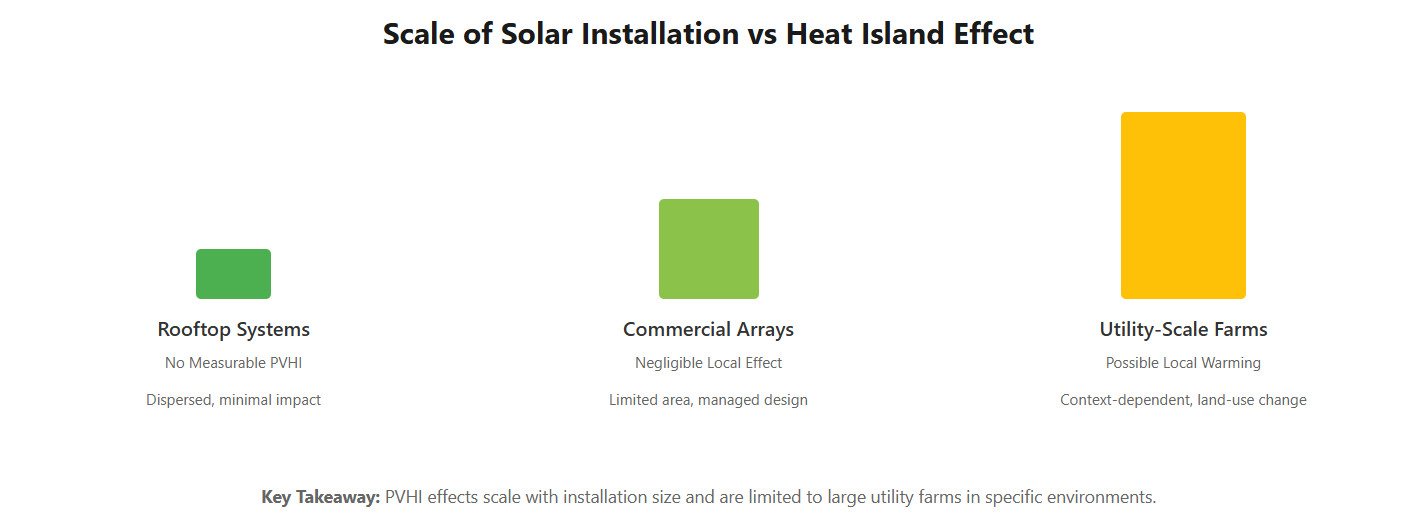
The rooftop systems are not large enough or not concentrated enough to affect anything outside the building. Utility-scale plants denaturalise the land cover with engineered surfaces. When vegetation is removed, natural cooling processes like evapotranspiration are reduced. What the panels generate is not additional heating but a change in the energy balance. Heat PV discussions in this context are regarding land-use change and not the panel’s behaviour.
Do Solar Panels Heat Up the Earth? Climate Context Explained
Local Heat vs Global Climate Impact
It is important to distinguish local thermal impacts from global climate dynamics because people often confuse short-term surface warming with long-term climate forcing when they ask, Do solar panels heat up Earth. Solar panels cannot create energy out of nowhere, so they transform solar radiation that would have otherwise impacted land or buildings.
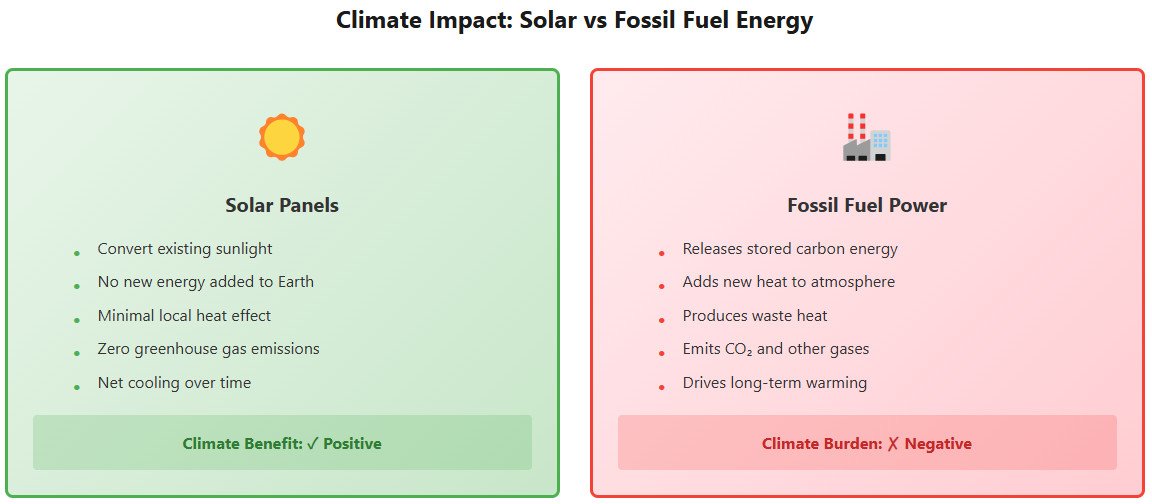
On the other hand, fossil energy systems emit the energy of their stored carbon as waste heat and accompanying greenhouse gases, producing both a thermal and radiative forcing in the atmosphere. From a climate science perspective, the localized heat produced by solar panels is not the same as the warming that accumulates through emissions. Comprehending this distinction is essential to understanding why solar remains a tool for mitigation but not a climate risk.
Global Solar Growth and Climate Role
Recent global energy assessments show that solar capacity continues to grow in the residential, commercial, and utility spaces. According to energy agencies internationally, solar energy is still one of the fastest-growing energy sources. This growth is closely linked to decarbonisation goals as solar directly displaces fossil electricity.
In simpler terms, options exist for countries to circumvent damage, leveraging existing technology that enables a timely and cost-effective transition from fossil fuel-based technologies. The impact of solar power on the climate is far more positive overall, in spite of the study and management of local heat interaction.
Comparison Table: Heat Behavior of Solar Technologies
Various solar approaches control heat differently, impacting how well they function, where they can be set up, and the climates suitable for them. The underlying table below addresses relative behaviour rather than absolute values and progressively clarifies why certain systems do better in hot surroundings. Residential modules that are widely available in the market include, among others, the monocrystalline products of Tier-1 solar panels, which are efficient and not too hot in operation.
N-type TOPCon modules offer enhanced tolerance for heat and reduced reflection tendencies. In this manner, the modules are ideal for regions where the temperature of solar panels is a concern from manufacturers like LONGi solar panels or Risen solar panels. It is common to see thin-film modules on large roofs of commercial systems because of their lower temperature. Unlike solar panels, solar thermal systems do not prohibit heat from escaping but instead trap and hold heat. Heat and solar panel discussions are about the technology type, not sunlight exposure.
| Technology Type | Heat Tolerance | Reflection Tendency | Typical Use |
| Monocrystalline PERC | Moderate | Low | Residential |
| N-type TOPCon | Higher | Very Low | Hot climates |
| Thin-film | Lower surface heat | Moderate | Large roofs |
| Solar thermal collectors | Designed for heat | Not reflective | Water and industrial heat |
How to Reduce Heat Impact from Solar Panels
Design and Installation Choices
The thermal behavior of a system is directly impacted by its design. A proper gap between the panels and the roof allows air to move freely and carry away heat. This airflow prevents hotspot development and protects from thermal stress. The orientation is also essential.
In order to avoid overheating at peak sunlight hours, panel alignment can help modulate temperature generation levels. Although heat will not be eliminated from solar panels, these design choices will prevent it from building up unnecessarily. Managing the heating of solar panels without losing output or system efficiency can be done by proper layout of the system.
System Maintenance and Management
The effectiveness of a system in operation can depend on more than in-service performance. Debris and dirt minimize efficiency and increase surface heat retention. Periodic cleaning allows the panels to operate closer to their range.
Monitoring systems let operators watch trends and identify abnormal temperature behavior before prognosis. Inverters play a supportive role by ensuring the stabilization of electrical conversion. By performing them together, the practices cool solar panels, meaning that heat is controlled as a by-product, not a limiting one.
Conclusion
Solar panels don’t mirror heat back to the atmosphere, unlike how some would think. Studies demonstrate solar panels do not reflect heat, but rather a more correct framing. They mainly absorb sunlight, convert some of it into electricity, and manage the rest as controlled heat. Factors such as technology type, the design choice of the installation, and scale can help understand how hot do solar panels get. Correctly evaluated, solar energy is an efficient and climate-friendly option, not a heat risk. For further information and knowledge related to solar systems, you can visit HBOWA’s blog sections, and if you need information related to top-tier products, you can also check our product pages.
Solar Products for Your Project
Solar Panels | Solar System | C&I Battery Storage |
 |  |  |
Frequently Asked Questions
Yes, because some of the radiation received is transformed into heat inside the panel. The heating of solar panels due to their electricity-generating capacity is a normal occurrence, and it is already factored into standards. If installed and ventilated correctly, there is no loss of performance, failure, nor is it dangerous.
Solar panels don’t actively trap heat after sunset. Similar to other building materials, they certainly give off their stored heat after sunset, but this does not have a significant impact on night temperatures, and rooftop panels usually cool down quickly when radiation stops, especially if they have ventilation gaps.
The wind effectively cools down solar panels. On the array and below it, the airflow through the panel can extract excess heat and stabilize the temperature. Panels operate more efficiently on sunny days with light wind, compared to hot, still conditions.
The question of whether solar farms create heat or damage the environment is raised due to large installations changing local land conditions. Recent studies indicate that any warming that may be occurring is limited and site-specific. Many fossil fuel generators threaten serious emissions and climate harm. Solar farms deliver clear net benefits compared to these generators.

