Introduction
The question that pops up more frequently is “do solar panels work in moonlight?“, as more people use solar energy, curiosity about its workings naturally extends to what happens after sunset. Often assumed to be a softer version of sunlight, moonlight is widely misunderstood in this way. Many people assume that it can meaningfully supply electricity to electronic devices at night. This article dispels preconceptions and instead discusses the physics of solar panels’ behaviour when the sun goes down. And why the light of the moon is not what it appears to be.

Key Takeaways
Do solar panels work in moonlight in a technical sense,—but the energy produced is far too small to be usable for homes, batteries, or electrical systems
Moonlight is reflected sunlight with extremely low intensity, which falls below the minimumoperating thresholds required for solar panels, inverters, and charging systems
Reliable nighttime solar power comes from proper system design, including/span>sufficient daytime generation and energy storage, not from solar panels producing electricity after dark.
Do Solar Panels Work in Moonlight?
Yes, do solar panels work in moonlight in a strict technical sense, but the amount they produce is useless, and solar panels are inoperative under moonlight.
How Solar Panels Actually Generate Electricity
You need to understand how solar panel works normally to generate electricity before questioning “Do solar panels work in moonlight?” They use the photovoltaic effect, in which incoming light causes electrons to become loose inside a semiconductor with more positive and negative charges. Two things matter during this process. The energy of each photon and the total number of photons that strike the panel surface.

The Sun produces a lot of photons every second, which do not happen at night. While every single photon that bounces off the moon can make electricity, the energy is very tiny. Solar panels are engineered to operate at minimum solar irradiance levels, which means that there is a certain light intensity or luminosity at which the production of electricity becomes measurable and stable.
An easy way to visualize this is rain and drizzle. Sunlight is like heavy rain, which fills a bucket quickly. Moonlight resembles a delicate light mist. Water does reach the bucket, but not enough to help. Because of the physics of solar panels, they can detect light but not create usable power. This means that moonlight fails fundamentally for other reasons, not because the panels stop working, but rather because the energy flow is far below operational levels.
Why the Difference Is So Extreme Between Moonlight vs Sunlight:
This difference is because inside the sun’s core, nuclear fusion reactions continually produce sunlight. In contrast, the moonlight has no energy of its own. The sunlight that the moon reflects gets lost in space, and before it ever reaches Earth, it is lost in the void.

Scientific measurements indicate that moonlight can deliver 0.1% to 0.3% of the brightness of light on a clear day when the moon is full. NASA’s lunar reflectance analysis and NREL solar irradiance studies have found that, while the average sunlight on Earth (daytime) can be observed as much as 1,000 watts per square meter, moonlight is measured in fractions of one watt. This gap explains why solar panels have almost zero efficiency at night.
| Factor | Sunlight (Daytime) | Moonlight (Nighttime) | Practical Impact |
|---|---|---|---|
| Light Source | Direct nuclear fusion from Sun’s core | Reflected sunlight from Moon’s surface | Moon has no self-generated energy |
| Intensity Level | ~1,000 W/m² (standard conditions) | ~0.1-0.3 W/m² (full moon) | 99.97% reduction in available energy |
| Relative Brightness | Baseline (100%) | 0.1-0.3% of daytime | 400,000× dimmer than sunlight |
| Panel Response | Full activation, optimal output | Technical detection only | Below minimum operating threshold |
| Inverter Status | Active and converting DC to AC | Shutdown (below cut-off voltage) | System enters sleep mode |
| Practical PV Output | High (300-400W per panel) | Negligible (<0.001W per panel) | Cannot power any load |
| Energy Storage | Charges batteries effectively | Cannot charge batteries | Nighttime power comes from stored daytime energy |
Can Moonlight Charge Solar Panels in Real-World Conditions?
When you hear people ask whether can solar panels charge from moonlight, it is often due to lab measurements. Very sensitive instruments can detect small electrical responses in the solar cells due to very low levels of light, including moonlight. Detecting does not entail using. In practical situations, the energy generated is considerably lower than the amount needed for any electrical load.
| Common Device / Load | Power Required | Moonlight Output (per 400W panel) | Time to Power Device |
|---|---|---|---|
| LED Light Bulb (10W) | 10 watts | <0.001 watts | ❌ Impossible (needs 10,000× more power) |
| Smartphone Charging (5W) | 5 watts | <0.001 watts | ❌ Impossible (needs 5,000× more power) |
| Laptop (45W) | 45 watts | <0.001 watts | ❌ Impossible (needs 45,000× more power) |
| Refrigerator (150W avg) | 150 watts | <0.001 watts | ❌ Impossible (needs 150,000× more power) |
| Air Conditioner (1000W) | 1,000 watts | <0.001 watts | ❌ Impossible (needs 1,000,000× more power) |
| Inverter Minimum Threshold | 20–50 watts | <0.001 watts | ❌ Below activation level — system stays off |
New solar systems have inverters with a designated inverter cut-off voltage. Should the incoming power fall below the specified level, the inverter will remain inactive to prevent inefficiency and instability. Consequently, even in bright moonlight, a panel surface does not convert it into electricity due to the system’s design. Also, most installations are made to enter a low-power or sleep state at night.
The question of whether solar panels charge at night finds a common answer across residential, commercial, and industrial systems from a practical perspective. Though it is possible that the moonlight interacts with the surface of the panel, this does not cause any charging or meaningful energy production under real operating conditions.
How Solar Homes Really Get Power at Night
When we look at complete systems and not just solar panels, understanding do solar panels work in moonlight is better. Solar homes aren’t energized at night because of the incoming light. They are powered by energy collected during the day. This difference is essential and often missed.

In solar battery storage systems, electricity is generated in the day, stored, and later discharged at night, and in a grid-connected setup, extra electricity generated during the day is exported to the grid because of an advanced net metering system, and power is drawn back when the sun is not available. The panels aren’t working, but the system is still operational. Although the panels are inactive, the system is working.
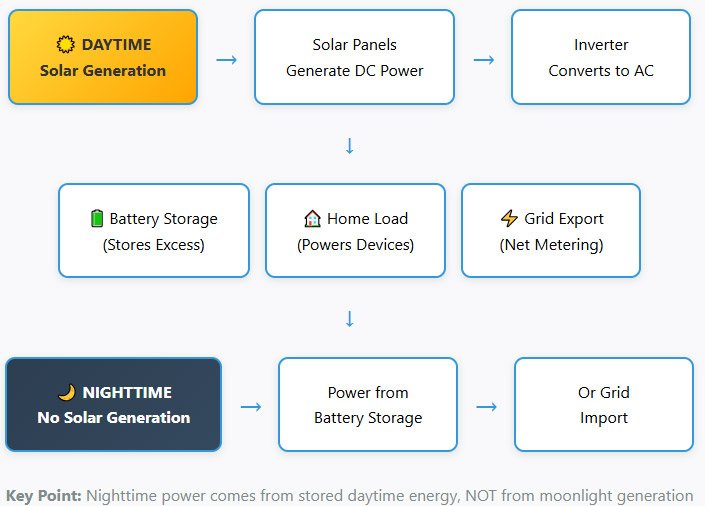
In off-grid solar systems, batteries are essential since no external grid is available. Combining both of these systems, hybrid systems offer storage and grid access. In an actual case study, it is assumed that the panels generate excess energy in the late morning and afternoon of the day, and this is stored in the battery, which provides great stability at night by providing solar energy at night regardless of the brightness of the moon.
Do Some Panels Perform Better in Low-Light Conditions?
Queries on do solar panels work in moonlight usually arise with talks about low-light solar panels, but low light and nighttime are different from each other. Low-light performance refers to the efficiency with which the panel works early morning, late afternoon, or in overcast conditions, when sunlight is present but not strong. These conditions happen in the morning or the evening, not at night.
| Panel Technology | Low-Light Performance | Best For | Moonlight Capability |
|---|---|---|---|
| N-Type (TOPCon / HJT) | Excellent in dawn/dusk | Cloudy climates, extended daylight hours | ❌ No meaningful output |
| PERC (Standard) | Good in moderate light | Standard installations, cost-effective | ❌ No meaningful output |
| Monocrystalline | Better than polycrystalline | Space-limited installations | ❌ No meaningful output |
| Polycrystalline | Moderate performance | Budget-friendly projects | ❌ No meaningful output |
| Bifacial Panels | Captures reflected light | Elevated / white roof installations | ❌ No meaningful output |
Various technologies have different behaviours under decreased irradiance. Solar panel companies providing newer technology with N-type cells typically experience less electrical loss and perform better in less intense light conditions than PERC solar panels. This happens because they utilise the light that the cells are unable to absorb by reflecting it back into the solar cell to create energy, and companies such as Longi, Jinko, and Canadian Solar panels are leading in that technology. Tier-1 manufacturers making these design changes, panels can start producing electricity a little earlier in the morning and go slightly longer in the evening, and that’s another reason that technology is a little expensive than the normal and older technology. Nevertheless, they are not going to change nighttime operation physics.

Many people misunderstand what is meant by “low-light performance”. It doesn’t mean to work in the dark. Lighting conditions at moonlight levels are well below the weakest daytime conditions. But there is no solar panel technology developed that can operate and generate power from moonlight yet.
Myths of Solar Panels and Moonlight
The belief that solar panels work in moonlight is one of several solar panel myths. This myth is not true. Moonlight has a significant power that can run solar panels at night. Although the panels can indeed detect light, the amount of energy produced is scientifically insignificant and cannot drive real electrical loads.

Yet another misconception is that artificial light from streetlights, floodlights, and so on can take the place of sunlight. Artificial lights emit low irradiance of solar light. They are designed for human vision and not for energy purposes. Charging panels with them would equate to losing energy rather than gaining it.


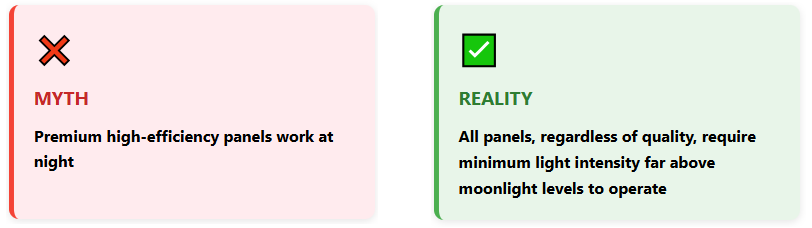
Another myth is that premium, high-efficiency panels will work if the light is low. Ultimate physical limitations cannot be overcome by advanced inventions. Solar panels don’t work in darkness; that’s a clear no. Daytime energy efficiency is determined by panel quality. Clearing these myths can help in managing expectations according to solar system performance.
Why Moonlight Solar Questions Matter More in Some Regions
The question of whether solar panels work in moonlight reflects varying worthiness depending on geography and infrastructure. In winter, long nights and short days occur in high latitudes, which increases fears about power after dark. A better understanding of the limits to nighttime generation in these areas can help prevent unrealistic expectations and poor system planning.
| Region Type | Challenges | Solution Focus | Moonlight Relevance |
|---|---|---|---|
| High Latitudes (60°+) | Long winter nights (20+ hours), short summer days | Oversized battery storage, winter load management | ❌ Zero — storage sizing is critical |
| Equatorial Regions | Consistent 12-hour day/night cycle year-round | Standard storage, predictable generation | ❌ Zero — reliable daily patterns |
| Developing Markets | Unreliable grid, replacing diesel generators | Adequate battery capacity, realistic expectations | ❌ Zero — proper system sizing prevents issues |
| Off-Grid Locations | No grid backup available | Larger battery banks, backup generator option | ❌ Zero — comprehensive storage essential |
| Urban Areas | Limited roof space, high nighttime loads | Grid-tied with net metering, efficient panels | ❌ Zero — grid connection provides nighttime power |
People in many markets, such as India, Pakistan, Laos, the African region, or any developing zones, adopt solar systems as replacements for unreliable grids and traditional fuel generators. The moonlight misunderstanding can cause undersized storage or overconfidence in panel output. A realistic perspective on global solar energy utilization reveals that success is predicated on matching daytime power generation with energy storage and demand, and not on wishful thinking about nighttime generation. Geography is not fundamental to physics, but can make the precise design of systems critical.
What To Expect and What Not:
The most essential takeaway is knowing what not to expect. No solar panel, no matter where on earth or what technology, generates power at night. System balance must be prioritised in planning. An effective design for solar systems must generate enough energy during daylight hours. It should also have enough storage capacity and be a realistic load.
After the sun goes down, storage is more important than panel quality. Through a combination of Tier-1 modules such as Jinko solar panels, Longi solar panels, Astronergy solar panels, Trina solar panels, Canadian solar panels, and appropriately sized LiFePO4 batteries from a trusted brand such as HBOWA, a reliable generation can be provided without assuming unreasonable night generation. Suppliers like HBOWA, wholesalers, and distributors stress futility, durability, compatibility with storage systems, rather than performing best in moonlight, while choosing solar panels. Clear expectations will ensure better results on residential, commercial, and industrial projects.
Conclusion
The solar panels will not work under moonlight of any type, size, or location. Solar design is for daytime generation, and electricity during the night comes from storage or the grid. Energy is captured by solar panels when the sun is shining, and what happens to that energy is determined by system design. Physics sets a limit on anything light can generate. Good engineering, appropriate sizing, and suitable planning will address nighttime energy needs, not moonlight performance expectations.
Solar Products for Your Project
Solar Panels | Solar System | C&I Battery Storage |
 |  |  |
Frequently Asked Questions
High-efficiency panels improve daytime performance, not nighttime generation, because their ratings explain how well panels convert sunlight into electricity under standard test conditions, not in darkness(night).
Moonlight or light LEDs and bulbs appear bright to the human eye, especially during a full moon, which leads to intuitive but incorrect assumptions.
Artificial lights cannot power solar panels, so streetlights, LEDs, and indoor lighting emit far less energy than sunlight, and, other than that, using artificial light would consume more electricity than the panel could generate.
Many researchers are conducting experimental methods, including radiative cooling, but these technologies produce extremely small amounts of power at very high cost, so the technology is limited to the Sun for the time being.