Introduction
2025 marks the year when Tier 1 PV Panels appear in almost every solar purchase discussion. Most clients think it means the module has the best performance. Others believe it is’ only an advertising slogan. The truth is often misinterpreted. It pertains to financial stability and significant market scale presence instead of efficiency or technology only. This post depicts what tier one solar panels actually mean, why the term is important, and how to use it for a wise purchase. HBOWA supplies Tier 1 solar modules as well as other advanced solar solutions, which are perfect for domestic, commercial, and business projects across the world.
What Are Tier 1 PV Panels? The Real Definition
The name Tier 1 PV Panels was given by Bloomberg New Energy Finance to grade certain PV module producers, not products. The aim of this name is to show which companies have a proven record of delivering projects on a large scale. Under the Tier 1 standards or criteria, a PV module producer needs to have their own-brand panels used in multiple projects that were financed with non-recourse debt from a commercial bank. And, finally, the projects were in the last two years, which include large-scale and meaningful production volumes.
It is to see the money-making dependability of the producers, not the product’s quality directly. Having tier 1 solar panels does not mirror the best efficiency or lowest degradation rate or are the one of the maximum warranty. But numerous high-end panels from regional or small manufacturers are not listed as they do not meet the requirements of financing and project scale. So by this, it can be drawn that having a Tier 1 status, the credibility, in general, is balanced and has been consistent via the industry, but the product should be verified for real quality by observing performance data, certifications, warranty, et cetra.

Tier 1 vs. Tier 2 vs. Tier 3 Panels: A Practical Comparison
The Tier 1 solar modules are the biggest manufacturing companies in this sector that possess the reputation of doing huge projects and a large suppling capacity. On the other hand, there are also Tier 2 and Tier 3 panel producers available in the market.
A Tier 2 panel manufacturer is generally a smaller solar panel provider that may not be involved in in-house manufacturing. Such companies may not quite have the track record to achieve the Bloomberg title of Tier-1. These companies may possess moderate financial stability. These solar panel suppliers may produce one or many dependable panels. Yet, they may not have any broad project they have ever worked on. Tier 3 panel manufacturers are the new entrants and/or solar panel providing companies that are quite small-scale and may not have an extensive global presence. They often lack an independent financial history. Therefore, they always fall into the riskier part of the industry.
| Criteria | Tier 1 | Tier 2 | Tier 3 |
| Financial stability | High | Moderate | Low |
| Warranty strength | 20–30 years | 10–20 years | 10 years or less |
| Manufacturing automation | Fully automated | Partial | Minimal |
| Global project presence | Extensive | Limited | Very limited |
| Typical use cases | Utility & large-scale | Commercial & residential | Small projects & local use |
A solar farm gets utilised with tier one solar panels, as securing the financing becomes easiest here, and all the required testing has already been performed, while there is no new technology applied. This creates a long-term bankable project, and the utility-scale solar farm mostly opts for tier 1 solar panels, or they are often high-quality tier 2 solar panels. On the other hand, a homeowner may be staying in a completely shaded area, and the tier 1 panels will still be required. When a customer/utility desires long-term benefits and quality, then tier 1 panels are required.
Updated Tier 1 Solar Panels List 2025
The tier 1 solar panels list 2025 gives the newest Bloomberg classification with the list of manufacturers who have met strict bankability and project financing requirements. The panel list of the current year includes well-known companies which has consistent worldwide production and verified large-scale installation. For instance, here are a few of the tier 1 companies’ solar panels provided by HBOWA in 2025:
-The Longi, Jinko, Trina, JA Solar
-Canadian Solar, Risen, Tongwei, GCL
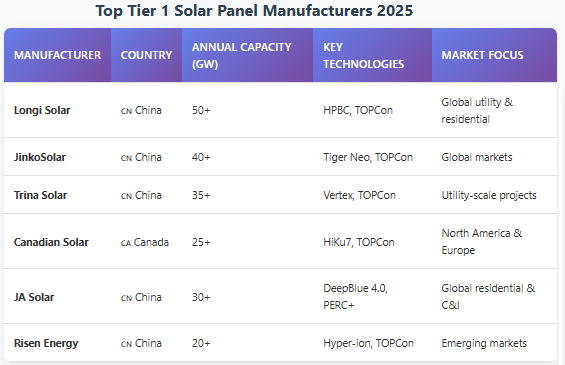
This tier 1 list can evolve annually since manufacturers can constantly change places because of numerous mergers, acquisitions, or market exits from bankruptcy. HBOWA guarantees quality from a bankable manufacturer who has the best technology. According to the HBOWA 2025 tier 1 solar panels’ list, what ties each and every panel together is the modern, high-efficiency cell technology using N-type TOPCon and PERC.

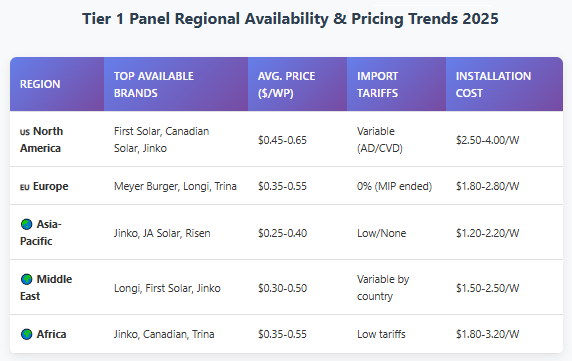
Everyone from around the world recognizes a tier 1 panel; however, some areas get more modules than others, so people get the tier 2 and 3 models just because they’re close.
Beyond the List: How to Choose Quality Panels
When it comes to choosing a solar investment, being placed on the tier 1 list is not all that matters. Buyers of tier 1 pv panels must check the performance specifications, degradation rates, and warranty benefits. Module efficiency varies by technology. PERC and N-Type TOPCon modules, like HBOWA’s, generally have higher conversion efficiency, which implies more energy output from the same module area.
The average degradation rate in the industry is around 0.8% per year of efficiency loss. By switching to using a panel with, say, a 0.3% annual degradation rate, which retains roughly 93% efficiency. This improves the lifetime returns significantly over 25 years.

One should also go through the warranty terms: Product and performance warranties. Product warranties enable one to claim for associated defects in the materials or manufacturing process. A performance warranty will guarantee the buyer a certain energy output for a certain period. A longer and stronger warranty is an indication of the manufacturer’s confidence.
Tier 1 Solar Panel Selection Process:
Our experts suggest that our clients follow this process for the best results

For instance, in Southeast Asia, a commercial business chose HBOWA N-Type TOPCon tier 1 solar module for a 500kW rooftop system because precipitated by its low 0.25% degradation rate, plus a product warranty of 25 years and high humidity performance, thus ensuring predictable returns and reduced risk of replacement.
Certifications That Matter (IEC, UL & More)
If your solar panel is made by a tier 1 pv module manufacturer, then by using independent certifications, you can be assured of the fact that your solar panel is meeting all the global safety and performance standards. The International Electrotechnical Commission, or IEC, tests panels for their output consistency, durability, environmental stress resistance, etc. And the Underwriters Laboratories or UL (for short) certification ensures the fact that the solar panel abides by the electrical safety and the codes that are applicable.

IEC has more certifications that address different conditions. Like, IEC 61701 is for salt mist corrosion resistance, which is a must for coastal installations in regions like the Asia-Pacific. IEC 61215 is for their prolonged exposure to heat or climatic requirements, which is needed in regions like the Middle East. These certifications are often highlighted in technical datasheets REC, for example, includes these certifications in their technical datasheet for the REC PV module or REC 405.
For Europe’s mixed-weather environments, panels with both heat resistance and corrosion protection are required for better results in terms of longevity and performance.
Real-World Performance: Why Tier 1 Status Still Matters for Investors
The status of a solar panel as Tier 1 may not be just a mere term for marketing activities. While the financiers frequently see the Tier 1 classification of solar panels as an essential criterion for financing with many banks and institutional financiers. For the solar panel supplier’s help in making large-scale projects, financiers and international banks accept projects financed by them, and their reputation can be a huge driving force.
A recent example of this situation is a very large industrial solar project in Africa that ended up using Tier 1 modules supplied by HBOWA in a solar plant of 20MW. It largely depends on the long-term maintenance contract being provided with the panels. Also, with the manufacturers having a good and trusted reputation, the possibility of regular technical support for the customer is often high.
The solar panel is classified as Tier 1, which can often be a good sign for residential buyers. But not the only deciding factor for any investment. Other factors such as panel efficiency, degradation rate, warranty, and life of the panel often can have a more significant impact on day-to-day performance and lifetime savings.
Tier 1 PV Panels in Different Applications
Tier 1 PV panels are used in residential applications, commercial applications, or in the industrial category, and all three have different priorities.
- For houses, people tend to look into the efficiency, the size, and how it looks, so that it matches with the roof space and their energy needs.
- In the commercial category, people look into the return on investment, the durability, as well as the bankability advantage of a solar panel, which is achieved if it is a Tier 1 solar panel.
- In the industrial category or off-grid systems, one must stress performance stability. Linking Tier 1 panelstogether with the LiFePO4 batteries of reputable brands, for example HBOWA, and inverters of Deye or Growatt ensures the storage and the conversion are reliable, and it reduces downtime and renders energy security.

The panel choice is also influenced by the location. In areas with sunlight, they install the modules with maximum efficiency to yield maximum energy. In the coastal areas, they install the panels with resistance to the salt mist. In areas with snow, they install the modules, which are tested for snow load as well as low-light performance.
By matching the Tier 1 panels to the environment, the operator increases the system’s lifespan and maintains a consistent output.
Conclusion
Smart buyers consider Tier status along with efficiency, warranty terms, and relevant certifications. Tier 1 pv panels are still valuable for securing financing for businesses, suppliers, and developers. HBOWA provides Tier 1 PV panels, advanced solar technology, and LiFePO4 storage to support residential, commercial, and industrial projects worldwide. Also, their globally recognized performance ensures both performance and longevity.
Frequently Asked Questions
No! Tier 1 status doesn’t determine pricing. Market competition, supply chains, and economies of scale often make Tier 1 panels competitively priced.
Not necessarily, Tier 1 indicates financial stability and bankability. Quality depends on materials, R&D investment, and manufacturing processes.
Yes, but choose models with appropriate certifications (lEc 61701 for coastal, lEc 61215 for hot climates, etc.)
Bloomberg NEF updates quarterly. Companies can gain/lose status based on recent project financing and market performance.