
Formula: W = V × A
The V to W calculator converts AC voltage and current into power output in Watts for that reason, Engineers, technicians, and electricians use the Best Digital Multimeter to quickly troubleshoot any electrical system, battery, appliance, or solar component. The instant power in watts (W) can be calculated by entering voltage in volts (V) and current in amperes (A), and for this reason, this tool helps engineers, technicians, students system designers to size verify or troubleshoot the electrical load without getting into lengthy theory.
Formula & Variable Definitions
Formula:
Power(W) = Voltage(V) x Current(A)
We can say that watts characterize electric power, and thus it is the rate of using or delivering electrical energy, and voltage refers to the electrical potential of the system or electrical energy source, whereas current refers to the flow of electrons in the circuit.
Watts (W) are considered an instantaneous and constant operating value, and the voltage (V) is taken, e.g., 12 V or 24 V, in a DC system, whereas the current (A) sets how much charge must flow to meet the power being drawn at a given voltage.
Assuming the DC System and negligible efficiency losses of this formulation, it’s a measure of strength at some moment rather than a measure of energy. Results should be treated as approximate rather than exact when the voltage or current varies significantly.
Example Calculation
A DC-powered ventilation system for an off-grid technical shelter with an HBOWA LiFePO4 battery bank and a Growatt off-grid inverter. In nominal DC voltage of 27.6 V, which is common to a 24V lithium battery system, during normal operation of the system. The recorded current consumption is 8.4A.
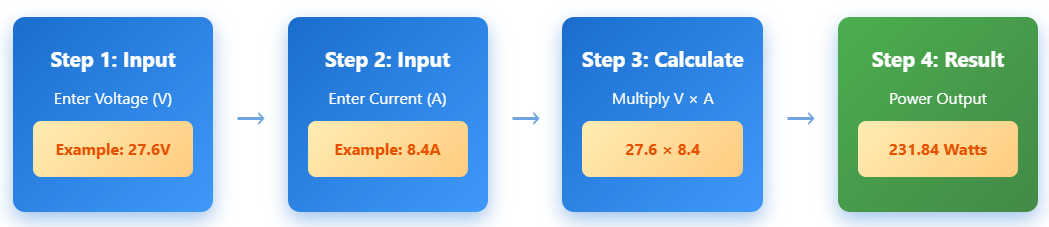
The ventilation system consumes an estimated 232 watts. This verified value assists in Growatt inverter sizing, estimation of HBOWA battery discharge rates, and selection of DC wiring and protection devices.
When to Use This Calculator
The V to W calculator helps plan or check electrical systems, and it is traditionally used for verifying load power before runtime or capacity estimation during battery system design. In solar installation, voltage and current readings help define power for a particular panel, charge controller, or DC load. Technicians employ it to evaluate the consumption of appliances, and it may also come in handy when diagnosing any issues. Giving a quick reference, the current measured would align with the powering behaviour at that voltage.
Reference Table: Typical V to W Operating Values
| VOLTAGE (V) | CURRENT (A) | POWER (W) |
|---|---|---|
| 9.6 V | 1.85 A | 17.76 W |
| 12.4 V | 3.15 A | 39.06 W |
| 14.8 V | 4.10 A | 60.68 W |
| 18.9 V | 4.60 A | 86.94 W |
| 24.8 V | 6.20 A | 153.76 W |
| 27.6 V | 8.40 A | 231.84 W |
| 36.5 V | 7.90 A | 288.35 W |
| 48.2 V | 10.40 A | 501.28 W |
| 51.2 V | 6.90 A | 353.28 W |
| 60.0 V | 6.15 A | 369.00 W |
| 72.0 V | 5.70 A | 410.40 W |
| 96.4 V | 4.25 A | 409.70 W |
| 7.2 V | 1.20 A | 8.64 W |
| 15.0 V | 2.50 A | 37.50 W |
| 16.8 V | 3.80 A | 63.84 W |
| 21.6 V | 5.00 A | 108.00 W |
| 30.0 V | 7.50 A | 225.00 W |
| 42.0 V | 8.80 A | 369.60 W |
| 57.6 V | 6.50 A | 374.40 W |
| 120.0 V | 3.40 A | 408.00 W |
The values reflect standard operating conditions found in battery-powered and DC-fed electrical systems. The voltage levels are representative of practical battery strings, regulated DC buses, and inverter input ranges. The current levels refer to sustained operating loads rather than short-duration peaks.
The expanded table shows how one can realise similar power levels with different voltage and current combinations at the source, which implies more current drawn for the bus system as the system voltage rises. This reference we’re giving you is for your reference only. To size, validate, or troubleshoot accurately, by entering measured values directly into the calculator, because the simulator will not always give the correct answer due to regulation, temperature, wiring losses, and load behaviour.
Solar Products for Your Project
 Solar Panels | 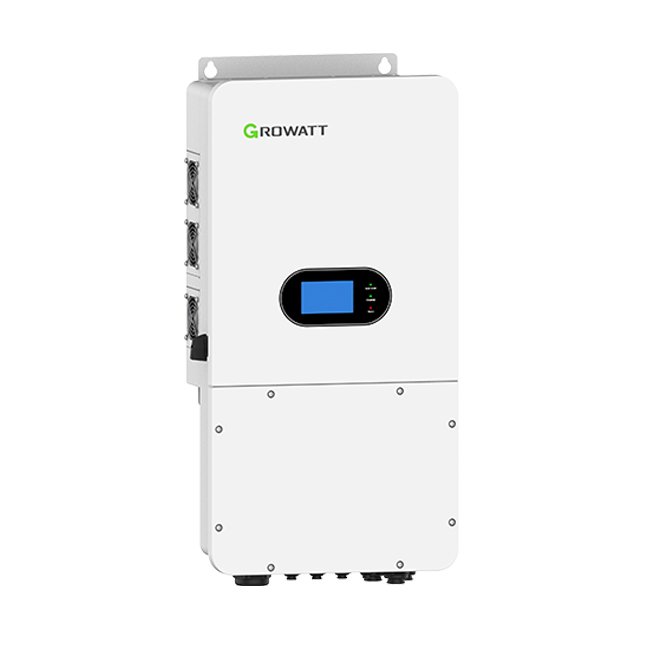 Solar Inverter |  C&I Battery Storage |
Accuracy & Limitations
The calculator presumes a constant voltage and current to operate. In practical systems, the voltage might drop when a load is connected, while the current and the load ultimately reach an equilibrium with the demand. Wiring, converter, and internal resistance efficiency losses are not included. The calculator does not consider the power factor, harmonics, or phase difference for AC systems. Temperature and other environmental conditions can affect measurements, and the results should be used as a planning and validation tool, but should never be used instead of a full electrical analysis where there is doubt.
Case Study
A field technician has to validate a small DC inverter delivering power to a portable communication device used for remote monitoring jobs. The Growatt SPF 5000 ES off-grid inverter and HBOWA 51.2V 100Ah LiFePO₄ battery to power the system. A 16-cell configuration of a LiFePO₄ battery may typically show 51.2 V.
During controlled tests, with the comms equipment at full duty, the DC input current of the inverter settles at 6.9 A. In order to achieve real input power calculations, these measured values are used, which show that the electrical power is 353.28 watts.
Power = 51.2 × 6.9 = 353.28 W
The actual demand on the HBOWA battery and the DC cabling is represented by this. The technician compares this number to the Growatt SPF 5000 ES inverter’s continuous operational capacity, which confirms that all is safe.
A 51.2 V, 100 Ah (≈5.12 kWh) HBOWA battery is estimated to run for roughly 14.5 hours under steady load before accounting for any system losses.
Conclusion
Using the v to w conversion calculator, you can find out the power from the voltage and current values quickly. The application covers battery, solar, and electrical applications while supporting their planning, verification. Users can ensure proper sizing, capacity, and safety by understanding how watts relate to the real operating conditions. This calculator simplifies a key electrical relationship without complexity.
Frequently Asked Questions
It describes how much electrical power a system delivers or consumes at a given operating point.
It can be used for basic AC estimates when voltage and current are known, but the result represents apparent power, and for exact results, the power factor has to be considered independently.
Power depends on both voltage and current because if current changes due to load variation, power will change even if voltage remains constant.