Three phase: kVA = (√3 × V × A) ÷ 1000
Introduction
Amps to kVA conversion is critical to consider to make accurate calculations. If you don’t know which one to use concerning electrical connections, it might lead to many problems both in circuit designs and equipment selections, or even excess power consumption. Engineers, electricians, and facility managers need to convert amps to kVA to distribute energy across systems correctly. Machines and equipment, energy, and backup generators distribute power based on the amount of power consumed and the actual power in kW consumed. To make things a little simpler, use this amps to kVA calculator between current and apparent power in both single and three phases to get accurate results.
What Are The Formulas for Converting Amps to kVA
The amp to kVA formula depends on the type of electrical system. The single phase and three phase circuits need different computations due to disparity in voltage and phase relationships. Using the right formula allows accurate power conversions for electrical equipment sizing.
In a single phase system, the amps converted into KVA formula is as follows:

For example, a household appliance running on 220V and drawing 10A requires:
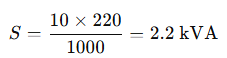
This calculation is very important for determining the actual need for power for the residential electrical loads.
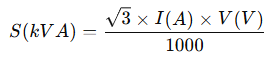
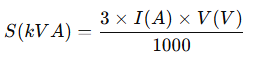
For a three-phase system, the formula differs depending on the type of the voltage:
- Line-to-line voltage:
- Line-to-neutral voltage:
If an industrial motor works at 50A and 400V (line-to-line), the apparent power is:

In real-world applications, amps to kVA three-phase calculations are used and very helpful for large-scale electrical loads.
The power factor (PF) affects the conversion. Different types of loads—resistive (heaters), inductive (motors), and capacitive (power correction systems)—affect PF values.
In commercial lighting, a power factor of 0.9 means a 100A system at 230V requires a kVA adjustment:

Understanding the conversion of amps to kVA with PF ensures that electrical systems operate efficiently without overloading circuits.
What is Amps to kVA Conversion Table?
An amp-to-kVA conversion table makes for a convenient reference for the most widely used electrical values. These are helpful for engineers and electricians who are estimating their power requirements without going through endless tedious calculations. Similarly, this table also contains the conversion values for different voltage levels and power factors, which are essential in kVA to amperage conversion for both single-phase and three-phase systems.
Amps to kva Conversion Examples & Cases
For single-phase system, the voltage is 240V, to convert 100 amps to kVA:
Kva=100×240/1000 = 24 kVA
For single phase system, the voltage is 240V, to convert 200 amps to kVA:
Kva = 200×240/1000 = 48 kVA
For three phase system, the voltage is 480V, to convert 100 amps to kVA:
Kva = 100x480x√3 /1000= 83.14kVA
For three phase system, the voltage is 480V, to convert 200 amps to kVA:
Kva = 200x480x√3 /1000 = 166.27kVA
Amps to kVA Conversion Table: Single Phase 230V and 240V
| Current (A) | 230V kVA | 230V kW (PF=0.8) | 240V kVA | 240V kW (PF=0.8) | Typical Use |
|---|---|---|---|---|---|
| 5A | 1.15 kVA | 0.92 kW | 1.20 kVA | 0.96 kW | Small appliance or lighting load |
| 10A | 2.30 kVA | 1.84 kW | 2.40 kVA | 1.92 kW | Small AC load or single device |
| 15A | 3.45 kVA | 2.76 kW | 3.60 kVA | 2.88 kW | Small equipment circuit |
| 20A | 4.60 kVA | 3.68 kW | 4.80 kVA | 3.84 kW | Workshop tools or small inverter load |
| 25A | 5.75 kVA | 4.60 kW | 6.00 kVA | 4.80 kW | Small commercial circuit |
| 30A | 6.90 kVA | 5.52 kW | 7.20 kVA | 5.76 kW | Small backup power or inverter sizing |
| 40A | 9.20 kVA | 7.36 kW | 9.60 kVA | 7.68 kW | Retail shop or small office load |
| 50A | 11.50 kVA | 9.20 kW | 12.00 kVA | 9.60 kW | Small commercial power system |
| 60A | 13.80 kVA | 11.04 kW | 14.40 kVA | 11.52 kW | Commercial backup load |
| 80A | 18.40 kVA | 14.72 kW | 19.20 kVA | 15.36 kW | Small business electrical panel |
| 100A | 23.00 kVA | 18.40 kW | 24.00 kVA | 19.20 kW | Commercial building or larger backup load |
| 125A | 28.75 kVA | 23.00 kW | 30.00 kVA | 24.00 kW | Small facility power calculation |
| 150A | 34.50 kVA | 27.60 kW | 36.00 kVA | 28.80 kW | Medium commercial load |
| 200A | 46.00 kVA | 36.80 kW | 48.00 kVA | 38.40 kW | Commercial electrical service |
| 250A | 57.50 kVA | 46.00 kW | 60.00 kVA | 48.00 kW | Large single-phase load estimate |
Amps to kVA Conversion Table: Three Phase 400V and 480V
| Current (A) | 400V kVA | 400V kW (PF=0.85) | 480V kVA | 480V kW (PF=0.85) | Typical Use |
|---|---|---|---|---|---|
| 5A | 3.46 kVA | 2.94 kW | 4.16 kVA | 3.53 kW | Small three-phase equipment |
| 10A | 6.93 kVA | 5.89 kW | 8.31 kVA | 7.07 kW | Small motor or pump |
| 15A | 10.39 kVA | 8.83 kW | 12.47 kVA | 10.60 kW | Commercial equipment circuit |
| 20A | 13.86 kVA | 11.78 kW | 16.63 kVA | 14.13 kW | Pump, HVAC, or small machinery |
| 25A | 17.32 kVA | 14.72 kW | 20.78 kVA | 17.67 kW | Workshop machinery |
| 30A | 20.78 kVA | 17.67 kW | 24.94 kVA | 21.20 kW | Small factory load |
| 40A | 27.71 kVA | 23.56 kW | 33.26 kVA | 28.27 kW | Commercial HVAC or production load |
| 50A | 34.64 kVA | 29.44 kW | 41.57 kVA | 35.33 kW | Manufacturing equipment |
| 60A | 41.57 kVA | 35.33 kW | 49.88 kVA | 42.40 kW | Industrial pump or compressor |
| 80A | 55.43 kVA | 47.11 kW | 66.51 kVA | 56.53 kW | Medium commercial power system |
| 100A | 69.28 kVA | 58.89 kW | 83.14 kVA | 70.67 kW | Factory, warehouse, or larger C&I load |
| 125A | 86.60 kVA | 73.61 kW | 103.92 kVA | 88.33 kW | Commercial electrical distribution |
| 150A | 103.92 kVA | 88.33 kW | 124.71 kVA | 106.00 kW | Large machinery or industrial load |
| 200A | 138.56 kVA | 117.78 kW | 166.28 kVA | 141.34 kW | Large C&I power system |
| 250A | 173.21 kVA | 147.22 kW | 207.85 kVA | 176.67 kW | Industrial distribution or backup power sizing |
| 400A | 277.13 kVA | 235.56 kW | 332.55 kVA | 282.67 kW | Large industrial facility |
| 500A | 346.41 kVA | 294.45 kW | 415.69 kVA | 353.34 kW | Heavy industrial or large backup system |
These values are essential when selecting electrical equipment such as transformers, generators, and industrial machinery. Since kVA to amperage conversion varies with power factor and voltage type, using an accurate reference table helps to increase the efficiency in power distribution planning.
Common Amps to kVA Calculation Examples
| Example | System Type | Calculation | Result | What It Means |
|---|---|---|---|---|
| 20A at 230V | Single Phase | 230 × 20 ÷ 1,000 | 4.60 kVA | Small single-phase commercial load estimate |
| 50A at 240V | Single Phase | 240 × 50 ÷ 1,000 | 12.00 kVA | Useful for small backup power or inverter sizing |
| 100A at 230V | Single Phase | 230 × 100 ÷ 1,000 | 23.00 kVA | Commercial panel or load estimation |
| 30A at 400V | Three Phase | √3 × 400 × 30 ÷ 1,000 | 20.78 kVA | Small three-phase machinery or workshop load |
| 50A at 400V | Three Phase | √3 × 400 × 50 ÷ 1,000 | 34.64 kVA | Motors, pumps, compressors, and small factory loads |
| 100A at 400V | Three Phase | √3 × 400 × 100 ÷ 1,000 | 69.28 kVA | Commercial and industrial electrical system planning |
| 100A at 480V | Three Phase | √3 × 480 × 100 ÷ 1,000 | 83.14 kVA | Industrial systems using 480V three-phase power |
| 250A at 480V | Three Phase | √3 × 480 × 250 ÷ 1,000 | 207.85 kVA | Larger industrial loads or backup power sizing |
Amps to kVA Conversion Calculator: How It Works
Amps to kVA calculator can convert electrical current into apparent power. There are high chances of human error and incorrect results when we carry out the calculations manually. The calculator needs input values of Amps, Voltage, and your Power factor (PF) to give you an answer. The calculator reverts to your answer immediately. If you have a single-phase system, use a different formula, whereas if you are looking at a three-phase system, use a different formula. This is important to ensure you have rated the power correctly to get the most out of the system. So for that by streamlining amps to kVA conversion, these calculators enhance both speed and accuracy.
Understanding Amps and kVA: What is an ampere (A) And Kilovolt-Ampere (kVA)?
The electrical current’s flow in a circuit is measured in ampere (A). The principle behind ampere measurement is the rate of the electric charge carried through a certain circuit. A higher amperage signifies a higher electric current through an electrical system. This leads to a significant difference in the efficiency and safety of electrical systems. For example, in households, different appliances like refrigerators, air conditioners, and microwaves, use a different amount of current based on their power consumption.
The microwave can utilize approximately 10 amps. The central air conditioning unit, on the other hand, might require drawing more than 30 amps. Thus, the ability to convert from amperes to kVA is vital when considering wiring, circuit breakers, and transformers required for different applications.
Kilovolt-ampere (kVA) measurement is used to measure the apparent power or the total power that includes active and reactive power in an electrical system. In contrast to watts (W) that measure the real power consumption, kVA amperes value consider the total power provided and the power lost due to inefficiency. The difference becomes profound in industrial applications.
For instance, a factory running machinery or any device has a total power demand of 100 kVA. However, the real power demand is equal to 80 kilowatts (kW) due to a power factor of 0.8. The distinction is critical when deciding the right dimensions for electrical tools and devices to use. Furthermore, overuse of kVA and amperes rating can lead to overheating and inefficiency. So understanding what is kilovolt amps and how they interact with amperage ensures accurate power distribution planning and equipment selection.
Why Convert Amperes to KVA and What Benefits it Serves?
Conversion from Amps to kVA is important in electrical design to ensure circuits, transformers, and generators are sized properly for their loads. Different electrical systems run on different levels of current.
The current level ranges from milliamps to thousands of amps. For example, when using a multimeter, the current confined in the wire can be from 0 to 2 milliamps. Similarly, the current level used in an electrical stove can range up to approximately 30,000 amps. The power conversion between Amps and kVA gives elevations to the uniformity of power measurements.
Amps to kVA is important in large-scale distribution of electricity. In a large scale, the even and safe distribution of power needs accurate power calculations, and it also is important in ensuring energy efficiency. The most significant requirement in converting Amps in kVA is the power factor between the load and the supply. The power factor is the ratio between real power (known as kW) and apparent power (designated as kVA).
The primary reason for converting amps to kVA is due to the power factor. Which is the ratio between real power (kW) and apparent power (kVA). Most commercial and industrial machine operates with a power factor (PF) < 1 and fails to produce ideal power. One crucial factor of working with electric-powered motors is their power factor. The power factor can be <1 due to inductive loads like motors and transformers.
If the power factor is low, then the apparent power demand is high, which means more kVA is required to supply the same real power. Amps to kVA conversion is critical in determining the selection of the right size generator in an industrial environment. If a factory holds a large number of machines that draw 200 amps at 400V with a power factor of 0.8. Then the generator capacity needed is 110 kVA.
If one chooses a generator of a lesser kVA number, then your generator will be undersized. This eventually leads to over-loading, inefficiency, and voltage drops. The major disadvantages of the lack of kVA conversion and correct generator sizing are as follows:
- If the generator is undersized and is unable to supply the requested power; the primary issue is the generator fails to start, or it is only able to carry a part of the load which results in tripping.
- It may cause a delay in the process because of the machine breakdown.
- It leads to increased costs due to the consumption of extra diesel and generator wear and tear.
- Power failure and voltage fluctuations.
- kVA conversion helps in the maximum energy distribution and formation of the whole system to be stable.
What Are The Real-Life Applications of Amps to kVA Conversion?
There are many real-world applications for understanding the conversion of amps in kVA. When we talk about home energy management, homeowners are required to estimate the amount of power they would need and this requirement comes in handy if the homeowners are selecting a solar inverter.
Since all solar systems come with varying loads, it helps if a homeowner understands the kVA calculation 3 phase to distribute the amount of energy efficiently. Also, in case a homeowner runs electricity on multiple appliances, changing the amps to kVA helps to choose the correct inverter capacity. One can avoid power shortages if they have an adequate kVA.
Businesses rely on Amps to kVA converting when sizing generators. The power rating of a generator is always rated in kVA, and businesses need to make a precise current calculation to find the correct size.
For instance, if a commercial building runs on 400V power and has a power factor of 0.9, then overloading can be a negative situation. If a firm fails to match the correct kVA rating, then its power distribution can perform overload or can be inefficient.
During the large manufacturing process, kVA calculation or computing 3 phase is very crucial. Every machine such as motors, conveyors, and compressors operates with varying load conditions resulting to the draw of different currents. An engineer should always calculate the required amps in kVA to make sure all power distribution systems and transformers can run on the maximum load.
What Are The Common Mistakes in Amps to kVA Conversion?
Making mistakes in amps convert to kVA can lead to inefficient management of the power. Thus to reduce the flaws the common mistakes are as follows:
- One mistake is forgetting the power factor. includes apparent power. Hence leaving the power factor out leads to an incorrect prediction.
- Another mistake is the use of wrong voltage levels which happens both in transformers and electrical. Single-phase and three-phase systems require different formulas to calculate kVA. And using the incorrect formula for the miscalculation may lead to equipment that is too small or too big.
- Misunderstanding the apparent power vs. real power is also an issue. kVA is the total power supplied. The usable power is the actual power supplied to the system and depends on the reactive power, i.e., the efficiency of the system.
Hence it is important to know how to calculate ampere from kVA to have an accurate assessment of loads or for proper electrical design.
Conclusion
To ensure accurate power management to various electrical systems, the understanding of converting amperes to kva is extremely necessary. It helps engineers and commercial spaces to pick the right equipment and the right ways of distributing energy. The conversion of Amps to the kVA tool has made the process a lot easier for commercial spaces. Applying the correct way of conversion, the best performance can be earned without causing unnecessary charges. Effective and optimized electrical performance can be achieved in homes or industries or generator sizing by knowing how to convert Amps to kVA.
Solar Products for Your Project
 Solar Panels |  Solar System Solar System |  C&I Battery Storage |