

Introduction
When charging as well as discharging, the cells of the battery generate heat, making temperature control crucial for energy storage cooling. Correct management of battery temperature makes sure of its continuous operation, reliability, and safety. The BESS, or the battery-based energy-storage system that remains immobile, usually uses air cooling or liquid cooling.
1. What Is Energy Storage Cooling?
1.1 Definition of Energy Storage Cooling
To keep battery cells, modules, and racks cool, heat needs to be removed using energy storage cooling. Energy storage system cooling is all about preventing batteries from becoming too hot; it is not about making the batteries as cold as possible but about controlling the heat and preventing excessive temperature differences within the battery system.
1.2 What Does an Energy Storage Cooling System Do?
This system process can be explained as:
Battery operation → heat generation → heat transfer → heat removal → temperature control
1.3 Where Is Cooling Integrated?
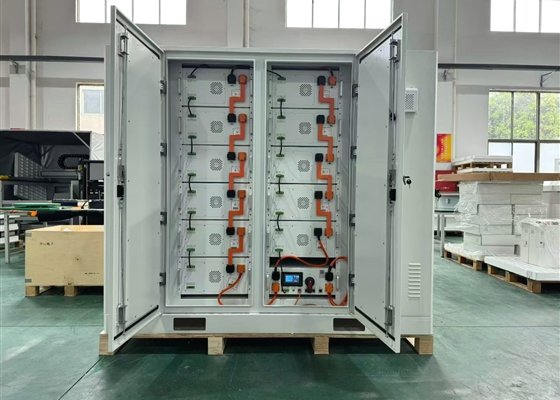
There are various levels at which cooling can be integrated into a battery energy storage system. Depending on the system’s architecture, the thermal management equipment may be able to serve an individual battery module, several racks, an energy storage cabinet, or a larger BESS container.
In the case of a cabinet, the cooling architecture must be able to work with the battery layout, the monitoring system, electrical equipment, and the enclosure. Multiple racks, as well as cooling units, can be combined for larger installations. Thus, battery energy storage cooling is integrated into the BESS’s overall design and control architecture.
2. Why Do Battery Energy Storage Systems Need Thermal Management?
2.1 Heat Generation During Battery Operation
During usual charging and discharging, battery cells are subjected to heat generation. In terms of the generation of heat, resistance, along with variations in the electrochemical processes, contributes to various amounts of heat generation. The rate of their production also depends on the current, operating conditions, along with the cell characteristics and system design.
2.2 Why Temperature Control is Needed
Battery thermal management is important; battery temperature can lead to an improper working environment, and the source of energy cannot be generated. difference in the temperature of the cells, the cells will work under conditions that are not the same, and this would lead to an imbalance thermal conditions of the cells over some time, the temperature difference would lead caused difference of ageing of cells.
Thermal management thus helps to maintain stable battery operation and helps it remain in the proper thermal range. The method of this management depends on the battery design, power level, profile of the operating system, enclosure, and environment around it.
2.3 Cooling Is One Part of a Larger Safety System
The cooling system should not be considered an alternative or replacement for safety systems for BESS. Cooling is not a fire protection system. Thermal Management is to maintain operating temperatures, but Safety requires several coordinated layers.
A modern Battery Energy Storage System (BESS) might interchangeably combine BMS, TM, electrical protection, monitoring and controls, enclosure design, and fire detection or suppression equipment. Each of these layers, serving different risks and combining as part of the safety architecture of the system, should operate together.
The standardized test method for evaluating thermal runaway fire propagation in BESS is UL 9540A. The safety requirements for grid-integrated electrochemical energy storage systems are covered under IEC62933-5-2:2015.
3. How Energy Storage Cooling Systems Work
3.1 The Basic Cooling Cycle
An energy storage cooling system operates by following a basic heat-transfer cooling process. The heat transfer process is a continuous series of events. The battery cells produce heat during operation. The generated heat is passed from the cells to the surrounding cooling structure or medium. The cooling medium carries away the heat from the battery assembly. Then the device meant for rejecting heat moves the heat outside the enclosure.
Sensors and control systems monitor the process of heat transfer based on the battery temperature and operating conditions. The cooling technology and BESS architecture might find the different components in a different arrangement.
The basic principle is:
Heat generation → heat transfer → heat transport → heat rejection → temperature control
3.2 Key Components of an Energy Storage Cooling System
Whether air or liquid acts as the heat-transfer medium of the system, the components used will vary. Common elements include fans or blowers, pumps, pipes, heat exchangers, cooling plates, cooling units, temperature sensors, and hardware used to implement a BMS or control system.
4. Air Cooling for Energy Storage Systems
4.1 How Air Cooling Works
A cooling energy storage system utilizes air as the conveying medium to take the heat from the battery parts. The air moves, or blowers move, across the battery chamber and the place where the heat is stored. Heated air flows through the ventilation pathway; a heat exchanger or HVAC system removes the heat from the chamber.
The basic path is:
Battery → surrounding air → airflow → heat exchanger or HVAC → outside environment
4.2 Advantages and Limitations of Air Cooling
The air-cooling feature does not require any kind of liquid loop circulation, pump, coolant piping, or liquid seals; hence, a simple thermal architecture. It reduces the number of thermal components to be integrated into an energy storage cabinet. PretaPower manufactures a BESS cabinet in an air-cooled, air cooling, practical architecture; a real site example of such an architecture.
5. Liquid Cooling for Energy Storage Systems
5.1 How Liquid Cooling Works
Battery liquid cooling uses a circulating coolant to transfer heat from the battery cells or modules. This heat can be removed by cooling plates, which are in contact with components such as battery modules and cells. A pump can perform the task of carrying the coolant fluid via hoses or pipes to a cooling unit or heat exchanger, from which it runs back into the battery circuit.
The basic path is:
Battery → cooling plate → coolant → pump and piping → heat exchanger or cooling unit → coolant return
This move is necessary when the battery energy storage system (BESS) needs greater control of heat removal from the battery cells within a compact battery arrangement. Well-designed liquid cooling energy storage systems can keep the heat close to its heat source, rather than depending mainly on the air movement within a battery enclosure.
5.2 Advantages and Limitations of Liquid Cooling
Liquid cooling can be used to implement a very high heat transfer capability and is useful where battery components are arranged at higher density. It also helps in having more controlled temperature management if the cooling plates, coolant circuit, sensors, and controls are properly designed. These attributes make a liquid-cooled energy storage system very suitable for demanding BESS configurations.
6. What Determines BESS Cooling Requirements?
6.1 Battery Chemistry, Power, and Heat Load
To start with cooling requirements, the battery design in terms of cell chemistry, cell format, module structure, electrical resistance, and operating limitations determines the amount of heat generated by a BESS. Moreover, the thermal requirements of the battery manufacturer should be considered before the energy storage cooling system is selected.
Furthermore, the power and energy capacity of a BESS are another way to characterise the system. A 300 kWh battery shows how much energy it can store, and a rating of 100 kW indicates how quickly the battery can charge or discharge. In case the two systems have the same capacity, they can have various thermal loads if the systems have different power ratings or different operating conditions.
For example, a 200 kWh system having a battery operating at 100 kW is different from a 200 kWh system operating at 200 kW. Hence, it is crucial to evaluate cooling based on the anticipated operating conditions and not just the kWh value.
6.2 Operating Profile and Installation Environment
The nature of the use of the BESS also determines thermal requirements. A factory employing storage for peak shaving may operate for a short period at high power. An off-grid system may have different charge and full charge-discharge cycle patterns.
The place of installation also matters. Ambient temperature, solar rays, ventilation, humidity, dust, and location of the enclosure – all these influence the thermal condition. For the Togo-based project of 300 kW PV and the HBOWA 400kWh storage project. The BESS operates at environmental temperature and solar radiation rates. While the documentation of the project designates the exact place of installation, the cooling method was also considered while planning the solutions. This illustrates the evaluation of BESS cooling against conditions.
6.3 System Density and Maintenance Requirements
Battery density and container design are vital. A single energy storage cabinet, a few cabinets connected together, and a large BESS container can all suffer from the heat management problem. High component density can raise the need for enhanced heat removal and heat distribution.
Maintenance requirements need to be evaluated at the same time. You need to decide on the approach to the correct battery cooling. You can consider things like equipment access, monitoring, spares, serving staff, and maintenance requirements (for the chosen cooling architecture) to support this.
7. Air Cooling vs. Liquid Cooling: Which Is Right for Your BESS?
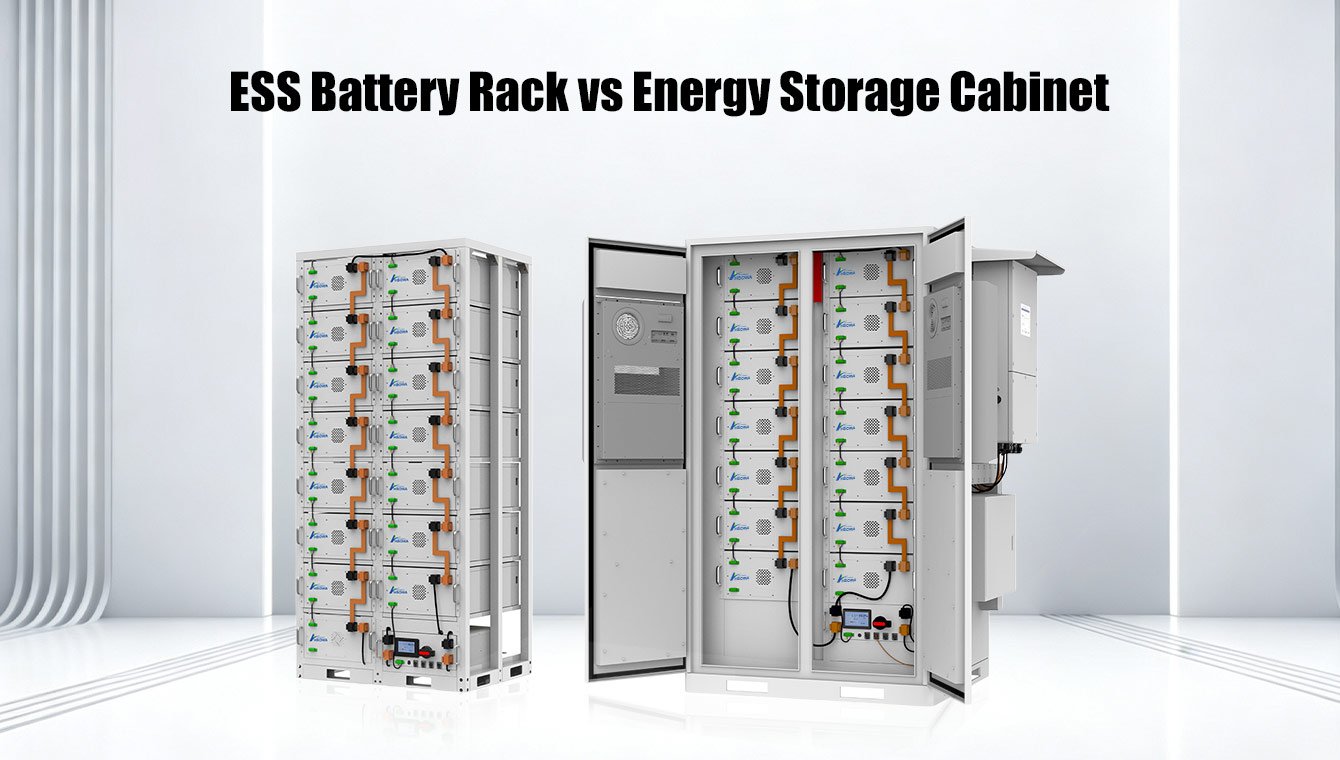
BESS’ actually needed thermal requirements should be how a user makes a choice between air and liquid cooling, and not whether air is better than liquid or the other way. Any method, if able to remove the incoming heat generated as per the battery architecture, operating profile, site conditions, maintenance strategy, and project requirements, would be a better choice.
| Factor | Air Cooling | Liquid Cooling |
|---|---|---|
| Heat-transfer medium | Air | Liquid coolant |
| Heat-transfer capability | Generally lower | Generally higher |
| Temperature control | Depends strongly on airflow design | Can provide controlled heat transfer when properly designed |
| Pumps and piping | Not required | Required |
| Leakage concern | No coolant-loop leakage | Requires leak management |
| Maintenance | Fans, filters, airflow and HVAC | Pumps, coolant, pipes, seals and cooling unit |
| System complexity | Generally lower | Generally higher |
| High-density suitability | Depends on system design | Often advantageous |
| Selection basis | Load, climate, density and design | Load, density, climate and control requirements |
7.1 When Air Cooling May Be Suitable
You can employ air cooling if the BESS can handle the thermal load while maintaining an acceptable temperature, maintain space in the form of airflow at the cabinet intakes, and the cooling environmental conditions fall within the design limits. Further, air cooling might be alluring if you wish to select a simple thermal architecture.
7.2 When Liquid Cooling May Be Suitable
Liquid cooling will get the utmost scrutiny for better benefits when the BESS has tighter temperature control, higher thermal loads, or greater battery density. When applied, the circulating coolant transfers most of the heat to a cooling plate that connects closely to the battery components.
This does not mean that liquid cooling is needed for all large BESS. Rather, liquid conductance could be used, depending on the overall thermal design. PretaPower’s commercial systems with the liquid-cooled architecture are an example of this, such as the 100 kW / 232 kW /h and 125 kW/261 kWh cabinets. However, these are specific product configurations and not universally applicable benchmarks.
7.3 Use Project Conditions to Make the Decision
Initiating the battery selection process from a thermal perspective. Selecting a battery to run cool enough will likely address all the other engineering challenges better than selecting a battery to meet other application requirements.
| Project condition | What to evaluate first |
|---|---|
| Moderate thermal load | Whether air cooling can meet the required heat-removal capacity |
| Higher battery density | Whether liquid cooling provides a more suitable thermal architecture |
| Hot or exposed installation | Cooling capacity under the actual ambient conditions |
| Frequent high-power cycling | Thermal load under the expected operating profile |
| Limited service resources | Complexity and maintenance requirements |
| Large containerized BESS | Complete thermal architecture and equipment integration |
8. Real-World Energy Storage Applications and What They Illustrate
The decisions concerning cooling should be linked to application and site conditions. HBOWA’s projects range from off-grid to factory and hotel applications and even small commercial applications. These projects show various design considerations but lack measured cooling-performance data and should not be used to compare air or liquid cooling systems.
| Project | System | Application | Cooling-Relevant Lesson |
|---|---|---|---|
| Togo | 300 kW PV + 400 kWh | Off-grid | Assess climate and site conditions |
| Poland | 50 kW / 300 kWh | Factory peak shaving | Assess operating profile |
| Romania | 100 kW / 200 kWh | Hotel | Assess commercial load requirements |
| Vietnam | 80 kW / 241 kWh | Café | Assess cabinet-scale integration |
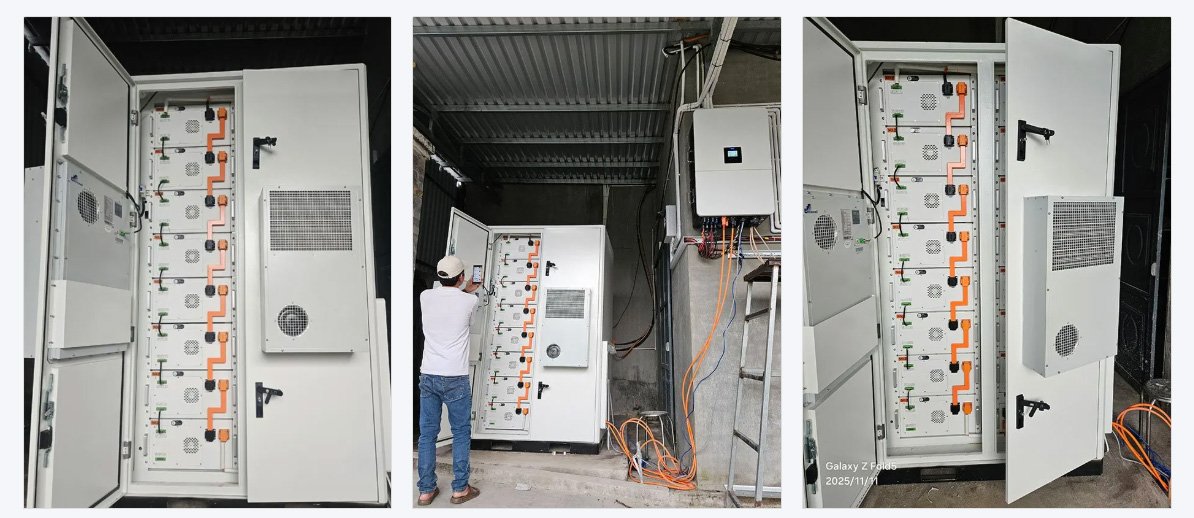
The Togo project operates in high temperatures and high solar radiation. Documentation with respect to the installation site and cooling method is among the info useful for solution planning. This shows the importance of considering environmental conditions when designing for battery energy storage cooling.
The Poland factory project employs 50 kW/300 kWh storage for self-use of solar energy, peak shaving, and load shifting. The power profile differs from a true off-grid application, which explains the significance of expected charge/discharge behavior.
The Romania hotel project incorporates 100 kW/200 kWh storage, while the Vietnam café project has an 80 kW inverter paired with 241 kWh of battery storage. The BESS thermal requirements of a battery energy storage system may differ with the scale, application, enclosure, and operating conditions.
9. Cooling, Maintenance and BESS Safety
9.1 What Should You Monitor?
The battery energy storage cooling requires continual monitoring after commissioning normal operation. Temperature readings and temperature differences can indicate abnormal operation. BMS and cooling-system alarms help to identify anomalies. Operators should verify fan and pump action, flow rates, alarm in the coolant system where applicable.
Architecture determines how it is maintained. Fans, filters, ventilating paths, and HVAC equipment need to be taken care of. Liquid cooling systems include provisions for coolant conditions, pumps, pipes, seals, connections, and leaks check. Check electrical connections, humidity, and corrosion where applicable.
9.2 Safety Standards and Thermal Management
Cooling is a component of BESS safety. The standardized test method for evaluating thermal-runaway fire propagation in battery energy storage systems is UL 9540A. The IEC 62933-5-2:2025 Technical Specification applies to the safety of integrated electrochemical energy storage systems and all life phases of the system.
They assist with manufacturing needs, regional regulations, monitoring, and fire-safety designs for the project.
Conclusion
Energy storage cooling is a system design decision rather than a choice between good technologies and bad technologies. Air cooling is suitable for more basic applications, and liquid cooling can support denser or more challenging systems. The appropriate solution is dependent on the battery, operating profile, environment, enclosure, and project needs.
Frequently Asked Questions
The cooling of energy storage removes heat from the batteries and controls the temperature within the operating limits of the BESS design.
The process of air cooling controls temperature control for the shortening of the heat removal cycle. Liquid cooling uses liquid in a circulating loop. Both rely on the system structure.
Not every time. Different factors like thermal load and battery density will influence which platform to choose.
Battery thermal management involves transferring heat generated by components of a battery via cooling plates and circulating coolant.
The design of the manufacturer determines the coolant. Water cooling battery is a coined-term in the sector, but not every BESS uses plain water.
Unless system design dictates otherwise, liquid cooling may be optimal for greater thermal loads and battery density.
Certainly not. Cooling regulates temperature conditions. Monitoring, electrical protection, enclosure design, and suitable fire safety are also needed for BESS safety.

