
Introduction
Since electric vehicle adoption has been on the rise and the number of households is increasing, the energy demand is also increasing. With all of this, many homeowners have their original solar installations failing. The homeowners are searching for solutions to add solar power to their system. Learn how to add solar panels to existing system, so it fits your needs. This article shares technical, cost, and other how-tos for instructions as per the current industry best practices and data for a solar array. You need not start from scratch; install more solar panel systems without being dependent on the grid. At HBOWA, we help homeowners and businesses to install a scalable system and remain flexible. Long-term performance and flexibility are obtained using LiFePO4 batteries with a hybrid inverter.

Can I Add Solar Panels to My Existing System?
Yeah, but there are some specific technical and compatibility conditions. Whether you can add solar panels to an inverter system depends on how your inverter is designed, the wiring setup you’ve opted for, and how old your system is. Adding solar panels to existing inverter setups is usually straightforward if the unused MPPT inputs are still available on the inverter or its DC load handling capacity can be increased. In case your inverter is already running at its full capacity, the inverters may need to be upgraded to accommodate additional solar panels.

The system voltage (V) and current (I) ratings must match between your old and new modules to prevent the power mismatch and reduce efficiency. For instance, adding new 450-W N-type solar panels to an inverter setup with two old solar panels of 300 W each may cause a string imbalance unless properly configured. Thus, the owner should verify inverter headroom, verify panel compatibility, and comply with the local electrical code before proceeding if homeowners are planning to add solar panels to their existing setup to make their homes energy efficient.
Benefits of Expanding Your PV System
What are the good things you would get from scaling up your solar power system? You can enhance your solar efficiency up to a great extent by adding more solar panels to an already existing solar setup. It can drastically increase the energy production of your house. You can then keep this yield to meet the upcoming higher power consumption of your new electric car, upgraded appliances. Even adding the solar panel to the pre-existing system also means that you can use every nook of your roof or ground. Incidentally, expanding your solar panel also helps you to balance out your load curve. This means you keep your old solar panel system for a longer time.
The government rules and subsequent benefits globally make expansion a more lucrative option. For instance, in Australia, citizens can earn Small-scale Technology Certificates (STCs) that cover as much as 30% of the expenditures of upgrading. The European Union incentivises the export of electricity with proper feed-in tariffs. Various US states have net metering or time-of-use credits that can give you increased ROI. The International Energy Agency lists that consumers with 2-3 kW of additional capacity boast an average annual improvement in self-consumption performance.
Key Technical Considerations & Compatibility
There are a few key technical considerations to take into consideration when considering adding solar panels to your existing system. Ensuring the expansion is done and is compatible with the current electrical alignment, inverter capacity, and the setup of the system is critical to ensure its safety, performance, and enhance the overall ROI in the equipment.

Inverter Compatibility & Upgrade Needs
The efficiency and size of your inverter will dictate how easily you can expand. New solar panels added to installations with string inverters must be electrically identical and connected in balanced strings. String systems also have input limitations, which, if exceeded, may void warranties or fault the solar system that’s already in place. Hybrid inverters, such as those from Growatt or Deye, are generally more flexible, often allowing modular expansion or a parallel solar installation if configured accordingly.
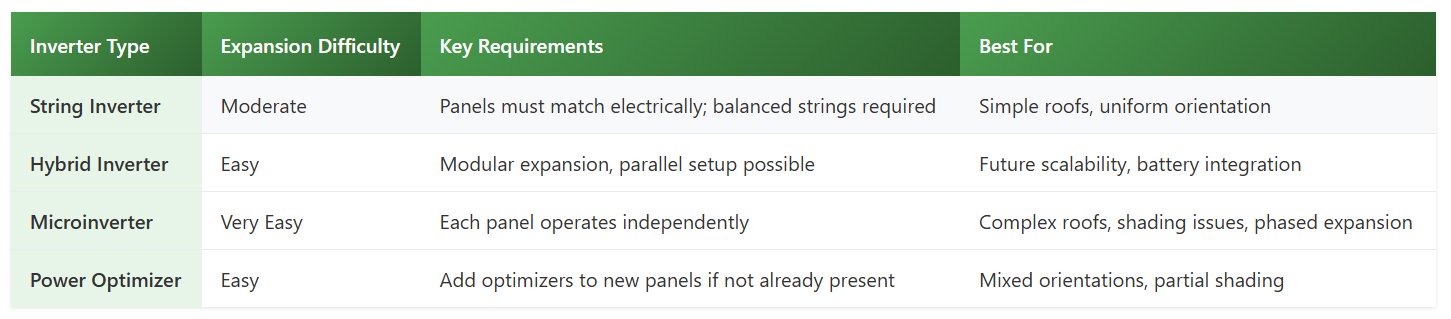
Microinverter supports only a single solar panel, meaning that after installing your solar panels, expanding solar panels can be done with ease and without too much hassle. Each solar panel operates independently, meaning the addition of new solar panels or expansion of solar panels should be completed with ease and with minimal risk to changing the entire electrical configuration of the existing panels. These are the fundamental components of adding solar panels, aligning the solar panel growth as a focus in the electrical configuration to further expand the pre-installed solar panels if necessary. If the extra solar panels are over the capacity of the inverter due to new installations, the maximum potential of the existing solar panels is decreased.
Matching Old and New Panels
Matching the panels seems to be an essential criterion, as it is for the inverters. Mismatch of voltage, current, and efficiency creates bottlenecks. By way of example, if one were to attach older 300Watt 18.5% efficient panels to newer 400Watt Perc Black modules that had an efficiency of 22.5%, one may notice some underperformance of the strings. The fix to this would be to isolate the newer panels on a separate MPPT input or another inverter.
Below is an example comparison:
| Specification | Older PERC Module | New N-type TOPCon Module |
| Power Rating | 300 W | 400 W |
| Efficiency | 18.5% | 22.5% |
| Voc (V) | 40 | 37 |
| Isc (A) | 9.5 | 10.2 |
These differences show why engineering balance is essential when mixing generations of modules.
Roof / Site Constraints & Orientation
Adding solar panels to an existing system also varies with the space and structure when you have a rooftop solar system. The orientation of the roof, shading, and other constructional spaces can also reduce the performance of new solar panels by up to 25% if ignored. Additional structural reinforcement or even a complete roof replacement might also be needed in dense areas. Alternatives like ground mounts, carports, or solar pergolas can accommodate can I add more solar panels to my system without using your roof or adding stress on the roof.
Electrical Safety, Code & Permitting Variations
Variations in codes and regulations are prevalent in any country across the globe. In the US, any additional installation beyond the basic system must comply with the NEC 2023 code and may trigger utilities’ re-approval if an export to the grid is also increased. In the EU, more than 10 kW installations may require feed-in limiters to comply with the national grid codes. In the Asia Pacific market-like Japan and Singapore, compliance with IEC and JIS standards is essential for additional capacity. Engaging certified installers to confirm local permitting and perform system testing under load is a must. Compliance will ensure safety, maintain warranty validity, and prevent costly retrofits later.
Cost & ROI: What to Expect
The cost of adding solar panels to the existing system ranges between $750 to 1300 per additional kW when the present hardware is kept. Cost ranges between $1200 to $1800 per kw when a full system replacement is needed. The cost of executing expansion is generally 30 to 40% cheaper than a complete system replacement these days. The additional cost to add solar panels might be better known as the ROI.
The cost to add solar panels to an existing system setup highly depends on a variety of factors, including:
– The price of new modules
– Inverter or MPPT upgrades
– Mounting hardware
– Labor
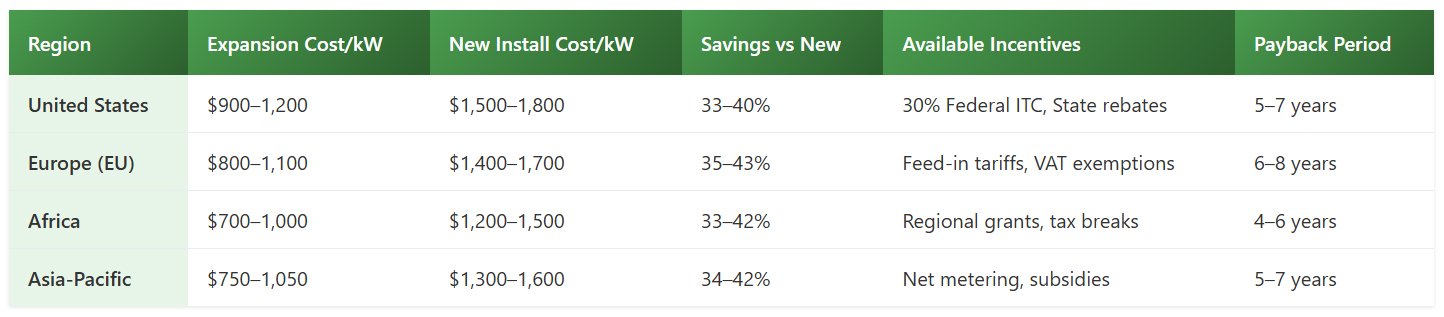
For instance, costs for expanding a 5 kW PV system to an 8 kW system in Spain are estimated at around 2,400 – 3,300$, delivering an additional 4,200 – 4,800 kWh per year. This would reduce the household utility dependence by 35 – 40%.
In the U.S., the federal Investment Tax Credit (ITC) is still 30% of the disproportionate cost. Other areas like Germany, Japan, and South Africa give either feeding tariffs or self-utilization bonuses. Homeowners who are thinking ‘how much does it cost to add solar panels‘, along with the efficient cost control to be increased, and inverters, since most panels are likely to last more than 20 years.
Step-by-Step Guide: Adding Solar Panels
Knowing how to add solar panels to existing system configurations correctly makes sure it is done safely, in compliance, and with performance, so follow these core steps while doing expansion.
Step-1: Assessment & Site Survey
Professional evaluation of the area available on the roof or ground. Evaluate shading, electrical characteristics, type of modules, inverter capacity, and availability of breakers. Tools like PVsyst or HelioScope should be put to use to model solar gain and new panels impact.
Step-2: Design & Sizing
Modules to add will not exceed the inverter or string limits. Calculate new string voltages. Inverter MPPT should be verified in the case of string addition. Adding solar panels to existing system determines that it meets the compliance and all the module placements.
Step-3: Component Selection
Modules should be Tier-1 or equivalent from best brands like Risen, Longi, Jinko, or Trina. The voltage and current rating of the new array should match the current array. For control, scalable inverters like GrowSun, Deye, and Growatt can be used, or if required, DC optimizers to be included. Cables, junction boxes, and rails must have international standard ratings.
Step-4: Wiring & Connection Plan
Electrically isolate new and existing circuits. Use DC cabling appropriately sized, fuses, isolators, or overcurrent devices. Grounding continuity should be there. To prevent the imbalance, the saved MPPT operation makes the proper connection.
Step-5: Installation & Commissioning
Whenever new modules are added, racking systems should be approved. Adding solar panels to the existing system connection, testing voltage and current, and configuring inverter parameters, including MPPT range and grid export limits. After the physical installation, insulation resistance and polarity tests should be run before system activation.
Step-6: Monitoring & Maintenance
Modern inverters have app-based monitoring to track generation and detect anomalies. Regular cleaning and inspection to get the most efficiency. The yield can be further enhanced with small orientation changes or firmware updates.
Following these steps, make sure that your practice of add solar panels to existing system upgrade performs safely, and delivers measurable long-term savings.
Real-Life Case Studies & Comparisons
To understand how to add Solar Panels to an existing system can be done, let’s see some examples for clarity:
A homeowner in Portugal wanted to add Solar Panels to his existing 4 kW system to make it 6 kW. He extended the system to the east-facing side of the roof of the house. Doing so, the total annual power generation in the house went from 5,200 kWh to 7,800 kWh. The system costs about six years’ worth of payback using the government feed-in tariffs. Adding Solar Panels to an existing system upgraded the production power.
In India, another commercial warehouse increased the Solar Panels from 50 kW to 65 kW. They used new Tier-1 modules and also a parallel-connected Growatt hybrid inverter. This alteration in their system increased the full-year generation power from 72,000 kWh to 93,500 kWh. The Solar Panels are capable of generating 38% less energy from grid power. The professional installation resulted in the electrical balance, code compliance of the locality, and maximum optimised MPPT used. These cases demonstrate that adding solar panels to existing system setups can achieve better outcomes in terms of energy.
Pros & Cons, Risks & Mitigation
Expanding the solar array offers clear benefits in terms of higher energy production, increased ROI, and scalability in the future, but there are also certain risks involved. There can be a mismatch in losses between old and new panels. The expansion could get delayed due to permitting. There can be an inverter overload, and also increased wiring losses.
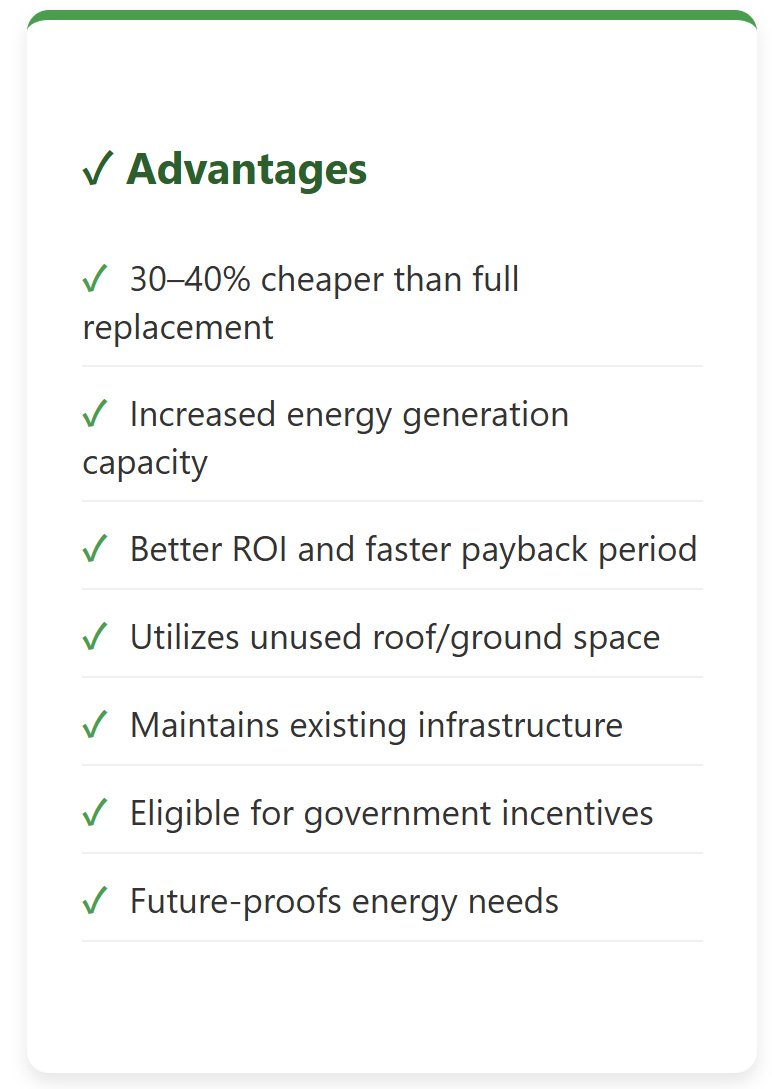
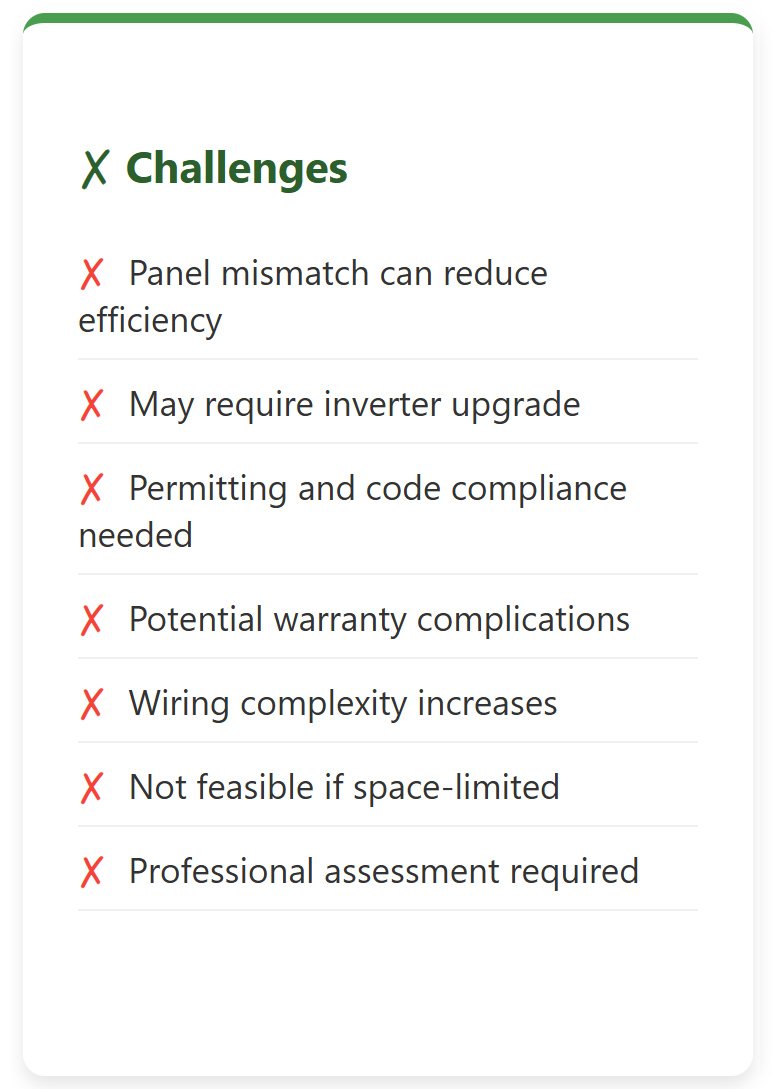

The risk can be mitigated by isolating the new strings in different MPPT inputs, adding some safety margins to the system design, and getting the site assessment and installation done by certified professionals. Proper planning makes sure that the benefits of adding solar panels to existing system outweigh the potential issues.
Conclusion
You can totally expand your solar setup and add more solar panels to the existing one if you plan it right and execute it well. Make sure to know how to add solar panels to the existing system configurations in order to make sure that you are getting the maximum out of your panels. Along with better performance and long-term cost-saving.
If you need professional design for adding solar panels into your existing system, HBOWA offers designing scalable solar solutions with hybrid inverters, LiFePO₄ batteries, or premium solar modules. Contact us for more details
Frequently Asked Questions
Expansion costs typically range between $750 and $1,300 per kW, depending on your region, import cost, inverter capacity, and installation rates. For an exact quote, conduct a site audit.
While it may seem simple, adding solar panels to existing system setups requires technical skills, electrical knowledge, and code compliance, so always use a licensed installer for your hardware and your safety and warranty protection.
It depends on the inverter capacity and MPPT input availability. A professional should assess whether your inverter and tell you if your old system can handle the extra load or not. You can also contact our expert, and we can help you in that regard.
Expansions done incorrectly can void panel or inverter warranties.
Yes, but how to add more solar panels to existing system off-grid setups depends on your charge controller and battery storage size. Systems with LiFePO₄ batteries generally offer better scalability, and HBOWA provides a wide variety of solar batteries for residential, commercial, and industrial needs.