Introduction
Energy storage investment means funding a battery energy storage project to create savings, revenues and/ operational value. The economics of the project will depend on the local electricity tariffs of the site, load profiles, system costs, contractors, financing, and operating conditions in practice. This article looks at the costs, returns, risks, and business models for BESS projects instead of energy-storage stocks, funds, or securities.
What Does Energy Storage Investment Mean?
An energy storage investment is the commitment of capital to a battery energy storage project to create some economic or operational value. A battery energy storage system can lead to decreased electricity bills, capture peak-valley arbitrage, mitigate demand charges, enhance solar self-consumption, back up private networks, and/or displace diesel in suitable off-grid applications. If the conditions are favorable, the grid can also earn value.
There are various investment structures. A purchaser can finance the system themselves, use a third-party investment or energy management contract, arrange leasing or project financing, as well as install storage at a new or existing solar installation. The right structure will depend on capital availability, risk allocation, and cash flow.
Notably, energy-storage investment in this context refers to physical BESS investment, not energy-storage stocks. Evaluation of an energy storage project should include site economics, operating use cases, and lifecycle performance. Battery Energy storage system.
What Determines the Return on an Energy Storage Investment?
Returns on BESS depend on more than just battery capacity or equipment price. The return on investment will depend on the economic value that the system creates over its operating life compared with capital and operating costs.
The Main Factors
The savings are dependent on the tariffs and price spreads, while CAPEX sets the capital requirement. Lowering demand charges can save you money. The delivery capability is determined by usable capacity and power rating. Over time, the value is affected by cycling, efficiency, and degradation. The cash flow throughout the lifecycle is affected by financing, market access, and O&M.
| Factor | Effect on investment economics |
|---|---|
| CAPEX | Upfront capital requirement |
| Electricity tariff | Potential energy-cost savings |
| Price spread | Arbitrage value |
| Demand charges | Additional savings |
| Usable capacity | Available stored energy |
| Power rating | Response capability |
| Cycling | Value capture frequency |
| Round-trip efficiency | Usable energy |
| Degradation | Capacity over time |
| O&M | Lifecycle costs |
| Financing | Cash flow and total cost |
| Market access | Monetizable services |
A Simple Way to Think About BESS Returns
It can be explained in easy way by making a formula statement:
Annual arbitrage value ≈ usable discharged energy × electricity-price spread × viable cycles × operating days, adjusted for efficiency and operating costs.
This is a descriptive benchmark rather than a universal ROI formula. An actual BESS ROI calculation requires tariff data, load behaviour, usable capacity, efficiency, degradation, O&M, and financing assumptions. Two batteries at two different sites can have or yield different outcomes.
According to IRENA estimates, the global total installed utility-scale battery storage cost fell by 93% from an average of $2,571/kWh in 2010 to $192/kWh in 2016–2017. It provides a scope or benchmark for OPT comparison but is a global utility-scale benchmark. In reality,energy storage pricing per battery capacity installed varies or changes with size, hours of duration, location, system, grid connection, and application of the battery. Compare the lifecycle cash flows to get the BESS payback and test scenarios rather than assuming a payback period.
How Can an Energy Storage System Generate Returns?
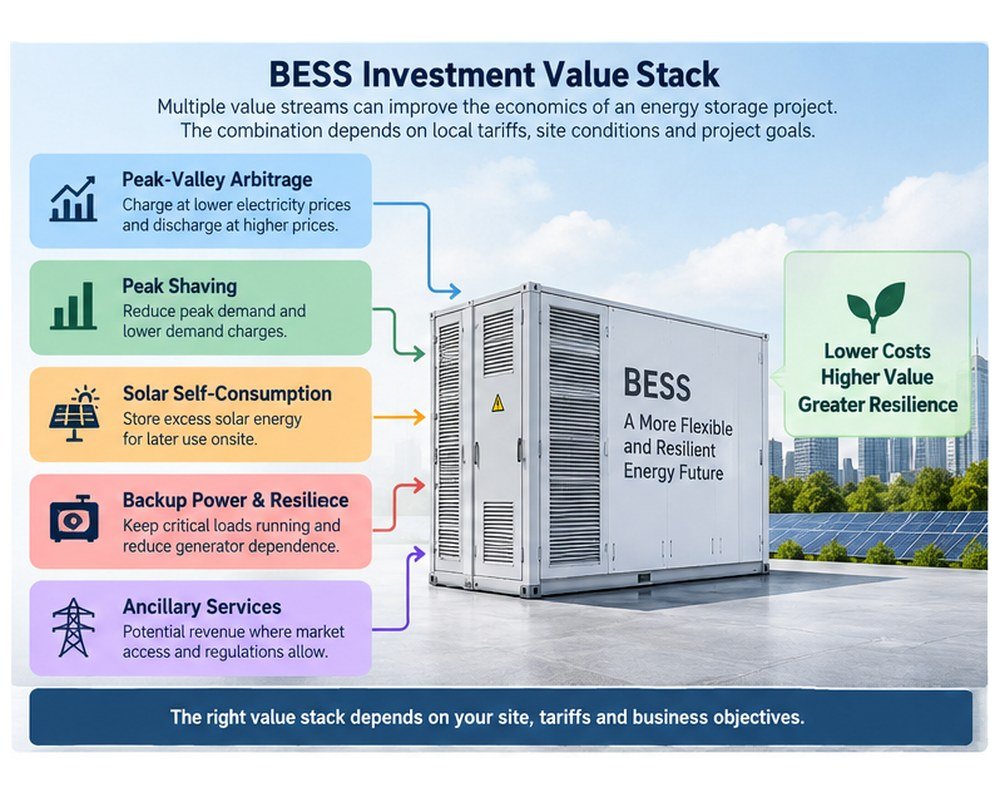
An energy storage system can save money, make money, and provide operational value. Wasting less electricity and lowering your electric bills is a way to save money. Having backup power can save your operations from disaster, and that is your operational value, with no revenue generated by the backup power.
Peak-Valley Arbitrage
Peak-valley arbitrage exists due to electrical cost differences over time. BESS charges during lowered-price periods and discharges when the costs of electricity are higher. The value of it all relies on tariffs, capacity, efficiency, and cycling. Little price spreads make the economics weak, and proper time-of-use tariffs can optimize investmentṣ.
Peak Shaving and Demand Charge Reduction
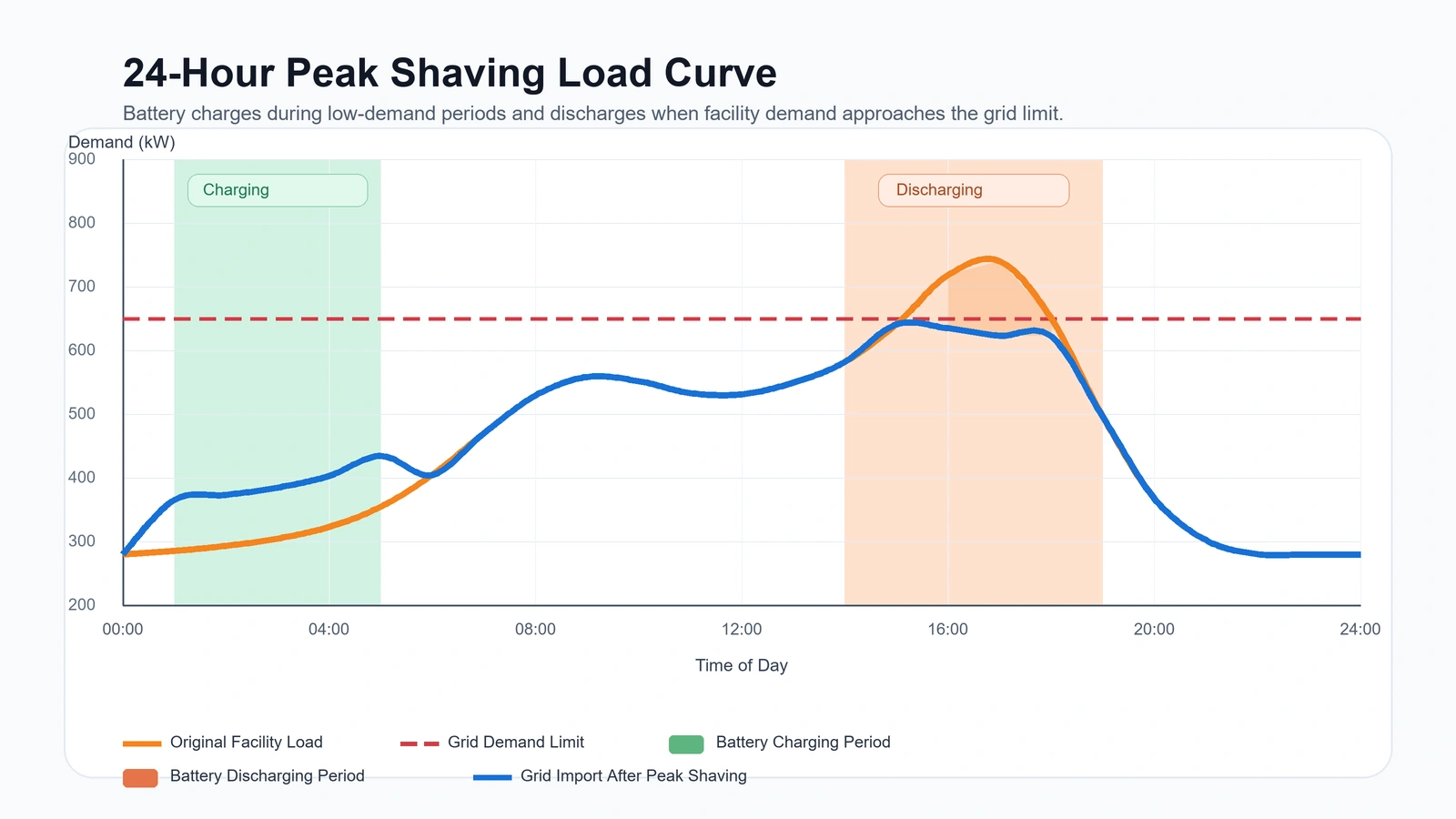
Peak shaving can be an effective technique for reducing the capacity ‘demand’ charges incurred during high ‘demand’ periods of a facility. If a battery energy storage system is charged during ‘off-peak’ times and discharged during the peaks, then the facility’s ‘demand’ will be reduced at the higher point and in interval load data. The power and time required for discharging depend on the load profile.
Solar Self-Consumption
Storage is the best option for ‘arbitraging’ solar energy to be used for later periods. It stops the power from being exported to the ‘grid’ and stores it for use for loads onsite later on. Storage may be integrated with a new PV, or storage could be added to an already existing build. Appropriately solar-plus-storage solution ensures that the generation is connected with the load timings.
Backup Power and Resilience
The primary purpose of industrial backup power is a service value stream, not a product value stream or automatic revenue. BESS systems can support critical loads, reduce diesel generator usage, and continue the services an industry provides. The profit value of a BESS may be the avoidance of downtime, loss of productivity, or any other loss due to unavailability during an outage. Analysing this profit value versus the cost of the outage and the resilience requirement.
Ancillary Services and Revenue Stacking
Where regulations, market access, and technical requirements permit, BESS assets can provide ancillary services like frequency support. Revenue stacking combines eligible value streams can be stacked for profit. However, not every commercial or industrial project can access said markets. Criteria to check, including eligibility, interconnection, aggregation, and design of the market, therefore do not add said profit value.
How Much Does an Energy Storage System Cost?
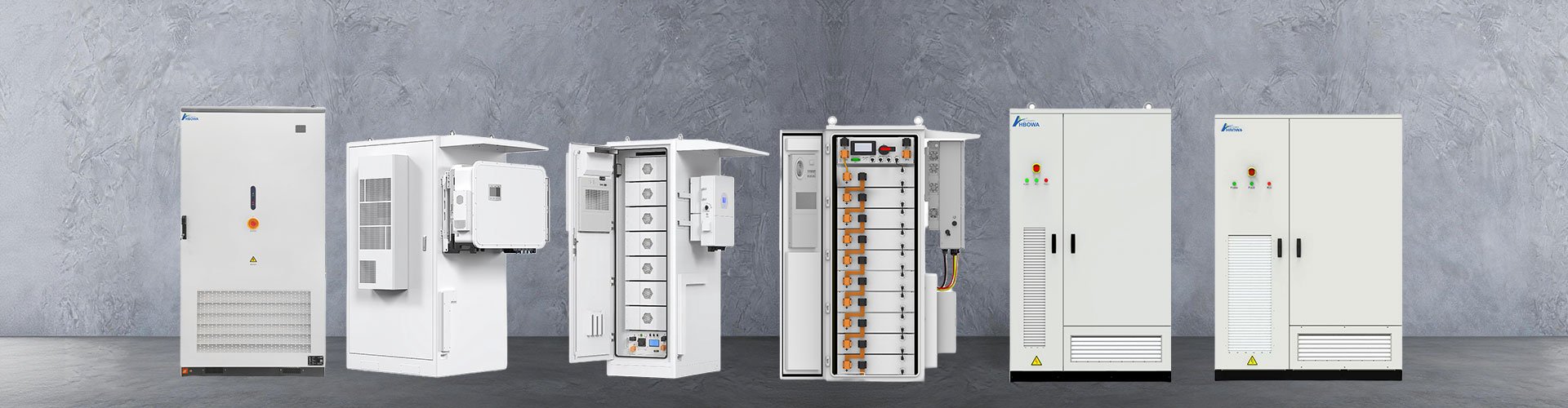
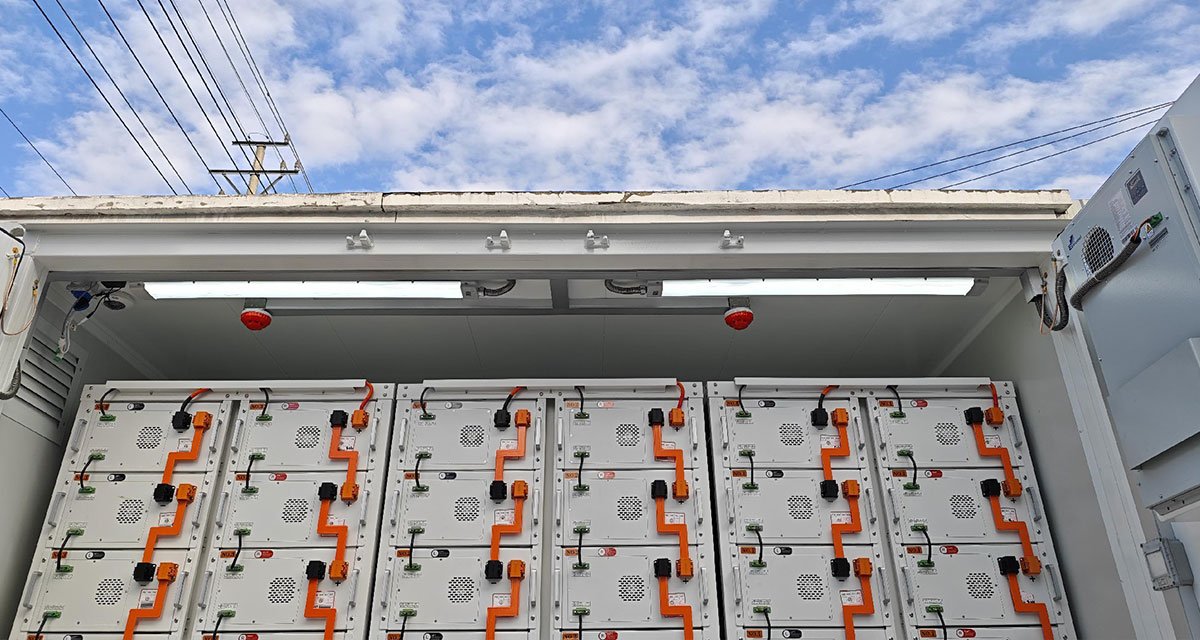
The energy storage cost for a whole project is much more than the battery cells. A typical battery energy storage system will have battery modules, cabinets/containers, PCS/inverters, BMS, EMS, thermal management, fire protection, electrical equipment, installation and commissioning, grid connection, monitoring system, O&M, and financing.
According to IRENA, the global utility-scale BESS installed cost fell from $2,571/kWh in 2010 to $192/kWh in 2024, which is about a 93% reduction. In 2024, turnkey system costs of about $148 to $165/kWh are also reported, depending on storage duration. These costs are broadly representative, and not a quote for any specific C&I project.
Hence, energy storage prices should not be judged by BESS price per kWh. Power rating, duration, site conditions, grid connection, safety requirements, EPC scope, and financing can materially change the total project cost.
Which Energy Storage Investment Model Is Best?
Like all energy storage investments, there is no one-size-fits-all approach to structuring the investment. The right structure depends on the capital available, desired degree of control, risk tolerance, project term, and level of expected cost savings or income. The main options are owner-funded and third-party or energy management contract (EMC) structures, along with lease and financing contracts.
| Investment model | Capital provider | Main advantage | Main consideration |
|---|---|---|---|
| Owner-funded | Site owner/investor | Maximum control | Higher upfront CAPEX |
| Third-party/EMC | Investor or energy service provider | Lower upfront capital | Savings or revenue sharing |
| Lease/finance | Financing provider | Spreads capital cost | Financing cost and contract terms |
Owner-Funded Investment
Owner-funded investment involves the site owner purchasing and controlling the BESS. The investor receives the subsequent economic benefits but also carries the capital, operating, performance, and technology risks. Such a structure is suitable for companies with available capital, predictable electricity consumption, and a long-term investment horizon. It also provides the owner with greater control over how the system is operated and the future use of the system.
Third-Party Investment and Energy Management Contracts
Under an energy performance contract, a third party supplies capital, project services, or both. One of the Contract terms defines how the savings or other project value will be divided. The agreement’s terms should describe how the underperformance will be treated. Using this structure, the capital requirement is for the customer (but the economic benefit is divided).
Lease and Energy Storage Financing
The capital cost can be spread over an agreed period by leasing or energy storage financing. The finance charges in the financing will apply to the battery storage, but others will affect the total Project economics. Must check the ownership, maintenance, residual value, early termination, and end-of-term condition before committing; the best battery storage investment is, therefore, the one that aligns capital requirements, control risk, and expected project value.
What Are the Risks of Energy Storage Investment?
A reliable energy storage investment must consider downside scenarios as much as expected returns. The project economics can change by altering the power tariffs, utilization, equipment performance, financing terms, or the regulations from the original assumptions. This makes energy storage investment risks a vital part of the review process rather than a detail to consider at the end
| Risk | What the investor should check |
|---|---|
| Tariff risk | Changes in price spreads and demand charges |
| Utilization risk | Whether projected cycling is realistic |
| Degradation | Capacity and performance over time |
| Financing risk | Interest and repayment burden |
| Technology risk | Warranty, compatibility, and serviceability |
| Safety risk | Thermal management, fire protection, and compliance |
| Regulatory risk | Market participation and grid requirements |
| O&M risk | Service response and spare-parts availability |
| Revenue risk | Whether projected services can be monetized |
Base-Case and Stress-Tested Economics
The stress-tested ‘base-case’ model is assumed to inform an investor of the actual conditions for an investment. The stress-tested model assumes less favorable conditions. For example, an investor might want to produce a base-case model with lower tariff spreads, smaller annual cycles, larger up-front CAPEX, lower usable capacity, unexpected downtime, etc., with more significant upfront financing costs assumed as well.
Moreover, battery degradation has unique significance as a system’s usable capacity may drop during the initial years of its operating life. Besides, the forecasted ancillary service revenue prediction should not be (and is not always) guaranteed for an investor in the absence of confirmed project market access and eligibility.
BESS safety is also project-specific; the project’s essential operational limitations include reviewing the manufacturer’s specifications and applying fire protection measures, following the electrical standards, etc. Another point to note is that the product certification given to a project would not satisfy every local fire, grid, or building requirement, as needed in the base-case model.
How Should You Evaluate an Energy Storage Investment?
Evaluate the physical site and operational profile before committing to an energy storage project. Location and grid conditions will specify interconnection requirements and operational constraints. The load profile will signify how much electricity is consumed at any one time and when the peak demand occurs. The electricity tariff will show whether the time-of-use savings or demand management can create enough value.
If solar PV is installed or planned, then compare generation periods with the onsite demand to recognize the role of storage. People must identify critical loads and the duration of backup required. The power rating required in kW and energy capacity in kWh should be evaluated as a pair rather than individually.
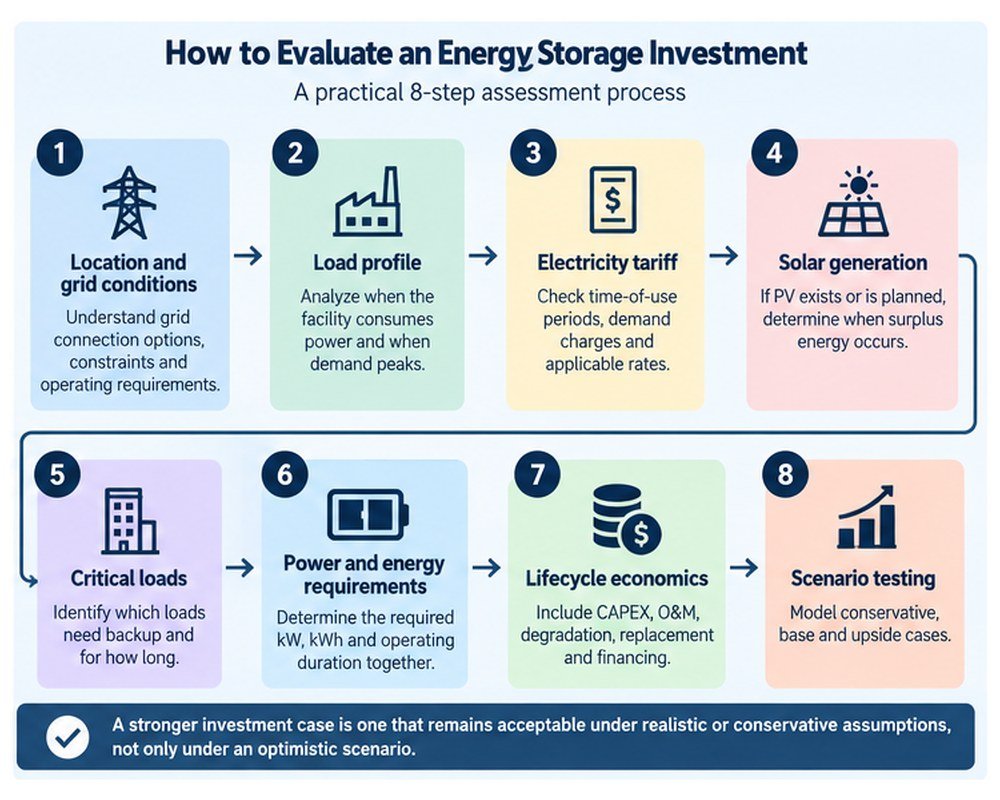
BESS ROI and BESS payback should include CAPEX, O&M, degradation, potential replacement costs, Financing, and OC costs. At last, we should model using conservative/base and upside rather than relying on one forecast.
The IEA reported that of the 108 GW of new battery storage capacity deployed across the globe in 2025, the market scale and growth velocity. The BESS is deployed at a swift rate is no guarantee of attractive economics at all sites.
A BESS project will have more financial strength if it can offer acceptable economics at realistic/ conservative assumptions rather than depending upon an optimistic payback.
Real-World Energy Storage Investment Examples
Continuous projects show why energy storage investment relies upon application, site conditions, and value streams rather than battery capacity alone. HBOWA’s undertaking portfolio provides a couple of models with different operating targets.
| Project | Configuration | Primary value/application |
|---|---|---|
| Poland factory | 50 kW / 301 kWh | Peak shaving, solar self-use, load shifting |
| Romania hotel | 100 kW / 200 kWh | Solar self-consumption, peak shaving, backup |
| Togo off-grid | 300 kW PV + 400 kWh | Off-grid supply, reduced diesel dependence |
In Poland, there is a 50 kW/301 kWh structure engaged in peak shaving, solar self-use, and load shifting on an annual basis. 50 kW/300 kWh Solar Battery Storage System in Poland.
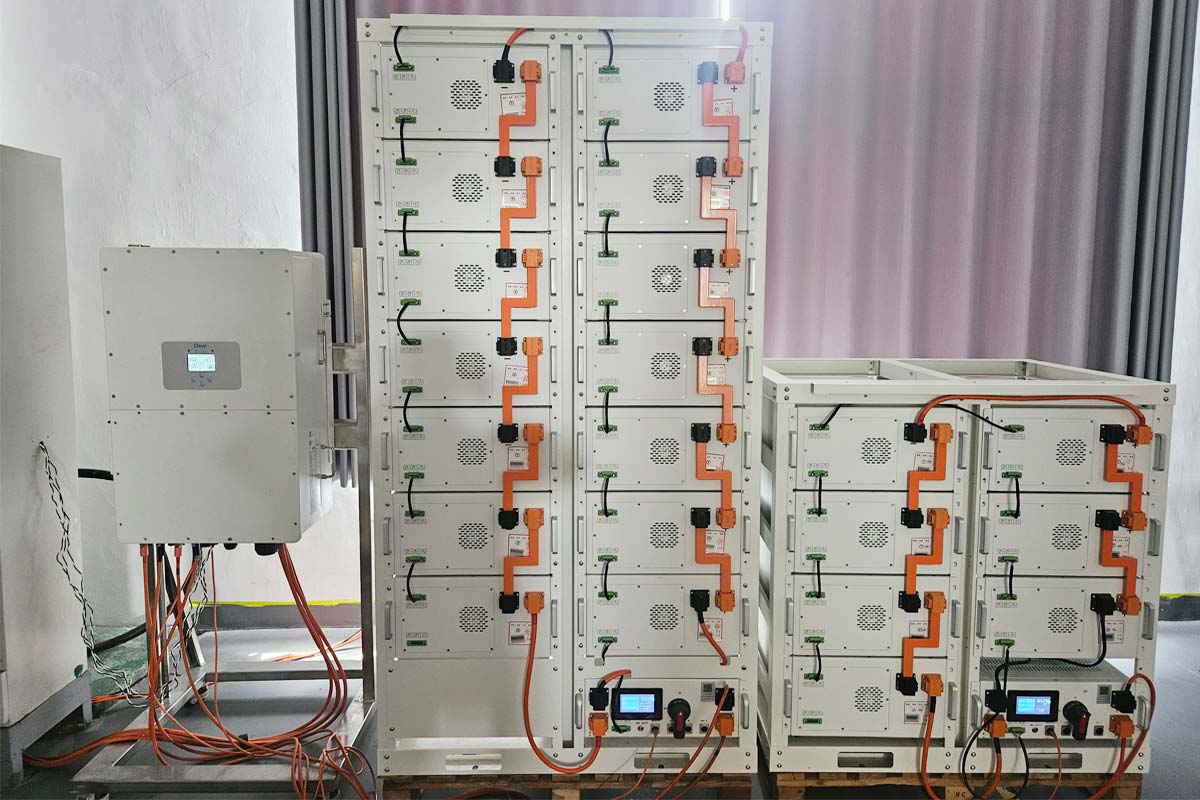
Togo gives an extreme model in 300 kW of PV with 400kWh of storage to help an off-grid application and diminish the use of diesel energy. 300 kW/400 kWh Off-Grid Energy Storage in Togo
The last support issue is that these projects don’t give checked ROI or results, so those numbers don’t warrant from the arrangements alone.
Energy Storage Cabinet vs Battery Container: Which Fits the Project?
The practicality and economics of a battery energy storage system are influenced by significant equipment configuration. The equipment selection should start with the required power and energy capacity, discharge duration, scalability, available footprint, thermal management, safety requirements, installation conditions, and grid connection.
An energy storage cabinet can be installed for modular commercial and industrial installations when the required capacity and site conditions support cabinet-based deployment. A battery container can be suitable and feasible for significant systems when containerized equipment provides a practical way to integrate substantial battery capacity and supporting equipment.
The primary principle is quite simple: equipment selection should follow the project’s load and operating requirements and not the other way around.
Conclusion:Is Energy Storage Investment Worth It?
To have an attractive energy storage investment, project-specific savings and resilience value should justify the full lifecycle cost of eligible revenues. But the return on investment (ROI) or payback period is not universal. The result depends on tariffs, utilization, CAPEX, degradation, financing, and operating requirements, a decision to be made based on realistic project data and conservative financial assumptions.