Introduction
Percentage efficiency of energy transfer indicates the proportion of energy input that is converted into output (useful energy). Percentage efficiency = Useful-output energy/Input energy × 100 (which is the basic formula). This applies to energy conversion, i.e., electrical systems, batteries, and even bigger energy-storage systems. Part of the input here becomes energy loss.
What is the Percentage Efficiency of Energy Transfer?
Percentage efficiency of energy transfer is the ratio of the useful output to the supplied energy. Often stated as a percentage, it can give an idea of how well a process can use its energy input.
The relationship can be expressed or explained in the following way:
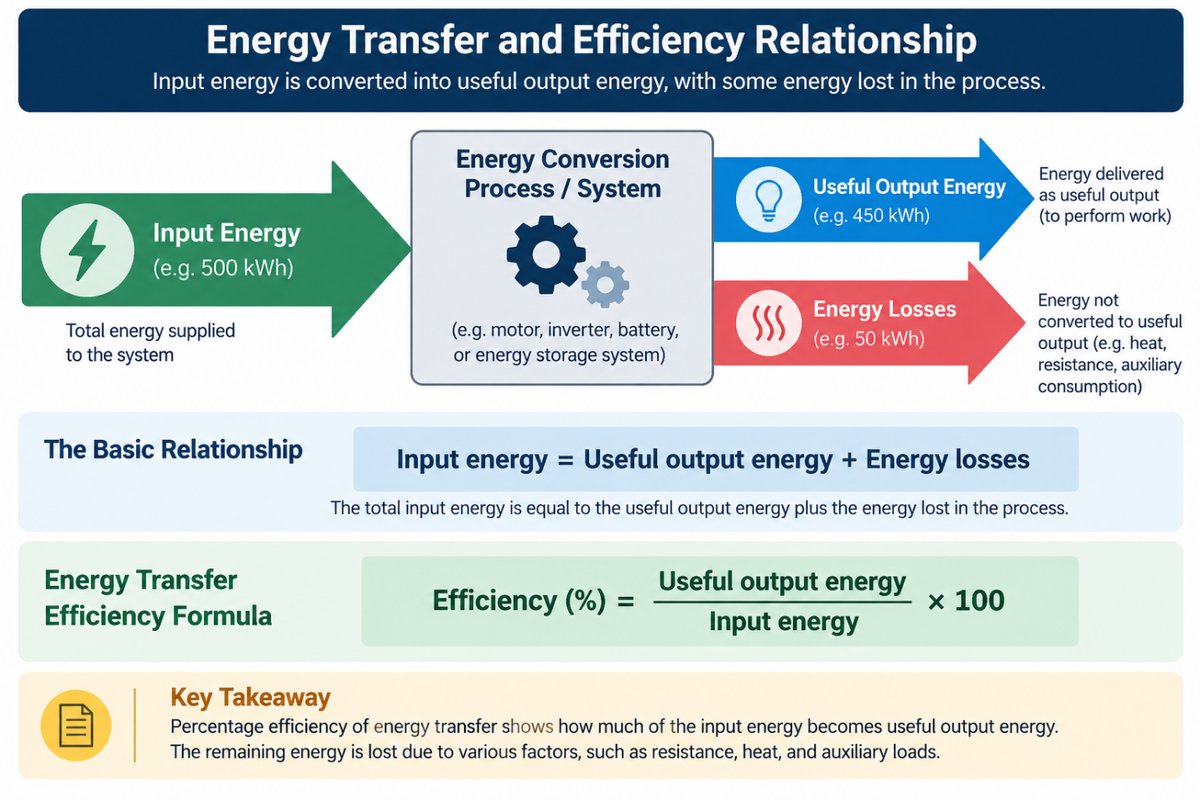
The term “useful” means the output level or measurement point of the system and what the system is required to deliver. In an electrical installation, for instance, the useful output may be the electricity supplied to a load. In a storage system, the measurement point may alternatively be on the DC side of the battery or at the AC connection point.
This is why the measurement boundary is inherently associated with energy conversion efficiency. A component-level measurement excludes other losses in the system, while a system-level measurement will include further conversion and losses happened.
How to Calculate Percentage Efficiency and Express it in a Formula?
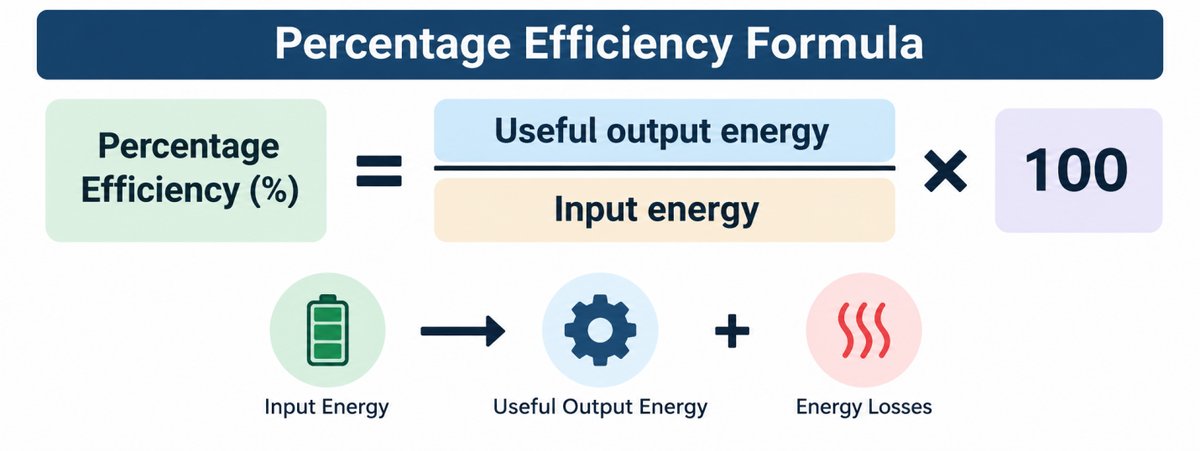
The standard percentage efficiency formula compares useful energy output with the energy supplied to the process:
Worked Example of Percentage Efficiency
Consider a certain system that has an input energy of 500 kWh and a useful-output of 450 kWh.
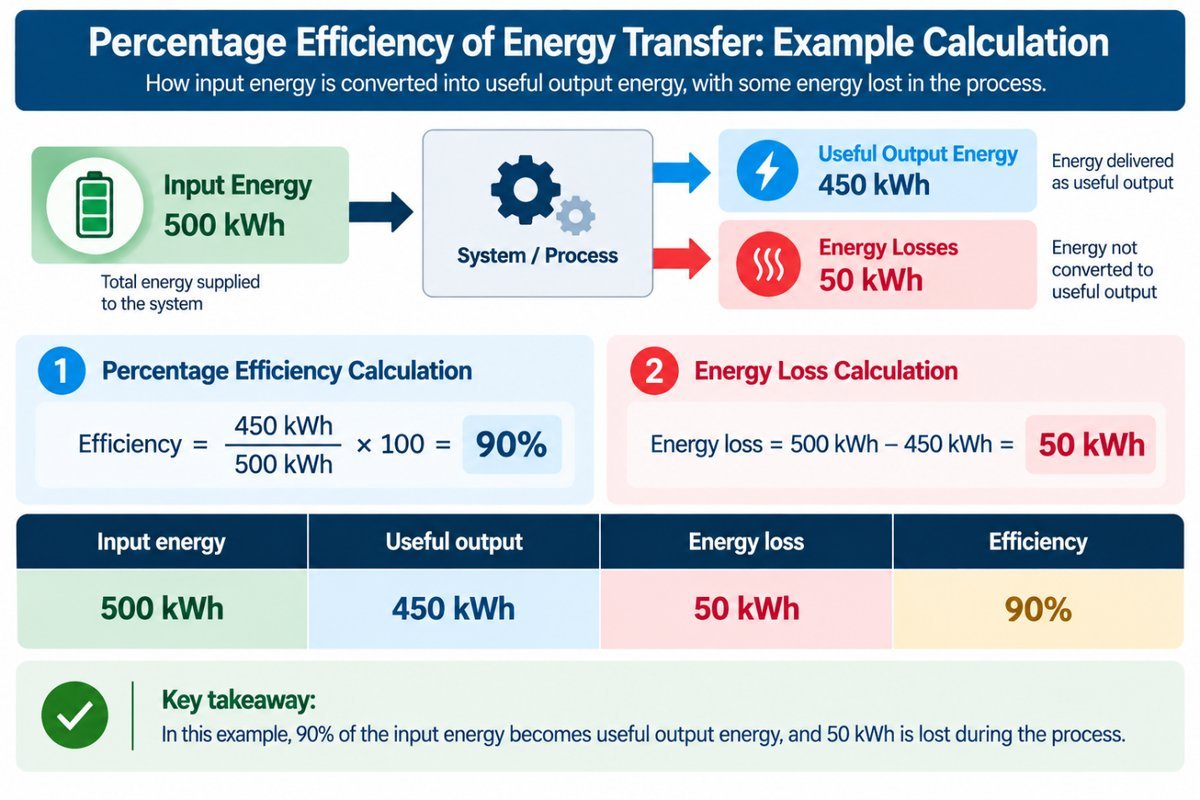
This means that 90% of what we measured as input became useful output under the conditions defined for that calculation. It doesn’t imply that the same process will operate at 90% at all times. When operating conditions, equipment configuration, or measurement boundary changes occur, actual efficiency changes.
Being able to tell the difference becomes significant when comparing the energy storage efficiency of batteries, inverters, or storage systems.
Where Does Energy Get Lost During Energy Transfer?
Energy is transferred or converted rarely without losses. The specific sources depend on technology, equipment, and the measurement boundary. Electrical systems typically suffer from losses, including resistance losses, switching losses, conversion (or transformation) losses, and internal equipment losses.
Electrical and Conversion Losses
Resistive conductors experience electrical loss as current flowing through them produces heat. Sometimes, electronically powered equipment wastes energy while converting electrical forms through switching. In the case of storage applications, the electrochemical system causes battery losses, whereas the inverter or power conversion systems cause further conversion losses.
Transformers may also cause losses by virtue of their electrical and magnetic operating characteristics. Energy losses occur as energy flows through multiple components instead of transferring directly from the source to the end load.
Thermal and Auxiliary Loads
Not all energy losses are in the energy-conversion path itself. A variety of equipment might consume electricity for cooling, heating, and standby functions. They’re often called auxiliary loads or balance-of-system consumption.
For a battery energy storage system, these loads could become relevant because the system requires thermal management and control equipment during the time periods when the battery is not converting energy.
Why Energy Loss Is Not One Fixed Percentage
A constant efficiency assumption can make for an easy calculation but does not capture the reality of storage operation. Sandia National Laboratories reports that charge and discharge efficiency can depend on state of charge, temperature, and charge/discharge power. Consequently, its investigation concludes that the generic constant-efficiency models may misrepresent the actual performance of storage systems.
For this reason, the efficiency percentage given must always be considered with the operating conditions and the measurement method by which it was obtained.
How Does Percentage Efficiency Apply to Battery Energy Storage Systems?
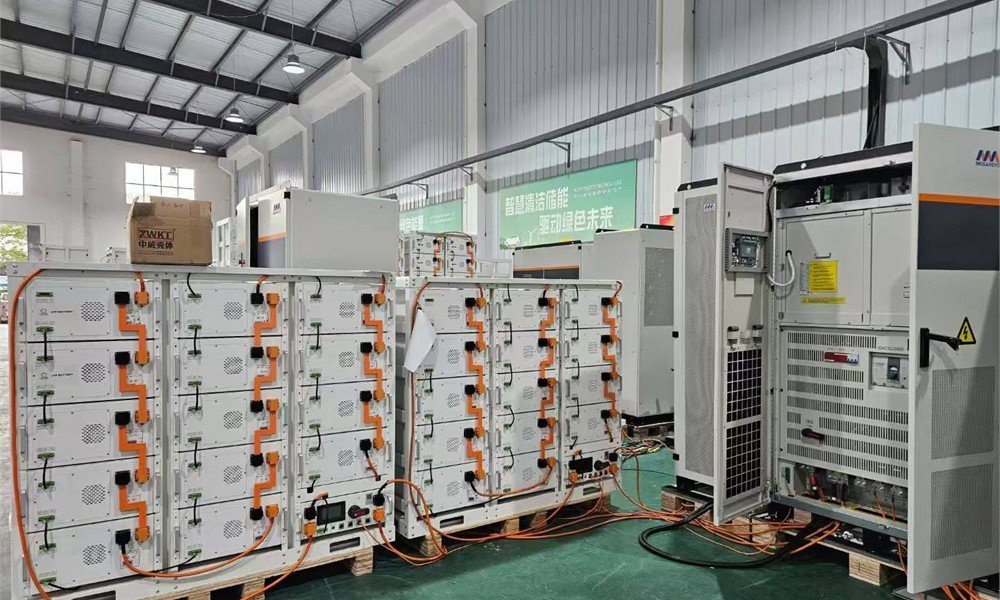
A <strong>Battery Energy Storage System (BESS)</strong> uses the same efficiency concept applied to a more complex energy path. A simplified pathway can be represented as grid or PV → PCS/inverter → battery → PCS/inverter → AC load or grid. The measurement of energy can be done at various points along this pathway, so that the energy storage efficiency obtained partly depends on the selected measurement boundary.
Battery Efficiency
Battery efficiency refers to how well the battery stores or releases electrical energy under a specified test condition. The entire storage installation’s efficiency should not automatically be taken as that of the effective part. If PCS and other equipment losses are to be excluded, measurements should be at the battery level.
PCS and Inverter Efficiency
PCS, or an inverter, is responsible for electrical conversion between DC and AC. BESS efficiency is therefore an important component of BESS efficiency and only one stage of the complete energy pathway. If other equipment uses or loses energy, a system can still have an efficient PCS and lower overall efficiency.
Round-Trip Efficiency
Round-trip efficiency assesses how much energy is recovered from storage, compared with the energy required to charge it under specified starting and ending conditions. According to Sandia and DOE documents, results for different boundaries are distinguishable (e.g., DC-to-DC and AC-to-AC), explaining why the same storage system can have disparate results.
HBOWA Expert Insight: A battery’s efficiency, an inverter’s efficiency, and a complete BESS’s round-trip efficiency are not interchangeable metrics.
Why Can Two BESS Efficiency Figures Look Very Different?
Even if two reported BESS efficiency figures concern the same storage technology, they may differ. Measurement thresholds are often the case. An efficiency outcome measured at the battery is not necessarily going to include the same equipment or losses as one measured at the AC connection point.
Measurement Boundary Changes the Result
A storage system can be assessed at the level of the cell, battery DC, DC bus, PCS, AC system, or point-of-interconnection. Measuring the efficiency of the conversions of a device can be done either in a DC-to-DC efficiency measurement or in an AC-to-AC efficiency measurement. A DC-to-DC measurement can focus on the battery and DC pathway. An AC-to-AC measurement can take into account the power conversion as well as other system-level losses.
According to Sandia, round-trip efficiency can mean overall DC-DC or AC-AC performance, including losses in electronics and self-discharge. It further mentions that since there is AC grid interaction at the point of interconnection, AC-AC efficiency is more relevant to utilities.
A Sandia analysis shows the effect. A system was tested that achieved 89% DC-to-DC round-trip efficiency without measured balance-of-plant losses, 83% with those losses included, and 76% on an AC-to-AC basis. These are results of a specific test, not universal industry norms. It shows why any efficiency percentage must also have a measurement boundary.
Maximum Efficiency and System Efficiency Are Different
The maximum efficiency of a manufacturer is a specific condition. Measured performance should not ipso facto be assumed as whole-system performance. In a real-world efficiency, you must define what equipment this warranty is based on and how it was derived.
What Factors Affect Energy Storage Efficiency?
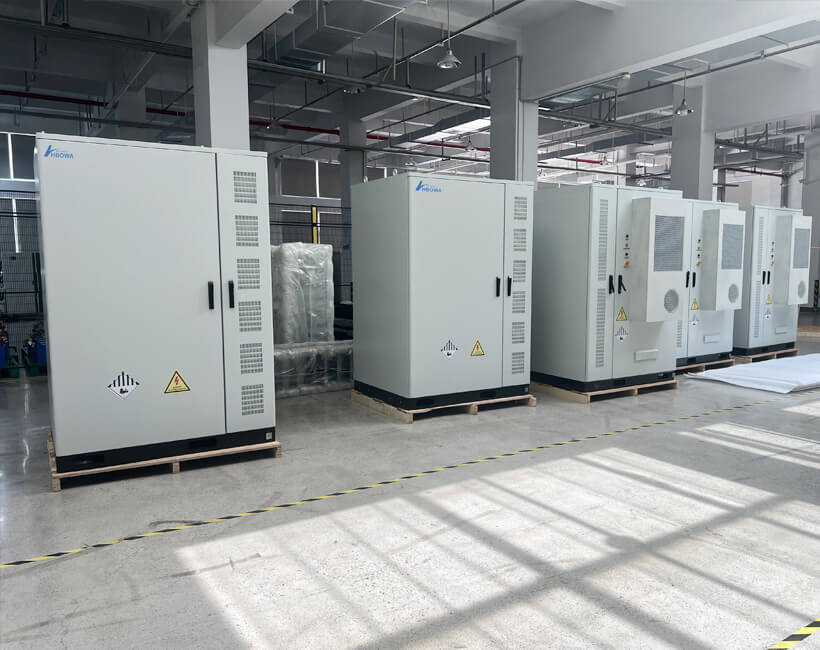
This energy storage system has an efficiency that varies in operation. Thus, it is a performance in a specific application and not a guarantee of performance at every operating point. The performance of storage technologies depends on the operating features and characteristics of the technology, system configuration, Sandia research, and DOE energy-storage assessments.
Charge and Discharge Power
The charge-discharge rate can affect the battery efficiency and power electronics operation. An efficiency measure taken at one power level should not be applied to another. This is especially the case when the BESS operates at a wide range of loads, and not continuously at rated power.
State of Charge and Temperature
State of charge indicates how much energy a battery stores. The functional dynamics of a battery can differ across the range of its usable SOC. Temperature can affect electrical performance as well as the energy required for thermal management. Thus, one should regard these variables when interpreting measured energy storage efficiency.
Auxiliary Consumption and System Design
The functions of cooling, heating, fans, pumps, controls, communications, and monitoring can consume electricity other than that of the battery charge and discharge. The system design will also determine the number of conversion stages through which the energy passes. A <strong>hybrid energy storage system</strong>, for instance, may have a distinct energy pathway from a standalone battery installation.
In this regard, HBOWA experts suggest that the ideal efficiency of the system must be assessed at the operating conditions reflective of the use, rather than being considered as a fixed property of the battery.
How Should Buyers Compare BESS Efficiency Ratings?
We can’t just look at which BESS efficiency has the highest percentage on the datasheet. EPCs, distributors, and other buyers of energy storage tech should first determine whether the numbers refer to comparable systems and test conditions.
Check What the Percentage Actually Measures
Before assessing the battery storage efficiency, it is necessary to determine the measurement boundary and whether the results are DC to DC, AC to AC, component to system, or system to system. Check if auxiliary loads, transformers, controls, and other balance-of-system equipment are included. Documentation should also include test power, temperature, SOC range, charge and discharge conditions, and test methodology.
Compare Like With Like
If two suppliers use different measurement boundaries, a higher percentage is not necessarily a better result. The battery-level efficiency number can appear to be higher than the complete system number simply because fewer losses are involved. The right way is to compare results computed using equivalent definitions and under the same conditions.
This idea strongly supports the development of Sandia’s energy-storage data, which abstracts separated subsystem specifications (e.g., power-conversion efficiency) from storage-system performance specifications.
Look Beyond Efficiency Alone
Energy storage system efficiency is not everything. Usable energy, power capability, degradation, operating temperature, safety, warranty, availability, auxiliary consumption, and application must also be considered. A technically fit BESS is one that meets the project’s performance criteria, based on its expected operating conditions, and not simply the one with the greatest published percentage.
Real Energy Storage Examples: Why Application Context Matters
Real-world projects illustrate that one cannot just take an isolated percentage of energy storage efficiency, but also consider it in relation to the application. The various projects documented by HBOWA utilize different power ratings, storage capacities, operating objectives, and system configurations. The differences impact different ways of generating, storing, converting, and using energy.
| Project | System configuration | Main application | What it illustrates |
|---|---|---|---|
| Poland | 50 kW / 301 kWh | -Solar storage -Peak shaving -Load shifting | Operating strategy affects energy use |
| Romania | 100 kW / 200 kWh | -Self-consumption -Peak shaving -Backup | One system can support several objectives |
| Togo | 300 kW PV + 400 kWh battery | -Off-grid solar + storage | Site conditions influence system operation |
| Vietnam | 241 kWh cabinet + 80 kW inverter | -Commercial power support | Integrated equipment affects the system boundary |
The storage system utilized for peak shaving and load shifting at the factory in the Poland project is a 50 kW/301 kWh system. The Togo project is a combination of 300 kW of PV and 400 kWh of battery storage used off-grid. BESS efficiency, as measured in the projects, is not published, so one may not use these configurations to calculate or infer it.
What Does a Product Efficiency Rating Actually Tell You?
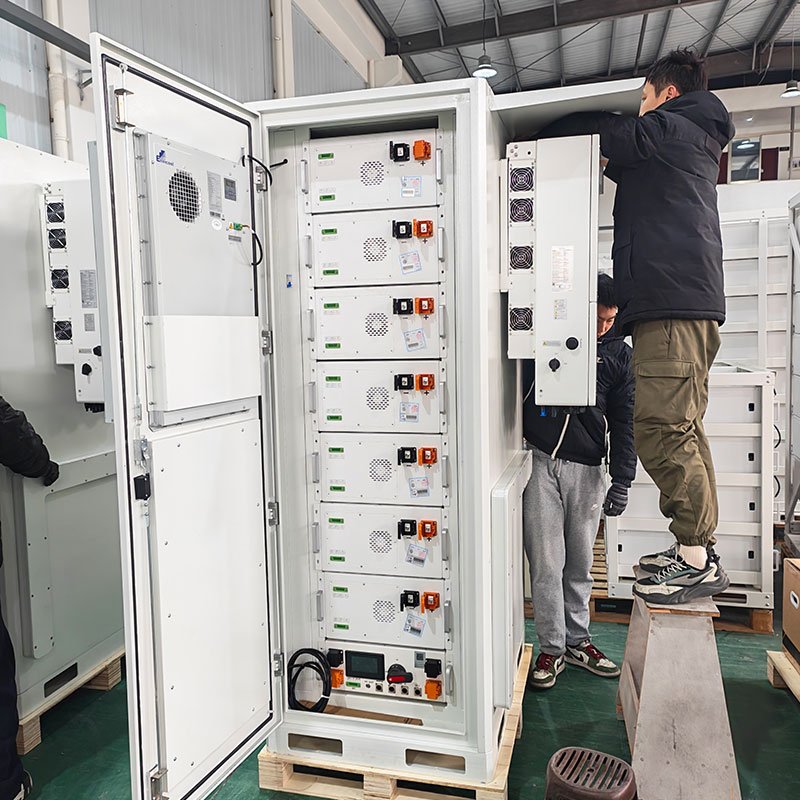
A rating for product efficiency tells you something, but what it means depends on how the manufacturer defines it and on the conditions under which product testing was conducted. For instance, in the specifications list for HBOWA’s one-stop energy storage cabinet, its 20kW/50kWh, 30kW/60kWh, and 50kW/107kWh configurations list a 98.30% maximum efficiency.
Maximum is the word that is important. This specification should not be taken as the round-trip efficiency of the whole system. A difference also exists from a measured field result that includes all auxiliary load and operating conditions.
When purchasing an energy storage cabinet or any other storage equipment, there manufacturers datasheet should be checked for their stated measurement boundary, test conditions, and efficiency definition. Supplier comparisons will be more meaningful, and one should not consider various types of efficiency figures to be equivalent.
Conclusion
The proportion of useful energy output to the input energy is used to calculate its efficiency. The percentage alone is not sufficient for energy storage. The measurement boundary, operating conditions, conversion pathway, and auxiliary consumption of the energy storage efficiencies reported should also be assessed by the buyers.
Frequently Asked Questions
A conventional energy-transfer process can’t exceed 100% efficiency when the useful output energy is properly compared with the energy entering the system. If the value exceeds 100%, the assessment boundary, energy source, assessment units, or calculation method must be investigated first.
A full round-trip efficiency for BESS can take into account losses from several stages not included in an individual component rating. The result may include the battery, PCS/inverter, controls, cooling, auxiliary equipment, wiring, and other balance-of-system loads, depending on the measurement boundary. Thus, a component efficiency should not replace that of complete-system performance.
Not necessarily. When the energy storage efficiency improves, the energy losses can decline, but the choice of system also depends on usable capacity, power capability, degradation, operating conditions, safety, warranty, availability, and application requirements. To start with, the two systems should be compared using equivalent measurement boundaries and test conditions.
The EPC should ask for the efficiency definition, the efficiency measurement boundary, the test conditions, charge and discharge power, SOC range, temperature, auxiliary-load treatment, and the test procedure. Operating data that are measured can add further evidence of performance and operation. When test conditions differ, only comparing headline percentages can be misleading.
A rated or maximum efficiency value refers to performance under conditions specified by the manufacturer or test method. Measured operating efficiency is the operating efficiency of a system in the defined operation. The two values can vary over time because of changes in power, temperature, SOC, auxiliary consumption, etc.