
Introduction
The terms ESS vs BESS are often compared to each other. An Energy Storage System includes several types of storage ways/technologies, while a Battery Energy Storage System is one such type. This guide explains the differences and uses, and it will help you choose what’s best for your energy needs.
ESS vs BESS
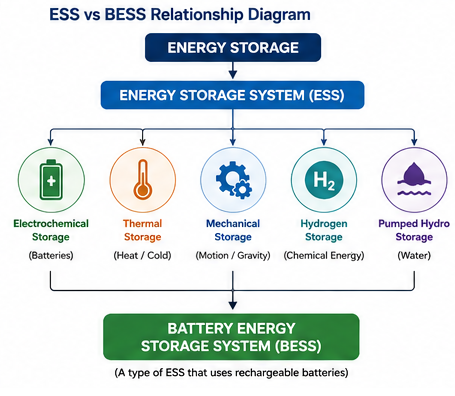
To put it simply, ESS vs BESS refers to an energy storage system versus a battery energy storage system. The former is a broad and generic term, while the latter, BESS, defines systems that specifically use rechargeable batteries to store electricity. A battery energy storage system (BESS) is therefore an energy storage system (ESS), but an ESS isn’t necessarily a BESS.
Understanding ESS:
An Energy Storage System (ESS) is a broad term. The energy stored will be electrical, mechanical, thermal, chemical, or another technology determined.
What Makes a BESS Different?
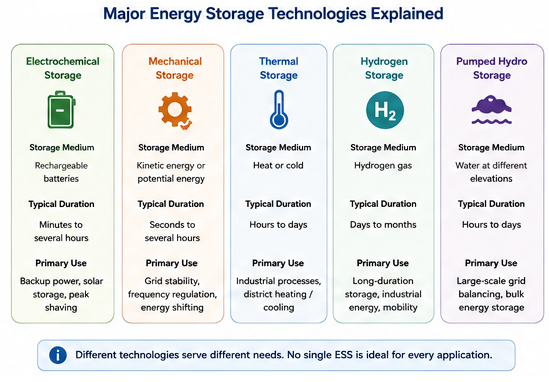
In contrast to other storage technologies, which involve mechanical movements or thermal processes, a battery energy storage system responds almost instantaneously to changes in electricity demand. This has made it one of the most popular battery storage solutions for commercial or industrial and renewable energy programmes.
The most commonly battery used in present-day systems is a lithium-based battery, with many applications opting for LiFePO4 batteries since they offer long cycle life, stable thermal features, and low upkeep.
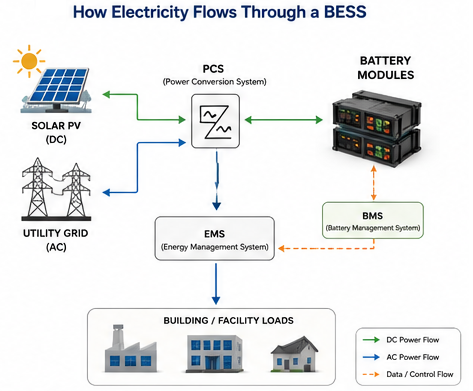
A current battery energy storage system is much more than battery modules in a box. The system uses intelligent control and power conversion technologies to operate safely and efficiently. Battery Management System (BMS) monitors battery health and working conditions in real time. The PCS converts direct current to alternating current and vice versa. The Energy Management System (EMS) manages charging and discharging, as well as overall operation, depending on energy demand and operating objectives.
Which Differences Actually Make Them Apart?
The decision between ESS vs BESS should be based on operational needs and not the name. The appropriate answer will depend on how energy will be stored, how quickly it must be supplied, how long it must be available, and whether the system may have to grow. It is important for project owners to look beyond definitions in order to select an energy storage solution that meets their current needs and supports their long-term energy strategies.
Due to their compact design, they are also suitable for commercial energy storage, industrial battery storage, and solar battery storage projects where space and installation time are a concern.
Decision Matrix:
| Decision Factor | ESS | BESS |
| Technology | Multiple storage technologies | Electrochemical battery storage |
| Installation | Depends on technology and project scale | Modular and relatively straightforward |
| Expandability | Technology dependent | Easily expanded with additional battery modules |
| Response speed | Varies | Very fast |
| Efficiency | Technology dependent | Generally high for modern lithium battery systems |
| Maintenance | Varies by technology | Digital monitoring simplifies maintenance |
| Long-duration capability | Strong for selected technologies | Best suited for short- to medium-duration storage |
| Renewable compatibility | Depends on configuration | Excellent for solar and wind integration |
| Commercial suitability | Selected applications | Widely adopted |
| Residential suitability | Limited for many technologies | Common |
| Industrial suitability | Yes | Yes |
| Future scalability | Technology dependent | High due to modular design |
Where Are ESS and BESS Used?
Different energy storage technologies address different operating challenges. The question of whether one technology is superior to another is less important than whether a particular energy profile application will be best served by a given system. This sensible way forward sheds light on the common co-deployment of ESS and BESS across much of today’s energy infrastructure.
Typical Applications of ESS and BESS
| Application | ESS | BESS | Why? |
| Homes | ✓ | ✓ | -Backup power -Improved solar utilization |
| Commercial buildings | ✓ | ✓ | –Peak shaving -Energy cost management |
| Factories | ✓ | ✓ | -Power quality -Operational continuity |
| Hotels | ✓ | ✓ | -Backup for critical services |
| Data centers | ✓ | ✓ | -High availability -Quick response |
| Telecom | ✓ | ✓ | -Continuous network operation |
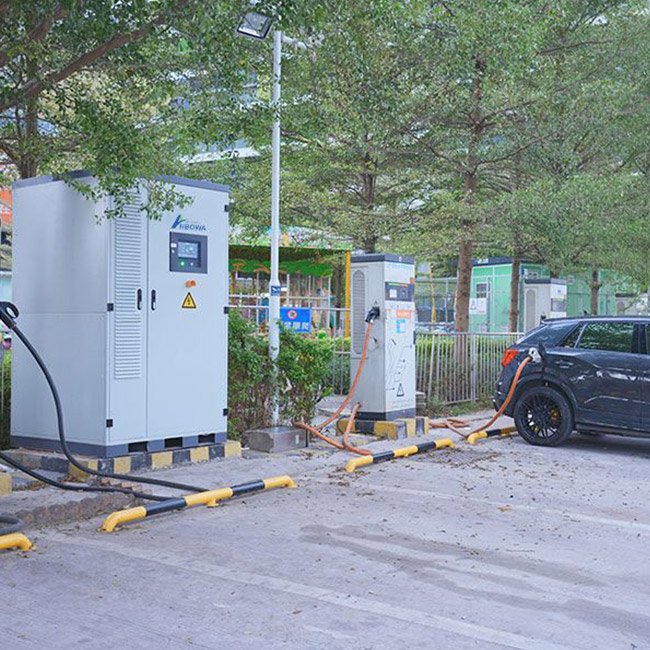
| EV charging | Limited | ✓ | -Fast response to fluctuating demand |
| Microgrids | ✓ | ✓ | -Stable local energy management |
| Solar farms | ✓ | ✓ | -Renewable energy integration |
| Utilities | ✓ | ✓ | -Grid balancing |
7. Real Projects: How BESS Solves Different Energy Challenges
The requirement for energy storage can be grossly different from one project to another. The best-rated solution depends more on the power demand of the site, the operational profile, and the goal of the business than on the size of the battery used.
 :
:
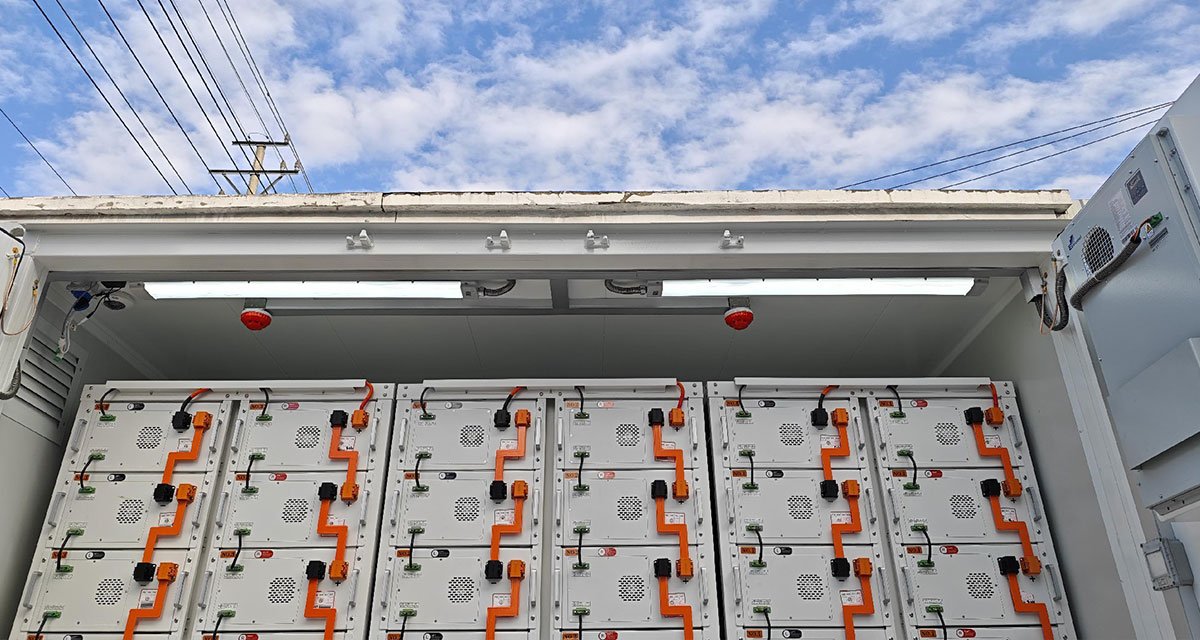 :
:For industrial units, the reduction in the highest power demand can keep the plant running with no expense of the higher grid power. A 200 kW/500 kWh Battery Energy Storage System was happened to be present in Malaysia for peak shading.
Romania:
A hotel requires an uninterrupted power supply round the clock because even for small outages, customer services may get affected, as well as the business. A battery storage unit of 100kW/200kWh was available in Romania to support the load during power cuts.
Philippines:
A project in Bohol, Philippines, which includes battery storage, shows how to harness surplus daytime solar generation and store energy for usage during high-energy consumption periods. For business owners with rooftop solar, consuming energy generated on-site gives greater benefit than exporting excess electricity.
Papua New Guinea:
In Papua New Guinea, diesel generators are used for supplying energy in several remote locations. But a hybrid solar-plus-storage project demonstrates that inclusion of battery storage alongside renewable generation can reduce dependency on diesel generators for energy and can provide a more reliable source of power supply in areas with lacking infrastructure.
How to Choose Between ESS and BESS
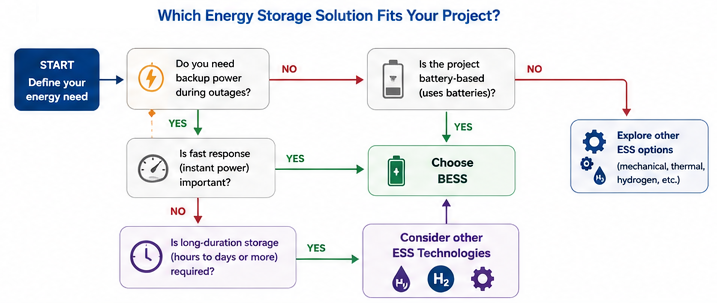
When you look at ESS vs. BESS, understand that the project requirements and not the preferences of technology should be the deciding factor. Every application has different operating priorities. How the energy will be generated, stored, and used over time becomes a selection criterion for the most appropriate solution.
When the primary objective is having reliable backup power, battery storage is a top choice. The fact that this solution provides an immediate response makes it practical for a wide range of requirements. Also, when solar energy is required (incorporated into a project), BESS often tends to be the best match. During the daytime, when the solar generation is in surplus, the battery bank will store it. Consumption happens when energy production is lower.
If storage duration is significant or if the project is utility-scale energy balancing, it is also possible to assess other ESS technologies depending on the project goals. Also, for future expansion (when motors run slowly), the storage solution should be expanded. Utility-sized battery banks have been installed to provide a few MWh of storage. The customer requirements expect several GWh or even a TWh of storage. Residential installations invariably want the simplicity and freedom of energy. Commercial and industrial projects are primarily interested in demand management, the ability to track and continue operations, and seeing returns on the investment.
Decision Flowchart
Components of a Modern Battery Energy Storage System
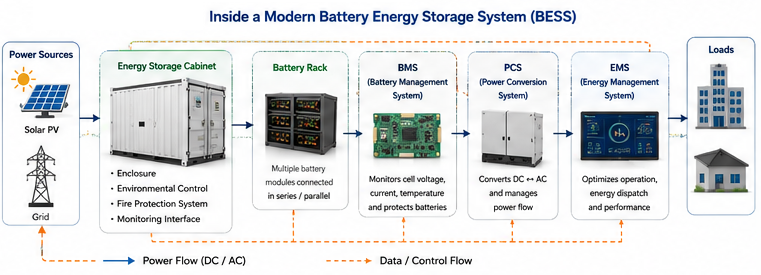
Battery Storage is the need of the hour. A modern Battery Energy Storage System (BESS) is a well-integrated platform where all the system components have roles to play. Each of these components communicates with the others while functioning to get a sense of how each of the system is performing.
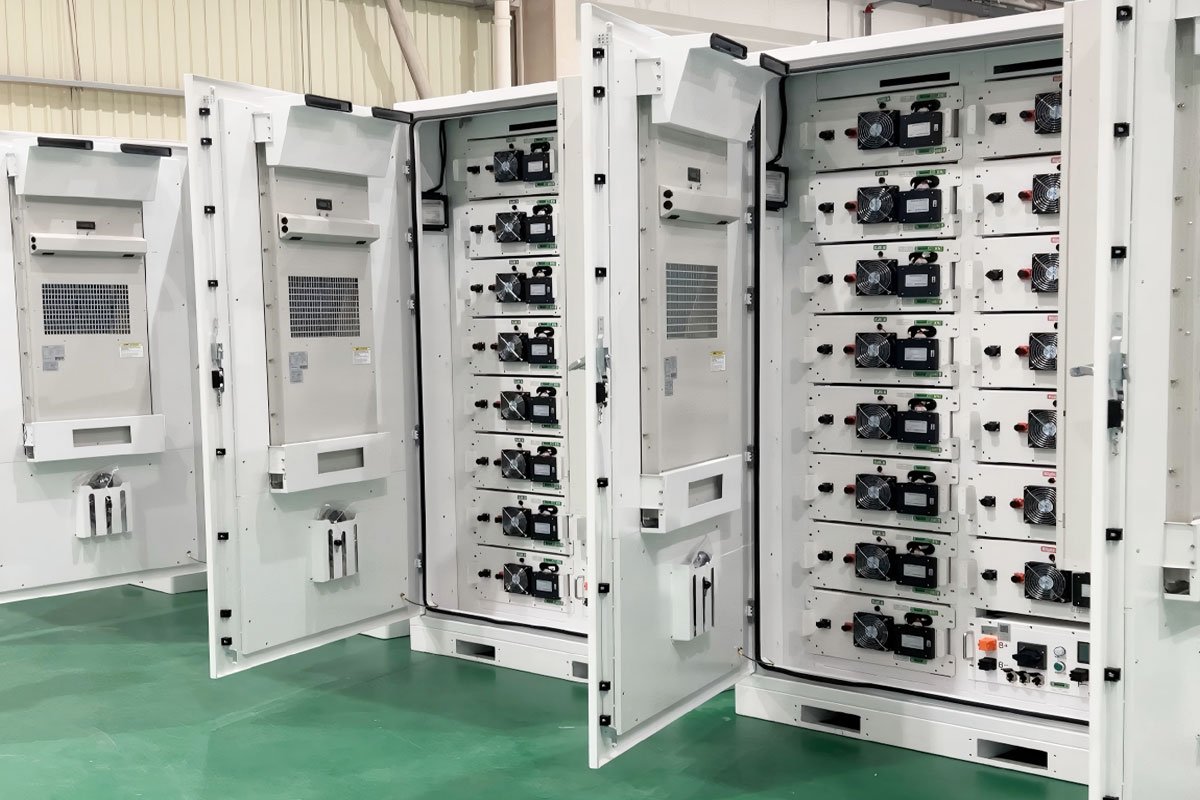
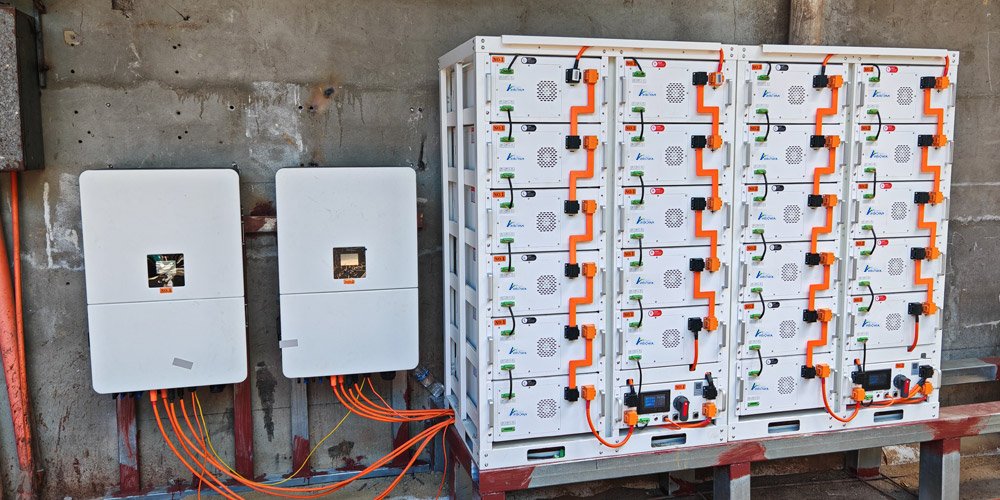
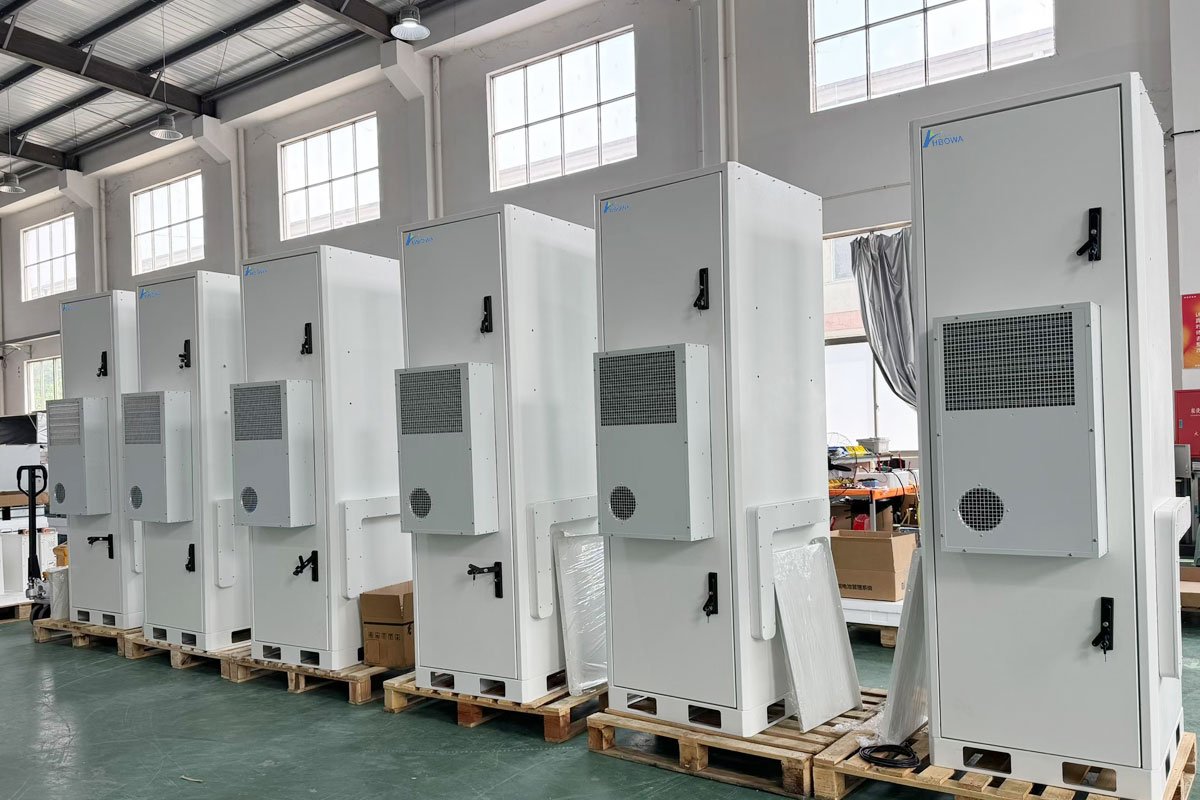
Battery modules store electrical energy, and they can be added up to increase the system capacity. They are assembled in a sequence to form storage battery racks. The battery racks are enclosed inside an energy storage cabinet to provide structural safety. For commercial and industrial applications, battery modules and supporting components may be integrated into an integrated C&I BESS cabinet.
The Battery Management System (BMS) has a clear-cut task to monitor voltage, current, temperature, and state of charge for each battery module. Power Conversion System (PCS) converts DC to AC for electrical load use. Above that, the Energy Management System (EMS) takes care of everything, such as charging, discharging, and operational schedules, to meet energy goals. Working on an energy storage system cooling system, maybe an air cooling system or a liquid cooling system, to control the system operating temperature.
Simplified BESS Architecture
Common Misconceptions About ESS and BESS
ESS is often confused with BESS. Several misconceptions and confusions exist about the same. One of the most believed myths is that every Energy Storage System involves batteries. However, batteries are only one category, and there are several other types. Similarly, every battery bank is not a Battery Energy Storage System, or BESS. The battery bank should have an intelligent control, power conversion, protection, and monitoring system, and thereby it becomes a BESS or Battery Energy Storage System. Another common belief is that BESS runway works with solar panels.
However, battery systems can also work with the utility grid, wind generation, diesel generators, or hybrid power systems. ESS is also sometimes taken as an alternative to an Uninterruptible Power Supply or UPS. UPS and ESS, though both give stored energy, have different roles, operating durations, and applications.
Future Trends in Energy Storage
A growing share of renewables in energy deployment and an ever-more flexible electricity system have already redrawn the storage landscape. Lithium iron phosphate (LiFePO4) batteries are becoming widespread because of their high-cycle life and inherently safe functioning. Flexible deployment for commercial and industrial projects is done by modular containerized systems, and different operating requirements are fully met by hybrid Energy Storage Systems with batteries and other storage technologies.
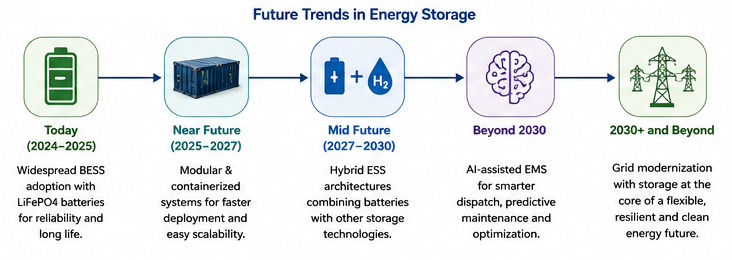
The charging strategy, system optimization, and predictive maintenance have been improved with AI-assisted Energy Management Systems. Energy Storage is an important grid modernization and clean integration technology worldwide, as stated by the International Energy Agency (IEA).
Frequently Asked Questions
Can a Battery Energy Storage System be added to an existing solar power system?
Yes. In most cases, a Battery Energy Storage System (BESS) can be integrated with a solar installation already present if the inverter, electrical infrastructure, and battery are compatible. A technical evaluation is suggested to determine if emergency equipment or modifications will be necessary for safe and efficient operation.
How do you determine the right BESS size for a project?
Determined by day-to-day electricity usage, peak demand, backup duration, green power production, and anticipated future growth, the right BESS size is different for different uses. The required Power output (kW) and storage capacity (kWh), both of which must again correspond to the system’s working requirements, are the two parameters to be evaluated.
What is the difference between battery power (kW) and battery capacity (kWh)?
The amount of electricity a battery can produce at a time is revealed by battery power, which is calculated by kilowatts (kW). The amount of electricity it can store is denoted by battery capacity, and it is calculated by kilowatt-hours (kWh). Both values are significant as they determine the energy storage performance and power duration of backup.
Do all Battery Energy Storage Systems use lithium batteries?
No. BESS may use lithium-based batteries, specifically LiFePO4 batteries, or lead-acid, Sodium-Ion, Flow batteries, or any other chemistry-based batteries. There are different suitable technologies that fit different projects, expected operational conditions, budgets, and performance objectives.
Can a Battery Energy Storage System support EV charging stations?
Yes. The experience of the Bureau of Energy Efficiency in India is that BESS is increasingly being used with EV charging infrastructure to reduce peak demand, improve reliability of charging, and use renewable power better. BESS may save energy during low demand periods and supply it during charging peaks to reduce pressure on connecting to the local grids.
What safety features are included in a modern Battery Energy Storage System?
Modern BESS now has various safety features like Battery Management Systems (BMS), Thermal Management, Fire protection and detection, Electrical protection devices, and Continuous system monitoring. These have reduced the operational risks and improved long-term reliability and system performance.
Can a Battery Energy Storage System be expanded after installation?
A lot of modern BESS solutions are designed with a modular architecture. If the system needs extra energy requirements for the future, then additional battery modules, a rack, or a cabinet can be installed in the system. The expansion capability of the system is defined by the system’s original design, capacity of the inverter, available space in the installation, and the compatibility of the existing equipment.
What should businesses evaluate before investing in a Battery Energy Storage System?
For businesses, they should assess their electrical energy consumption patterns, peak demand charges, backup power requirements, the energy generation from renewable energy systems, any free installation space in the installation, and future energy goals before buying a BESS. Pre-evaluating these criteria before purchasing a BESS ensures that the bought system is performing well, scalable, and economically valuable in the long term.
Conclusion
ESS and BESS are not the same. ESS is a storage system, and BESS is one of the systems that comes under the ESS category. Every application, performance requirement, scalability, and long-term energy goals require different solutions instead of using a single technology for all the components.