
mAh to Wh Calculator
Formula: Wh = (mAh × V) ÷ 1000
How to Convert mAH to Wh
To convert mAh to Wh, you can use this formula:
Wh = (mAh × V) ÷ 1000.
For example, a 10000mAh battery has a total energy capacity of 10000 × 3.7 ÷ 1000 = 37Wh. Using the mah to wh calculator will ease the process for larger batteries or more than one battery. It allows users to calculate real-life power delivery and save people from using confusing mAh ratings.
Practical mAh to Wh Conversion Table
When a battery’s mAH capacity and nominal voltage are known to us, we can calculate its real-world energy capacity in Watt-hours using the formula. The table below shows common conversions for different voltages:
| Capacity (mAh) | Voltage (V) | Energy (Wh) | Typical Use Case |
| 2,600 | 3.7 | 9.62 Wh | Smartphone battery (typical single-cell Li-ion) |
| 3,000 | 3.7 | 11.1 Wh | Compact electronics / small rechargeable devices |
| 5,000 | 3.7 | 18.5 Wh | Small power bank |
| 8,000 | 3.7 | 29.6 Wh | Travel power bank (lightweight) |
| 10,000 | 3.7 | 37 Wh | Standard power bank |
| 15,000 | 3.7 | 55.5 Wh | High-capacity power bank (daily carry) |
| 20,000 | 3.7 | 74 Wh | High-capacity power bank |
| 26,800 | 3.7 | 99.16 Wh | Airline-friendly power bank (commonly kept under 100Wh) |
| 30,000 | 3.7 | 111 Wh | Airline limit zone (under 100Wh preferred) |
| 40,000 | 3.7 | 148 Wh | Large power bank / field charging (often restricted on flights) |
| 50,000 | 3.7 | 185 Wh | Often exceeds airline limits |
| 5,000 | 3.2 | 16 Wh | LiFePO4 solar cell / small LiFePO4 pack |
| 10,000 | 3.2 | 32 Wh | LiFePO4 solar storage (portable) |
| 15,000 | 3.2 | 48 Wh | LiFePO4 battery module (DIY / backup loads) |
| 20,000 | 3.2 | 64 Wh | LiFePO4 battery pack |
| 30,000 | 3.2 | 96 Wh | LiFePO4 pack for small off-grid / RV auxiliary loads |
| 40,000 | 3.2 | 128 Wh | LiFePO4 storage block for portable solar generator builds |
| 5,000 | 7.4 | 37 Wh | 2S Li-ion pack (cameras, portable tools, testing equipment) |
| 10,000 | 7.4 | 74 Wh | 2S Li-ion pack (high-capacity handheld power / field gear) |
| 5,000 | 11.1 | 55.5 Wh | 3S Li-ion/LiPo pack (drones, RC systems, portable rigs) |
The mah to wh table above will help you estimate (and compare) different battery chemistries you are likely to use. You might now know how to convert mah to wh, but still want to get the complete value fast. You can always use the mah to wh calculator to make things faster.
Step-by-Step: Sizing Solar Batteries Using mAh to Wh
Step 1: Calculate Your Daily Energy Needs
List all applications and their power consumption. Multiply watts by hours of daily use to get Wh per day.
Example: 300W refrigerator x 8 hours = 2400 Wh/day.
Step 2: Determine System Voltage
Choose your battery system voltage(12V, 24V, or 48V), higher voltage systems are more efficient for larger loads.
Example: 48V system for medium to large setups.
Step 3: Convert Wh to Required Amp-Hours
Divide your total Wh by system voltage to get the required Ah capacity.
2400 Wh / 48 V = 50 Ah needed.
Step 4: Apply Battery Chemistry(mAh to Wh)
Using LiFePO4(3.2V cells), calculate individual cell energy using mAh to Wh formula.
10000 mAh x 3.2 V / 1000 = 32 Wh per cell.
Step 5: Factor in Depth of Discharge & Efficiency
Account for 80% DoD(LifePO4) and 90% system efficiency. Increase capacity by 40%.
50 Ah / (0.8 x 0.9) = ~70 Ah actual battery needed
Learning and understanding 10000mAh to Wh conversions allows users to be more precise during the design of any system, whether it’s for LiFePO4 packs in off-grid solar systems or power banks.
Solar Products for Your Project
Solar Panels | Solar System | C&I Battery Storage |
 |  |  |
Why Voltage Matters
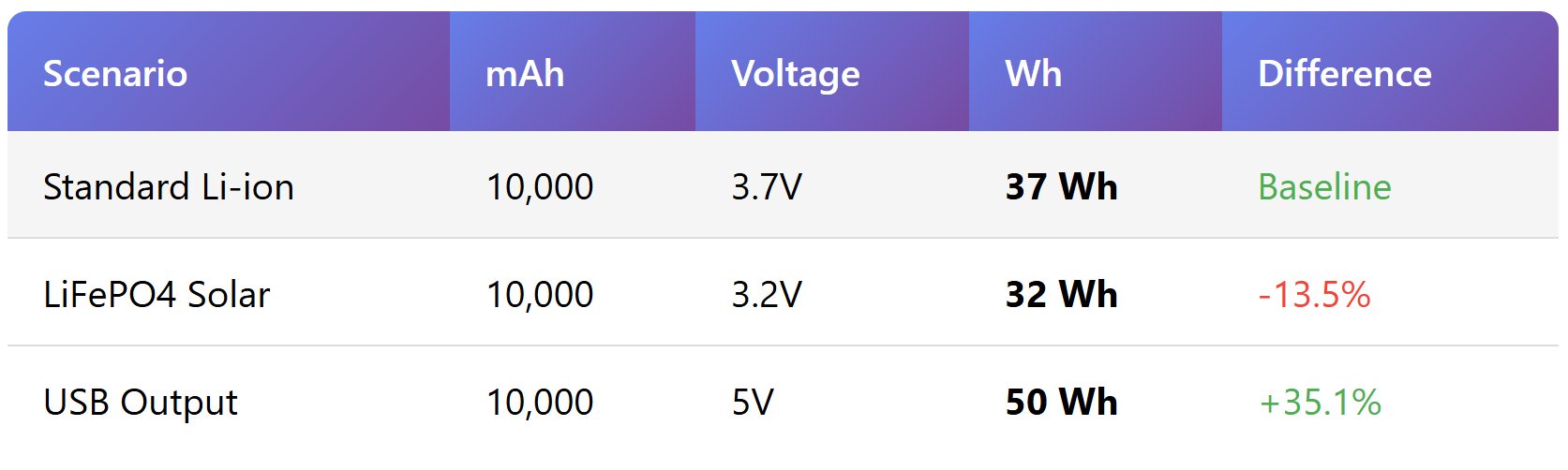
The only milliamp-hour value isn’t enough to judge the service life of a battery. This is because voltage has a major role in it, as voltage is the potential at which the current is released. If two batteries have a voltage varying with their mAh, you will never be able to calculate the energy in them only by their mAh. Such as a 10,000 mAh Li-ion cell, voltage 3.7 V, will provide 37Wh etc.

A 10,000 mAh battery at 5 V will deliver 50Wh. Also, LiFePO4 cells have a nominal value of 3.2 V, hence the calculation should be done based on it. This holds to avoid oversizing or undersizing a solar or storage system.

Checking the voltage will ensure that the Wh is accurately converted from mah, and also allow more reliable energy planning for solar panels, inverters, and battery packs.
Battery Chemistry Comparison
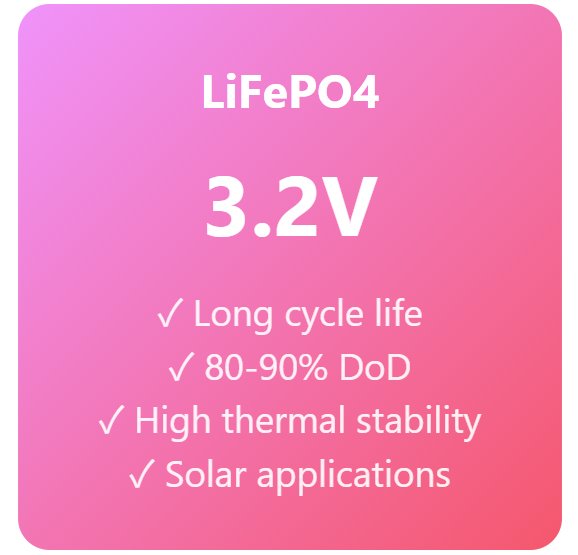
Different battery chemistries affect energy storage and performance. LiFePO4 cells are very effective chemistries, offering a nominal voltage of 3.2V. They also offer termination at 2.5–2.8V, which means they offer a long cycle life with very high thermal stability. It also discharges between 80–90%.
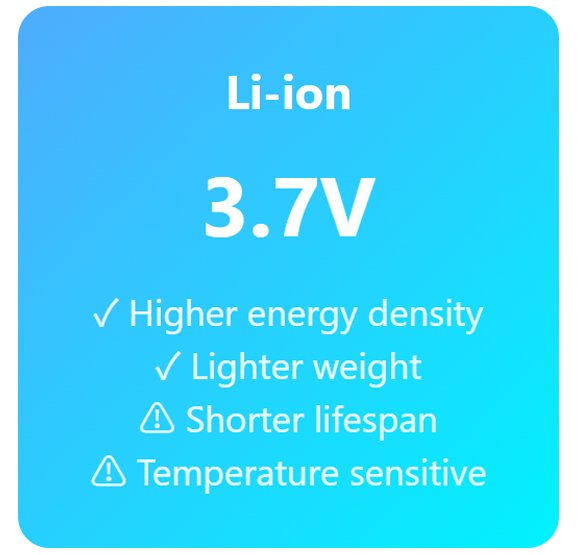
Standard Li-ion cells offer a nominal voltage of 3.7V. It has a slightly higher energy density, although it also has a little less cycle life and may not perform well in a high-temperature environment.
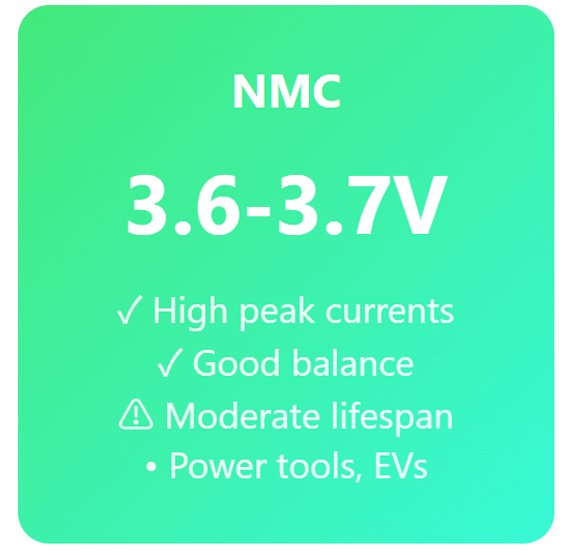
The NMC or the LFP variant often used offers a bit higher peak currents and may often affect the sizing calculations. The above differences would often help Mah to Wh conversions reflect usable energy. It also avoids oversizing or undersizing a system. This can allow selecting a compatible set of solar modules. It will often undergo efficiency from the internal resistance, temperature, or conversions during charging. The systems are often for off-grid or backup systems.
Real-World Case Study: Solar Backup & LiFePO4 Example
When you are thinking of sizing a battery for a solar backup application using solar, you need to convert mAh to Wh accurately. Here’s a quick case study to understand why we convert mAh to Wh.
Let’s say for a small solar off-grid setup, you are required to power a 300 W refrigerator for 8 hours overnight. So the total energy requirement will be 300 W x 8 hrs = 2,400 Wh.
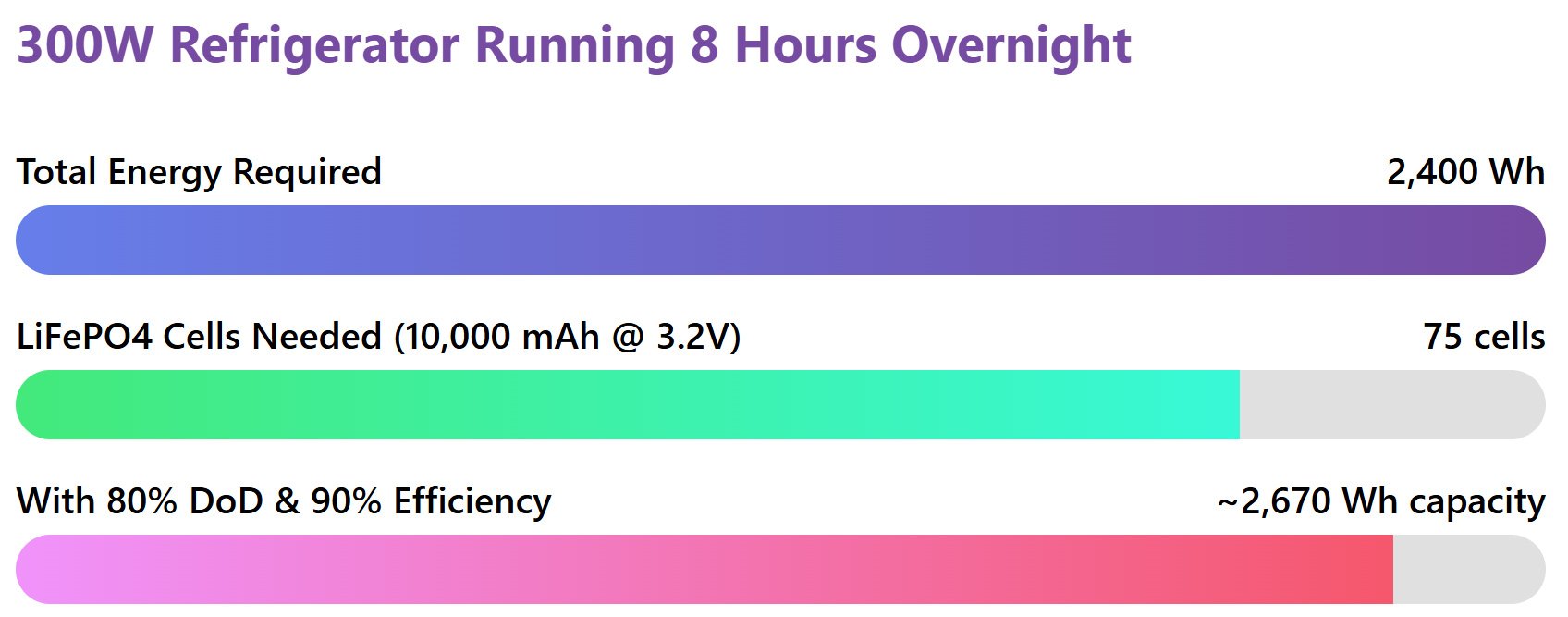
To size the batteries, you will use HBOWA‘s LiFePO4 batteries that are rated at 3.2 V per cell as the working nominal voltage. Now, let’s find the required amp-hour capacity of the LiFePO4 cell to power the refrigerator.
First, find the Total battery Ah needed: 2,400 Wh ÷ 48V system voltage ≈ 50 Ah. Now, to convert the Ah to mAh in watt hours. One single 3.2 V LiFePO4 cell of 10,000 mAh provides 32 Wh. So, 75 cells at 10,000 mAh each are needed to satisfy the overnight load, factoring in a depth of discharge of 80% and a system efficiency of 90%.

So, practically converting confirms the correct sizing of the battery without over- or undersizing of the battery bank. HBOWA’s mAh to Wh calculator helps in this task, and installers can easily calculate mAh to wh and wh to mah values to estimate the battery size instantaneously for residential, commercial, or industrial applications.
Suppose you purchased some other brands and are feeling suspicious about datasheet datasheet-based mAh to wh calculation and what is happening on your benchtop reality but if you buy from HBOWA we always provide you the exact datasheet and you can look back in our HBOWA LiFePO4 datasheets and confirm our referenced nominal voltage and capacity for a year for any real job you may assign to us for free.
Matching Battery Capacity With Solar Panel Output:
To design a solar system, it is necessary to match battery Wh capacity to panel output. Regarding sunlight availability hours, efficiency losses, and inverter conversion, a battery bank of 2400Wh needs panels to generate the equivalent energy. For instance, if a 500Wh solar panel generates approximately 2.5kWh/day with a 5 peak sun hours a day, it can charge up to 2400Wh in a day.
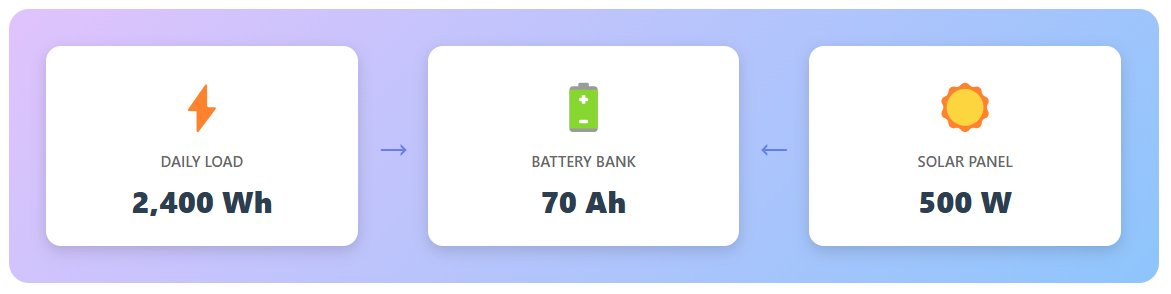
With temperature losses, wiring losses, and inverter losses, the net energy is slightly decreased. There are some mah to wh calculators which help with solar panel and battery bank working along with solar irradiance matching to plan their house panel capacity and battery bank capacity to avoid buying low-performing or high spending products.
| Appliance | Power (W) | Hours/Day | Daily Energy (Wh) | mAh @ 12V |
|---|---|---|---|---|
| LED Lights (5 bulbs) | 50 | 6 | 300 | 25,000 |
| Refrigerator | 150 | 24 | 3,600 | 300,000 |
| Laptop | 60 | 8 | 480 | 40,000 |
| WiFi Router | 10 | 24 | 240 | 20,000 |
| TV (LED) | 80 | 4 | 320 | 26,667 |
| Phone Charging (2) | 20 | 2 | 40 | 3,333 |
| Water Pump | 500 | 1 | 500 | 41,667 |
| TOTAL DAILY USAGE | – | – | 5,480 Wh | 456,667 mAh |
Power Bank and Portable Devices: Practical Tips and Caveats
Although portable devices and power banks often show rated capacity in mAh, the real usable energy depends on the voltage requirements and conversion efficiency. For example, if a battery of 10,000mAh is rated at 3.7V, its theoretical capacity should be: 37 Wh.
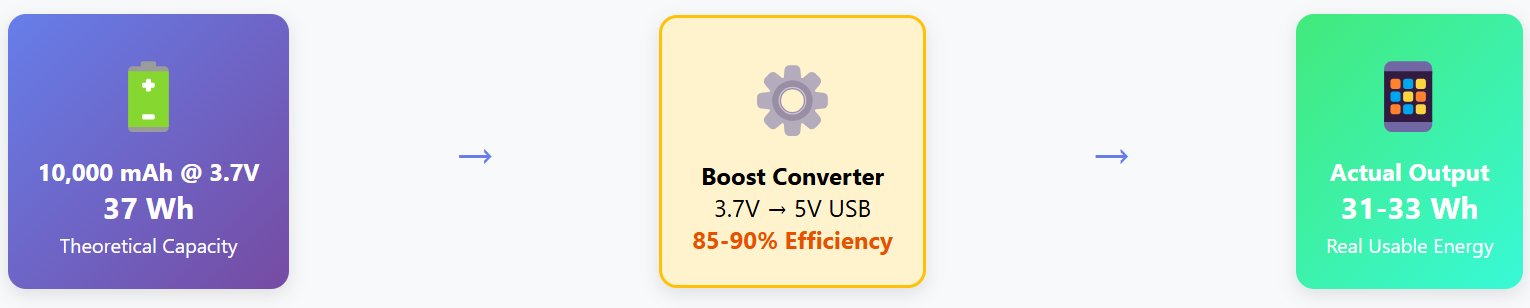
Most USB power banks list an output of 5V. For this reason, a boost converter is used to generate the required voltage and provides from 85% to 90% energy to prevent power loss. Thus, if you calculate the energy being fed to your phone or tablet per hour, it will be less, probably ranging from 31 to 33 Wh. This converter loss is often indicated in a mah to wh calculator, which gives you a clear idea of what to expect from a particular power bank.
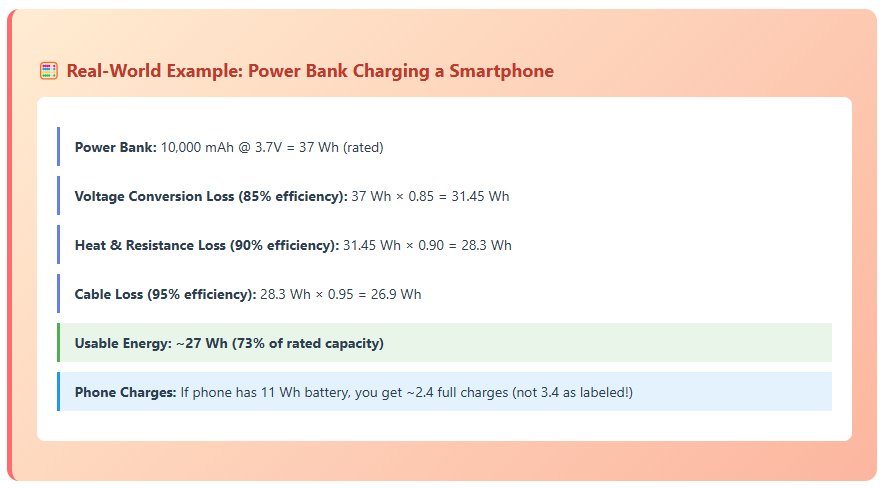
Therefore, most users make a mistake to overthink the run time of servers, going according to their phone tab, or any small appliance using power banks. To make a clear assumption, you should always check the mah to wh, and this is suggested by our HBOWA experts.
How to Select a Good mAH to Wh Calculator:
A well-thought mah to wh calculator helps people translate battery capacity correctly and clearly, and it must take an entry for mAh and Nominal Voltage. Presets for common cell types such as 3.2 V LiFePO4 or 3.7 V Li-ion are mandatory. It should also have optional features like calculating a runtime based on the Watt load. You need a copy results option which shows the mah in watt hours, and another important aspect is that the user must be able to adjust for efficiency loss. Results display in Wh, so you can see and compare batteries or solar setups easily. Clear labels and a simple layout help you more than a very techy-looking calculator, and confuse you, so it should have a simple and user-friendly design. For more information, see our other guide for in-depth guidance related to solar energy.
Conclusion
In essence, knowing how to convert mAh to Wh helps you size batteries right for solar panels, off-grid solar inverters, hybrid solar inverters, and portable devices, and it would help if you considered the voltage, efficiency of conversion, and varying real-life aspects to ensure that the system gives the required energy. A mah to wh calculator does the needful and helps to plan a dependable off-grid or backup option. For even more accurate specifications, you must refer to the data sheet, such as that from HBOWA LiFePO4 Batteries, to check the capacity and voltage, and select or install the ideal system.
Frequently Asked Questions
Yes, 10,000 mAh equals 10 Ah, but energy depends on voltage, and Ah alone does not indicate total power.
LiFePO4 cells nominally run at three point two V, while Li-ion cells typically run at three point seven V.
At 3.7 V, 20,000 mAh equals 74 Wh.
Airline limits are based on Wh, and A 50,000 mAh Li-ion at 3.7 V that is equal to 185 Wh, which often results in exceeding carry-on limits.