Formula: Charge Time = (Ah × V) ÷ (Panel W × Sunlight Hours × Efficiency)
Introduction
Estimating how much time it will take to fully charge a battery using solar panels is not always simple. There are many different variables that will affect the ultimate result, such as the size of the battery, the efficiency of the panel, the number of hours in a day of sunlight, etc. As a result, many users are often overestimating or underestimating the time it will take these panels to charge. This is a result of another failure to properly understand the data, which leads to inefficiency of the solar system. That is why a solar panel charge time calculator is necessary to turn complex energy data into an easily usable estimate for even the layman, so that they can be ensured to be using their equipment as efficiently and as accurately as possible.

What Affects Solar Battery Charging Time?
Several factors influence how long it takes a solar battery to be charged. Below are details on some of the most impactful.
Panel wattage: The wattage of a solar panel determines how quickly it can supply energy. If the panel’s wattage is high, it can send energy to the battery more quickly, and vice versa. For example, a 100-watt supply charges faster than a 30-watt panel, assuming similar conditions.
Battery capacity (Ah): Battery size is measured in ampere-hours (Ah). Once the size of the battery is known, it is easier to charge it. Suppose a 100Ah LiFePO4 battery takes more time to charge than a 50Ah one under the same conditions.
Battery voltage (V): Voltage, in general, is electricity. Voltage affects the amount of electricity stored. Any other charge time increase will depend on the increased voltage capacity of the battery. A 12V 100Ah battery stores less electric energy than a 24V 100Ah battery. Hence, a 24V battery will take longer time to charge.
Depth of discharge (DoD): A LiFePO4 battery can typically be taken to 80–90% depth of discharge (DoD) without side effects. If only 80% of a battery’s capacity is recharged, a 12% increase in charging time will result, roughly.
Environmental Factors: It can be said that, arguably, of these factors, the availability of sunlight is one of the most critical. Any other factors include geographical location, the number of hours of sunlight a year during the panel’s selling season, the panel’s tilt, and any shading that may block sunlight. Hence, the same make and model of the system may act in different ways in southern Spain than in northern Germany.
Charge Controller Type: A Charge controller is a device that tracks and blocks solar panels to batteries. MPPT Charge controllers are more effective than PWM charge controllers. If a panel supplies, for example, 100Ah of energy to the battery, then under a PWM charge controller, 100Ah isn’t sent to the battery. But under an MPPT charge controller, 98Ah of energy is sent to the battery. Any other charge controller is only 75% efficient and sends 75Ah of energy to the battery when 100Ah is supplied to it.
The solar power battery calculator shows the exact parameters and removes all doubts.
| Battery Size (LiFePO4) | System Voltage | Panel Type | Charge Controller | Estimated Charge Time |
| 100Ah | 12V | 100W | PWM | ~13–15 hours |
| 100Ah | 12V | 100W | MPPT | ~9–11 hours |
| 200Ah | 24V | 200W | PWM | ~12–14 hours |
| 200Ah | 24V | 200W | MPPT | ~8–10 hours |
The calculation in the table is made by assuming clear skies, proper tilt angle, and 5 hours of peak sun/day.
LiFePO4 vs Lead-Acid: Which Charges Faster and Why?
LiFePO4 charges a lot faster than lead-acid batteries. This is due to their superior chemical efficiency and higher usable capacity. These batteries determine how long it takes to fill off solar power.

Only about 50% of the whole capacity is usable as opposed to lead-acid systems. On the contrary, LiFePO4 units use 80% or even more of their total capacity. This allows them to go longer between complete charges and last longer.
The rate at which batteries accept charge in minimal charging time is another differentiating factor. LiFePO4 batteries get a higher current during the bulk phase. LiFePO4 batteries charge at a consistent voltage during discharge and recharge, while most lead-acid batteries slow down as they approach full charge.
LiFePO4 units often last 6,000-plus cycles at 80% depth of discharge if you use a reputable battery brand such as HBOWA. In contrast, lead-acid will yield less than 500 cycles at 50% DoD, even if you use the top of shelf battery brand. When someone uses a battery charging time calculator and inputs information from LiFePO4 batteries, it beats lead-acid using the same calculator under the same conditions.

LiFePO4 batteries like HBOWA deliver faster charging, more energy, and holds that energy longer, as well as a more extended lifecycle.
| Metric | LiFePO4 | Lead-Acid |
| Usable DoD (%) | 80%–90% | 50% |
| Cycle Life (avg.) | 3000+ | 300–500 |
| Charge Acceptance | High | Low |
| Full Charge Time | Shorter | Longer |
A battery charge rate calculator clearly reflects these differences, making LiFePO4 the best choice for fast and reliable solar charging.
How to Calculate Charging Time Using a Solar Panel
Step 1: Convert Amp-hours (Ah) to Watt-hours (Wh)
First and foremost, you must figure out the total power stored in your battery. To achieve this, all you will need to do is multiply the amp-hours by volts with this formula:
Wh = Ah × V
For example, if your battery is of 80Ah at 12V, then the Wh= 80Ah × 12V = 960 Wh. After converting Ah to Wh, you may also need to calculate current for battery cables, fuses, and charge controllers. Our watts to amps for battery systems guide helps compare 12V, 24V, and 48V current values for solar battery setups.
Step 2: Apply Depth of Discharge
After achieving a result, you must now calculate just the power that needs to be refilled. If you are charging a LiFePO4 battery to 80%, the power that must be refilled is:
960Wh × 0.8= 768 Wh. This step will give the solar panel charge time conducted a proper input. Overestimating it will lead to wrong time results.
Step 3: Account for Controller Efficiency
So if the controller was a MPPT type and it had an effectiveness of 95%, we can track down the real output.
With a 30W solar panel and an MPPT controller, output will be:
30W × 0.95 = 28.5W
Step 4: Final Charging Time Formula
At long last, we can work out the charging time. The charging time utilized in the count is the number of hours needed to produce the energy expected back in the battery.
Charging Time = (Wh × DoD) / (Panel Output × Efficiency)
Charging Time = 768Wh / 28.5W ≈ 26.9 hours
This is the hour of charging you will require under the perfect conditions of daylight utilizing a 30 Watt board with a MPPT.
| Battery (Ah/V) | Panel (W) | Controller | DoD (%) | Estimated Time (Hrs) |
| 100Ah / 12V | 30W | MPPT | 80% | ~32 hrs |
| 100Ah / 12V | 100W | MPPT | 80% | ~9.6 hrs |
| 100Ah / 12V | 200W | MPPT | 80% | ~4.8-5.5 hrs |
| 100Ah / 12V | 200W | PWM | 80% | ~7-8 hrs |
| 200Ah / 24V | 200W | MPPT | 80% | ~19-21 hrs |
| 200Ah / 12V | 400W | MPPT | 80% | ~4.8-5.5 hrs |
| 200Ah / 24V | 400W | MPPT | 80% | ~9.6-11 hrs |
Guesswork is put to rest by using a reliable charge time calculator as well as a solar charger calculator. A solar charger calculator is especially useful when calculating how long it will take to charge different battery sizes with varying solar panel outputs. Through a charge time calculator, users looking up how to calculate the charging time of battery by solar panel and incorporate the method into a battery charger time calculator tool to skip these steps for fast results.

The Three Charging Stages (Why the Last 20% Takes Longer)
The calculator estimates the bulk stage — the period when the controller delivers its maximum current. Real charging happens in three stages:
Stage 1: Bulk (constant current): the controller pushes the maximum safe current into the battery and the voltage rises. This stage covers roughly 0–80% of capacity, and it is what our calculator and tables describe.
Stage 2: Absorption (constant voltage): once the battery approaches full voltage, the controller holds the voltage steady and the current tapers off. This is why the final 20% takes noticeably longer than the estimate — a battery that reached 80% in five hours may need another two to three hours to reach 100%.
Stage 3: Float (maintenance): the controller holds the battery at a lower maintenance voltage so it stays full without overcharging. Lead-acid batteries require all three stages; most LiFePO4 profiles simply stop charging at full and do not need a float or equalization stage. If your loads must run through the afternoon, size your array to reach 80–90% by mid-afternoon rather than counting on a theoretical 100%.
Case Study: Off-Grid Cabin Setup (With LiFePO4 Batteries)
An example of an off-grid cabin located in a remote place uses a 48V solar system with a 3 kW hybrid off-grid solar inverter. The cabin has four 400W solar panels connected in series that generate electricity that is fed into a 48V 100Ah HBOWA LiFePO4 battery using an MPPT charge controller. For this 48V battery and inverter setup, charging time is only one part of the design. Installers may also need to calculate DC Amps to kW to understand battery discharge power, inverter input demand, cable loading, and fuse or breaker selection.
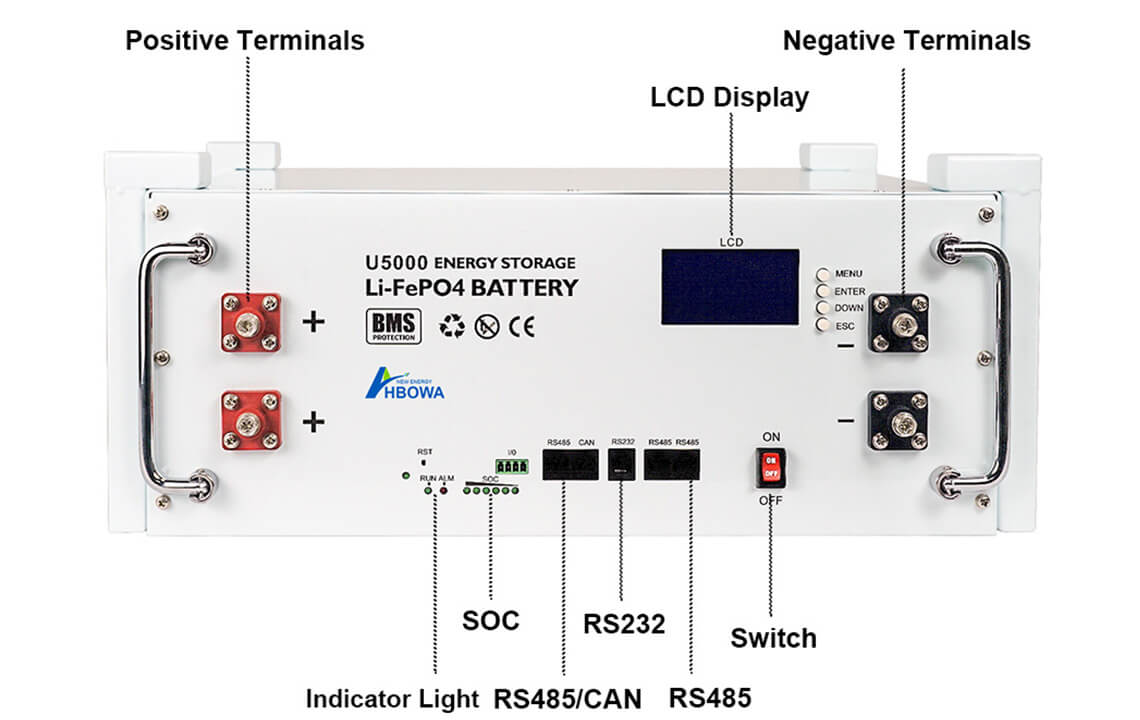
HBOWA 48V 100Ah Server Rack Battery
Thus, the capacity of the storage battery bank is 4.8 kWh. If the depth of discharge is 80%, then a total of 3.84 kWh of energy should be recharged every day using a solar and battery calculator.
So, the effective output of the solar panel array is around 1.52 kW, and it can be used in the field under real-world conditions, i.e., around 80% efficiency due to inverter loss, wire loss, and others. So, as from the battery charge time calculator, it takes approximately 2.5 to 3 hours of peak sunlight to recharge the battery totally with the current setup.
One of the main advantages that were seen with this example was that the HBOWA LiFePO4 battery had a high efficiency. There was no drop in the battery voltage or recharging time, even under the cloudy conditions, unlike the lead-acid battery system. In this case, the battery bank estimated shows that the system sizing was sufficient. Thus, using the solar panel and battery calculator showed that we can calculate the off-grid battery and also estimate the correct solar panel and battery bank.
Choose the Right Solar and Battery System for Your Project
Your charging-time estimate is the starting point. The next step is to match solar generation, battery capacity, power conversion, and required backup time to the way your site operates.

Hybrid Solar System
For projects that need solar panels, battery storage, an inverter, and system controls configured as one coordinated solution.

Battery Energy Storage System
For commercial and industrial projects that require a broader battery storage configuration based on load, backup time, site conditions, and project goals.
Do You Need a Charge Time Calculator? Why It Matters
You can always rely on a solar panel charge time calculator. The need to calculate the charge time for your batteries is often essential. People can often make a quick error when doing the calculation themselves. The focus on factors such as the essential de-rating of panels, depth of discharge, and controller efficiency, among others, can often be ignored. These, in turn, often leads to mis-estimation.
One of the most common errors is due to these misestimations. Users might end up with an oversized system, which means a deficit when it comes to energy availability. Others might end up with an undersized system, leading to an overspent budget.
And, for most of the users out there, a battery charge time calculator for the solar panel often keeps them from feeling perplexed. Individuals who are managing off-grid cabins, RVs, or emergency power at homes simply enjoy caressing their backs. Recharging your battery systems has never been so right before, and this tool can help you ensure that your set-up continues to meet your energy needs.
Using the battery charge time calculator, you can figure out the amount you might save. So, using a battery and energy storage calculator that is free of cost, and you don’t have to hire expensive experts. It also helps you in reallocating your budget.
The Solar Panel Battery Calculator Does It for You. Whenever you need to calculate the charge time of your solar panel batteries, you can always turn to a solar panel charge time calculator. The battery or energy storage calculator does all the maths for you.
Solar Charge Controllers: Impact on Charging Speed
The solar charge controllers work as a mediator between the solar panels and the battery. Solar charge controllers are the prime factor that decides the charging process and efficiency of the converted energy into the cells. The solar charge converters are of two types: PWM, i.e., Pulse Width Modulation, and MPPT, i.e., Maximum Power Point Tracking.
The MPPT controllers generally give efficient battery charging, as they convert around 90–95% of the solar energy into the battery cell. At the same time, the PWM gives around 75–80% of solar energy to form charge during the charging process of the battery.
The solar charge controller calculator sites provide an exact difference between the charge controllers. Suppose you are looking to charge a 12V 100Ah LiFePO4 battery. You are placing the charging battery solar panel setup under perfect sunlight conditions. Then, via an MPPT solar panel charge converter, it will take 5–6 hours to charge the battery properly. Whereas under the same conditions, the PWM charge controller would take 7–8 hours to charge the battery to its utmost level. You can see the table above.
If your battery is exceptionally fast and active in charging, for instance, an HBOWA battery, then using the battery charger calculator and an MPPT controller helps in the proper utilization of the battery energy and saves much time. People usually prefer to use MPPT controllers over PWM converters for the proper and fast charging process, even under extreme temperatures.
Conclusion
If you are using a solar panel battery charger, then one of the most important things you need to know is the solar panel charge time calculator. It is important that you have an idea of how long it will take to charge the battery, as well as the efficiency of its working. There are various components that you will need to select if you want your solar panel to work effectively. Some of the reasons why you need the battery charge calculator are mentioned above. For accurate results, use a reliable calculator or work with a solar professional when designing or upgrading your battery-based solar system.
Frequently Asked Questions
Roughly 5–6 hours of good sunlight in ideal conditions: a 100Ah 12V battery at 80% depth of discharge needs about 960Wh, and a 200W panel delivers close to that in five peak sun hours. In practice, allow 6–8 hours with a PWM controller, clouds, heat derating, or an aging battery.
For arrays above roughly 200W, yes. PWM controllers clip the panel voltage and waste 25–30% of the potential harvest, while MPPT converts the excess voltage into additional charging current. On a small 30–100W setup the absolute difference is small and PWM can be the economical choice. Cold or frequently cloudy climates widen the MPPT advantage further.
Usually the absorption stage: the last 20% of charge happens at reduced current, especially on lead-acid batteries. Other common causes include panel temperature derating in hot weather, dust or partial shading on the array, voltage drop in undersized cables, reduced capacity in an aged battery, and cold batteries accepting charge more slowly. Compare full-sun, mid-day readings before assuming a fault.
Not directly. A bare panel’s voltage swings too widely with sunlight, so a charge controller or solar inverter must sit between the panel and the battery. Direct connection risks overvoltage and uncontrolled current. The battery’s BMS provides final protection, but the controller is what sets the correct charging curve.
About 200W is the theoretical minimum: refilling a 100 Ah 12 V battery from 80% discharge takes roughly 960Wh, and five peak sun hours on a 200W panel produces about 1,000Wh. In practice, 250–300W with an MPPT controller is the safer choice to cover clouds, heat losses, and the slower absorption stage.
Five factors dominate: battery capacity and depth of discharge (the watt-hours you must replace), real panel output versus rated wattage (irradiance, temperature and orientation), controller efficiency (an MPPT unit harvests more of the array before it becomes charging current), battery chemistry and age (lead-acid tapers early while lithium accepts high current longer), and wiring losses. Season and weather set the daily window, so the same array charges a bank roughly twice as fast in summer as in winter.
Work at system level: multiply bank capacity (Ah) by voltage for watt-hours, then by the discharged fraction. Divide that by total array wattage and apply a 1.2–1.3 loss factor. Example: a 200Ah 24V bank at 50% discharge needs 2,400Wh; an 800W array delivers about 800W × 5 peak sun hours ÷ 1.25 ≈ 3,200Wh per sunny day — a full recharge in roughly one summer day, or a day and a half in winter.
Panel type changes how much energy reaches the controller, not the charging curve itself — the controller always sets the battery’s charge stages. Monocrystalline cells convert more sunlight per square meter and handle heat better than polycrystalline, so they deliver more watt-hours on a roof with limited space. For charge time, what matters is total watt-hours delivered per day: a correctly sized mono array simply finishes the bulk stage earlier in the day.
Size the controller by current: divide total array wattage by battery bank voltage, then add a 25% safety margin. A 400W array on a 12V bank produces up to about 33A, so a 40A MPPT controller fits; on a 24V bank the same array needs only a 20A unit. Undersized controllers clip the array and stretch charge times, while oversized ones simply cost more without charging faster.
Yes, as long as the combined array stays within the controller’s maximum input voltage and current ratings. Wiring panels in series raises voltage, while parallel wiring raises current — match the configuration to the controller’s limits and your battery voltage. Exceeding the voltage rating can damage the controller immediately, whereas exceeding the current rating only clips output. Always check the controller’s maximum PV input on its spec sheet before combining panels.