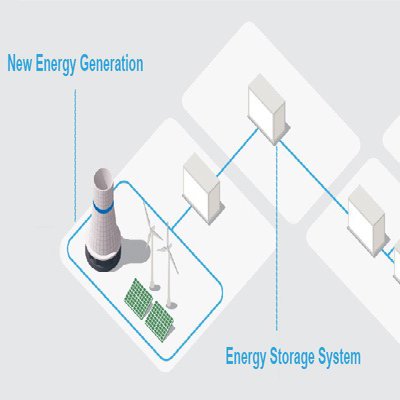
A project can use one battery for peak shaving and demand response, but the strategies solve separate problems. One controls a facility’s peak demand. The other changes net grid demand under a program or price signal. This guide helps you compare both before specifying a C&I BESS.
Peak Shaving vs Demand Response at a Glance
Peak shaving is usually a site-controlled strategy. Your EMS watches facility demand and discharges the battery before grid import crosses a target. The project normally aims to reduce demand charges or keep the site within a transformer or grid connection limit.
Demand response is program-based. A utility, system operator, retailer, or aggregator sends a price signal, event notice, or dispatch instruction. The site then reduces or changes its net grid demand under the program rules. The response may come from battery discharge, load reduction, process rescheduling, on-site generation, or a combination of these resources.
| Comparison Point | Peak Shaving | Demand Response |
|---|---|---|
| Main objective | Limit the facility’s maximum grid demand | Change site demand to support a grid or market program |
| Typical trigger | Local meter reading or EMS demand threshold | Price signal, event notice, dispatch instruction, or contract rule |
| Main controller | Site EMS and facility operator | Site controls coordinated with a utility, aggregator, retailer, or system operator |
| Operating pattern | Often runs whenever load approaches the site limit | Runs during defined events or price periods and may require availability between events |
| Financial value | Avoided demand charges or avoided capacity upgrades | Program payment, market revenue, incentive, or avoided high-price consumption, depending on local rules |
| Measurement | Facility billing meter and demand interval | Approved meter data, baseline, telemetry, event performance, and settlement method |
| Main contract | Electricity tariff and site operating rules | Demand response enrollment or market participation agreement |
| Main BESS risk | Too little kW or kWh to control the full peak | Too little available SOC or failure to meet an event obligation |
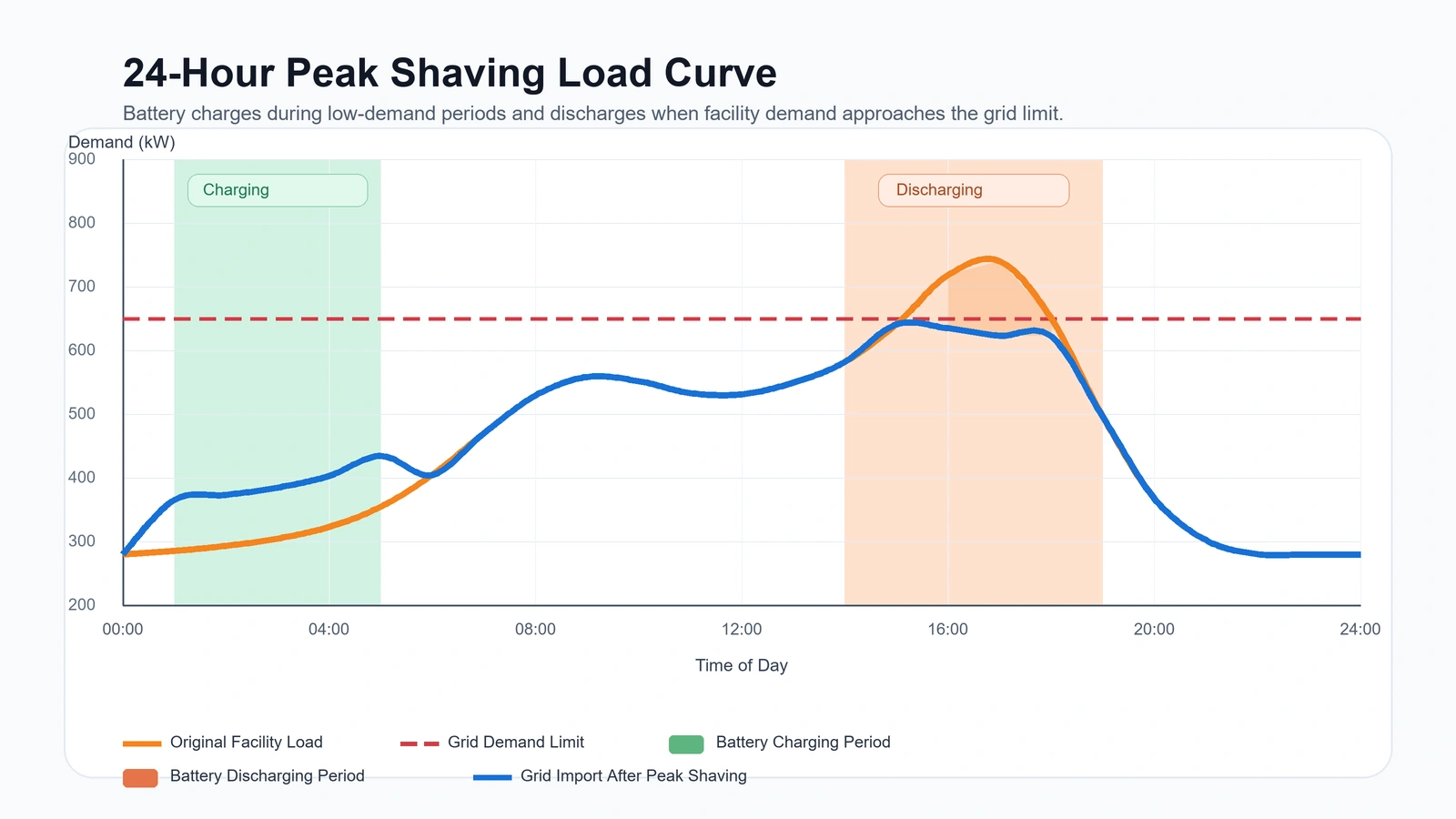
The simplest distinction is control. Peak shaving starts with a limit chosen for the site. Demand response starts with an external program condition. A project can use both, but it must coordinate the two control objectives.
How Peak Shaving Works at a Commercial Site
A facility can create a high monthly demand charge during one short operating interval. Motors, chillers, pumps, production lines, or EV chargers may overlap and push grid import above the usual level. The billing method varies by tariff, so the project team must confirm the measurement interval and charge structure.
For peak shaving, the EMS monitors the site meter and compares demand with a target. When grid import approaches that target, the PCS discharges the battery. The system stops or reduces discharge after the load falls, the battery reaches its SOC reserve, or another operating limit takes priority.
The site can run this strategy without joining a demand response program. It still needs suitable metering, an accurate load profile, enough PCS power for the highest controllable peak, and enough battery energy for the peak duration.
How Demand Response Works
Demand response starts with a program, not a battery. The program defines which sites can participate, what counts as a response, how much notice the operator gives, what data the site must send, and how the operator calculates performance.
Some programs ask a facility to reduce demand during an event. Others use time-varying prices or automated dispatch. A battery can respond quickly, but the program may also allow flexible production loads, HVAC, pumps, generators, or other controllable assets.
Before you include demand response income in a project model, confirm these points:
- Who calls the event or sends the price signal
- Whether the site must enroll through an aggregator
- How the program calculates the baseline
- Which meter and telemetry data it accepts
- How much response the site must keep available
- Whether the program requires tests or minimum event performance
- How it handles non-performance, maintenance, and communication failure
- Whether reduced import is enough or the program allows battery export
These rules decide whether a technically capable BESS can earn demand response revenue. Equipment capability alone does not establish program eligibility.
How a C&I BESS Supports Both Strategies
A battery energy storage system gives the project a controllable power source behind the meter. The battery supplies energy, the PCS controls charge and discharge power, the BMS protects the battery, and the EMS decides when the system should act.
Peak shaving mainly depends on real-time site demand and a local threshold. Demand response adds an external instruction or program condition. This additional layer may require a gateway, an approved protocol, separate telemetry, user permissions, and a defined fallback mode.
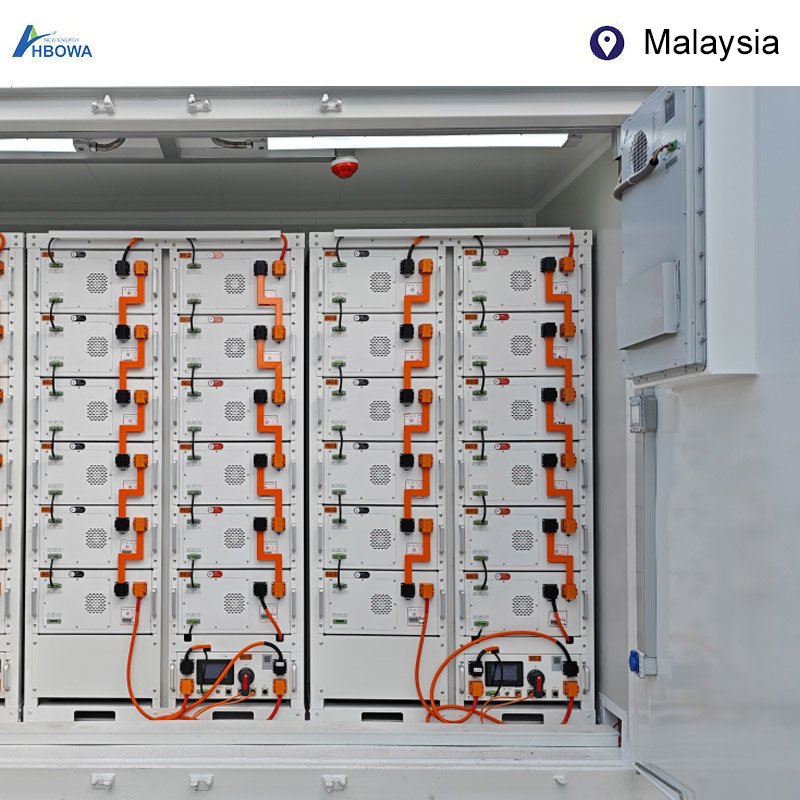
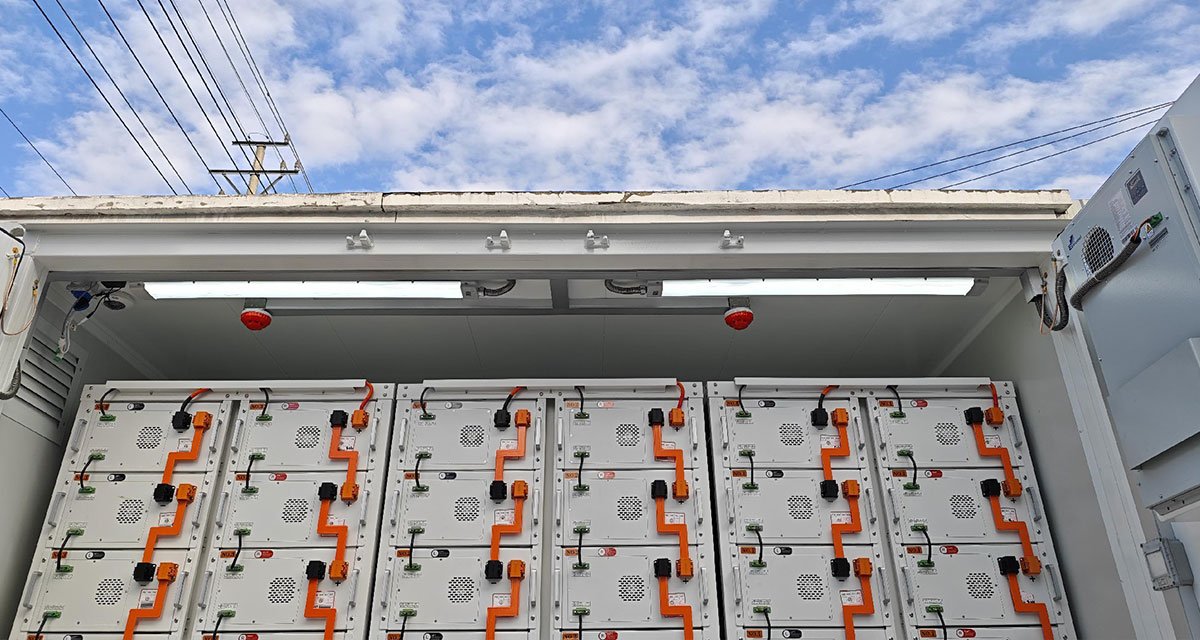
HBOWA’s Hbowa-233-IEC liquid-cooled system specification lists peak shaving and valley filling, demand control, demand following, load tracking, planned charge and discharge, standby power, and demand response among its control strategies. Selected C&I cabinet specifications also describe local and remote policy control, power tracking, demand regulation, and RS485, CAN, Ethernet, and Modbus communications.
These functions support equipment-side demand management. They do not prove connection to every aggregator, utility, or market platform. When you evaluate an energy storage cabinet, confirm the final model, control protocol, meter arrangement, external interface, cybersecurity requirements, and acceptance test for the target program.
Can Peak Shaving and Demand Response Run Together
Yes, but the battery cannot commit the same power and energy twice. A battery that has already discharged for a morning site peak may have too little SOC for an afternoon demand response event. A battery that keeps a large event reserve may save less on daily demand charges.
The EMS therefore needs an operating priority. The project team should decide:
- How much SOC remains available for demand response
- How much energy stays reserved for backup power
- Whether a demand response event can override the site’s peak-shaving limit
- How the system reacts if the external communication link fails
- Whether production loads can contribute when the battery reaches its limit
- How additional cycling affects the battery duty profile and warranty conditions
Run both strategies against the same interval load data. A peak-shaving model and a separate demand response model can each look attractive while asking the battery to deliver conflicting power at the same time.
Peak Shaving vs Load Shifting vs Demand Response
These terms often appear together, but they describe different decisions.
- Peak shaving limits the highest grid power demand.
- Load shifting moves energy use or battery discharge from one time period to another.
- Demand response changes site demand under an external price, event, or program condition.
A regular tariff schedule may support load shifting without any demand response enrollment. Peak shaving may also run every working day without an external event. Demand response adds program rules, performance measurement, and another party to the control chain.
Which Strategy Should Your Project Prioritize
Start with the site’s actual commercial problem.
Prioritize peak shaving when the tariff includes a material demand charge, the site repeatedly exceeds a contractual limit, or a transformer or grid connection constrains peak import. The load curve must show when peaks occur, how high they rise, and how long they last.
Prioritize demand response when a suitable local program exists and the site can meet its availability, control, metering, and operating requirements. Check whether the expected payment justifies integration work, reserved SOC, additional cycling, and the risk of non-performance.
Use both when the battery has enough power and usable energy for both duties and the EMS can manage priority correctly. The combined case should also protect backup requirements. A hybrid solar system may add PV or generator inputs, but each additional objective competes for the same control and capacity limits.
How the Choice Changes BESS Specification
The strategy changes more than the EMS setting. It affects the project data, equipment configuration, control design, and commercial model.
| Design Area | Peak Shaving Check | Demand Response Check |
|---|---|---|
| PCS power | Can it offset the target demand spike in kW | Can it deliver the committed response while respecting site limits |
| Battery energy | Can it sustain the peak for its expected duration | Can it preserve enough usable kWh for the event window and required reserve |
| Metering | Does the EMS read the correct point of grid connection | Does the program accept the meter, sampling interval, and data path |
| Control | Can the EMS follow a local demand limit | Can the system receive, validate, prioritize, and acknowledge an external signal |
| Communications | Can local devices exchange reliable operating data | Does the external interface meet the program’s protocol and security requirements |
| Backup | What SOC must remain after daily peak control | Can the site preserve backup reserve while keeping event capacity available |
| Lifecycle | How often will normal site peaks cycle the battery | How do event frequency and reserved availability change the duty profile |
| Acceptance | Can the site demonstrate threshold control under real loads | Can all parties verify notification, response, telemetry, fallback, and settlement data |
Do not size either strategy from monthly kWh alone. You need interval demand, tariff details, event duration, operating schedules, critical-load requirements, grid limits, and the final control responsibilities.
Market Differences in the United States Europe and Southeast Asia
The technical distinction remains the same in all three markets. The commercial rules do not.
United States
Many commercial tariffs include demand charges, but utilities use different billing intervals and rate structures. Demand response may involve a utility, ISO or RTO, retailer, or aggregator. Confirm the current program rules for the project location instead of applying one PJM or California example to the whole country.
Europe
European projects may interact with a transmission system operator, distribution system operator, supplier, or aggregator. Access to flexibility or balancing programs varies by country and service. Confirm prequalification, telemetry, aggregation, settlement, and local network rules before you reserve battery capacity for demand response.
Southeast Asia
Electricity tariffs, demand charges, grid structures, and demand response programs differ by country and utility. Peak shaving can still operate as a local site strategy when a formal demand response program does not apply. Verify local enrollment, metering, dispatch, and export rules before including a second revenue stream.
What Each Project Party Should Confirm
Demand response adds commercial and operational parties that a normal peak-shaving project may not need. Assign each responsibility before equipment procurement.
| Party | Questions to Confirm |
|---|---|
| Project owner | Which loads can change, what production limits apply, and how much backup reserve must remain |
| EPC or system integrator | Where to meter, how to protect the system, who supplies the gateway, and how to test every operating mode |
| BESS manufacturer | Which model supports the required kW, kWh, controls, protocols, alarms, and remote functions |
| EMS provider | How the system prioritizes site limits, external events, backup reserve, and communication failure |
| Utility or program operator | Which tariff or program applies, how it measures performance, and what operating rules the site must follow |
| Aggregator | How it enrolls the asset, sends events, manages telemetry, calculates the baseline, and handles settlement |
A clear responsibility matrix prevents a common procurement mistake. The equipment supplier can provide compatible hardware and control functions, but another party may still need to register the site, integrate the market interface, validate the baseline, and manage settlement.
Final Thoughts
Peak shaving controls your site’s demand. Demand response follows an external program condition. A C&I BESS can support both when power, energy, SOC, controls, and responsibilities align. Contact HBOWA to review your load data and project requirements before selecting the system.
Frequently Asked Questions
No. Peak shaving normally limits a facility’s own maximum grid demand. Demand response changes site demand under an external program, price signal, or event. Both can reduce grid import during a peak, but they use different triggers, measurement methods, contracts, and revenue mechanisms.
No. Load shifting moves energy use from one time period to another. Demand response asks a site to change demand under a program condition or external signal. A demand response event may use load shifting, but scheduled load shifting can run without joining any demand response program.
Yes, if the battery has enough power and usable energy and the EMS can assign priority. The project must reserve SOC for events, daily peak control, and backup. It should also test what happens when both strategies request discharge at the same time.
No. The battery may provide the technical response, but the site must still meet local program rules. These may cover enrollment, meter accuracy, telemetry, baseline calculation, availability, event performance, testing, and settlement. Confirm them with the local utility, program operator, or aggregator.
There is no universal answer. Peak-shaving value depends on the tariff and the site’s controllable demand peaks. Demand response value depends on program payments, event frequency, availability requirements, penalties, and integration costs. Compare both against battery cycling, reserved SOC, and backup needs.
Collect interval load data, electricity bills, tariff rules, transformer and grid limits, operating schedules, critical loads, PV or generator data, and expected demand response event requirements. Monthly energy totals do not show the peak height, event duration, or discharge power that the PCS must supply.
Not always. Some programs measure a reduction in site import, while others may allow or require export. The answer depends on the meter boundary, interconnection agreement, and program rules. Do not assume that a BESS can export until the utility or system operator confirms it.
Yes, if the design reserves enough SOC and the controls protect it. A larger backup reserve leaves less energy for peak shaving or demand response. Define critical-load power, backup duration, event commitment, and control priority in the same operating model.
It depends on the market and project size. Some sites contract directly with a utility or system operator. Others participate through an aggregator that combines and manages several assets. Confirm who handles enrollment, dispatch, telemetry, baseline approval, performance reporting, and settlement.
Test the site demand threshold, meter direction, charge and discharge limits, SOC reserve, external signal path, user permissions, alarms, fallback mode, communication loss, and recovery. If the project includes demand response, test the complete event sequence with the program operator or aggregator.