

Formula: kVA = VA ÷ 1000
Converting VA to KVA means the apparent power in volt-amperes is converted into kilovolt-amperes. This calculation is mostly used for solar systems, hybrid inverters, transformers, generators, UPS systems, and commercial electrical design. Grasping the conversion of volt-amps to kva is valuable to homeowners who have to choose backup equipment. Furthermore, installers, distributors, and designers use it for inverter-sizing, transformer choice, UPS planning, and electrical load verification. In fact, they do so in both residential and commercial power systems.
Formula and Variable Definitions

This formula explains the relation of volt-amperes with kilovolt-amperes. A volt-ampere indicates the apparent power within an electrical system. The kilovolt-ampere shows this same quantity on a larger commercial scale.
In small residential systems, electrical machines are often rated in VA since these apparent power values do not vary too much. Larger commercial equipment, including transformers, hybrid inverters, industrial UPS systems, and backup generators are often specified in kVA to ease equipment ratings and infrastructure planning.
VA kVA conversions are popular since electrical systems should be sized to apparent power demand instead of wattage alone. By using this, engineers and installers can decide if electrical equipment can support connected loads safely at nominal and peak operation.
Example Calculation
Think of a business backup system installed in a retail distribution area. The system will have a combined apparent power demand of 8500 VA required to run refrigeration controls, security infrastructure, networking equipment, and lighting circuits.
To convert the load into kilovolt-amperes:

From the Installer’s Point Of View, this value will help you choose your inverter size, UPS capacity, transformer rating, and backup generator. Correct VA to KVA calculations in commercial solar installations also help avoid overloading the system and improve long-term operational reliability.
When to Use This Calculator
This calculator is useful when it is necessary to convert a power rating into a standard kilovolt-ampere equipment selection or planning value. In real-life applications, many manufacturers use VA for smaller electrical devices, and large commercial systems use kVA.

In the installation of solar energy networks, a hybrid inverter is selected with a subsequent calculation of battery backup voltage and KVA requirements. The right planning for apparent power will ensure that electrical loads remain balanced during daytime generation and backup operation. In a battery storage application, it is important to understand apparent power demand because inverter systems must support continuous operation and temporary overloads. Those overranges will be produced by motors, compressors, and inductive equipment.
Electrical expansion projects involving infrastructure upgrades or generator sizing at commercial and industrial facilities also use the kva calculator and the apparent power calculator. The conversion of volt-amperes to kilovolt-amperes allows engineers and distributors to more accurately compare the specifications of equipment and define safe operating limits. Home users usually do volt amp calculator conversions when selecting backup generators, UPS systems, or home battery inverters for emergency power systems.
VA to KVA in Solar & Backup Power Systems
The calculations of apparent power are key for inverter size and electrical structure in solar and backup power systems. The solar panels produce real power, measured using watts. Various AC electrical equipment contains reactive loads. These reactive loads increase the demand for apparent power in the system.
For instance, HVAC systems, refrigeration compressors, pumps, and industrial motors typically require more apparent power capacity during their startup conditions than during steady state operation. Hybrid inverters, transformers, and backup generators are often rated in kVA, instead of watts alone, hence the term.
Through ac inverter kVA calculation, installers can accurately size battery storage systems, transformers, cable infrastructure, and protection devices while minimizing the risk of overload conditions. In larger commercial solar installations, optimally planned apparent power ensures efficient use of energy and stable system operation under variable load conditions over the long term. Present-day LiFePO4 battery systems, such as the HBOWA energy storage batteries used in residential and commercial projects, are often paired with Growatt hybrid inverters and Tier 1 TOPCon solar panels for stable power delivery during daytime generation and backup operation.
VA vs kW vs kVA
The kW is a measure of real power used by electrical apparatus, while kVA is for the apparent power in the system. The two differ depending on the power factor of the load connected to it.

In pure resistive systems, like electric heaters or incandescent lighting, the kW and kVA values are almost similar. This similarity occurs when the power factor is quite close to 1. However, systems that consist of motors, compressors, transformers, inductive equipment, etc., operate with a power factor that is quite low. Therefore, the apparent power is higher than the real power consumption.
Reference Table
The table below gives reasonable examples of VA to KVA conversions for residential, commercial, and industrial electrical systems.
| Apparent Power (VA) | Apparent Power (kVA) | Typical Application |
|---|---|---|
| 100 | 0.1 | Small UPS for router/PC |
| 250 | 0.25 | Desktop + monitor backup |
| 500 | 0.5 | Home office / small fridge |
| 750 | 0.75 | Mini fridge + lights |
| 1000 | 1 | Residential backup starter |
| 1500 | 1.5 | Small window AC unit |
| 3000 | 3 | Medium home backup |
| 5000 | 5 | Small commercial inverter |
| 7500 | 7.5 | Retail store backup |
| 10000 | 10 | Small office / telecom |
| 15000 | 15 | Commercial HVAC support |
| 25000 | 25 | Industrial machinery |
| 50000 | 50 | Data center row |
| 100000 | 100 | Factory / large facility |
| 250000 | 250 | Utility / substation |
| Equipment | Typical kVA Range | Application |
|---|---|---|
| Home backup UPS | 0.5 – 3 kVA | Residential electronics |
| Solar hybrid inverter | 3 – 15 kVA | Home / small commercial |
| Three-phase inverter | 15 – 100 kVA | Commercial / industrial |
| Distribution transformer | 50 – 2500 kVA | Buildings / factories |
| Backup generator | 10 – 2000+ kVA | Facilities / data centers |
These values illustrate how apparent power grows from small residential backup systems to large industrial electrical infrastructure. In practice, large systems are almost always expressed in kVA as their values are more easily compared than the kW values of transformers, generators, UPS systems, and hybrid inverters.
Accuracy and Limitations
The process of VA to KVA conversion is a mathematically simple one because it only takes into account unit scaling. However, the apparent power calculation makes no allowance for power factor, inverter losses, harmonic distortion, and actual energy consumption in an AC electrical system.
In practice, reactive loads of systems like motors, compressors, and so on, can increase apparent power demand beyond design levels. Real system performance can be affected by startup surges, load variations, and ambient conditions. Moreover, inverter efficiency, transformer losses, cable resistance, and temperature may affect electrical performance in operations. Commercial engineers and professional installers do transformer kva calculation, generator kva sizing, or backup infrastructure planning, adding other safety margins for this reason.
Case Study
An Indian telecoms operator facility in Mumbai has a solar and battery backup system installed to ensure services are not disrupted when the grid goes down. The Apparent Power 22000 VA is dedicated to network, monitoring, and cooling equipment feeds.
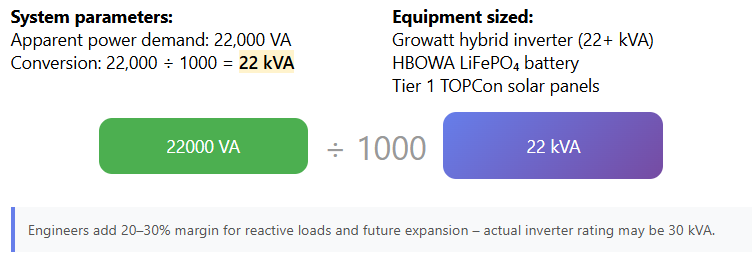
This allows engineers to properly size the inverter, transformer, UPS, and backup generator so that these systems can run properly for an indefinite amount of time.
The facility utilizes an HBOWA LiFePO4 battery storage system along with a Growatt hybrid inverter and Tier 1 TOPCon solar panels to ensure stable backup performance during low solar generation and grid outages.
Apparent Power Sizing Checklist
|
|
When designing the system, engineers should always consider reserve capacity, inverter inefficiencies, reactive loads, and future expansion of infrastructure.
Conclusion
VA to KVA conversion is a practical way to convert apparent power into standard units that are used in the electrical system (Residential, commercial, and industrial). When volt-amperes are calculated in kilovolt-amperes, users can compare equipment rating, verify infrastructure, and assess electrical load capacity. This calculation will give the right value for solar energy systems, hybrid inverter planning, transformer sizing, UPS infrastructure, backup generators, and commercial electrical analysis. A better understanding of VA to KVA conversion will help homeowners, installers, distributors, and engineers make better decisions that lead to increased efficiency, reliability, and performance over the life of a system.
More Calculators for You
Solar Products for Your Project
 Solar Panels |
Solar System |  C&I Battery Storage |


