Introduction
What size solar system do I need? The response relies on your energy consumption, roof availability, sunlight at your house, future energy plans, and money. Opting for the right size instead of the biggest system enhances long-term value, energy savings and system performance of homes and businesses.
What Size Solar System Do I Need?
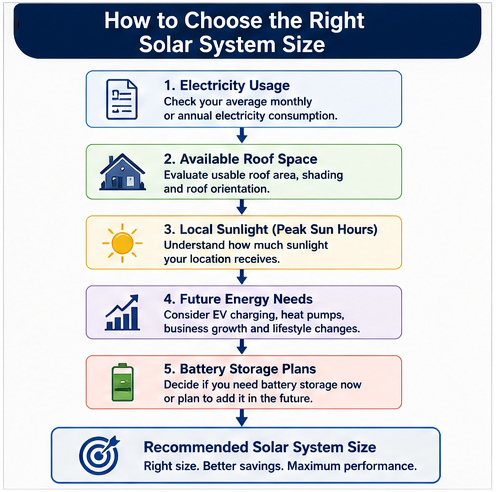
The answer is not a straightforward one: there is no one-size-fits-all regarding what size solar system I need. The appropriate size of a solar system depends on how much electricity you consume, the amount of usable roof area available, the solar irradiation your suburb receives, whether your energy requirements are likely to rise, and whether you wish to install battery storage in the future. Selecting a system based on these aspects can enhance self-consumption and reduce the risks of paying for excess capacity.
Don’t just think about the number of panels you need. Consider your monthly usage first. A dwelling with average usage will have different needs from those of a retail shop, warehouse, or office with greater daytime demand. Weather patterns also play an important role, meaning that the same solar panel can produce various amounts of energy depending on the sunlight in the region.
Finally, keep in mind upcoming alterations such as the need to buy an electric vehicle later, install air conditioning, expand business, and so on, through a hybrid battery later. If you plan ahead, you can reduce upgrade costs in the future.
Recommended Solar System Size by Monthly Electricity Usage
| Monthly Electricity Usage (kWh) | Typical Property | Recommended System Size | Approximate Panel Count* | Ideal Battery Size (Optional) |
| Up to 300 | Apartment | 3–4 kW | 7–10 | 5–10 kWh |
| 301–600 | Small house | 5–6 kW | 11–15 | 10–15 kWh |
| 601–900 | Family home | 6–8 kW | 15–20 | 10–20 kWh |
| 901–1,500 | Large home | 10–12 kW | 23–30 | 15–25 kWh |
| 1,501–2,200 | Estate / Small Business | 15 kW | 33–45 | 20–30 kWh |
| Above 2,200 | Commercial property | Site-specific assessment | Project dependent | Project dependent |
*Approximate panel count assumes modern high-efficiency modules. Actual requirements vary with panel wattage and site conditions.
Five Factors That Determine the Right Solar System Size
Finding the right size of solar system is not just equating your bill to a panel size. An efficient system takes into consideration current power usage, installation conditions, and future needs. By considering the subsequent factors, we can avoid having to deal with undersized systems that do not meet the demand or oversized systems that take an eternity to recover their investments.
Electricity Consumption
The most reliable place to start is your electricity bill, which shows how much energy you actually used. Looking at bills from at least the last 12 months will help account for seasonal heating or cooling changes. By using this technique, a more realistic picture of annual demand can be built than simply using one month’s usage.
Available Roof Space
Solar panels cannot be supported on every square metre of a roof. Obstructions on the roof, such as a chimney or skylights, reduce usable area. Determining the effective roof area yields more accurate results than measuring total roof area. For a detailed analysis, readers can check out HBOWA’s Roof Space Calculator.
Local Climate and Peak Sun Hours
Solar energy production relies on sunlight availability, which varies by location and climate. European Commission’s PVGIS and U.S. resources, like these. An analysis of solar generation was carried out at NREL based on irradiation data for the specific location rather than an assumption. These tools help to plan the system better in regions.
Future Electricity Needs
Often, solar systems’ energy demand changes during the lifecycle of the system. Whether you buy an electric car, install air conditioning, switch your heating to a heat pump, start working from home, or boost your business, you will be using much more electricity. When selecting a system, if these future changes are considered, upgrades won’t be that expensive.
Battery Storage Plans
If you think you’ll install battery storage in the future, a Hybrid Solar System or battery-ready inverter may make extensions a bit easier. Those interested in this option can refer to HBOWA’s Hybrid Solar Systems guide to see how batteries influence the design of the overall system.
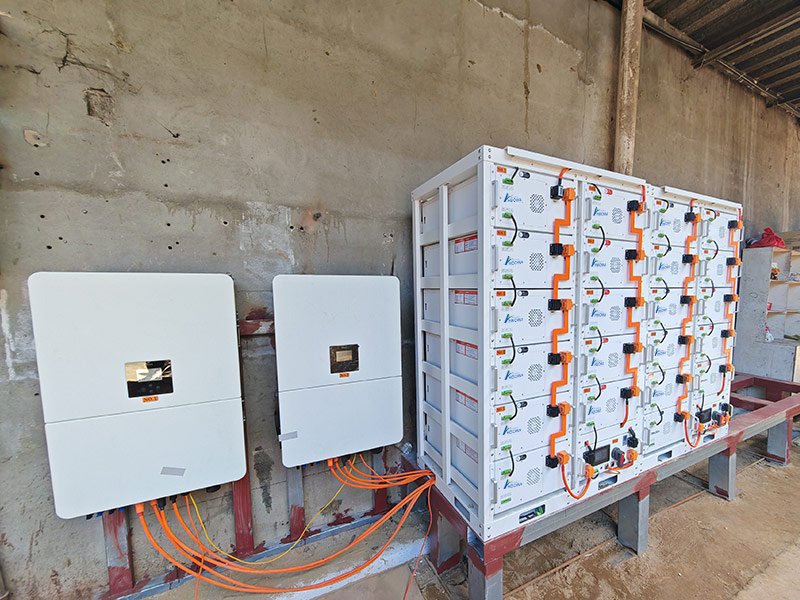
Recommended Solar System Sizes for Different Homes and Businesses
The best answer to what size solar system I need ultimately depends on the type of property and when electricity is consumed. In a residential system, we are often dealing with lowering the electricity bill of the household.
While in a commercial solar system, we are typically dealing with the daytime operations, production schedules, and growth ramp-up in the business. In general, choosing a system with a capacity that matches existing operating conditions ensures better long-term performance than selecting the largest available installation.
Recommended Solar System Sizes by Property Type
| Property Type | Typical Daily Usage | Recommended System | Optional Battery |
| Apartment | 5–10 kWh | 3–4 kW | 5–10 kWh |
| Small house | 10–20 kWh | 5–6 kW | 10–15 kWh |
| Family home | 20–30 kWh | 6–8 kW | 10–20 kWh |
| Large home | 30–45 kWh | 10–12 kW | 15–25 kWh |
| Office | Site dependent | 15–30 kW | Based on operating hours |
| Retail shop | Site dependent | 20–50 kW | Optional for peak shaving |
| Warehouse | Site dependent | 30–100 kW+ | Recommended where backup is required |
| Farm | Site dependent | Custom design | Based on critical loads |
| Workshop | Site dependent | 15–50 kW | Optional |
| Small factory | Site dependent | Engineering assessment | Project-specific |
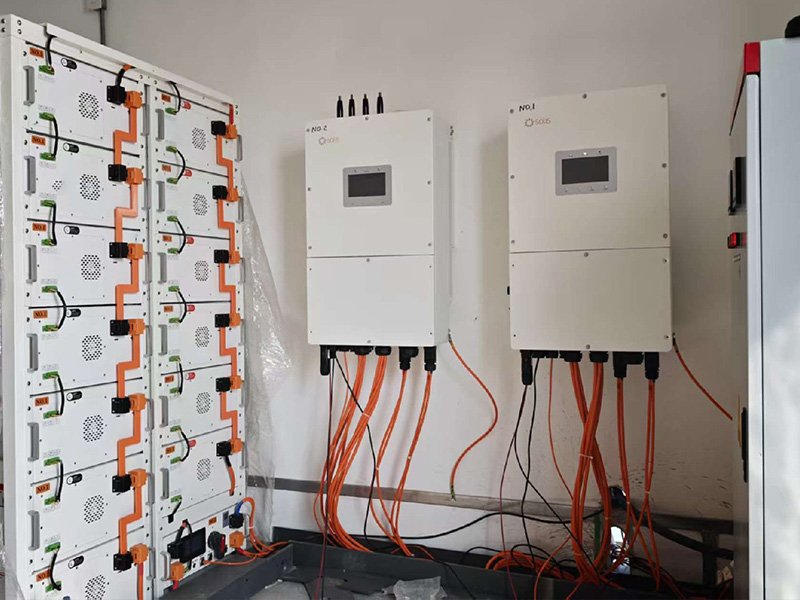
Domestic users typically benefit from installing systems in the 5 kW to 8 kW range, where electricity consumption isn’t high, and most appliances run during the day. If you have enough space on your roof, switching to a bigger system for your electric heating or cooling at home may be worthwhile.
There should be a different design for commercial buildings. The load profiles of offices, shops, workshops, warehouses, and farms usually differ from each other because of the operating hours and equipment.
A business should not opt for a pre-defined package or specification that is determined by what is available, but should consider its daytime demand. As well as its seasonal production cycle and expansion plans, before making a selection on the capacity of the system required before making a selection.
If backup power or increased energy independence is a priority, integrating a LiFePO4 battery with a Hybrid Solar System greatly increases energy flexibility by allowing for stored off-peak (daytime), generated power to be used later. Nevertheless, the charge capacity of the battery should be based on the operational objective and not on the solar array size. With this method, residential and commercial users can build systems that remain operational, scalable, and future-proof in energy needs.
How Much Does a Solar Panel System Cost?
Numerous individuals looking into what size solar system I need also look into the price of the solar panel system. It relies on much more than just system capacity. According to the U.S. National Renewable Energy Laboratory (NREL), the hardware and “soft costs” usually consume most of the total solar system cost. It is unrealistic to provide a single international price for the various variables that differ according to country, local regulations, and project complexity.
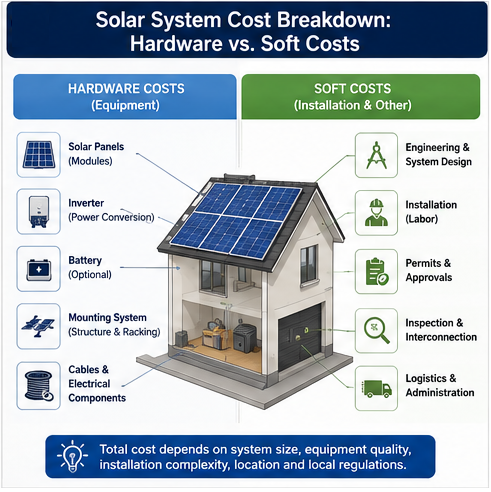
The standard of equipment also determines the long-term value. Tier-1 solar panels produced by manufacturers like Risen, LONGi, Jinko, Trina, JA Solar, Canadian Solar, Tongwei, and GCL are a popular choice among installers and commercial buyers due to their reputation for manufacturing consistency, bankability, and long-term product support.
Inverter selection must comply with the application. For instance, the Growatt inverter is often chosen for projects that might require hybrid functionality or a future battery addition, while other projects will specify other inverters.
Factors That Influence Solar System Cost
| Cost Factor | Why It Affects Cost |
| Solar panels | Module technology, efficiency, warranty, and manufacturer influence equipment value. |
| Inverter | String, micro, or hybrid inverter selection affects system functionality and expandability. |
| Battery | Adding energy storage increases hardware, installation, and commissioning requirements. |
| Roof | Roof type, pitch, accessibility, and mounting complexity affect installation work. |
| Installation | Labor availability, engineering, electrical upgrades, and project complexity vary by market. |
| Permits | Utility approvals, inspections, and local regulations differ between regions and countries. |
Instead of comparing the cost of quotes associated, compare the quality of the equipment, the installation standard, the standard warranty, and after-sales support. Often, a well-designed system will deliver better long-term value than the lowest quote up front will.
Should You Add a Battery Now or Later?
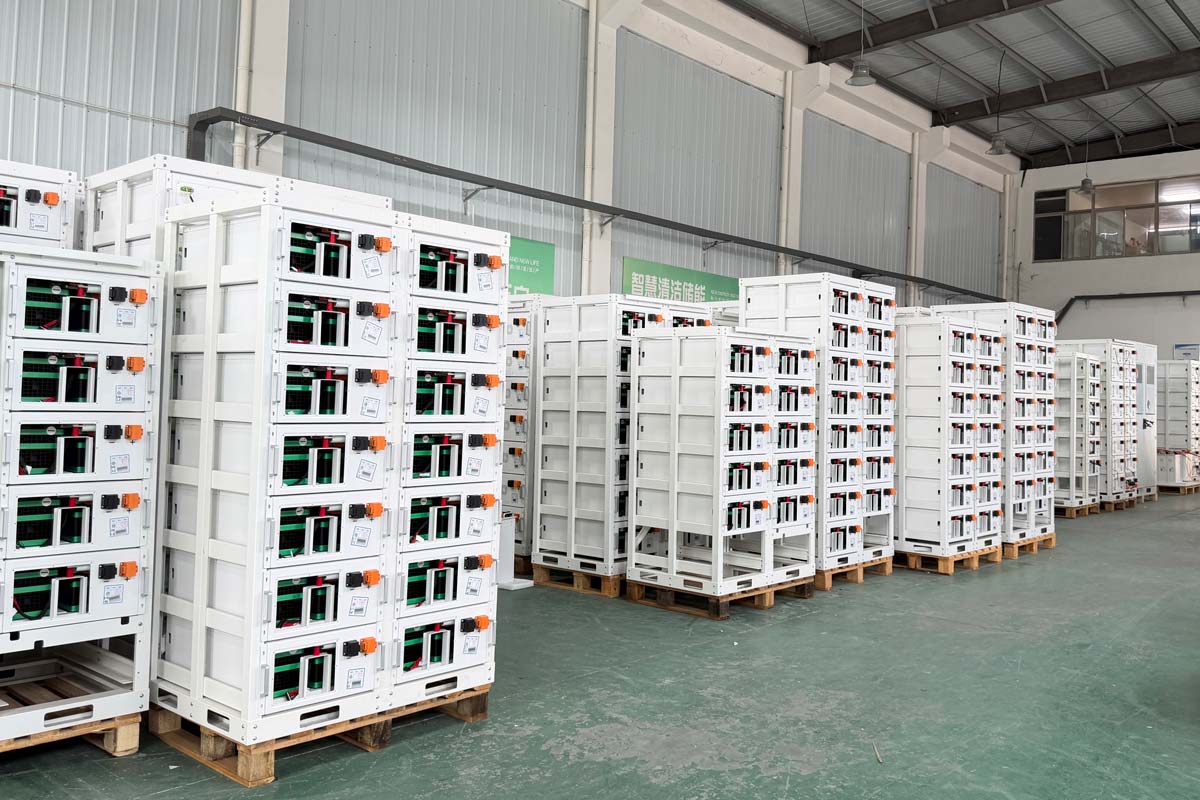
Adding battery storage during a standard solar installation will make it a Hybrid Solar System. The ideal time to invest in it is according to energy goals, not the solar array’s size. If backup power, energy independence, or reducing the dependence on costly peak-hour electricity is a concern, it is best to install a battery in the beginning.
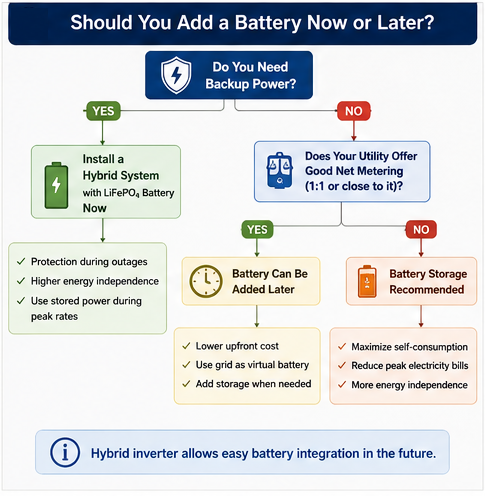
A LiFePO4 battery is most commonly used in residential and commercial storage because it has a high cycle life, stable performance, low maintenance, and is quite safe compared to many other lithium battery chemistries.
If their main aim is to minimize the initial investment, the solar panels can be installed first, and battery storage can be added later. To build on the battery in the future without replacing major electrical equipment, a hybrid inverter can be chosen during the installation. HBOWA’s battery guides and Hybrid Solar System guide offer further technical information people might need to prepare for those eventual upgrades.
| Standard Solar System | Hybrid Solar System + LiFePO₄ Battery |
| Lower upfront investment | Higher initial investment |
| Uses electricity as it is generated | Stores excess daytime energy for later use |
| Limited backup capability during outages | Backup power for selected or essential loads |
| Easier initial installation | Greater long-term energy flexibility |
Plan Solar and Battery Storage for Your Next Step
Solar system size should be planned together with your future electricity demand, available installation space, inverter compatibility, and battery storage requirements. The right next step depends on whether your project is for home backup or commercial energy management.
Home Solar & Battery Backup
For residential projects, evaluate household electricity use, essential backup loads, solar production, and the backup time you need.
Commercial Solar & Energy Storage
For commercial projects, evaluate the load profile, peak demand, site conditions, grid connection, and whether storage is needed for backup or demand management.
For an initial evaluation, please share your location, electricity use, available installation area, target solar capacity, battery plans, and future expansion requirements.
Should You Size Your Solar System for Today or the Future?
While thinking about what scale solar system I require, it’s important to not only consider how much electricity usage I have now, but also what my requirements will be for the future. Solar systems mostly keep running for years, and electrical requirements for the most part increase with time while embracing new advances in your home and business structures. Expecting the future expansion could help avoid the cost of a future upgrade and right-size the system for long-term needs.
Electricity demand will significantly increase because of electric cooking stoves or induction plates, electric heat pumps, and EV charging in the future. Or the use of homes for office purposes or over-expanding business needs can increase the requirement for electricity to be used.
While other factors like tariffs, grid policies, or export programs, etc., are evolving in several markets, it can make onsite generation much more beneficial.
The meaning of future-proofing is not just the installation of the largest possible system, but also It means creating a system that can accommodate growth in the future with excessive oversizing.
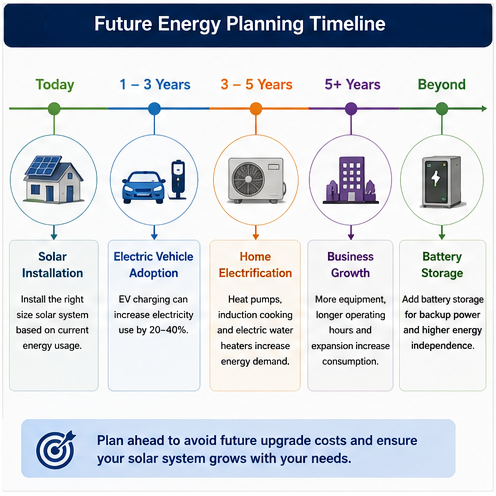
Selecting a Hybrid Solar system, leaving space on the roof with all possible rise options compatible with the existing equipment or panels and batteries in the future, may offer more flexibility than rebuilding the system later. This gives the future modification cost less and makes the system align with future energy needs.
Common Mistakes When Choosing Solar System Size
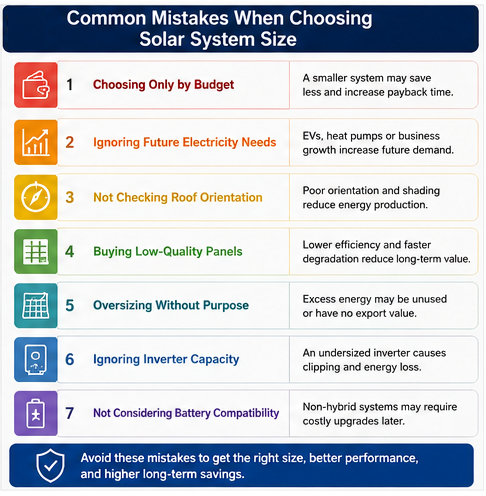
Choosing the ideal solar system involves more than just matching electricity requirements to panel size. The choices we make when installing things today affect the performance of the system for decades to come. Refraining from these errors below can make a solar installation more dependable and economical.
Conclusion
The question of what size solar system I need is dependent on your energy use, future plans, property characteristics, project aims or goals, etc. Not standard size. HBOWA’s solar sizing calculators and technical guides give detailed calculations that let you compare equipment and system options to build a solution for reliable long-term energy performance.
Solar Products for Your Project
 Solar Panels | 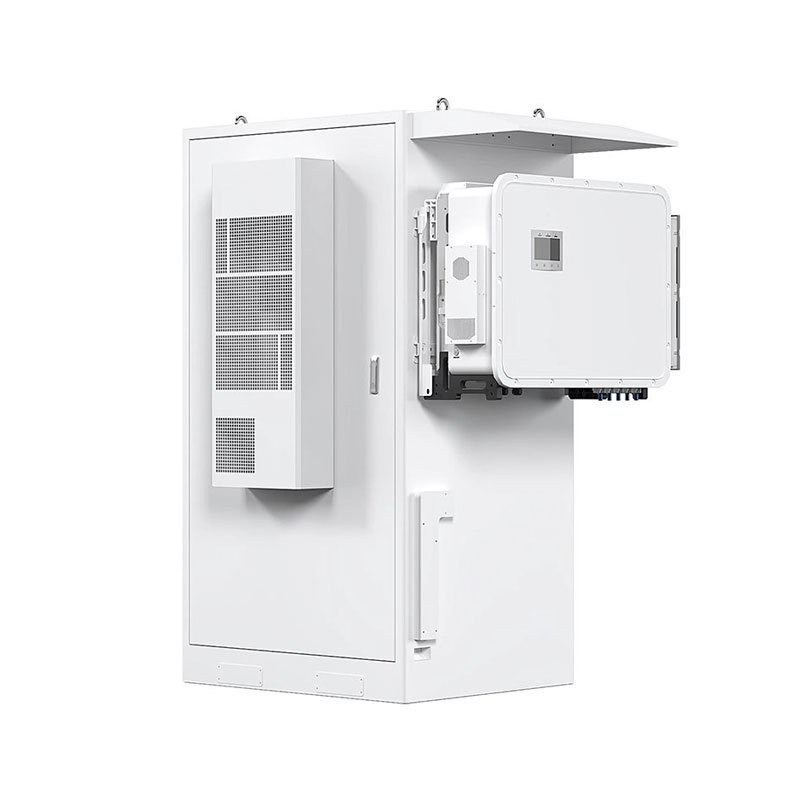 Energy Storage Cabinet Energy Storage Cabinet |  Solar Power System |
Frequently Asked Questions
A 6kW solar system is appropriate for most homes. That is, it can fulfill their energy requirements. But the most suitable size depends on the annual energy consumption of the household and its roof area. Homes with electric cars or complete electric heating may need a larger system.
Most homeowners either elect to install a larger solar system or factor in room for future expansion when charging an electric vehicle due to increased household demand for electricity. The optimal size depends on the distance of the journey, charging habits, and whether it’s charged mostly in the day.
Yes, but not without a practical reason. Some homeowners will foresee future electricity demand, while businesses may see expansion. Before oversizing a system, always factor in local utility export limits, net metering policies, and inverter capacity.
Yes. The orientation of a roof and shade impact energy production, whereby two identical systems may generate different amounts of energy. A usable roof space, roof angle, and local solar resources should all be evaluated in a site assessment before system design.
Never. A commercial solar system is pegged to its operating hours and equipment loads, seasonal demand, and business growth instead of household electricity use. Typical commercial undertakings need an assessment for engineering of a site-specific nature, determinative of system capacity.
Established manufacturers, with higher-quality modules, are often desirable entities as they provide consistent manufacturing quality, warranty support, and proven field performance. It’s best to consider efficiency, degradation warranty, certifications, and inverter and mounting system compatibility rather than brand name only when comparing products.
Yes, in many cases. Hybrid inverters offer future battery integration without needing to change the inverter for easier upgrades. It all depends on your long-term energy plans, budget, and local electricity tariffs.
Seek globally acknowledged certifications like IEC 61215, which pertains to performance, and IEC 61730, which deals with safety. The solar panels went through international standards testing for electrical safety with regard to long-term reliability and performance analysis.
Most types of roofs can take solar panels, but their suitability will depend on many factors, namely, the amount of usable space, structural condition, and the roof’s orientation and shading, as well as local building codes. A professional site assessment is the best way to verify whether your roof is capable of holding the recommended size of the solar system.