
Introduction
A 100KW solar energy system is a medium-sized commercial solar energy system suitable for a business with high daytime energy requirements. State and local governments are adopting systems of this size to help manage energy costs and improve energy resilience. This guide reviews system output, space requirements, and installation price, as well as factors influencing long-term financial return.
What Is a 100KW Solar System, and Who Uses This System?
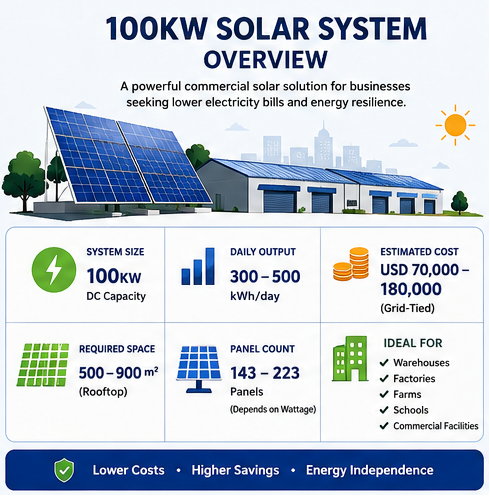
A 100KW solar system is a solar PV system having a capacity of 100kw. A system this size is designed primarily for commercial and industrial use that consumes a lot of power daily, unlike the residential installation of 5kW to 15kW.
Residential and commercial solar systems differ in energy demand, which is their key difference. Solar suitability of commercial facilities making extensive use of equipment often walk-in coolers, air conditioning or heating units, refrigeration units or production machinery, makes installation of larger solar arrays economically attractive.
Common examples of businesses utilising a 100kW installation are manufacturing plant warehouses, schools, farms, shopping centers, and cold storage. Generally, organizations that consume a number of hundred kilowatt-hours or more per day.
Typical Applications of a 100KW Solar System
| Business Type | Typical Daily Consumption | Suitability |
| Warehouse | 300–600 kWh | High |
| Factory | 400–1,500 kWh | High |
| School | 250–500 kWh | High |
| Farm | 250–800 kWh | Moderate to High |
| Shopping Center | 500–1,200 kWh | High |
| Cold Storage Facility | 600–2,000 kWh | Very High |
How Much Power Does a 100KW Solar System Produce?
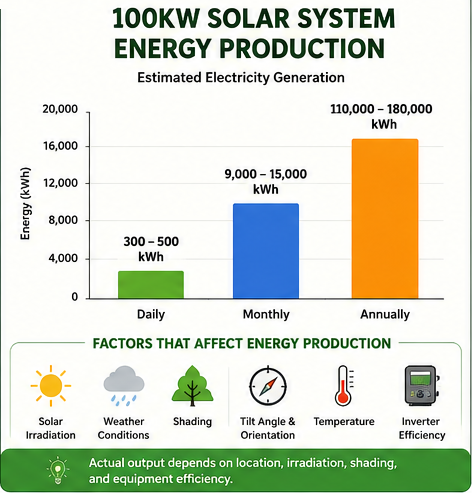
There is no fixed number; a safe range falls between 300 and 500 kWh of power every day, but this is not that simple, and it can be different. The system’s actual production is determined by the production of irradiance, environmental conditions, losses in the system, orientation of the modules, and efficiency of the equipment.
Daily, Monthly, and Annual Energy Production
A frequently asked question is, “How much is 100kw solar system’s power output?” Your answer may vary as per location. Based on effectiveness information made available by the U.S. According to NREL and IEA, commercial photovoltaic systems usually have performance ratios between 75% and 85%, which means that not all theoretical energy is converted into electricity.
So, ideally, a 100-kilowatt solar system can generate between 9,000 kWh and 15,000 kWh a month, and the annual production is about 110,000-180,000 kWh.
Estimated Energy Output
| Production Period | Estimated Output |
| Daily | 300–500 kWh |
| Monthly | 9,000–15,000 kWh |
| Annually | 110,000–180,000 kWh |
Factors That Affect Energy Production
There are various factors that affect how much a 100kw solar system produces over its life. Solar irradiation is the most paramount variable, as greater sunshine means greater electricity generation. When strings are connected, shading from nearby buildings, trees, or rooftop structures drastically reduces solar panel output.
The tilt angle and orientation affect the production, too. In the Northern Hemisphere, south-facing arrays, and in the Southern Hemisphere, north-facing arrays generally produce the highest yields. Heat and high temperatures reduce panel efficiency. Photovoltaic modules perform well under moderate operating conditions. Commercial inverters available in the markets today are mostly over 98% efficient.
The location of production significantly affects the output. In Arizona, a 100kW system, which has yearly solar irradiation greater than 2,100 kWh/m², typically generates far more electricity than a similar German system, where average monthly irradiation is less.
How Big Is a 100KW Solar System? Space, Panel Count, and Roof Requirements
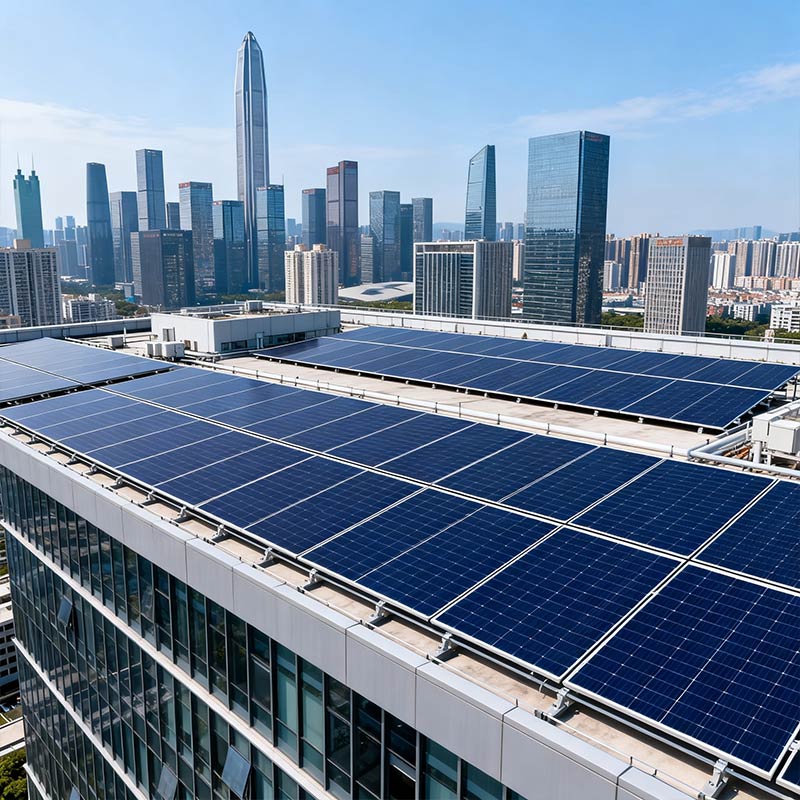
Many businesses often question “how big is a 100kw solar system?” The answer largely depends on module wattage, mounting design, and site layout. Usually, the physical area that commercial projects occupy has dramatically reduced using the new technology by the Tier-1 solar panels such as Longi, Risen, or any other.
The number of solar panels depends on the capacity of each module, which means the use of higher-wattage modules lowers the total number of panels used and could also lower installation labour requirements and vice versa. Modern N-type TOPCon modules are typically rated at 550W to 700W, while many existing commercial systems employ 450W panels.
How Many Solar Panels Are Needed for a 100 kW Solar System?
The number of solar panels depends on the capacity of each module, which means the use of higher-wattage modules lowers the total number of panels used and could also lower installation labour requirements and vice versa. Modern N-type TOPCon modules are typically rated at 550W to 700W, while many existing commercial systems employ 450W panels.
Panel Quantity Comparison
| Panel Wattage | Approximate Quantity |
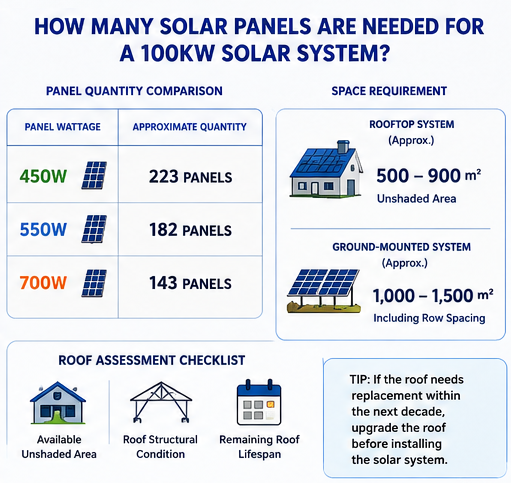
| 450W | 223 panels |
| 550W | 182 panels |
| 700W | 143 panels |
Roof and Land Area Requirements
A 100KW solar system on the rooftop needs at least 500 to 900 square meters that is exposed to the sun. The area of the rooftop will depend on the manufacturer’s panel efficiency, row spacing, and local fire setback. Ground-mounted systems usually require extra land to maintain access and spacing between rows optimally.
HBOWA’s Expert Tip
Businesses can conduct a preliminary assessment of their roof by reviewing three different factors. These are the amount of unshaded area available, the condition of the roof structure, and the remaining life of the roof. If the roof needs to be replaced in the next ten years, many installers suggest roofing upgrades first before installing the solar array.
How Much Does a 100KW Solar System Cost?
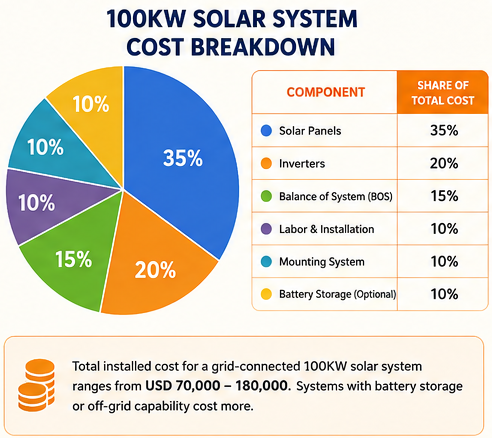
The estimated cost of a solar system of 100KW on a rooftop project site can be around $70000 to over $180,000, depending on what PV module technology and brand is used, import tax, and other factors. The cost of systems with large battery storage or off-grid functionality can be substantial.
Average Cost Structure
The factors on which the commercial solar system depend on the country’s policy, labor rates, equipment choice, and complexity of the project. The cost benchmarks published by NREL show that hardware accounts for the large majority of capital cost expenditures, with labor and balance-of-system also significant.
100KW Solar System Cost Breakdown
| Component | Share of Total Cost |
| Solar panels | 25–35% |
| Inverters | 10–15% |
| Mounting system | 10–15% |
| BOS (cabling, protection, monitoring) | 15–20% |
| Labor and engineering | 15–25% |
| Battery storage (optional) | 20–50% additional |
Factors That Influence System Cost
When it comes to the cost of 100kw solar system, the quality of materials counts. Bankable Tier-1 manufacturers are chosen by commercial buyers because long-term performance and warranty support are important for project economics. Several commercial projects around the world have adopted N-type TOPCon and PERC modules of Longi, Jinko, Trina, Canadian Solar, Risen, JA Solar, Tongwei, GCL, and many other manufacturers.
The final price is also affected by installation difficulty. Roof strengthening, crane access, enhancement of switchgear, and problematic electrical interfaces may escalate costs. Another key variable is mounting type, since ground-mounted systems usually require additional structural materials and site preparation.
Which Solar System Works Best For You?
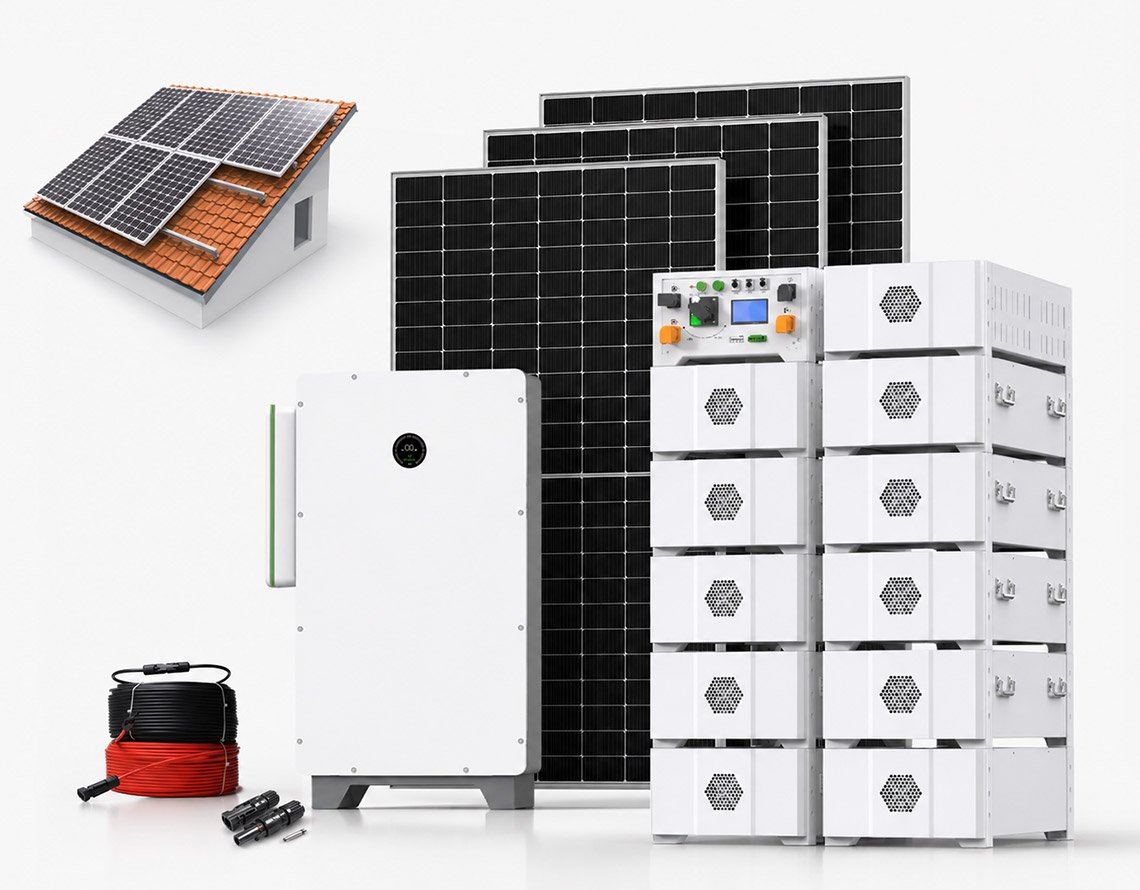
Opting for the correct configuration is as important as choosing the right size system. A 100KW solar energy system can work as an on-grid solar energy system, a hybrid solar energy system, or an off-grid solar energy system. Every configuration has varying levels of independence, resilience, and investment requirements.
System Type Comparison
| Feature | On-grid | Hybrid | Off-grid |
| Grid dependency | High | Moderate | None |
| Battery required | No | Optional/Yes | Yes |
| Backup capability | No | Yes | Yes |
| Cost | Lowest | Medium | Highest |
| Best for | Urban businesses | Businesses needing backup | Remote sites |
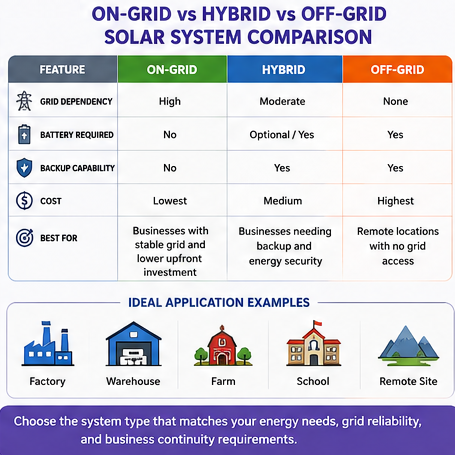
An on-grid solar system does not store electricity. This system is connected with the utility network, and it is opted to cut the cost of monthly electricity bills. A hybrid solar system combines solar energy production with battery storage, and is opted for by the business who wants to store excess energy and use it during outages or peak tariff times. Lastly, an off-grid solar system uses PV modules and batteries (and often generators) to disconnect from the grid altogether and get independent from the grid, usually used by businesses (manufacturing factories and warehouses) that are placed in remote areas.
Which Businesses Benefit Most From Each System Type?
The ideal setup mostly depends on energy usage patterns and grid reliability. Most grid-connected systems provide maximum self-consumption with minimal upfront costs when used by warehouses, shopping centers, and factories in urban and industrial areas.
In essential applications like cold storage warehouses, healthcare facilities, and data centers, where downtime can be costly and cause losses, a hybrid solar system is often recommended; battery storage offers backup power while also supporting peak shaving. In most cases, outage frequency, electricity tariffs, and the cost of the business being interrupted will enable you to answer the question, “Is a hybrid solar system worth it for commercial users?”
Remote agricultural activities, mining sites, and communication infrastructure often require off-grid system because it is unavailable or very expensive.
What Battery Size Is Required for a 100KW Solar System?
There is no specific number or size of battery required in a 100KW solar system.
It is falsely assumed that all 100kW systems require the same amount of storage. Two facilities with the same capacity of solar may not need the same size of battery banks because they consume energy differently.
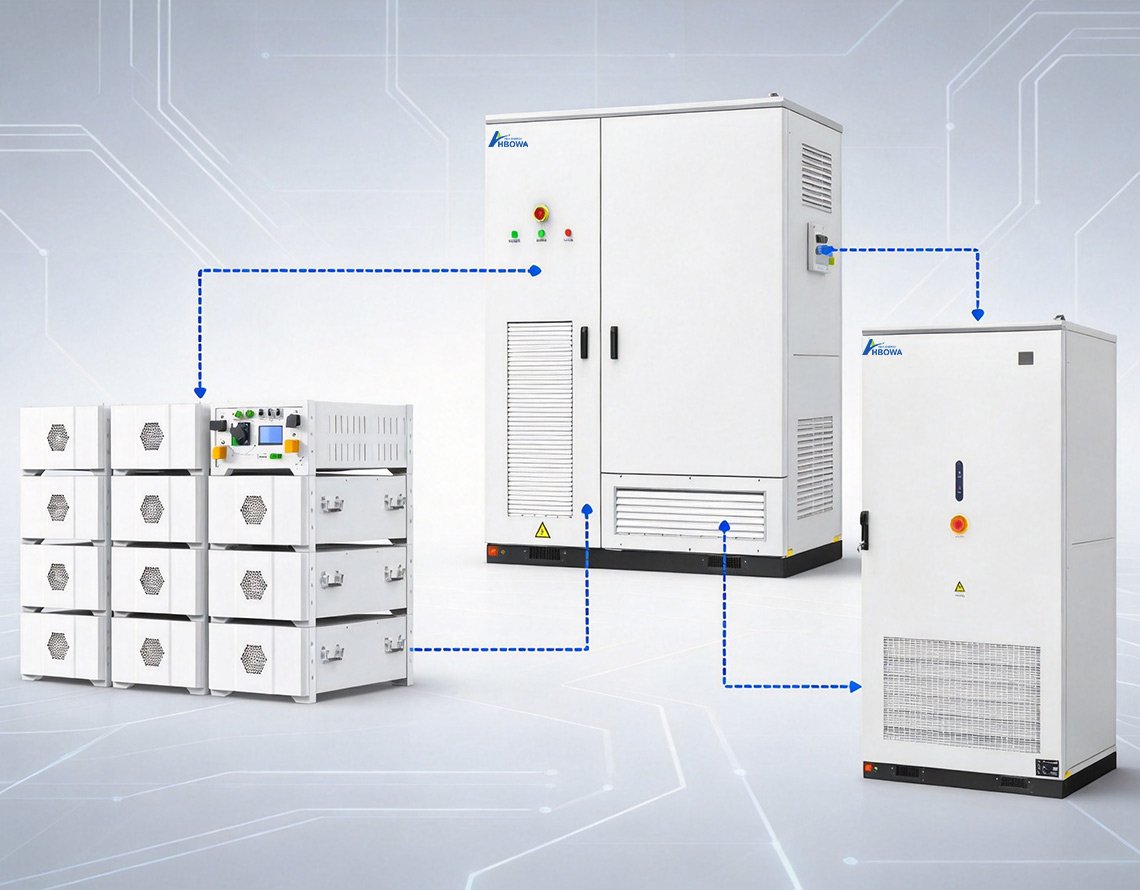
For commercial installations at this scale, an outdoor energy storage cabinet can combine the selected battery capacity with PCS, BMS, EMS, thermal management, and protection.
Typical Battery Capacity Recommendations
Commercial storage projects are designed around specific operational goals such as:
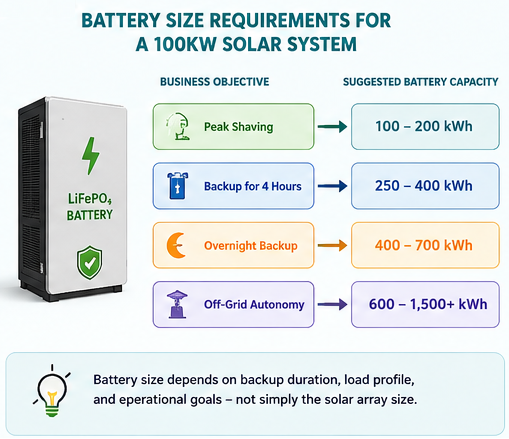
Battery Sizing Framework
| Backup Objective | Suggested Battery Capacity |
| Peak shaving | 100–200 kWh |
| 4-hour backup | 261–400 kWh |
| Overnight backup | 400–700 kWh |
| Off-grid autonomy | 600–1,500+ kWh |
In real life, a warehouse consuming most electricity during business hours may only require 150–200 kWh of storage for demand charge reduction, and at the same time, an agricultural facility wants overnight backup, which requires more than 500 kWh of storage capacity.
Why LiFePO4 Batteries Dominate Commercial Storage
LiFePO4 battery technology is increasingly being adopted in commercial projects as a result of its safety and long lifespan. The International Renewable Energy Agency (IRENA) has published analyses on utility-scale storage, which point to lithium iron phosphate chemistry becoming one of the predominant technologies for stationary energy storage applications.
A large number of B2B buyers are opting for commercial LiFePO4 battery systems as the lower lifetime operating cost may offset the higher initial investment. These systems enhance energy security and lower peak demand fees when combined with a hybrid solar inverter of the proper size.
ROI, Savings, and Payback Period of a 100KW Solar System
A properly designed and installed 100KW solar system can save more money during its lifetime. Solar payback periods for commercial projects are generally positive.
Generally, the best returns are achieved when businesses consume most of their solar generation on-site and do not export electricity back to the grid.
Example ROI Scenarios
| Business | Annual Consumption | Potential Savings Pattern |
| Warehouse | 120,000–180,000 kWh | High daytime self-consumption |
| Factory | 250,000–500,000 kWh | Consistent production load improves ROI |
| Agricultural Facility | 100,000–300,000 kWh | Seasonal savings depending on irrigation schedules |
Factors Affecting ROI
Financial performance is influenced by multiple variables. Electricity prices remain one of the most important factors because high utility rates generally improve project economics.
Returns in some markets can be further improved with government incentives, tax benefits and accelerated depreciation. Using your battery for peak shaving and load shifting can increase savings if demand charges are applicable in your area. Overall project economics are influenced by financing arrangements like loans or power purchase agreements.
How to Choose Solar Panels and Inverters for a 100KW Solar Project
What to Look for in Solar Panels
Due to the proven track record, large production capacities, and financial stability, many commercial projects are now utilizing Tier-1 solar panels.
N-type TOPCon technology has earned thousands of megawatts of market share in 2026. This technology generally offers higher efficiency and lower annual degradation rates than older technologies. PERC modules are still widely deployed because they offer a good balance of performance and cost.
You should also scrutinize the panel warranties. These days, most leading manufacturers offer a product warranty of 12 to 25 years and a performance warranty of up to 30 years. Degradation guarantees compare to priorities, as lower degradation means higher lifetime energy production.
Choosing the Right Commercial Inverter
Commercial solar systems are designed with multiple string inverters or centralized inverter systems.
Choosing the right hybrid solar inverter becomes essential when planning battery integration. Before purchasing, buyers should check the efficiency of the inverter, its monitoring capabilities, remote diagnostic capabilities, and the number of MPPT inputs.
Commercial installers all around the globe often leverage solutions from established manufacturers, with Growatt inverter products being a prominent example used in commercial and industrial applications due to their advanced monitoring support and scalable designs.
Common Mistakes Businesses Make When Planning a 100KW Solar System
Common Mistakes and Recommended Solutions
| Mistake | Consequence | Recommended Solution |
| Ignoring load profile | Lower self-consumption and reduced savings | Conduct an energy audit before system design |
| Underestimating roof structure | Additional engineering costs or installation delays | Perform structural assessment before procurement |
| Oversizing batteries | Unnecessary capital expenditure | Size storage according to actual backup needs |
| Choosing lowest-cost equipment only | Higher degradation and maintenance costs | Prioritize proven, bankable manufacturers |
| Neglecting future expansion | Costly system modifications later | Design with expansion capacity in mind |
Case Study:
A distribution warehouse consumes about 450kWh of electricity daily. The demand mostly occurs at 8 a.m. Between the hours of 6 a.m. and 6 p.m., lighting systems, conveyor equipment, ventilation, and office operations are operational.
The engineers recommended a 100KW hybrid solar system, instead of a grid-connected one, after checking the load profile of the facility. Each year, the warehouse experienced several short interruptions in electric power, causing delays and inventory issues.
The final design consisted of a solar array of 100kW coupled with a battery energy storage system of ~250 kWh capacity. The batteries were sized to support critical loads during outages and to lessen peak demand charges in the late afternoon.
After the installation, the business increased its solar self-consumption, energy resilience, and reduced its cost of purchases at peak periods. The system has been designed with extra inverter capacity for subsequent expansions with the warehouse’s activities.
Conclusion
A 100 kW solar system works best when the design matches your load, roof space, tariff, and backup-power target. For a reliable quote, share your electricity bills, site photos, and battery requirements with HBOWA.
Solar Products for Your Project
 Solar Panels |  Solar System Solar System |  C&I Battery Storage |
Frequently Asked Questions
Certainly. A well-structured solar system of 100KW size can curtail commercial demand charges effectively by controlling the quantity of electricity sourced from the grid. High daytime consumption businesses may gain the most, with solar generation with battery storage complementing it for peak shaving.
In commercial projects, yes! A structural evaluation confirms that the roof can safely bear the weight of the solar panels, mounting structures, as well as wind, snow, and other external loads. Older industrial buildings and warehouses will require this assessment.
Certainly. Various enterprises set up a 100KW solar system to compensate for the electricity they use for EV charging. Bringing together solar technology with EV chargers may help cut operational costs and meet sustainability goals.
No, not at all! The size of the system must reflect the actual and projected consumption of electricity, installation space, and grid code.
Yes, with some obvious conditions, they are suitable for budget-sensitive projects if they have undergone professional testing and performance verification, and buyers should always review remaining warranty coverage of the modules, degradation levels, and certification documentation before purchasing for commercial applications.
Commercial solar panels often have performance warranties of 25-30 years. Inverters and batteries may need replacement earlier, depending on product quality, operating temperature, cycling and maintenance.
Plan for about 500-900 m2, or 5,400-9,700 sq ft, of usable unshaded roof area. Final layout depends on panel size, setbacks, access paths and local code.
Payback often ranges from several years to more than ten years. Electricity price, self-consumption, installed cost, incentives, demand-charge savings and financing determine the final result.