
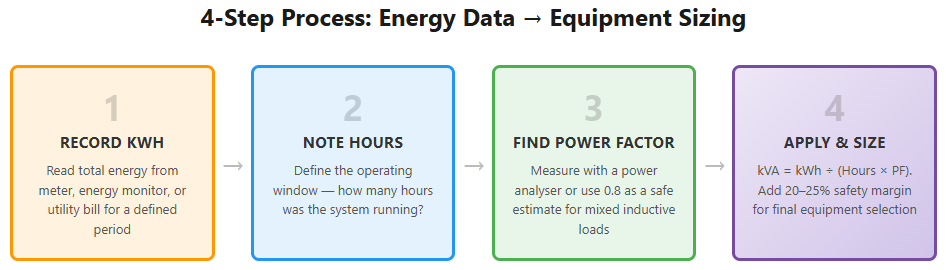
Formula: kVA = kWh ÷ (hrs × PF)
A kWh to kVA calculator converts the electric energy in kilowatt-hours (kWh) into apparent power in kilovolt-amperes (kVA). When assessing power systems, it is necessary to convert energy consumption, duty cycle, and power factor to a generator or transformer, or inverter rating. This calculator is designed for engineers, electricians, solar designers, and facility managers who require fast, reliable results for system sizing, validation, and load analysis rather than theory.
Formula & Variable Definitions
Formula:
kVA = kWh / (Hours x PF)
kVA: Apparent power
kWh: Energy used from the meter or the utility bill
Hours: Operating Duration
PF: Power Factor, typically 0.7-0.9
This relation links the power demand with energy consumption. Kilowatt-hours mean how much electrical energy we use over a period. Similarly, kilovolt-amperes means how much total apparent load power we require at any one instant. The conversion relies on the duration of energy consumption and the efficiency of the system’s conversion of electricity into work.

The total energy applied during a defined operating period is represented in the formula kWh. The number of hours is the period over which that energy will be consumed. Power factor is a measure of the efficiency of the load. It takes into account the phase difference between current and voltage in the AC systems. A low power factor will require a higher kVA for the same power usage, which puts a greater strain on wiring.
This calculation is applicable to AC, where apparent power is important. Kilowatt to kVA conversion is not a straightforward unit scaling. Moreover, this cannot be accurately performed without time and power factor information. The result depicts the apparent power at steady state under normal conditions.
Example Calculation
A commercial refrigerator facility is continuously running to protect inventory. Over the 6-hour peak operation period, the site used 42.6 kWh of energy. Measurements show that there is an average power factor of 0.78 owing to motor loads that are inductive.
To determine a proper generator, the calculation is done as follows:
KVA = 42.6 / (6 x 0.78)
KVA = 42.6 / 4.68
KVA = 9.1
This value is directly used for determining generator or UPS capacity. Generally, engineers apply a safety factor above the calculated kVA to allow for high starting currents, fluctuations in loads, and future growth. The conversion avoids undersizing of equipment, which could cause overheating, voltage fluctuation, or early failure of the equipment.
When to Use This Calculator
This calculator may be used when we have energy data; however selection of equipment will require apparent power ratings. It is often used in generator sizing for backup power systems. Those are fuel consumption and runtime estimates based on the energy load, but the generator rating is given in kVA.
The calculation is used by designers of solar and hybrid systems to size inverter capacity. They use it to check if the electrical network installations that exist are sufficient for energy consumption measures. The conversion also supports checks, for example, whether the kWh measured consumption corresponds to a kVA-rated equipment with known operating conditions.
This method uses time and power factor, unlike simple kilowatt to kVA calculations, and is thus suitable for real-world system planning, not nameplate comparisons. This is especially useful for professionals interested in determining kVA requirements from energy records.
Reference Table (Typical Values)
The following extended table shows a more realistic kWh to kVA conversion example ranges under different operating times, and the power factor for all the values are assumed to be 0.8, which is typical for a mixed inductive load, i.e. motors, compressors and HVAC equipment, and with these figures, professionals can easily estimate their kWh to kVA requirements quickly for planning or verification without calculation.
| Energy (kWh) | Hours | Power Factor | Apparent Power (kVA) |
| 1.6 | 1.0 | 0.8 | 2.0 |
| 3.2 | 1.5 | 0.8 | 2.7 |
| 4.9 | 2.0 | 0.8 | 3.1 |
| 6.8 | 2.0 | 0.8 | 4.3 |
| 9.4 | 2.5 | 0.8 | 4.7 |
| 12.5 | 3.0 | 0.8 | 5.2 |
| 15.8 | 3.5 | 0.8 | 5.6 |
| 18.9 | 4.0 | 0.8 | 5.9 |
| 22.7 | 4.5 | 0.8 | 6.3 |
| 26.4 | 5.0 | 0.8 | 6.6 |
| 31.6 | 5.5 | 0.8 | 7.2 |
| 39.7 | 6.5 | 0.8 | 7.6 |
| 47.9 | 7.0 | 0.8 | 8.6 |
| 54.2 | 8.0 | 0.8 | 8.5 |
| 63.8 | 8.5 | 0.8 | 9.4 |
| 76.9 | 10.0 | 0.8 | 9.6 |
| 88.4 | 10.5 | 0.8 | 10.5 |
| 112.4 | 12.0 | 0.8 | 11.7 |
| 136.7 | 13.0 | 0.8 | 13.1 |
| 168.3 | 16.0 | 0.8 | 13.2 |
| 194.5 | 16.5 | 0.8 | 14.7 |
| 225.8 | 18.0 | 0.8 | 15.7 |
| 274.6 | 20.0 | 0.8 | 17.2 |
| 318.9 | 22.0 | 0.8 | 18.1 |
| 382.4 | 24.0 | 0.8 | 19.9 |
The further extension of the reference appears to highlight how demand for apparent power varies with the speed of energy consumption. With the same total energy, shorter durations require more kVA while longer durations distribute more and use less instantaneous apparent power. These figures are extremely useful when learning to work out kVA from recorded energy data or when undertaking quick kilowatt to kVA conversion checks in system planning.
Accuracy & Limitations
According to the calculator, the operating conditions remain stable throughout the occurrence, the power factor is constant, and the energy is consumed uniformly throughout the duration specified. The power factor changes with the load level of the system, induction motor starting, inverter operating mode, etc. These variations can increase apparent power beyond calculated values.
The calculation did not consider the efficiency loss of the generator, inverter, transformer, and surge current during a transient. The actual capacity requirements can also be affected by temperature, altitude, or aging equipment. Any calculated kVA value for critical systems should be validated with the manufacturer and the actual measurement.Value in use conversions, despite limitations, provide reliable baselines for planning, comparisons, and preliminary equipment selection.
Solar Products for Your Project
 Solar Panels |  Solar Inverter |  C&I Battery Storage |
Case Study
Despite the complexity of the facility, due to quorum cabling, the data processing facility took the right decision to install a standby generator to cater for essential loads in case of grid outages. The energy monitoring done through multiple test runs indicates 94.8 kWh energy consumption of the critical equipment during an 8-hour outage. The average load power factor measured is 0.82.

The generator must be able to support an output of at least 14.5 kVA on continuous operation. The team takes the generator rating of 20 kVA after applying a design margin of 25 percent on account of startup currents and future expansion.
To avoid overload, to help with voltage stability, and to prolong service life, Accurate calculations are key to harnessing historical energy data to make strategic infrastructure decisions, which ensures organisations do not rely on guesswork.
Conclusion
The converter between kWh and kVA fills the gap between energy consumption levels measured and apparent power requirement levels. Using the right kWh to kVA conversion method with time and power factor gives a true view of system capacity requirements for generators, inverters, and electrical infrastructure. This method supports accurate planning and helps understand how professionals determine kVA so that electric systems can function at true operating conditions.
More Calculators for You
Frequently Asked Questions
You can always use either the “HBOWA Calculator” or use the Formula to convert kWh to kVA is “kVA=kWh÷(Hours × Power Factor),” and you can also read section 2 for more clarification.
The power factor determines the relationship between kVA and kW. This relation links the power demand with energy consumption. Kilowatt-hours mean how much electrical energy we use over a period. Similarly, kilovolt-amperes means how much total apparent load power we require at any one instant. The conversion relies on the duration of energy consumption and the efficiency of the system’s conversion of electricity into work.
Yes, but use the values accurately for accurate results and it is advised to use an online calculators such as provided by Kipardo for better results and to avoid human error.
Nay! A kilowatt to kVA calculator will convert real power in kilowatts directly. This tool converts energy over time in kilowatt-hours and apparent power using an estimation of the duration (typically hours) and the power factor.