Introduction
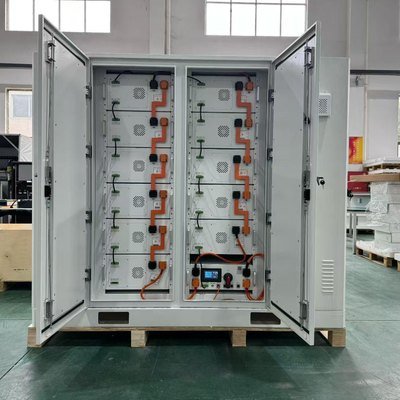
The number of solar batteries your system needs will depend on five things: your daily consumption of electricity, the number of hours of backup required, battery voltage, usable battery capacity, and the type of solar system you have. The best answer to the question “How Many Batteries Do I Need for My Solar System?” for homes and businesses requires understanding these variables.
How Many Batteries Do I Need for My Solar System?
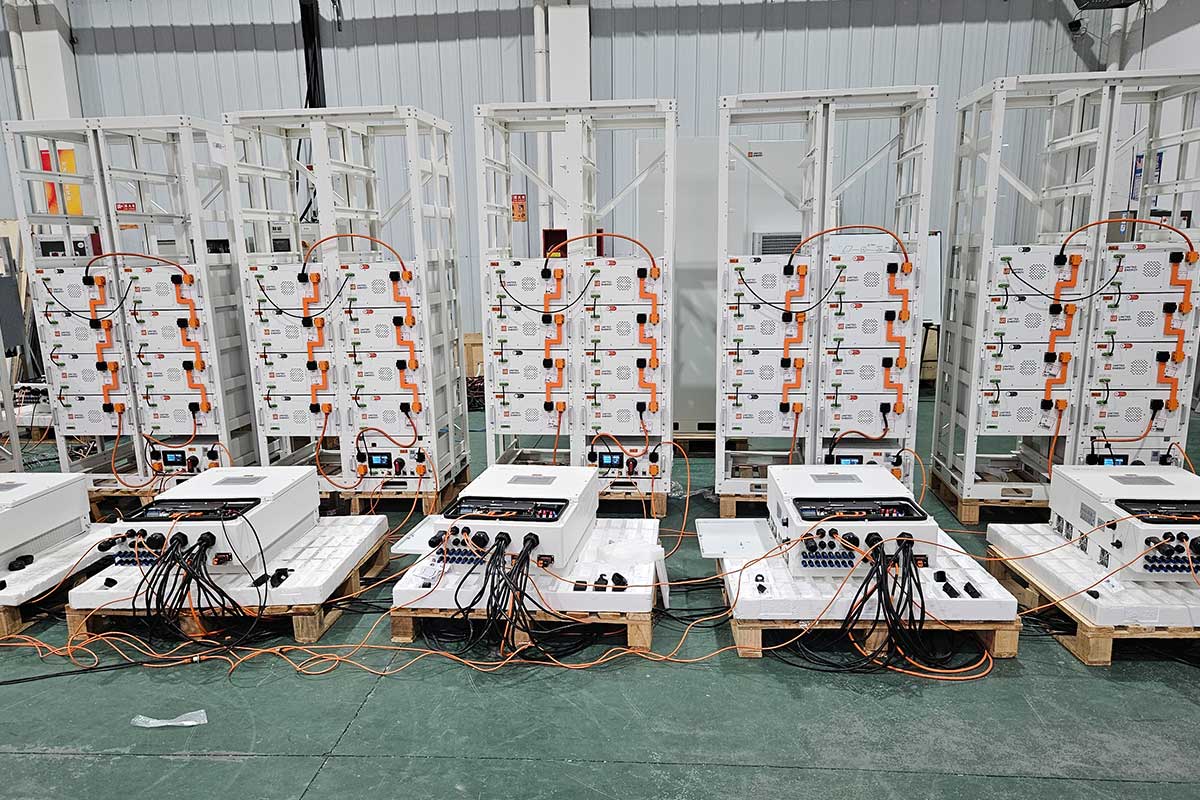
There is no one magic number when it comes to how many solar batteries your property needs. Because the batteries you need depend on how much power you consume, how long you need backup power for, the usable capacity of each battery, and whether your system is grid-tied, hybrid, or off-grid.
| Solar System Purpose | Typical Battery Need |
| Backup power only | 1–2 batteries |
| Daily load shifting | 2–4 batteries |
| Hybrid system | Depends on energy use and battery capacity |
| Off-grid system | Based on daily energy demand and required autonomy |
A battery sizing professional would first look at what you actually need to consume and store, according to some experts in the field. This method enhances system performance while avoiding needless expenditures, and it also permits expansion if your electricity needs increase.
What Determines the Number of Solar Batteries You Need?
The sizing of your batteries starts with an analysis of how the power is used, not just matching batteries to the solar array’s size. A system with good design provides energy output matching the demand while also accommodating its storage capacity, charging rate, and expected growth.
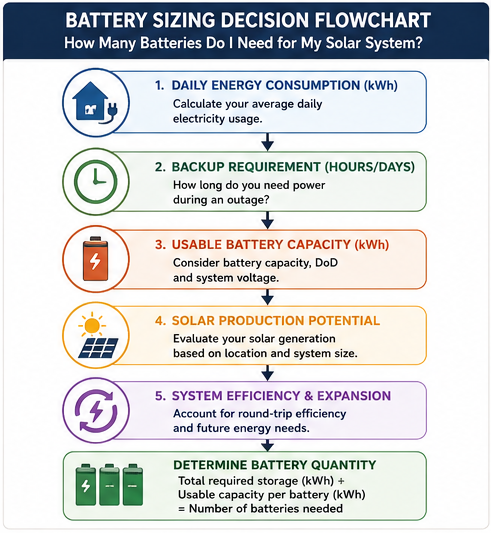
Electricity Consumption Per Day (kWh):
Every calculation of storage starts with daily energy use in kilowatt-hours (kWh), so using electricity bills, smart meters, or home energy monitoring systems can help figure out how much energy is used on a typical/day. Creating a system based on actual consumption measurements yields better results than estimated averages.
Backup Duration
The defined backup time is the period for which the stored energy must supply essential or total household loads. Some people only need emergency power for a few hours, while others need overnight backup or several days of power independence.
Battery Usable Capacity
A battery’s specification does not always match the amount available for use. Battery capacity rating, the nominal value, is not used for professional calculations. Instead, a usable energy reference is used. The usable energy is the real energy amount that would be accessible. This rating of the battery shows how much electricity is really delivered.
Depth of Discharge (DoD)
The depth of discharge provides information on the amount of energy that can be used from a battery. Today’s LiFePO₄ batteries generally allow a much higher usable DoD than traditional lead-acid batteries. Consequently, more usable energy is available from the same rated capacity.
Solar Production
The electricity storage of a solar battery only happens through a solar system. The charge that every building can get per day is decided by local solar radiation, roof orientation, shading, weather on a seasonal basis, and the efficiency of the panel.
Battery Proficiency and Future Expansion
The amount of stored energy that can be recovered after charging and discharging, known as round-trip efficiency, and planning for future electric vehicles (EVs), heat pumps, or business growth avoid undersized battery storage systems that require costly upgrades in the future.
Step-by-Step Formula to Calculate Battery Requirements
Estimates of battery quantity are usually made using tables of simplified data, which can be misleading. Professional designers will calculate the storage required from the energy demand, battery performance and system efficiency. A practical way to choose the size of the battery bank can be obtained from the equation.
Required Storage (kWh) = Daily Consumption × Backup Period ÷ (Depth of Discharge × Battery Efficiency)
Every variable has a crucial purpose. The amount of electricity that should be supplied through backup within the backup period is the daily consumption. The backup period is the duration, in hours or days, that the battery needs to run for. The depth of discharge (DoD) is a measure of what percentage of the rated capacity of the battery can be used. Also, battery efficiency refers to small energy losses when charging or discharging.
Think of a household using 18 kWh of electricity on a daily basis and requiring backup for 12 hours. As 9 kWh is to be supplied for just the daily requirement, it implies half (1/2) of the daily demand.
Let us assume that the homeowner selects a LiFePO₄ battery of 10 kWh with 90% usable DoD and 95%round-trip efficiency.
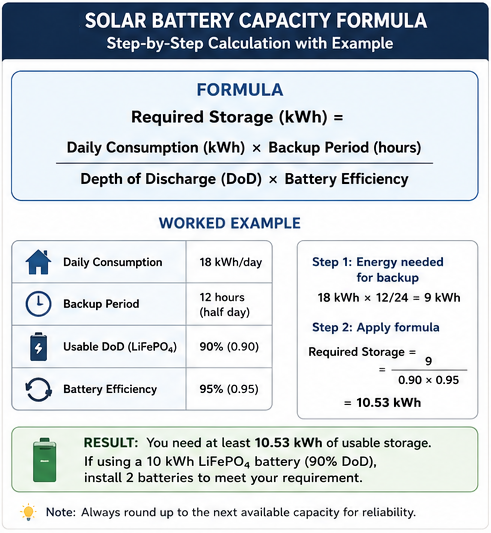
Because a single 10 kWh battery has less usable storage than required, the homeowner will either opt for a battery with a greater usable capacity or install two smaller batteries exceeding 10.53 kWh of usable storage together.
Using this calculation as a starting point is a far more accurate approach than simply selecting batteries based on solar system size. This is the basis of many professional solar battery calculator tools used during design.
Battery Quantity Examples by Solar System Size
The size of a photovoltaic (PV)system gives us good context for estimating battery storage, but it should never be the only reason. The difference in consumption of electricity between 2 sites with the same or similar solar panels and batteries may vary depending on the backup need, consumption profile, day and night operation, plans to increase the load, etc. The table below is suggestive and not prescriptive.
| Solar System Size | Average Daily Output* | Typical Battery Range (Usable) | Approx. Qty of 51.2V 100Ah Batteries (5.12kWh each) | Approx. Qty of 51.2V 314Ah Batteries (16.08kWh each) | Suitable Application |
|---|---|---|---|---|---|
| 15 kW | 60–75 kWh | 30–60 kWh | 6–12 batteries | 2–4 batteries | Large homes, villas, small offices |
| 20 kW | 80–100 kWh | 40–80 kWh | 8–16 batteries | 3–5 batteries | Businesses, commercial use |
| 30 kW | 120–150 kWh | 60–120 kWh | 12–24 batteries | 4–8 batteries | Commercial buildings, light industries |
| 50 kW | 200–250 kWh | 100–200 kWh | 20–40 batteries | 7–13 batteries | Warehouses, hotels, farms |
| 60 kW | 240–300 kWh | 120–240 kWh | 24–47 batteries | 8–15 batteries | Medium commercial facilities, schools, larger farms |
| 80 kW | 320–400 kWh | 160–320 kWh | 32–63 batteries | 10–20 batteries | Factories, malls, hospitals |
| 100 kW | 400–500 kWh | 200–400 kWh | 40–79 batteries | 13–25 batteries | Large commercial buildings, industrial sites |
| 150 kW | 600–750 kWh | 300–600 kWh | 59–118 batteries | 19–38 batteries | Factories, industrial parks, large C&I projects |
A larger PV system does not automatically mean more batteries. For instance, a household whose peak electricity usage is predominantly during the day may not need much storage even if it has a large solar system. By contrast, a business that operates heavily during the evening or has equipment loads overnight may require more than six times the number of batteries, even for the same PV capacity. Expert system design assesses electricity needs and operational goals first, and battery quantity second.
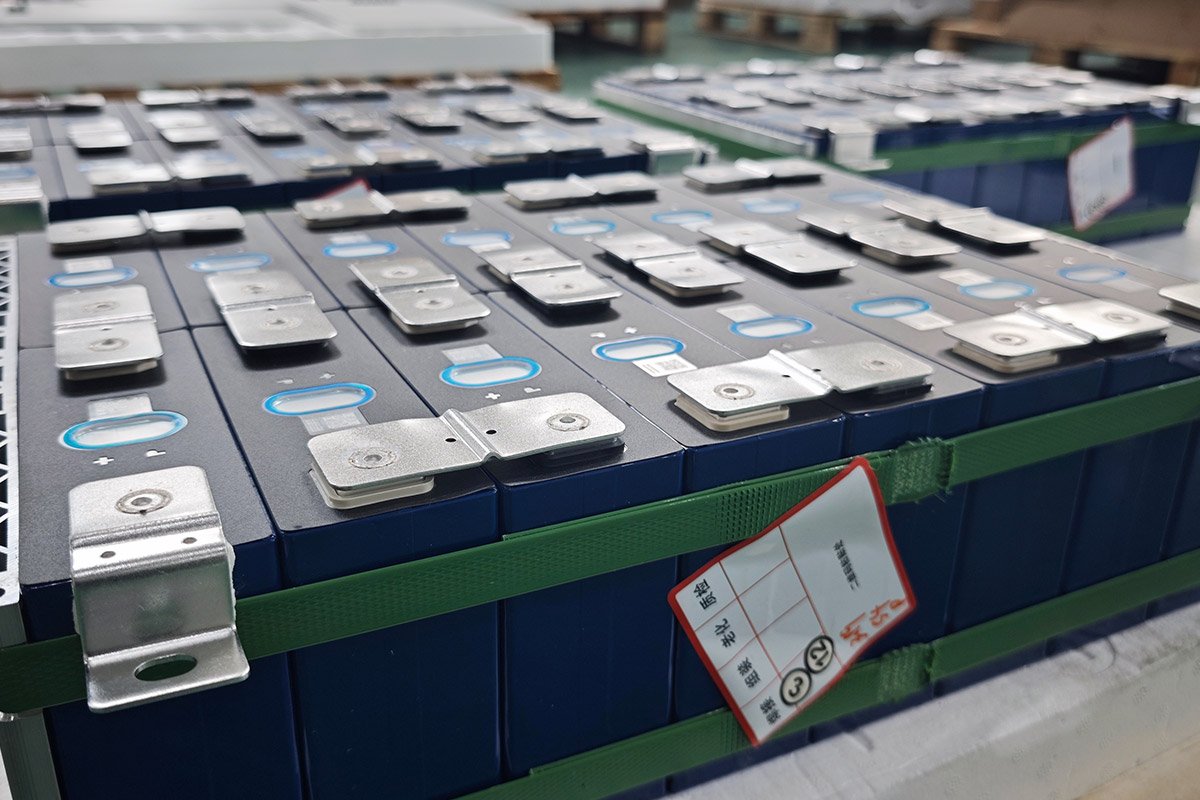
How Battery Chemistry Changes the Number of Batteries Needed
Different battery chemistries will result in different amounts of usable energy from each battery in storage. Evaluating batteries purely in terms of their announced capacity can yield misrepresentations, as various technologies allow their capacity to be useful.
| Feature | LiFePO₄ Battery | Lead-Acid Battery |
|---|---|---|
| Usable Capacity | High, about 90–95% of nominal capacity | Low, about 50–60% of nominal capacity |
| Depth of Discharge (DoD) | 80–95% | 50–60% |
| Cycle Life | 3,000–6,000+ cycles | 300–800 cycles |
| Maintenance | Minimal, maintenance-free | Regular checks and water top-up required |
| Space & Weight | Compact and light | Bulky and heavy |
| Battery Quantity for Same Backup | Requires fewer battery units | Requires more battery units |
| Best Use | Solar energy storage, ESS, backup power, off-grid systems | Low-cost backup systems with limited cycle use |
With LiFePO₄ battery systems, the usable capacity is often much closer to the rated capacity, as they can safely operate at a greater depth of discharge (DoD) without affecting service life very much. Lead-acid batteries require a higher safety margin to reduce degradation. As a result, only part of their rated capacity is available for regular use.
Two battery banks that might have the same nominal kilowatt-hour rating can still yield different performance in practice This distinction. When calculating battery capacity, designers should look at usable energy and not what is printed on the battery. This strategy yields a more accurate assessment of necessary batteries, avoids oversizing the storage system, and ensures a dependable backup performance.
Sizing Batteries for Commercial vs. Residential Use:
Different battery sizing methods depend on how electricity is consumed. Demand for residential properties usually peaks in the morning and evening, while demand for commercial and industrial loads is more predictable and is during day time.
| Factor | Residential | Commercial | Industrial |
|---|---|---|---|
| Typical System Size | 3 kW–15 kW | 15 kW–100 kW | 100 kW–MW+ |
| Load Profile | Evening and night household loads | Daytime operations with peak hours | Continuous heavy loads |
| Peak Demand | Moderate | High, especially during business hours or evenings | Very high, continuous demand |
| Critical Loads | Essential home appliances | Business-critical loads and operations | Mission-critical equipment |
| Backup Goal | Outage backup and energy savings | Peak shaving, cost reduction, and backup power | Energy reliability, peak shaving, and continuous operations |
| Scalability Need | Moderate | High | Very high |
| Battery Solution | Modular home battery systems | Scalable commercial battery storage | Large-scale industrial battery systems |
For domestic and household systems, the aim is often to enhance self-consumption, lower grid dependency, or supply essential appliance backup. As a result, battery sizing is based on household energy use and backup duration.
Projects involving commercial battery storage are increasingly focusing on peak demand reduction and continuity of operations, as well as electricity costs and future business opportunities. Prioritize critical loads during system design. Equipment such as refrigeration systems, communication infrastructure, and manufacturing equipment often requires uninterrupted power.
For industrial battery applications, scalability is becoming more important. Over time, many businesses expand their capacity, build electric vehicle charging infrastructure, or acquire new equipment. Creating a modular battery system allows it to add additional storage without affecting the original installation. This approach is especially useful for organisations that want to develop long-term energy resilience with scalable LiFePO₄ battery systems supplied via wholesale or commercial procurement.
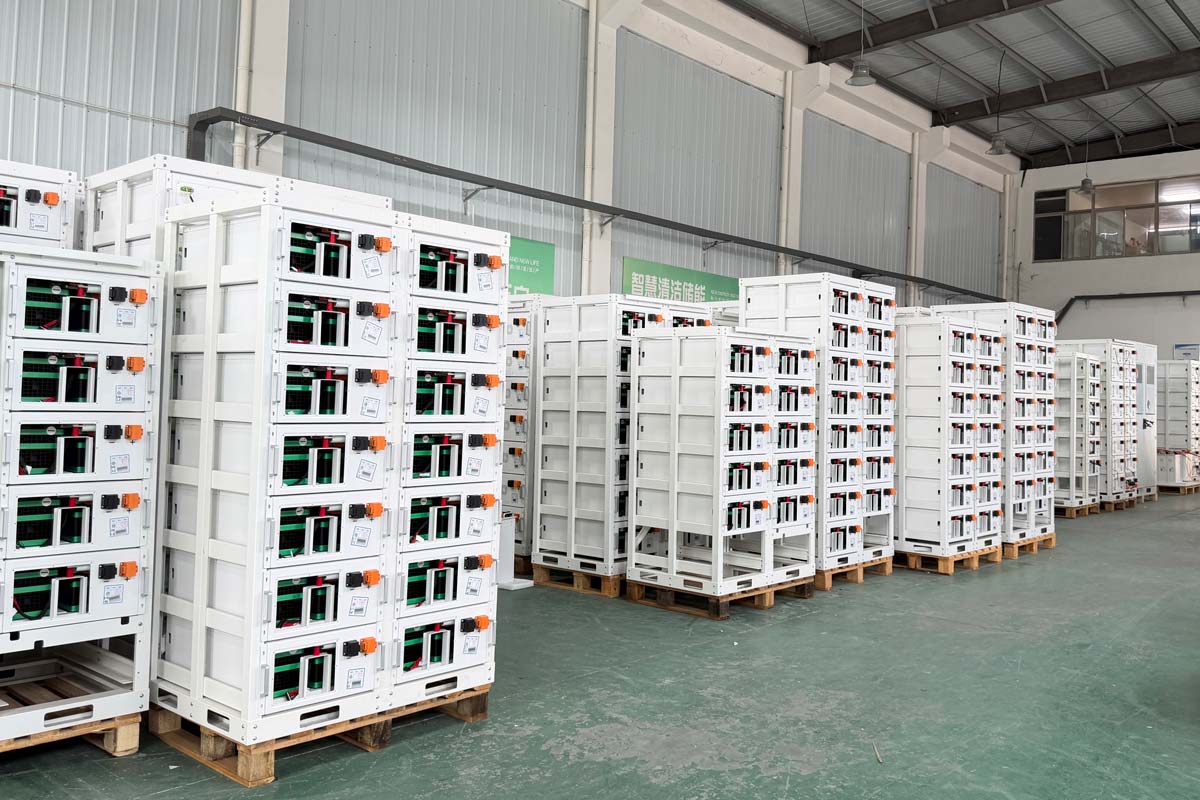
Choose the Right Battery Solution for Your Project
The number of batteries you need depends on the application. Residential systems are often designed around household consumption and backup time. Commercial systems require a broader evaluation of load profile, peak demand, installation conditions, and system control requirements.

For Home Solar & Backup
Explore residential battery solutions for solar self-consumption and household backup requirements.
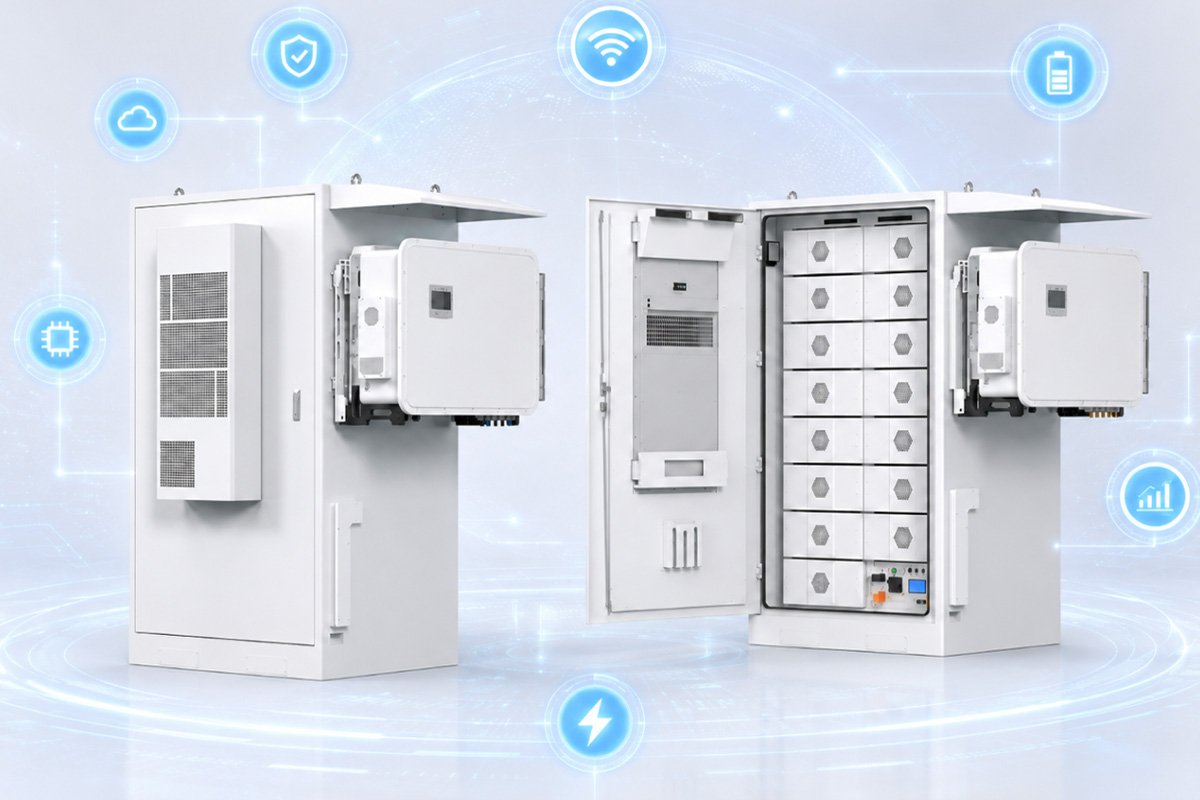
For Commercial & Industrial Projects
Explore C&I energy storage cabinets for peak shaving, commercial backup power, solar storage, and project-specific applications.
For an accurate battery sizing evaluation, please provide your daily energy use, expected backup time, solar production, load profile, installation location, and future expansion plans.
Common Battery Sizing Mistakes to Avoid
If the battery is not sized correctly, performance will suffer, costs will rise, and equipment life will be adversely affected. Over-sized battery banks may sit for long amounts of time in a partial state of charge, and undersized systems may discharge too quickly and fail to deliver the expected backup.
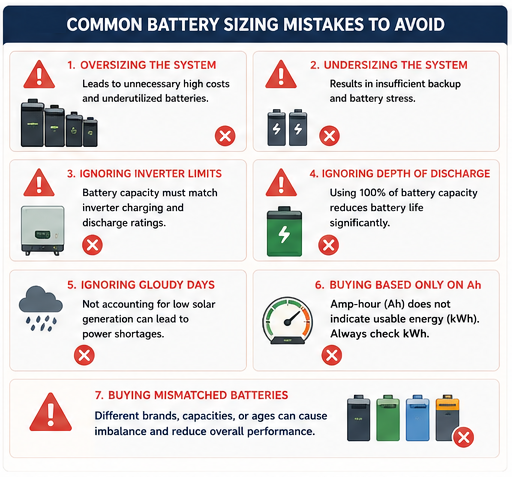
One more typical error is disregarding inverter compatibility. The battery must have the voltage, communication protocol, and charging specifications supported by the inverter. Disregarding the depth of discharge (DoD) can yield unrealistic storage calculations since not all rated battery capacity is designed for daily usage.
Also consider local weather conditions. When cloudy days last in succession, solar generation will reduce, and so will battery charging. Furthermore, choosing batteries by their amp-hours (Ah) alone without reference to voltage or usable kilowatt-hours will lead to incorrect comparisons.
Choosing Batteries That Match Your Solar System
Choosing the right battery represents more than just capacity. The battery must match the system voltage 12V, 24V, or 48V and be fully compatible with the inverter’s charge parameters and communication protocols. Many current hybrid solar inverter platforms are capable of connectivity through a CAN Bus or RS485 for battery monitoring and energy management.
The capacity of modular storage to accommodate additional storage solutions enables them to work as an easily expandable storage option. Systems that incorporate Tier-1 solar panels, compatible hybrid inverters, and LiFePO₄ batteries will maximise efficiency, reliability, and energy use. Check the technical specifications before you buy. Also verify the manufacturer’s compatibility list. For example, check the supported battery list before purchasing a Growatt or Deye inverter.
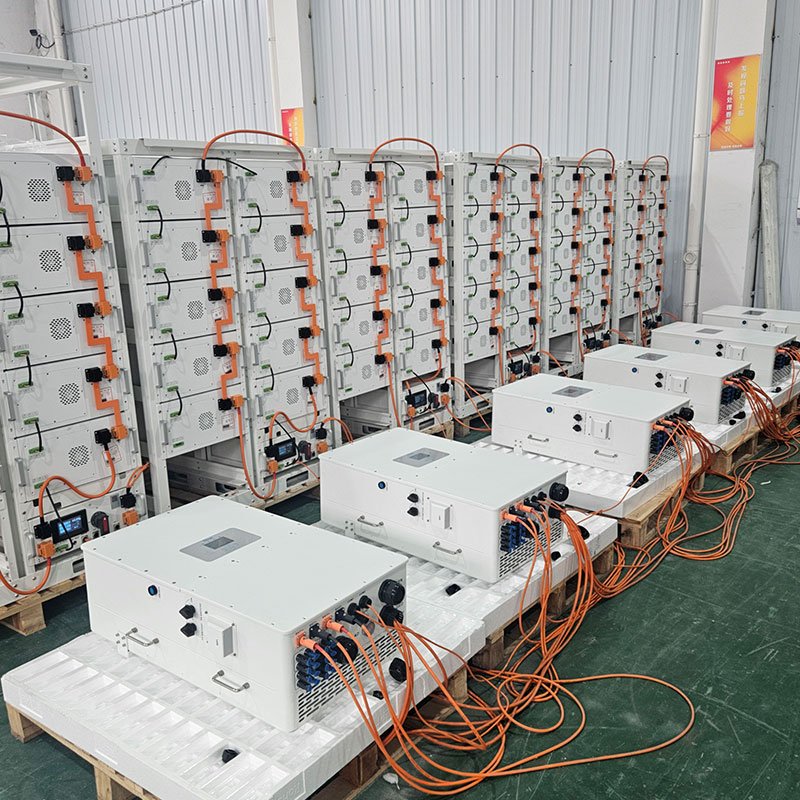
Real-Life Business Scenarios
The examples that follow explain why the answer to the question, “How Many Batteries Do I Need for My Solar System?” will differ due to energy requirements rather than just the size of the solar array.
A house with a 5 kW solar system wants to run lights, fridge, internet modem, and a few small appliances during outages at night. Since only a few essential circuits require backup, a single 10 kWh LiFePO₄ battery may offer enough usable storage, depending on real consumption.
A retail business with a 15 kW solar system is looking to save on electricity costs during peak tariff periods, not provide overnight backup. Multiple batteries sized to the afternoon and evening demand can improve self-consumption and decrease top-up electricity purchases without excessive over-sizing of storage.
A warehouse that will be making use of a 30 kW hybrid solar system has its office equipment, monitoring systems, and certain machinery continuously working during the power cuts. Instead of using a single large battery, a scalable battery bank allows storage capacity to expand as future energy needs increase. It also improves system resilience while making maintenance and future upgrades easier and more flexible.
Conclusion
How many batteries do I need for my solar system? This depends on your calculated energy consumption and backup needs. Further, the type of battery chemistry, usable capacity, and future electricity demand are considerations too. Not just solar panels. Calculating the storage based on actual loads will help design a safer, more efficient, and cost-effective solar power system.
Frequently Asked Questions
The battery life has a direct connection to backup time. A system that provides four hours of backup needs much less battery storage than one designed to power a home overnight or through several days of bad weather. As the backup period increases, the required usable battery capacity also increases, regardless of the solar system size.
Indeed, numerous contemporary LiFePO₄ battery systems feature modular designs that facilitate the installation of extra batteries as electricity needs increase. However, it is easiest to expand if the new batteries are the same chemistry, voltage, capacity, and communication protocol as the existing bank. Prior to the expansion, check for inverter compatibility.
Not needed. The inverter and battery should match, but the capacity of the battery should mainly be determined by your load and backup requirements.
It is not advised at all because batteries from various suppliers will likely have different charging profiles, internal resistance, battery management systems (BMS), and communication protocols. Using the same batteries should help equalize charging and ensure performance and longevity.
When designing the system account for future electricity demand. When you install an EV charger, heat pump, air conditioning unit, or you put on more consumption on a daily basis. Choose a scalable battery storage system to add more capacity without replacing the existing installation.
That is up to you. Net metering can lower your electricity bills by giving you credit for excess solar energy sent to the grid. However, it usually does not provide backup power during a power outage. Batteries are ideal for energy independence, backup power, and higher solar self-consumption.