Formula: Ah = A × Hours
When we want to change A to Ah, we calculate the battery capacity in amp hours using the electrical current stated in amps and how long we. A calculation of this type reveals how much charge is stored or consumed by a battery with a known current over a period of time. A common tool used by electrical engineers, solar installers, and electrical technicians is an amps to amp hours calculator to assess battery runtime, check consumption, or validate the electrical load of battery-powered systems.
Formula & Variable Relationship
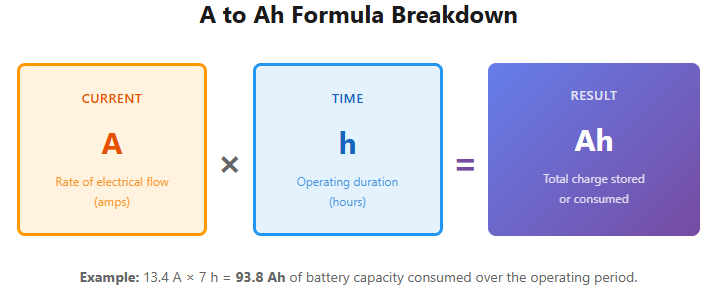
Amps to amp hours conversion indicates the accumulation of electrical current into stored electrical charge over time. Current is measured in amps, which describes the amount of charge passing a point per unit time. Amp hours refer to the volume of that charge delivered in a given time period.
When current flows steadily in a circuit, electrical charge builds up in proportion to time. When the existing charge transits through the element or the circuit, multiplying the current by the number of hours will give us that amount. The total charge is called amp-hours.
5AH is the charge of 5 amps when the current flows for one hour. Doubling the time here doubles the charge as the current flows for a longer time. Thus, the conversion relates to the rate of flow with a charge.
Using this conversion in the battery systems helps to estimate how much capacity is consumed by loads. If the current draws steadily for several hours, this type of charge can calculate this value. This finding helps to compare the demand for use with the capacity of the current battery.
It is to be noted that the current must remain stable during the time of calculation, as indicated in the formulae here. The real current of the loads fluctuates under the actual conditions of operating, during the startup operations of the device, etc. Thus, this value here even offers a reliable average finding for a system design and an electrical analysis.
Example Calculation
Consider a mobile research station powered by batteries. It contains data acquisition equipment, environmental sensors, processing electronics, and communication hardware, including a satellite modem.
According to the engineers, the battery system can be used to operate the equipment continuously for seven hours before requiring recharging. They have recorded the measurements that the equipment draws an average current of 13.4 amperes during operation. The total ampere-hour consumed during the operation is plotted by the engineer to determine how much battery capacity is required to support their operation.
By using the conversion, we are able to assume that the number of electrical charges that are used over a period is obtained by multiplying the current by the operational time. Using the conversion from amps to amp-hours, multiply the battery current that is produced by the period of battery operation. 13.4A*7h = 93.8 Ah.
This result means that the 93.8 Ah would nearly be consumed while the equipment operates for 7 h. If our installed battery has a capacity of say 120 Ah, the system works at a safe limit, we will have the extra capacity if we have any efficiency losses, and a safety margin. Such handy calculations are normally done in a lab when designing battery systems for field operations, off-grid monitoring facilities, emergency power systems, and solar-powered appliances.
When to Use This Calculator
The reason engineers and technicians use the amps to amp hours calculator is that they need to translate electrical current into a charge sufficient for a battery and work.
This calculation is frequently performed when designing battery systems and when checking to see that a battery system has sufficient capacity, not to be confused with power, to store it. Amp hours is an essential parameter when estimating how much battery storage is required for the solar system to run at night.

By calculating the amp-hour rating from the current and how long it is served, they can also tell whether enough storage is installed on the battery bank to keep the system working. The amps to amp hours calculator is also beneficial when it comes to portable power systems, electric mobility devices, backup energy storage systems, and field instrumentation. Understanding the amount of current needed over time helps to assure the duration to keep the current lower than the battery’s energy limits.
Reference Table (Typical Values)
The table given above helps you in converting amps to amp-hours for realistic operating durations. The amp hours of charge show us the increase as the current flows over time.
| Current (A) | Time (Hours) | Capacity (Ah) |
| 2.6 | 2 | 5.2 |
| 3.8 | 3 | 11.4 |
| 5.4 | 4 | 21.6 |
| 7.2 | 5 | 36.0 |
| 8.9 | 6 | 53.4 |
| 10.3 | 7 | 72.1 |
| 11.7 | 8 | 93.6 |
| 13.6 | 8 | 108.8 |
| 15.2 | 9 | 136.8 |
| 17.5 | 10 | 175.0 |
| 19.4 | 11 | 213.4 |
| 22.1 | 12 | 265.2 |
| 24.6 | 13 | 319.8 |
| 27.3 | 14 | 382.2 |
| 29.5 | 15 | 442.5 |

Here is a table based on typical values, which shows the accumulation of the electric charge as the current itself remains somewhat the same for a longer duration. If the current value is increased or the duration is increased, then the total amp hours of the system will also increase.
These kinds of tables are used by the electrical engineers more often to get a rough estimate of the battery sizing, load analysis, energy consumption, etc. even though this gives a reference to plan but always one needs to keep a safety margin and cannot believe this table datas as such always to consider the battery losses and changes in the load conditions in a real system.
Accuracy & Limitations
Conversion from amp to amp hours is based on the assumption that the electrical current remains constant during its entire working period. However, in real electrical systems, this network is under continuous fluctuation as it may change from one state to another state, may get activated from time to time, or may start up with input surges.
The performance of batteries also depends on the local temperature, discharge rate of the battery, and its internal resistance. Excessive current draw can bring down the effective capacity of the battery. The capacity of the battery decreases with the increase in age, and various environmental factors also affect its performance.
That’s why additional capacity margins are provided along with the battery systems. To get an approximate value of the energy, it can be used efficiently. But real-time operating conditions may not satisfy this value as the calculators don’t include manufacturers’ battery specifications and input power efficiency or other real-world data.
Case Study
A shoreline environmental monitoring station that uses a battery-powered communication system to transmit oceanographic data from underwater sensors comprises an underwater sensor or an array of sensors that continuously record oceanographic data, electronic equipment, and a remote research centre for reporting the observed measurements.
The electronics that support the monitoring system at the monitoring station consume an average current of 18.2 amperes when in use. The monitoring station at an isolated place and thus uses a battery system that charges from solar to operate. The battery system must support the electronics for around 11 hours overnight.
Engineers calculated the total electrical charge consumed during the nighttime running period to determine how much battery capacity is needed. The average current is multiplied by the running duration, which results in a total consumption of about 200.2 Ah.
This calculation gave an idea about the requirement for battery banks, which are slightly greater than 200 Ah to work without any interruption. The engineers, thus, decided to go for a battery system that is rated slightly above 200 Ah to account for inefficiency losses, variations in temperature, and the degradation of the battery for a long period. By carrying out this calculation during the planning of the system, the engineering team ensures that the monitoring station runs throughout the time of low solar generation.
Solar Products for Your Project
 Solar Panels |  Solar Inverter |  C&I Battery Storage |
Conclusion
The conversion from Amps to Amp-hours is a great way to work out how the electric current amounts to stored battery capacity that accrues over time. The mathematical relation process aligns electric current with the time period to help the engineers and technicians determine energy consumption. It also enables them to plan the battery storage systems in accordance with the power backup needs and to validate the electric load requirements. Despite practical scenarios adding further elements, the Amp-hour conversion remains the basic conversion technique, which will be a great help in evaluating the electric-powered systems implemented with a battery.