Introduction
Systems that include a storage system and an integrated storage system comprise the power conversion arrangement, software for the management of energy, and protection of the circuit. There is an integrated energy storage and proprietary induction generator along with the control system in place within the cabinet. Integration of the storage systems also introduces various System Integrated Storage (SIS) programs.
1. What Makes an Energy Storage System “Integrated”?
Integration Is More Than Putting Components in One Enclosure
An integrated energy storage system is not defined simply by placing a battery and inverter inside the same cabinet. Integration refers to the manner in which the various equipment and functions are designed to operate together. This difference in meaning is critical to bear in mind when evaluating a battery energy storage system of the battery type for a residential, industrial, and commercial installation, or solar plus storage.
Beyond the integration of the control, the building management system, or BMS, controls the manner in which a battery operates while the PCS executes the EMS functions, and so the monitoring and communication, as well as the functionalities as a whole of the system, are coordinated.
Accordingly, the effectiveness of the energy storage system integration should be judged by examining the performance of these electrical, control, safety, and operational functions, and not by the co-location of the components in a common enclosure.
2. How the Components Work Together in an Integrated Storage System Architecture
An energy storage architecture is composed of a set of interconnected layers rather than one piecemeal apparatus. In a solar-plus-storage application, the electricity may flow from the PV system, battery, loads, and grid via power-conversion equipment, whereas the control systems determine the ‘how’ and ‘when’ the energy is used.
Battery System
The battery is the storage layer of energy. It may be composed of individual cells arranged in modular and rack arrangements. The BMS keeps an eye on the vital operational conditions and helps to keep the battery within the predetermined limits. In an integrated battery energy storage system, this monitoring layer needs to communicate with other system controls instead of functioning in isolation.
PCS or Inverter
The power conversion system serves as the electrical interface between the DC side of the battery and an HVAC network wherever applicable. In an AC-connected structure, the PCS executes bi-directional power conversion during the charging or discharging process. The power path may be slightly shifted depending on whether the system has AC coupling, DC coupling, or a hybrid configuration
In a solar energy storage system, it makes a difference in how the battery storage interacts with PV generation, site loads, and the grid. Also, its power rating may be determined based on the necessary charge and discharge rate and the preferred operating profile of the project.
Energy Management System
The EMS offered a higher-level operating logic and matched the battery charging and discharging with PV production, electricity demand, grid conditions, and predefined operating objectives. These objectives could be solar self-consumption, peak shaving, backup operation, or any other energy management strategy to be followed based on the project.
Protection, Thermal Management, and Communications
An integrated system requires some supporting layers. The electrical protection layer is there to prevent faulty or abnormal operating conditions. The thermal management layer will maintain the equipment within the specified temperature range. The fire detection and protection system looks after the safety requirements according to the site. The Communications layer enables communication of monitoring and control functions throughout the entire system.
During sizing of the system, power capacity and energy capacity should be considered separately. Power capacity is the rate at which a storage system supplies or absorbs energy, usually measured in kW or MW. Energy capacity is the total amount of energy a storage system can store, measured in kWh or MWh.
3. Five Levels of Integration in Energy Storage Systems
You can evaluate integration stepwise. To differentiate a physical product from a fully integrated project, a five-level matrix helps.
| Integration level | What is integrated? | Main purpose |
|---|---|---|
| 1. Battery | -Cells/Modules -BMS | -Battery monitoring and protection |
| 2. Power | -Battery -PCS/Inverter | -Bidirectional energy conversion |
| 3. Cabinet | -Battery -PCS -BMS -EMS -Protection | -Simplified equipment deployment |
| 4. System | -ESS -PV -Grid -Loads -Controls | -Coordinated energy operation |
| 5. Project | -ESS -Electrical Infrastructure -Site -Operating Strategy | -Complete project integration |
The battery itself is the focus of level 1. Power integration adds the conversion level. Bringing large equipment and controls into a coordinated physical package.
4. Integrated vs. Split Energy Storage Systems: Which Architecture Fits the Project?
The choice between integrated and split architecture will depend on project requirements. An all-in-one energy storage system will limit the number of interfaces that must be engineered separately. A split architecture allows greater flexibility in the selection, replacement, or independent expansion of components.
| Factor | Integrated system | Split system |
|---|---|---|
| Installation | Often simpler for standardized projects | Requires more system-level integration |
| Footprint | Often more compact | Components can be distributed |
| Procurement | Fewer major equipment interfaces | More supplier interfaces |
| Customization | Often more standardized | Generally greater component flexibility |
| Replacement | Depends on system design | Individual components may be replaceable |
| Expansion | Depends on supported architecture | Can offer greater flexibility |
| Thermal design | Often defined by the system design | Components can be engineered separately |
| Communication | Usually designed as a coordinated system | Interfaces require validation |
| Project complexity | Can be lower for standardized applications | Useful for customized projects |
| Lifecycle flexibility | Depends on modularity and supplier support | Can benefit from multi-component flexibility |
Cost and efficiency must also be carefully considered because a total project cost includes equipment and installation, electrical infrastructure, commissioning, controls, site conditions, and lifecycle needs.
The system’s boundary condition also affects its efficiency and ratings. As per the U.S. Department of Energy, energy storage is less than 100 percent efficient due to energy losses when it is converted and then retrieved. The battery-storage systems that NREL modeled in its 2024 Annual Technology Baseline assumptions take 85% round-trip efficiency as representative. That number is a modeling assumption, not an all-purpose efficiency rating for every integrated ESS.
5. Integrated Storage System Applications: Residential, C&I, Off-Grid and BESS
Integrated storage systems can carry out a range of applications, from home energy storage to utility-scale applications. The changes in architecture depend on the operating objective. Residential systems typically focus on backup power and self-consumption needs, while C&I energy storage may focus on peak shaving and load shifting, as well as resilience and scalability. Off-grid systems require closely matched PV generation, storage, and loads.
| Application | Why integration matters | Typical priorities |
|---|---|---|
| Residential | Simplifies a compact system | -Backup -Self-consumption -Space |
| Commercial | Coordinates multiple operating needs | -Peak Shaving -Backup -Solar |
| Industrial/C&I | Connects power and energy management | -Demand Management -Resilience |
| Off-grid | Coordinates generation and loads | -Reliability -Energy Autonomy |
| Microgrid | Manages multiple energy sources | -Controls -Flexibility -Grid Interaction |
| Larger BESS | Coordinates complex power flows | -Capacity -Safety -Grid Services |
The wider application range is becoming more important as battery storage moves beyond residential applications. According to the IEA, in 2025, a total of 108 GW of battery storage capacity globally came online, around 80% of new capacity being utility-scale. As solar and wind deployment expands, battery storage is increasingly seen as a provider of power-system flexibility.
6. Real-World Integrated Storage System Examples
The project portfolio of HBOWA demonstrates different configurations for commercial, industrial, solar-plus-storage, and containerized applications, suggesting that integration requirements depend on power, energy capacity, site conditions, and operating objectives.
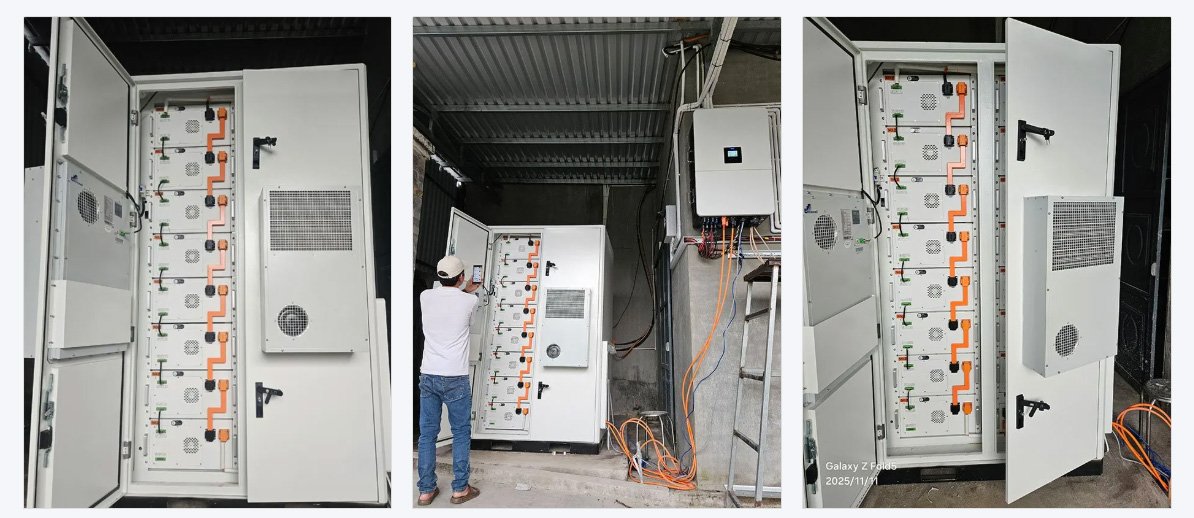
241 kWh Battery Storage Cabinet for a Café in Vietnam
For a commercial café project in Vietnam, HBOWA provided a battery storage cabinet of 241 kWh battery storage cabinet with an 80 kW Deye three-phase high-voltage inverter. The system is designed for application in commercial electricity use, energy stability, and managing the energy of any load, such as air conditioning, lighting, refrigeration, coffee machines, payment machines, etc. This example shows a cabinet-level integration for a commercial application where the space is constrained, and battery storage and inverter control function as a system.
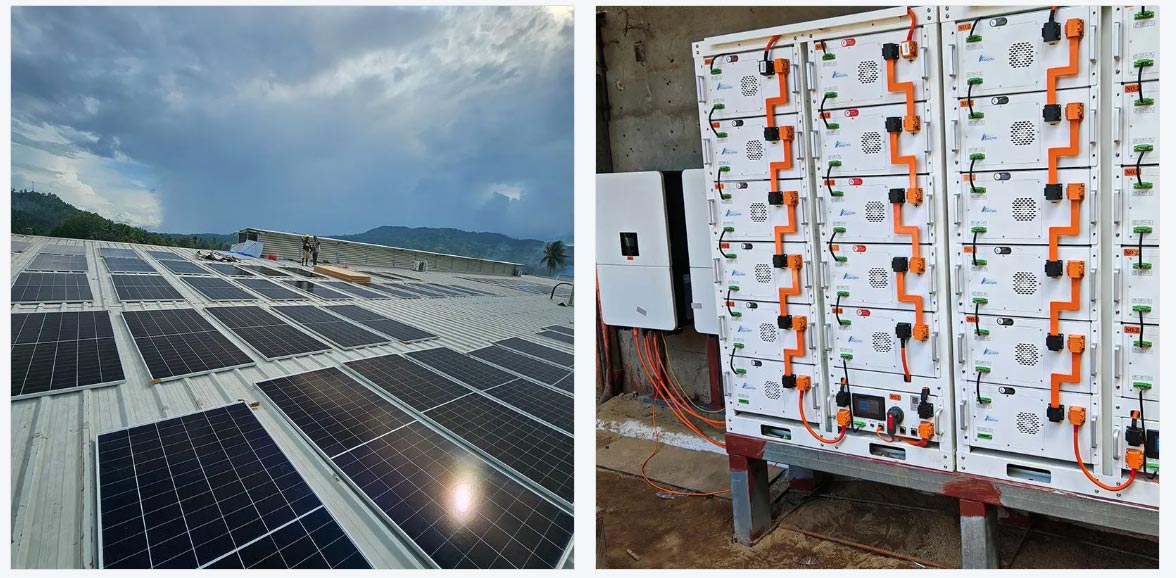
160 kW / 314 kWh Solar-Plus-Storage System in Papua New Guinea
Another one of HBOWA’s projects is a solar-plus-storage system in 160 kW / 314 kWh solar-plus-storage system in Papua New Guinea that consists of two 80 kW inverters and a 314 kWh battery. A solar energy project of this type demonstrates system-level integration where the battery storage must be considered alongside solar panels, inverter capacity, load requirements, and the site’s energy operating strategy.
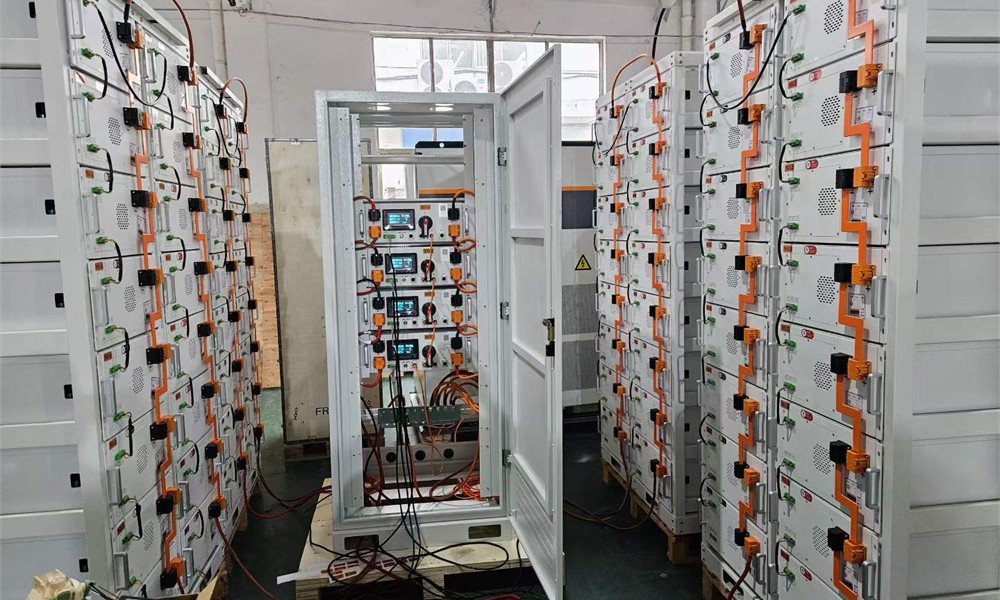
1 MWh BESS for Peak Shaving and Backup in Ukraine
HBOWA offered a 1 MWh BESS container used for peak shaving, load shifting, and backup power for a bigger commercial application in Ukraine. It was assembled and checked in the factory before delivery to cut down the installation work at the project site. This example demonstrates that containerized integration can satisfy the larger energy requirements and simplify some deployment and commissioning activities.
These projects illustrated an important selection principle: no single integrated storage architecture fits every application. A commercial cabinet, solar-plus-storage system, and containerized BESS may employ differing physical configurations, yet still must all provide coordinated battery, power conversion, control, protection, and site-level functions.
7. Benefits and Limitations of Integrated Energy Storage Systems
Integration has the capability to improve operational coordination also. While the control structure is a single system, battery charging and discharging decisions can be coordinated with power production from the PV array, load at the site, and grid conditions.
But, there are constraints associated with the Integration also. A highly standardised system may not be so adaptable. Proprietary communication protocols provided by a vendor might impose a reliance on the supplier, and the expansion may be constrained if the original power conversion system (PCS), battery architecture, or controls were not sized for future capacity.
The serviceability should be equally considered a critical feature. A compact design can reduce the complexity of installation, but damage to individual components may require compliance with manufacturers’ service procedures. The system-level thermal management should also be assessed; after all, the compact packaging doesn’t remove the heat generation or temperature control requirements.
The rationality of integration is pretty straightforward. Integration can reduce complexity in one part of an energy storage project while transferring complexity to another part.
8. How to Select an Integrated Storage System for an EPC or Commercial Project
In choosing an integrated storage system, the first step is to start from the project’s initial load profile and the operating objective, not a preferred cabinet size or battery chemistry. Go over when the site demand occurs, what the peak demand levels are, what the critical loads are, the amount of daily energy consumption, and what the expected operating patterns are. Then one needs to determine if the system is for peak shaving, backup, solar self-consumption, load shifting, off-grid operation, microgrid control, or another.
The next step to take is to make the plans for both the power and energy required. A simple planning relationship is:
Required duration = usable energy ÷ required power
For instance, three hours seems to be the theoretical duration at 80 kW (240 kWh of usable energy). Actual runtime is affected by state of charge (SOC) limits, input-output conversion losses, temperature, load variation, and overall system operating limits.
The next factor is the interface compatibility check. It is about the communication between the BMS, PCS, EMS, PV equipment, grid controls, and the monitoring platform. One needs to confirm the protocol compatibility and who has control authority before ordering.
The documentation for safety is the last factor. One needs a review of all the applicable certifications, test reports, thermal management, fire protection, installation requirements, and local codes. UL notes that thermal runaway fire propagation is evaluated using UL9540A, and the edition 2026 of NFPA 855 has fire testing at a large scale, if relevant.
Lastly, what is of paramount importance is the comparison of the total energy storage project cost. One should not just compare the battery price per kWh. The total project cost should be taken, which involves PCS, EMS, switchgear, the cooling system, protection, transportation, installation, commissioning, maintenance, and future expansion costs.
9. Integrated ESS Lifecycle: Safety, Maintenance and Future Expansion
The energy storage lifecycle spans several years beyond procurement. Deliberation should be based on the complete scenario, including the span from installation and commissioning of the utility over the years of institutional maintenance, adding up to its replacement in the distant future.
Before anyone buys a single unit of the utility, its maintenance must be considered. If any of the single battery modules, PCS parts, cooling elements, or control devices will be serviced with the item for future reference. Consumers should ask about the warranty extension, spare-parts availability, software support, remote monitoring, procedure for augmenting the battery in the future for that particular brand of implemented utility.
Equivalent lifecycle compatibility is additionally essential. Total solutions may require equipment, firmware, communication protocols, or control software from just one manufacturer. It is strongly suggested to ask how replacements, software upgrades, battery augmentation, or system expansion will be managed throughout the required operating life.
Relatively, safety needs to be evaluated depending on the innovation, installation environment, system size, and local requirements. ESS establishment considerations contained in NFPA 855 incorporate fire protection, detection, suppression, ventilation, gas detection, placement, and emergency operations.
10. Integrated Storage Cabinet vs. BESS Container
An integrated storage cabinet and a BESS container both provide coordinated energy storage, but are aimed at different project configurations. Cabinets are better for more distributed or space-constrained situations, while containers can allow for large centralized storage and supporting equipment.
Check out the energy storage cabinet vs. BESS container comparison from HBOWA for a deeper dive. The dedicated article can offer a deeper project-selection analysis without repeating it here.
Conclusion:
An integrated storage system is not just a packaging format, but an architecture. These can simplify deployment and designers’ tasks to command the entire system’s functioning. Yet it may have vendor dependency or expansion constraints. Selection of these systems depends on project objectives, power, energy, solar and grid architecture, site conditions, safety and serviceability, and lifecycle requirements.
Frequently Asked Questions
Yes, but whether it can be expanded depends on the original system architecture. If the battery is to be expanded, check for available PCS capacity, BMS and EMS limits, battery compatibility with new battery manufacturers, physical space, communications compatibility, and manufacturer restrictions.
The impact depends on the failed component and system design. Then, if any of the PCS, battery, controls, or auxiliary equipment has a fault, it can affect different functions. Make sure the fault isolation capability, level of component serviceability, method of replacement, availability of spare parts, and whether the system can still operate under clearly defined fault conditions are suitable before buying.
Not necessarily, but compatibility must be verified before procurement. Electrical requirements, communication protocols, control interfaces, approvals, warranty conditions, and software compatibility can impact the output of the 3rd-party connection. EPC needs to confirm which combinations of equipment from different vendors are being approved/ supported by the system manufacturer.
Yes. An integrated storage system has nothing to do with the PV generation. It can only support the function of backup power, peak shaving, load shifting, or similar energy management applications during the shortage of power.
Usable capacity is usually lower than or different from nameplate capacity because operating conditions matter. The conditions include SoC limits, temperature, battery degradation, BMS settings, discharge limits, conversion losses, manufacturer- defined operating windows, etc.
If you are a buyer of storage systems, you must request technical datasheets, electrical single-line diagrams, installation and commissioning procedures, communication documentation, safety certifications, warranty terms, maintenance requirements, emergency procedures, etc.