

Introduction: What Color Is a Solar Panel and Why It Matters
One of the most frequently asked questions when people come across solar energy is the solar panels’ color, and they ask what color a solar panel is. When we observe the panels on several rooftops and several solar plants, they appear deep black or reflective blue. The color of the panels does say a lot about how the panel is made, how much energy it can extract from the sun’s power, and how it performs under different conditions. During the last few years, black solar panels have become more popular in the market, as they produce more energy, tolerate temperature better, and have a sleek design that attracts people. In conclusion, the color of the panel tells us about the technology and its capabilities.
Understanding Solar Panel Colors: What Determines the Shade?
The color of your solar panels depends on their construction. Basically, how silicon cells are built and with these cells, various coat is used. The two main technologies to create solar panels – Polycrystalline and Monocrystalline– give them different optical effects and ultimately their color.
Polycrystalline silicon is composed of multiple crystals that are fused together. The result of such a silicon surface is an uneven crystalline structure. Lights are scattered in many directions. Generally, a solar panel looks blue due to the scattered reflection of crystals. Furthermore, if an anti-reflective coat is applied, it makes the panel look blue. You shall encounter a blue shade on most of the solar panels, which might be old or budget-friendly.
On the other hand, black solar PV panels are made with monocrystalline cells. They are made up of a single pure silicon crystal. The crystalline structure is uniform in these solar cells. The irregularity in the structure absorbs more wavelengths of light. A shorter wavelength of light is reflected, thus makes it look deep black. The use of an anti-reflective coat on these cells helps to absorb more light, further enhancing the absorption, thereby increasing the efficiency of the system.

In addition, the black backsheets, anodized frames, and tempered glass, etc., all add to the dark look of a panel. This is the reason why a premium all-black module panel is completely uniform. The standard version of the dark panel cells might show a slight layout. In short, the color of a solar panel is a direct reflection of its crystalline structure, precision in manufacturing, and light interaction (of course, on a microscopic level).
Blue vs Black Solar Panels: The Key Differences Explained
When choosing solar panels, many homeowners wonder about the difference between blue vs. black solar panels. They also wonder whether the color of the panels affects their performance. However, in reality, there is no stark contrast between a blue and a black solar module. The difference in colors indicates two different technologies, i.e., polycrystalline and monocrystalline, respectively. Further, in the appearance, efficiency, and cost category, both types of solar modules differentiate themselves.

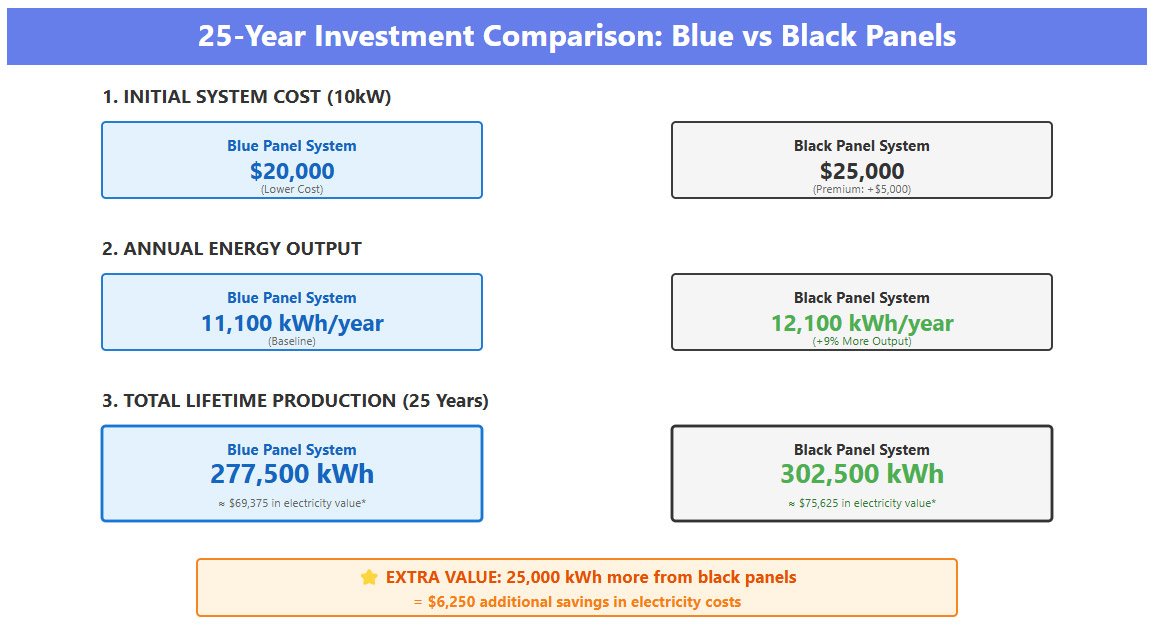
The ‘blue solar panel’ or a polycrystalline solar panel costs less since the process to produce them is more straightforward and less wasteful. However, they need more surface area to produce the same output when compared to the ‘black solar panel’.
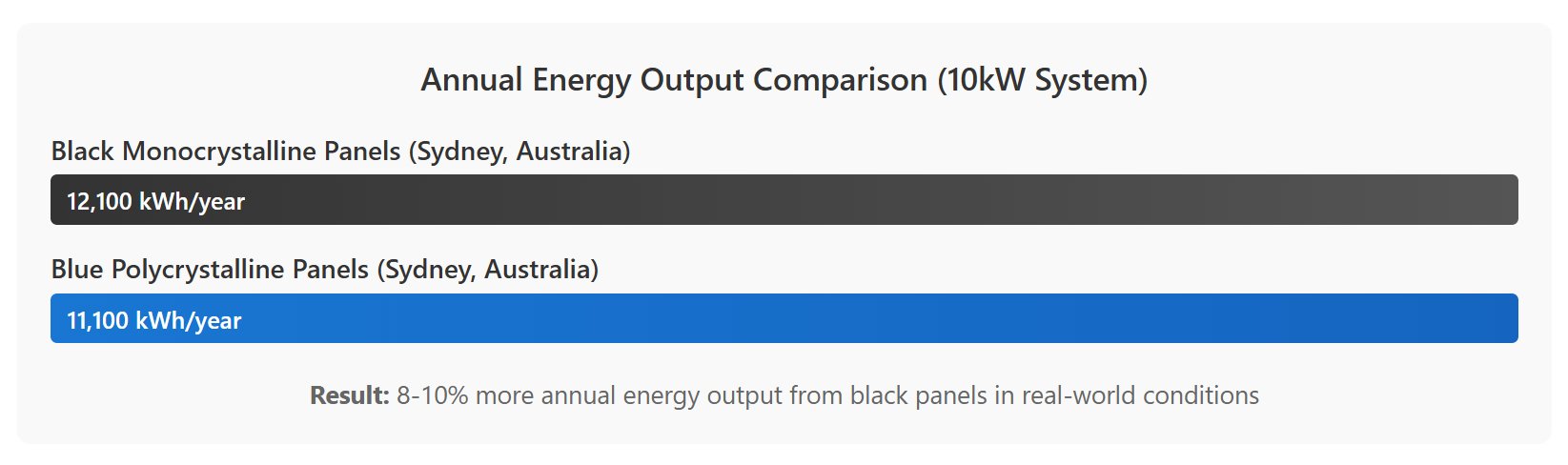
It is proven from the example of a 10kW rooftop installation in Sydney, Australia, that black solar panels generated between 8-10% more annual energy than blue polycrystalline panels, with overall output averaging at 900kWh/month. Besides Australia, comparing the performance of these two types of panels in Michigan, USA, it was observed that the monocrystalline counterparts again proved to be better, generating around 20kWh more monthly.
So the answer to the question “Are black solar panels better than blue ones?” is yes, black monocrystalline systems appear to be better than blue ones if efficiency, aesthetics, and long-term energy output are the priorities. Nonetheless, costs, too, often become the determining factor for buyers.
Why Black Solar Panels Dominate Modern Solar Markets
Black solar panels are very dominant in the modern solar markets throughout the globe, catering to both residential and commercial projects. Black solar panels have evolved as a favorite choice because of the improvements in the way they are manufactured, their efficiency, and their recent architectural beauty. The homeowners and designers have shown a preference for black on the black solar panels, which easily merge with dark roofs and other modern building materials, instead of the reflective properties of the older blue modules.
Technically, the black solar PV panels can absorb more light than their lesser counterpart by virtue of their uniform crystal structure. They have uniform light absorption and can grab more sunlight than the conventional black modules, producing a greater number of kWh per square meter. Besides, they lag less in cloudy or low-light conditions and lose less energy in high temperatures. The modules also need fewer panels to get the same system capacity, which is ideal for installations running out of the roof space.
The recent housing project in Northern Europe provides a valid example. In the before scenario of the building, the outdated blue polycrystalline solar panels could well produce 18kW of electricity. However, the house replaced them with HBOWA’s 420W all black solar panel modules using N-type TOPCon technology. The new system increased 14% power generation, and at 8% less installation space, and the renovation added to the appearance of the building with black fittings and fixtures of the new panel modules.
The HBOWA keeps providing more advanced black solar panels and high-efficiency Growatt inverters to keep the performance and the reliability of your installation at optimal levels. The phrase ‘Black Solar Panels Dominating Modern Solar Markets’ was destined to be told, thus showing an increase in the number of consumers who show their inclination in getting long-term selling prices and are losing the appearance and regular design harmony, and black solar panels are currently the global standard in solar technology panels.

Why Are Solar Panels Black? The Science Behind It
Even though sunlight looks colorless, monocrystalline Silicon reacts with a black shade. The primary cause of black PV panels is Monocrystalline Silicon.
The black PV panels are built with a single and even crystal of silicon that attracts almost the entire visible light spectrum. The interaction between the photons and electrons also reduces reflection, supporting more photons’ transformation from sunlight to electricity as opposed to being missed as heat or shine.

The modern black solar panels, such as the N-type chips and the PERC cells, have been the latest invention. The electron movement and reaction with the solar cells are improved over the former designs. The efficiency of such cells exceeds 22% and exhibits a deep black surface while it traps light even further.
The decreased reflection and absorption power are denoted by the darker shade instead of the low competitiveness under different light conditions. The group has been more refined through the various manufacturers even premium designs are available now. The Astronergy Bifacial Black 450W (N-type), Jinkos Tiger Neo 420W All-Black, and Canadian Solar’s HiKu6 All-Black 405W models are some of the models used, representing the premium designs. Cutting-edge engineering and design have merged to maximize the power yield per square meter with the use of black modules. The black modules have become the new benchmark, replacing the white ones because of its performance of the best-selling design.
Why Are Some Solar Panels Blue?
Since they’re based on polycrystalline silicon, solar panels appear blue. Polycrystalline silicon consists of several crystal fragments that are melted together to form. When sunlight reflects on the solar panel made up of polycrystalline silicon, the photons scatter in a way that produces a blue shimmer.
Although they’ve been around for a while, blue solar panels still appear in PV markets because they have better-quality light dispersion and lower prices. Blue solar panels are the foundation of early PV market development.

Compared to silicon gear monocrystalline panels, blue panels waste much less silicon than the latter and are therefore slightly more resourceful. The efficiency of blue panel silicon is 15-18 percent. Although they have seemingly lesser returns, they are preferred for certain projects because of their cost-affordability.
For example, a farm in India still makes use of blue polycrystalline panels for sprawling rooftop areas because they are economically efficient and return good results. Operating in a hot climate, the farm can manage to maintain a stable power output with the light-colored panels.
Black-on-Black and Full Black Solar Panels: The Aesthetic Revolution
Black-on-black solar panels include black solar cells, a black backsheet, and a black frame. These panels blend with today’s contemporary and modern rooftops, enhancing the trend of modern aesthetics.
People and architects prefer using black solar PV panels on their roofs to make their houses look even more beautiful, clean, and refurbished. In cases of housing developments, including all terraced houses, townhouses, and commercial and urban roofing, all black solar panels blend with the overall design and aesthetic case for a specific city and local area.
Full black modules‘ look does impact temperature and efficiency slightly. These panels are fully black and retain more heat. They can have a minor lower efficiency in conversion slightly under extreme heat. A construction contractor now uses full black panels so that no color differences can affect the house’s beauty.
| Type | Appearance | Heat Retention | Efficiency | Ideal Use |
| Full Black (HBOWA 415W Ultra Black PV) | Sleek, modern | Slightly higher | 21.5% | Residential roofs |
| Standard Mono | Visible grid | Lower | 22% | Commercial arrays |
HBOWA provides 410W–430W monofacial and bifacial black modules designed for performance across all climates, offering both style and substance for today’s energy-conscious homes.
Efficiency and Performance Factors Across Climates
The color and material make a difference in the performance of panels under different climatic conditions. However, because of the modern cell design, the loss of heat is less when compared to older models. In hot weather, the black solar PV panels will ensure a higher efficiency per square meter with increased light absorption and current flow.
In colder conditions or with cloud cover, the black modules offer better performance compared to lighter color options. The modules offer light capture that is gradient, and enough voltage remains stabilized under partial scattering or cloudy weather.
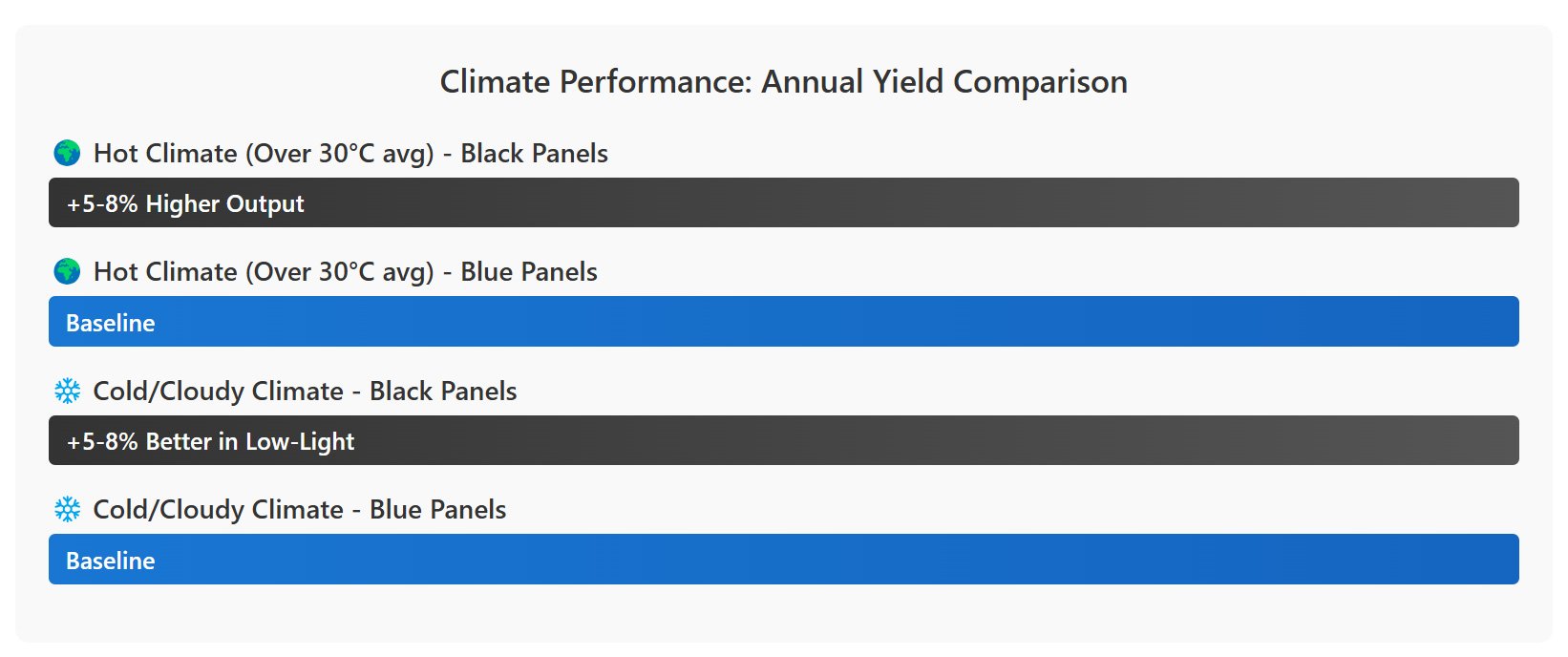
In Europe’s northern parts, the field data shows that monocrystalline black panels yield almost 5-8% more in a year than the traditional modules of blue color during periods with low sunlight. Moreover, there are advanced choices, such as the 420W Black Mono Solar Panels and the 425W Full Black Bifacial Solar Panels, which help to collect the reflected light from roofs and surrounding objects. By combining the solar setup with the Growatt hybrid inverters, the system offers better energy conversion in various temperatures.
Market Trends: Why Black Solar Panels Lead the Future
Everyone is likely to see far more black solar panels in the global solar market in the years to come. Across contemporary residential rooftops of Europe to commercial installations of Australia, the uptake of these panels is happening massively due to both their better performance and sleek looks. Despite the embracing of solar all over the U.S., it is predominantly commercial developers in America and the People’s Republic of China switching to black PV panels for their better efficiency in power generation and integrating them with the design of the buildings.
The newer technologies that are making the black solar panels are “next-generation” modules. Not only do these modules absorb more light, but they also produce more power with that light. Moreover, over the years, degradation has been less in them. A recent study has told the world that by replacing their existing polycrystalline setup with branded N-type black modules and branded inverters, a commercial warehouse solar project recorded a 23% higher return on investment (ROI) with a total module capacity of 2MW.
In addition to their better performance, what makes the all-black modules a good investment is that their thin wafers and separation of materials make it easy to recycle at the end of the lifetime of the panel. As more and more is produced and the cost of silicon remains stable, the cost of black panels is on the brink of scaling down to match that of blue ones.
Given these statistics and technological advancements, one can ask why all solar panels are not black. Yet. The applications and costs of production still vary greatly because these panels are made in a slightly more complex process, which makes them slightly more expensive than all the other colors.
Choosing Between Blue and Black Solar Panels: Which Is Right for You?
Rather than which color is trending, selecting a solar panel color that is more practical is an ideal way to decide which solar panel color is the most suitable to solve your purpose.
Here’s a simplified decision matrix:
| Application / Use Case | Recommended Panel Type & Preta Power Example | Efficiency Range | Key Advantages |
| Residential (Urban) | All-Black Monocrystalline (N-type) | ~21.5% | -Sleek -All-black aesthetic for a premium look. -High efficiency for limited roof space. |
| Residential (Suburban/Rural) | Standard Black Mono-Facial (PERC) Example: Trina 415W Monocrystalline Black Frame Panel | ~21.0% | -Excellent balance of performance and price. -Reliable energy output for family homes. |
| Commercial Rooftops | Blue Polycrystalline or PERC | ~21.3% | -Cost-effective for large rooftops. -Stable performance in hot conditions. |
| Industrial Facilities | Black Bifacial N-type TOPCon Example: 550W N-Type TOPCon Bifacial Panel | >22.5% | -Dual-side power generation. -Maximizes energy output – High ROI on large industrial buildings. |
| Agricultural / Warehouses | Blue Polycrystalline Panels Example: Risen 330W solar panel | ~17.2% | -Lowest initial cost per watt. -Ideal for large-scale -Cost-sensitive installations on open land. |
| Utility-Scale Projects | Mixed Arrays (Bifacial + Poly) Examples: – 550W N-Type TOPCon (Bifacial) -330W Polycrystalline | 17.2% – 22.5%+ | -Balances cost-to-output ratio for massive projects. |
| Cold or Cloudy Regions | Black N-type or TOPCon | ~21.5% | -Superior low-light and temperature performance, and cloudy weather. -Better energy harvest in diffuse light. |
| High-Temperature Zones | Blue PERC Panels Example: Preta 450W Half-Cell PERC Panel | ~20.5% | PERC technology reduces performance degradation in high heat -Offering reliable output in deserts/tropics. |
Conclusion
In the wrap-up, “What color is a solar panel depending upon the best use for efficiency” is about more than a panel’s appearance; it is about the evolutionary process of one of our most basic energy lines. While blue and black panels are equally and efficiently powering the world, black solar panels are both more efficient, a bit more modern, and yes, prettier. With so many modern new technologies like N-type, bifacial, and PERC technology, the efficiency and power of a black panel are therefore more prominent.
HBOWA provides very high-efficiency black modules from tier-1 brands, along with Growatt and Deye inverters, which provide a convenient and trustworthy solution for solar energy to residential, commercial, and industrial projects.

