Introduction
Adding solar panels to an existing system is often possible, but a successful upgrade depends on far more than finding extra roof space. Homeowners and businesses should ensure current equipment is compatible, electrical capacity is adequate, future energy needs will be met, and local laws apply before installing more panels.
Can You Add Solar Panels to an Existing System?
Obviously yes. In most cases, solar panels can be added to an existing installation only if the original one is safe to expand. Before you decide anything, check the inverter you are considering in terms of its capacity. The condition and orientation of the roof, the suitability of the solar panels, the electrical limits, utility or grid connection specifications, and eventual battery storage plans. These factors determine whether new panels can function effectively without compromising system efficacy.
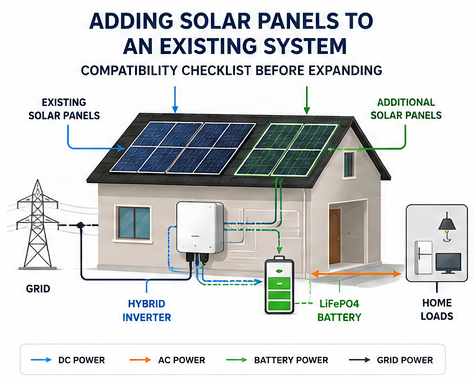
The most successful upgrade, rather than pushing out the largest installation with a maximum number of panels, is designed around your current equipment, future power needs, and long-term scalability
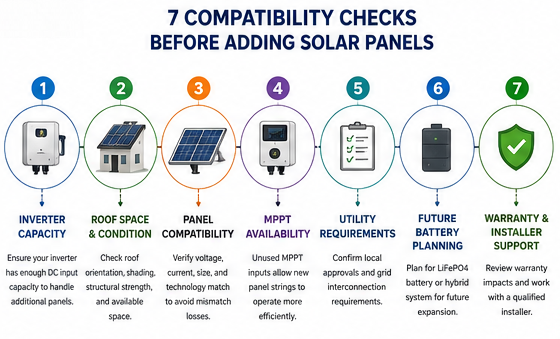
Before Buying More Panels: 7 Compatibility Checks That Prevent Costly Mistakes
When expanding a solar system, one should begin with a technical assessment rather than a product comparison. By installing compatible equipment first, the risk of installation failures is reduced, the long-term operating performance is improved, and unnecessary equipment replacement may be avoided.
Check Your Inverter Capacity
All inverters come with the maximum DC input rating. If the current inverter has spare capacity, we can connect additional panels without needing to change it. The system may already be operating near its design limit, and it would be more appropriate to install a larger inverter or a Hybrid Solar Inverter (such as selected Growatt inverter models specifically designed for future expansion) rather than forcing more panels onto a poorly sized system.
Evaluate the Remaining Roof Space
A roof is only useful if it gets enough sunlight and can accommodate more equipment without any hazards. Prior to extending the array, consider the orientation of the roof, seasonal shading from bordering constructions or trees, and the roof condition.
Confirm Panel Compatibility
Rather than brand name matching, matching electrical specifications is better. The inverter’s design range must be consistent with the voltage, working current, and panel size. Modern TOPCon solar panels, in general, have higher efficiencies than older PERC solar panels. Proper electrical design is thus needed to couple PERC and TOPCon together so that mismatch losses are minimised.
Verify MPPT Availability
Unused MPPT inputs aid in easy expansion by allowing new strings of panels to work independently.
Understand Local Grid Requirements
Many utilities need updated approvals or modified interconnection agreements before more generation capacity can be hooked up. Each country, region, and electricity provider has its requirements.
Consider Future Battery Storage
If battery storage is in your long-term plans, design the build-out accordingly. A Hybrid Solar System, along with a LiFePO4 battery, is easier to upgrade in the future and boosts energy self-consumption with no major redesigns afterwards.
Review Warranty and Installer Support
Before making changes to an existing installation, check the impact on equipment warranties and workmanship coverage. You reduce compatibility issues when you hire an experienced installer for a roofing job.
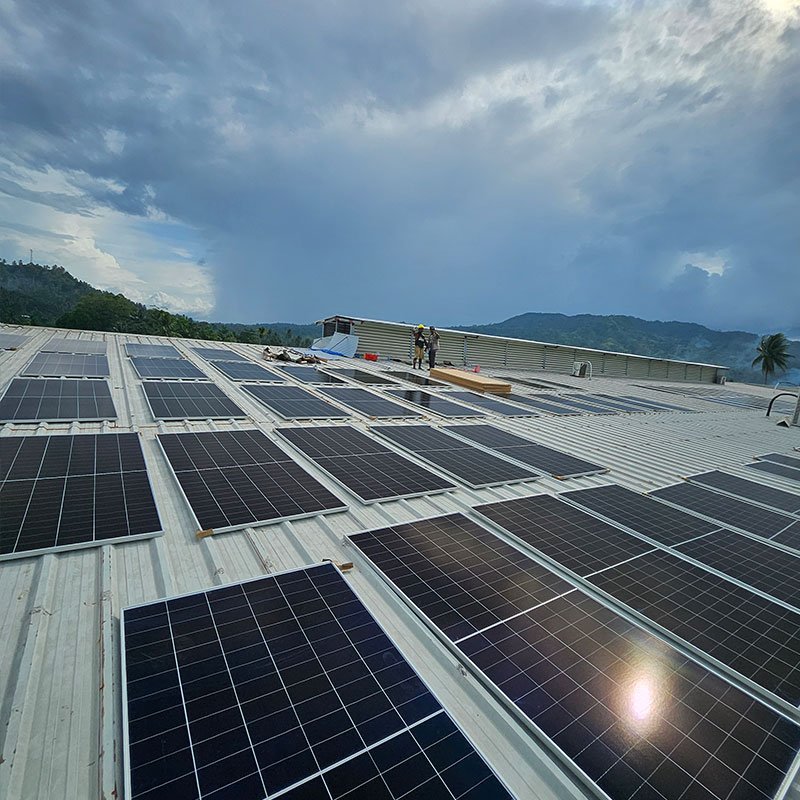
Four Ways to Expand an Existing Solar System
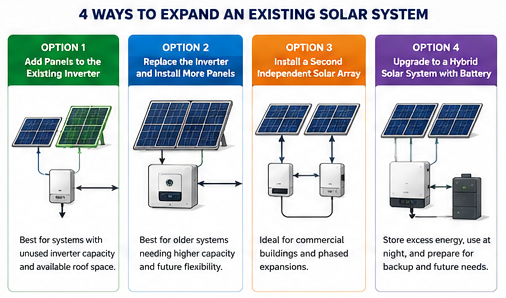
No one way exists for solar expansion. Which option is the best depends on the status of the existing equipment, the expected demand for electric power, and other related factors, and the space around the installation. Another important consideration is any plans for future upgrades.
Option 1: Add Panels to the Existing Inverter
If the inverter was originally sized with more DC capacity in mind, adding extra panels is likely the easiest and most affordable approach. This method is most effective when enough inverter power and roof space, along with electrical compatibility, are already present. The system must still be evaluated by a specialist to ensure that it remains within specifications.
Option 2: Replace the Inverter and Install More Panels
Older systems tend to have the inverter be the limiting factor rather than the solar panels. A new inverter that is larger than the existing one allows for a flexible design and future technology. At this point, many owners are also selecting a modern Hybrid Solar inverter, that prepare them for battery storage without the need for another major upgrade later.
Option 3: Install a Second Independent Solar Array
By installing a different solar array, the original design will not have to change very much. This option is ideal for commercial premises, warehouses, farm buildings, and businesses with expected future increases in electrical requirements. Each system is its own installation, allowing for simpler maintenance on independent systems.
Option 4: Upgrade to a Hybrid Solar System with Battery Storage
To boost generation during the day, a number of property owners are now putting extra panels with storage. A Hybrid Solar System with LiFePO4 batteries captures and stores surplus solar energy for use during the evening, back-up, and peak electricity times. This strategy can enhance energy independence, while it can also utilise the electricity produced during the day better. Scalable system architecture is supported by many modern Growatt inverter solutions.
| Upgrade Method | Upfront Cost | Installation Complexity | Future Expansion Potential | Best Suited For |
| Add panels to the existing inverter | Low to Medium | Low | Moderate | Systems with available inverter capacity |
| Replace inverter and expand the array | Medium | Medium | High | Older systems requiring greater capacity |
| Install a second independent solar array | Medium to High | Medium | Very High | Commercial properties and phased expansions |
| Upgrade to a hybrid system with battery storage | High | High | Excellent | Long-term energy independence and future battery integration |
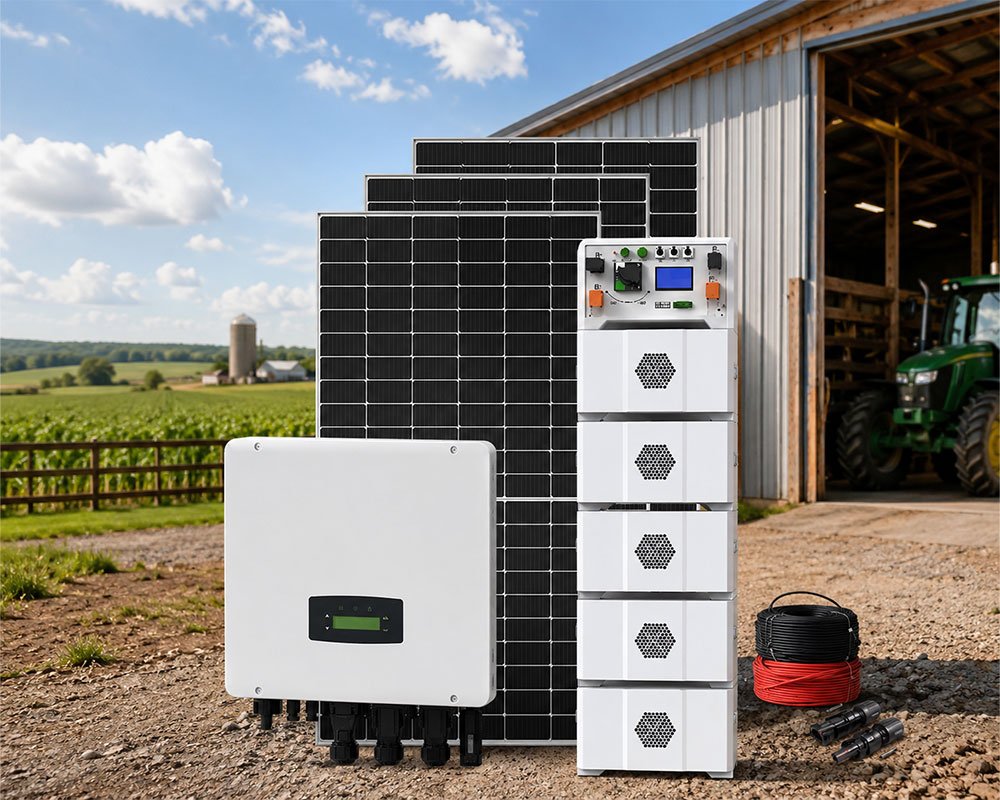
Can You Mix Different Solar Panels? Here’s What Actually Matters
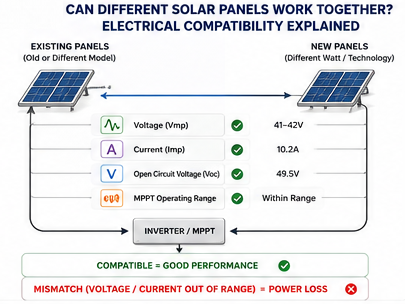
One question that homeowners keep asking these days is whether they can use a 450 W panel with a 600 W panel. In reality, wattage by itself is rarely the ultimate consideration. It is more important whether the new and existing panels have compatible electrical characteristics.
To add panels to your existing system, installers will look at the operating voltage – Vmp (maximum power voltage), operating current – Imp (maximum power current), and open-circuit voltage – Voc of all 3 panels. They then decide how each panel will connect to the inverter’s MPPT (maximum power point tracker). Whenever these values are widely spread, the whole string will function at the performance level of the weakest panel, which causes solar panel mismatch, and the strength in the energy generation will be reduced.
Over the years, solar modules degrade and lose output. Thus, newer modules with old degraded panels may be electrically imbalanced, despite seemingly similar specs. Hence, manufacturers typically recommend, when possible, matching panel technology and electrical characteristics.
If matching the identical panels is no longer feasible, Tier-1 solar panels with similar voltage and current ratings would generally be a better option than modules based only on wattage. Before installation, a qualified installer must always check compatibility.
| Feature | TOPCon Solar Panels | PERC Solar Panels | Older Mono Panels |
| Typical efficiency | Higher | Moderate to High | Lower |
| Compatibility with older arrays | Requires electrical matching | Easier when replacing similar PERC modules | May require careful system redesign |
| Long-term expansion potential | Excellent | Good | Limited for large upgrades |
| Best use | New installations and future expansion | Existing PERC system upgrades | Small extensions where compatibility permits |
When Adding More Panels Is Not the Best Option
Adding to a solar array isn’t always the most realistic option. In certain circumstances, adding further panels may drive costs up without significantly improving energy yield.
A roof already near capacity doesn’t have much room for effective expansion. An undersized inverter will restrict other panels from working, unless the inverter is updated. If buildings nearby cast heavy shade on roofs or if the roof is shaded by a mature tree, then that roof will not see the benefit from adding more modules, regardless of their efficiency rating.
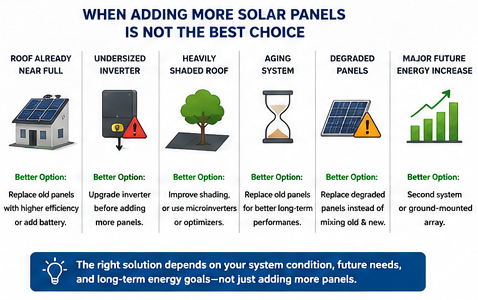
The system currently in use will also need to be old. When older panels show evident performance loss, replacing the original array with new, high-efficiency modules may yield better long-term results than blending old and new equipment.
The properties that expect a significant future demand for electricity, like planning on electric vehicle charging or business expansion, might need a second solar system, battery storage, or a ground-mounted system when good land is available.
For example, there’s a rooftop system that was installed at a warehouse eight years ago. The inverter capacity from that system is not enough. Instead of trying to push more panels on top of the existing installation, the owner may achieve better scaling by installing a second independent array that will support future operations.
Residential vs Commercial Solar Expansion: What Changes?
The fundamentals of solar expansion are similar between residential and commercial solar energy projects, but the priority of planning is often very different. Most homeowners are largely concerned with lowering their electricity bills and growing energy independence.
Businesses, on the other hand, have to also think of future operational growth, maintenance planning, and return on investment on a much more expansive energy profile.
Commercial projects often undergo expansions in multiple phases or stages. Designing for scalability from the start helps to minimize upgrade costs and disruptions due to rising demand for electricity.
Battery storage planning has similar processes. Usually, residential systems are sized for evening household needs while commercial battery systems are primarily sized for peak demand reduction, backup power, or operational continuity.
| Residential Solar Expansion | Commercial Solar Expansion |
| Priority is lowering household electricity costs | Priority is reducing long-term operating costs |
| Expansion usually follows lifestyle changes | Expansion often follows business growth |
| Battery size is based on daily household usage | Battery size is determined by operational load profiles |
| Maintenance is relatively straightforward | Preventive maintenance becomes more important across larger systems |
| Return on investment is measured through household savings | Return on investment also considers productivity, operating expenses, and future scalability |
Careful planning allows both residential and commercial systems to remain flexible as energy requirements evolve.
Should You Add Panels, Replace Equipment, or Upgrade Everything?
The selection of an upgrade path should depend on the condition of the existing system and NOT on adding more equipment. An analysis of current hardware, expected electricity demand, and prospective growth will guarantee that each investment is in further performance, rather than a cost later.
| Current Situation | Recommended Approach |
| Inverter has spare capacity | Add compatible solar panels |
| Inverter operating at maximum capacity | Replace the inverter with a larger model |
| Planning to install battery storage in the future | Upgrade to a Hybrid Solar Inverter |
| Roof has reached practical capacity | Consider a second solar array or ground-mounted system |
| Existing panels have significant degradation | Replace the original array instead of mixing incompatible modules |
| Warehouse or factory expects major energy growth | Install an independent commercial expansion system |
Instead of wondering which renovation is the cheapest now, property owners should ask which option will keep providing the energy they need for a decade. A better long-term alternative than the simplest installation is a well-planned extension.
Conclusion
Installing additional solar panels in an existing system will improve energy production as long as the purpose of the upgrade is not solely based on quantity but also on compatibility. If you evaluate your inverter, roof, electrical design, and future energy needs first, you can find the right expansion strategy, enhance long-term performance, and avoid unnecessary costs as energy needs increase.
Frequently Asked Questions
There isn’t a fixed or a magic number. The maximum is dictated by your inverter input capacity, available installation area, local electrical legislation, and design limits of your existing system. A commercial system evaluation is the best way to determine how many more panels can be safely installed.
Indeed, you can, but not by adding more panels to an overloaded inverter. Based on the design of your system, you may need to install a larger inverter, replace the existing one, install a second inverter, or install an independent solar array.
This depends on the age and state of your existing equipment. It is often practical to expand an existing system when the inverter and panels are relatively new. A separate installation may provide longer-term performance and flexibility if the system is older or approaching design limits.
Sure! Prior to buying an electric vehicle, many homeowners expand their solar systems to reduce future charging costs. By looking into future electricity demand when planning the expansion, we can avoid unnecessary upgrades and size the system accordingly.
The requirements for power and energy meters are different in each country, utility, and location. In many locales, increasing a grid-connected solar system necessitates updated interconnection authorization and/or revised permits or inspection before the enhanced system can operate. Always check local requirements before beginning the project.
Sure. Many solar systems for businesses are designed with phased expansion. Businesses may add solar capacity as demand for electricity increases, more facilities are added, or hours of operation change. When you design to scale for the future from the get-go, installation will be easier down the line.
If your evening electricity consumption, backup power needs, or energy independence is high, then putting in additional solar panels with battery storage can be more efficient than doing two upgrades. The right approach depends on your energy objectives and your current amenities’ compatibility.
When selecting equipment, ensure that there will be future growth potential. For example, select an inverter that is compatible with any future upgrades and quality solar panels. Also, ensure that the system design allows for battery storage or increased capacity later on. It’s usually cheaper to plan for future electricity requirements as part of the first upgrade than multiple small changes later.