

Formula:
DC: V = W ÷ A
An A to V calculator performs amps to voltage conversion at a certain power level that would be required to maintain current levels. Simply having amperes doesn’t tell us anything about the voltage and thus power (watts), and what type of system it is for is needed for this calculation. The calculator is used by electricians, engineers, solar installers, and technicians looking for speed and reliability of voltage values when sizing, verifying, and troubleshooting systems. It assists in answering questions like “What is the number of volts in one amp under real-world conditions?
Formula & Variable Definitions
Basic DC & Single-Phase AC Formula
V = W / A
V: Voltage
W: Power
A: Current
Single-Phase AC with Power Factor
V= W / A x Power Factor
Power Factor: 0.8-1(ideal)
Three – Phase AC Formula
V = W / (A x Power Factor x √3)
Electric potential does not refer to flow. Current shows the amount of electrical charge flowing through a system. The two are linked by power. You need to know power in order to convert amps to volts. This is a basic error in many explanations.
The extra factor represents that in three-phase systems, the power is equally divided among three conductors that are phase separated. This means that the industrial systems can provide higher total power output without increasing the current in the same proportion.
Example Calculation
A testing station requires 6 amps of continuous drawn current while operating delicate measurement equipment. The entire station consumes a total of 540 watts of power.
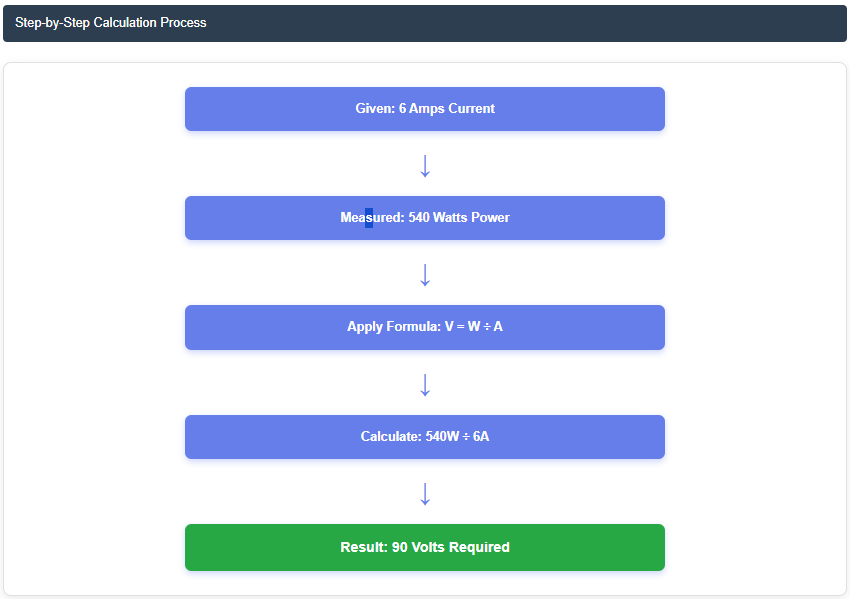
We must perform amp to volt conversion using power as a reference to discover the voltage needed to support this load. By dividing total optionality power by the current, we notice the system operates at 90 volts.

When choosing a power supply or inverter output, this value is very important. Using a source of lower voltage would have the circuit draw more current, ultimately overloading the wiring or component. This example shows why amps to volts conversion is not a theoretical matter, but an issue of safety and stability.
When to Use This Calculator
If the power requirement is known but the voltage must be found, this calculator is used if the current is known. The synchronous reference frame generator is especially useful in battery systems, inverter design, DC power distribution, lab testing setup, and custom electrical projects where the supply voltage is not fixed by a standard.
Electricians use it to check whether a power source can safely support a measured current draw. Engineers use it when designing a system to keep voltage levels consistent with components. When checking whether charge controllers, inverters, or battery banks are operating in the intended voltage ranges, solar professionals rely on it.
Common Real World Application
This phrase can also prove beneficial when diagnosing problems. When the current and power of a piece of equipment are known, voltage can be calculated to reveal conditions of under- or over-voltage, which may be causing overheating or inefficiencies or unexpected shutdowns.
Solar Products for Your Project
 Solar Panels |
Solar System |  C&I Battery Storage |

Reference Table (Typical Values)
| Amps (A) | Power (W) | Phase | Volts (V) |
| 1.5 A | 180 W | Single | 120 V |
| 2 A | 240 W | Single | 120 V |
| 3 A | 360 W | Single | 120 V |
| 4 A | 480 W | Single | 120 V |
| 5 A | 600 W | Single | 120 V |
| 6 A | 720 W | Single | 120 V |
| 8 A | 960 W | Single | 120 V |
| 10 A | 1,200 W | Single | 120 V |
| 6 A | 1,000 W | Three | 96 V |
| 10 A | 1,732 W | Three | 100 V |
| 12 A | 2,490 W | Three | 120 V |
| 15 A | 3,118 W | Three | 120 V |
| 20 A | 4,156 W | Three | 120 V |
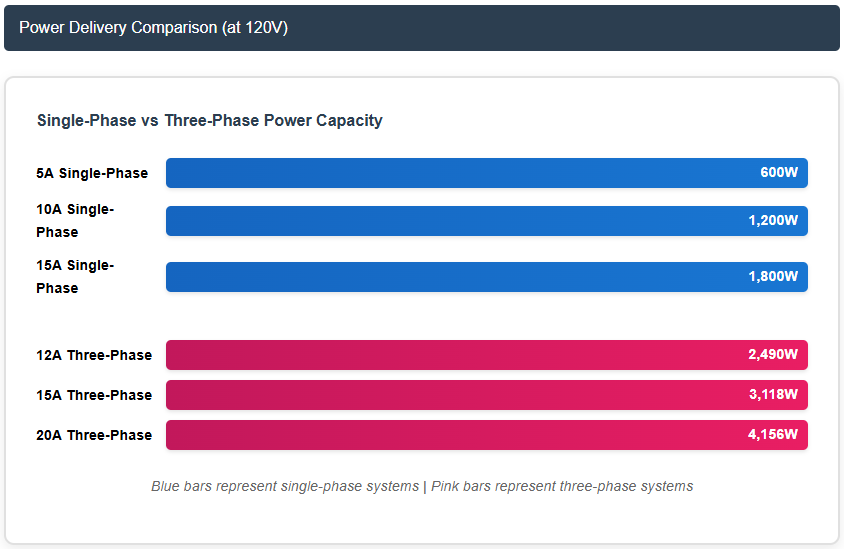
These values show how the voltage depends on the current and power. Moreover, it shows how three-phase power gives more power at less voltage per phase.
Accuracy & Limitations
The calculator assumes constant operation and known power use. In actual systems, power may vary based on changes in load, efficiency loss, or startup conditions. When power increases while current remains the same, voltage must also increase.
Three-phase circuits are assumed to be balanced. When voltage requirements are uneven due to a phase imbalance, the average value will not suffice. At startup or during transient operation, the effective power demand may change due to inductive loads like motors.
Due to all these factors, the results of the A to V calculator should be considered planning values. Engineers would typically apply additional margin in the design of systems for efficiency losses, temperature effects, cable resistance, and operating variances.
Quick Troubleshooting Guide
Case Study
A mobile inspection unit operates diagnostic equipment powered from a customized DC supply. The measurements indicate that the system draws a steady 4.5 amps. Field tests suggest that the total power requirement is about 405 watts.
The engineers’ amps to volts conversion calculation shows that the system requires 90 volts to work well. Nevertheless, the power supply presently just delivers 72 volts. As a substitute, the system tries to draw a higher current that heats the cable and causes faults.
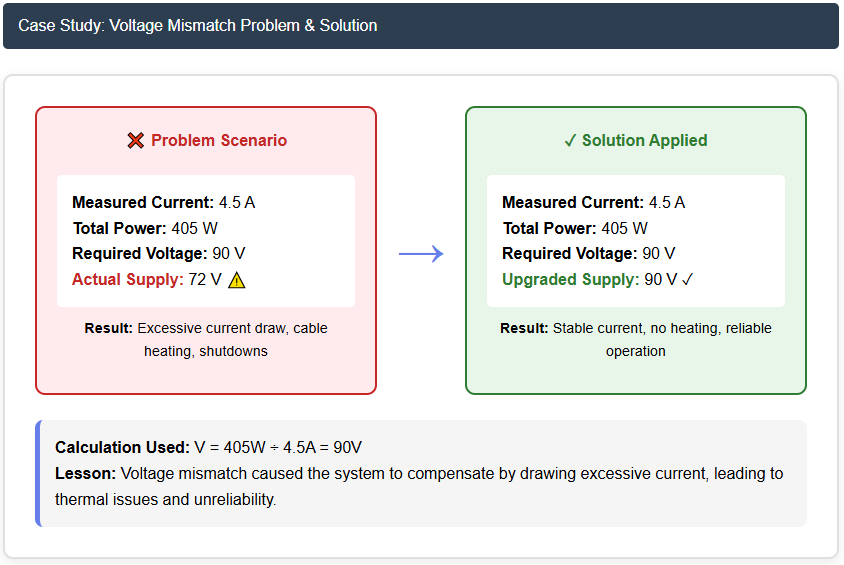
Following the identification of the voltage mismatch through the conversion of amperes to volts, the team upgraded the supply to one that gave a regulated output of 90 volts. Current is stabilized, heat build-up is eliminated, and the system becomes very reliable.
This case shows how misapprehending amps and volts can lead to actual operating failures, even with current values that appear reasonable.
Conclusion
When the power is known, the A to V calculator is a very handy tool to convert current to voltage. For the proper design of the system, the selection of the power supply, fault diagnosis, and other applications.
When we understand that the amps to volts calculation needs reference power, users avoid many mistakes that can overheat equipment, affect efficiency, or even cause it to fail. With single-phase or three-phase systems, the calculator helps in the performance of the design.
More Calculators for You
Frequently Asked Questions
There is nothing set in stone. The voltage level is determined by the amount of power we’re delivering at that current.
No, you need to know the power because voltage(V) is not determined by amps alone for better understand read the section of “Formula and Variable definition” this will clear the ambiguities regarding this concept.
Yes, as long as the power is known. Three-phase systems require a phase correction factor.
Voltage depends on power demand, not the current, and please read the example calculation and Case Study section for better understanding and if you still have queries please contact HBOWA expert and we will help you to clear the concept and also help you to provide most suitable solution regarding your solar needs.

