Enter both prices in the same currency. This energy-only comparison excludes equipment cost, maintenance, battery degradation, generator startup fuel, minimum loading, demand charges and solar opportunity cost.
Introduction
A comparison of solar panels vs. a generator is not a straightforward one, as solar panels do not normally provide backup in a grid failure. The assessment contrasts an inverter with battery storage and solar with a generator. Solar power can generate electricity every day, while a generator can provide continuous backup when there’s fuel.
What Are really Need to Compare Between Solar Panels and a Generator?
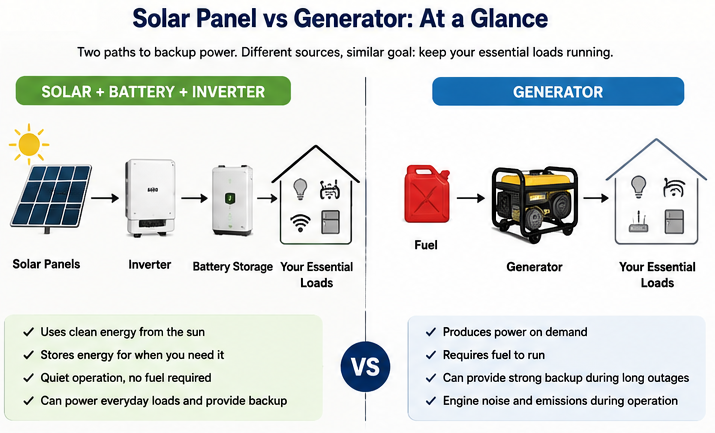
Solar power systems offer newfound resilience against power loss from the utility grid thanks to solar battery-integrated inverters and panels. The solar power system converts sunlight into electricity using panels in DC. An inverter comes with the power generation unit of a solar system to convert DC electricity into AC electricity, capable of meeting the demand in a new home or office.
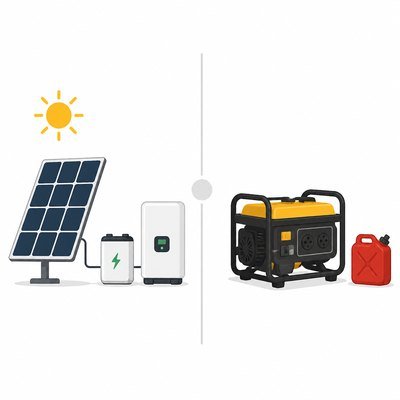
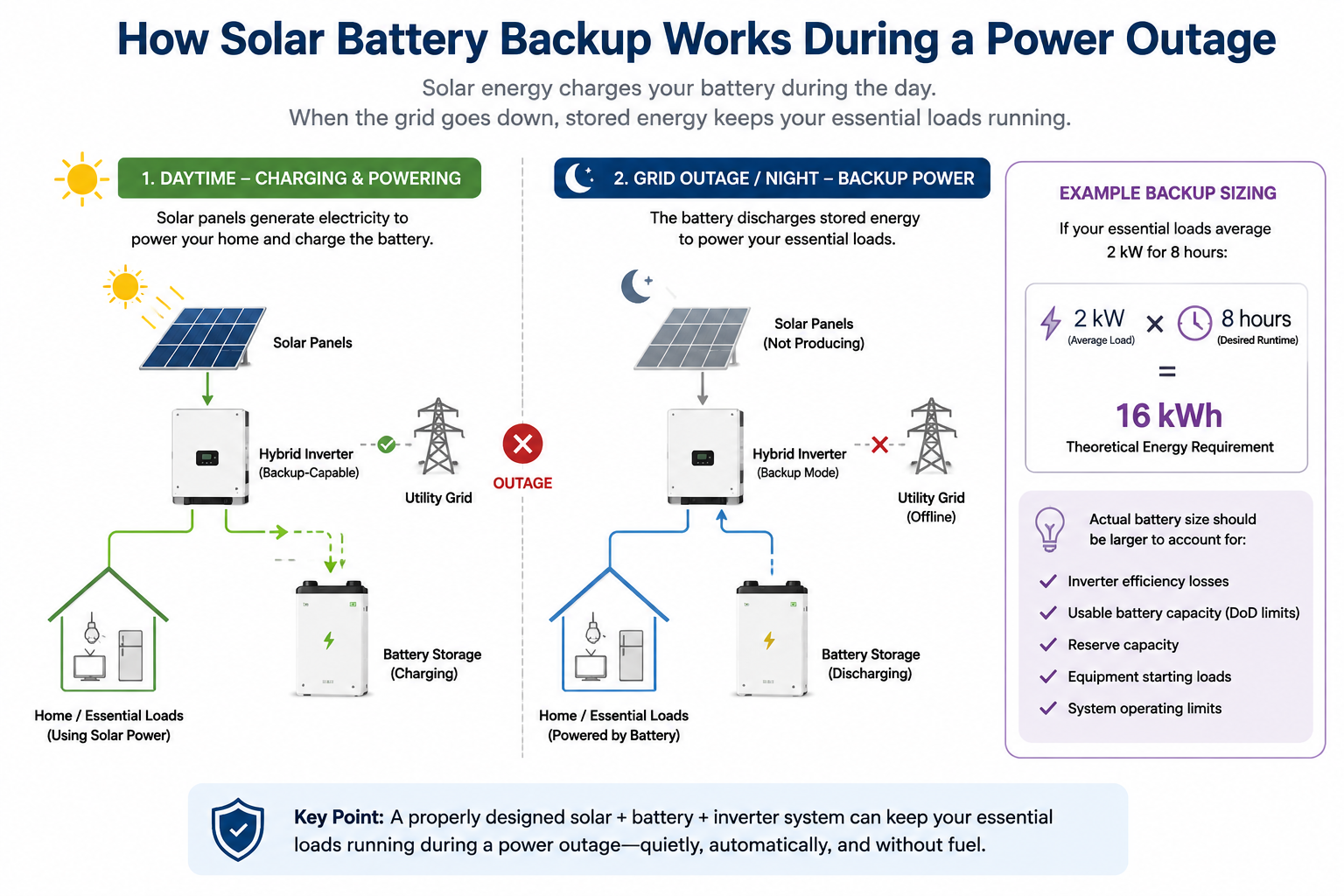
The inverter and battery backup system altogether have to be configured to remain online/active even when the power shuts off. The US Department of Energy (DOE) says that solar panels can shut down when the power grid goes down even though they are producing electricity. They need a battery backup system and an inverter capable of supporting islanded operations that allow the system to operate autonomously from the grid.
How a Generator Supplies Backup Power
A generator operates in a different way: fuel powers an engine, the engine propels an electric generator, and the electric power supply then gives power to the connected loads. Normally, portable units are manually operated, whereas the standby units are used with automatic transfer equipment supplying power to the selected load or our entire home when the main grid fails.
What Does “Solar Generator” Mean?
The term solar generator vs solar panels can be confusing. “Solar generator” is frequently and commonly referred to as a type of portable battery power station that can be recharged via solar panels. That is, unlike a solar PV and battery system, which is generally installed in homes or commercial buildings.

Solar vs Generator:
Solar Panel vs Generator Comparison
The backup needs are most often fulfilled differently by solar and generators. Combining solar and storage is different than a generator, which generates electricity as required. The choice depends on runtime, fuel access, load requirements, operating cost, noise, and if system must provide value when the grid is available.
| Factor | Solar + Battery | Generator |
| Upfront investment | Usually higher | Usually lower |
| Fuel | None | Required |
| Everyday energy | Yes | No |
| Backup duration | Depends on storage and solar availability | Depends on fuel and capacity |
| Noise | Very low in operation | Engine noise |
| Maintenance | PV, battery and inverter | Engine and electrical systems |
| Extended outage | Depends on storage and recharging | Stronger when fuel is available |
It is not correct to say that generators are better than solar panels in all kinds of cases. Solar vs. generator is an application-based question, whereas generator vs. solar panels depends on whether the solar system has adequate storage to suit your load and runtime or not.
Solar Panel vs Generator Cost: Upfront and Long-Term Expenses
The cost of solar battery backup exceeds the cost of both the panels and the battery. A fair comparison should include the entire setup and costs associated with the service period.
The first investment for solar-plus-storage is typically the solar panels, inverter, battery storage, mounting equipment, electrical protection, installation, and permits or interconnection, if applicable. Battery capacity and inverter power also influence price, as bigger capacity and power will be able to store more energy and supply a greater load.
The costs of generators adopt a different structure. Purchase costs may include the generator and transfer switch, electrical work, and installation, and are not usually included for certain standby systems. Ongoing expenses then rely on fuel use, number of operating hours, repairs, and part replacement.
This makes sense as to why a headline figure for the cost of solar panels with battery storage can be misleading. A solution for a refrigerator’s power needs during a short outage will differ from one for a commercial facility that may need power for hours. The type of generator, load, annual run, and local fuel prices also affect generator economics.
A beneficial way to compare costs is to use the total cost of ownership, or TCO, approach: initial cost + operating cost + maintenance + replacement costs − applicable savings or incentives. When considering solar, factor in battery and inverter transportation and degradation. Always have fuel depending on your generator.
Storing solar energy can provide value even if the grid is available, as stored energy can still be used later. A generator generally creates value while it is running, so the purchase price alone does not provide the same benefits.
Older articles in the U.S. might indicate a residential clean-energy tax credit of 30% running through 2032; however, the IRS says that the credit does not apply to property placed in service after December 31, 2025. Because tax incentives vary by market, the latest rules should be consulted before calculating project economics.
Solar Panel vs Generator for Backup Power
If there’s a brief outage, a well-configured solar-plus-storage system can provide backup without needing to turn on an engine or bring fuel. The battery-fed energy is stored by the inverter, with automatic transfer or control functions to move selected loads to backup power. When power cuts occur quite often but are not that long, solar battery backup for home can benefit.
The capacity of your battery is more crucial than the number of panels for an overnight outage. Critical loads can be explained with the following example. Let us say the critical loads average 2 kW for 8 hours. Therefore, the theoretical energy requirement is 16 kWh. Sizing of the actual system will also take into account conversion losses, reserve capacity, battery operating limits, and equipment such as pumps’ or compressors’ starting loads.
For outages spanning days, it's no longer straightforward. As long as it is suitably sized and there is enough fuel available, a generator can keep on producing electricity. Solar-plus-storage can recharge on-the-fly in daylight as solar conditions allow, reducing fuel logistics. Some days can be cloudy or have high load, and/or storage can be limited.
According to the DOE, proper configurations of solar and storage can provide resiliency. So, it’s not just comparing solar panels VS generator for a home. You also have to know how much power you will need, for how long, and how you’ll recharge the system. Before sizing the battery, critical loads must be prioritised because powering everything can take much more storage than maintaining critical services.
Solar vs Generator: Reliability, Lifespan and Maintenance
A fair comparison between PV modules and solar panels must separate the lifespan of PV modules from the service life of batteries and power electronics. According to the DOE, silicon PV modules are believed to last for 25 years or longer and continue producing in excess of 80% of their original power.
There are a lot of factors that can change battery life, such as chemistry, temperature, depth of discharge, cycling frequency, charge and discharge rates, design, etc. For instance, HBOWA rates its 51.2V 100Ah LiFePO4 battery at 5 kWh, with more than 6,000 cycles at 25°C and 80% DoD, and a 5-year warranty. These are specifications for HBOWA and not general LiFePO4 performance.
Generators require maintenance different from other power equipment due to their engines and fuel systems. Availability can be impacted by oil and filter service, fuel-system checks, periodic tests, and servicing. Different generators come with specific requirements depending on the type, environment, and manufacturer.
Accordingly, reliability should be evaluated at the system level. NREL evaluated emergency generators, solar PV, and lithium-ion BESS for outages of 1 hour to 2 weeks. It points out that if you assume the backup resource is 100% reliable because fuel is available, the estimates obtained can be inaccurate, particularly for longer outages. When choosing between a solar battery and a generator, there are several important factors to keep in mind.
Solar Panel vs Generator: Safety and Environmental Impact
In a solar power vs generator comparison, one of the major considerations is safety. Solar-plus-storage systems include DC or AC electrical equipment, a battery management system, protection devices, thermal controls, and suitable installation. The equipment needs to be selected and installed based on the regulations and requirements demanded by electrical and fire safety.
Generators introduce hazards related to combustion. Portable generators are carbon monoxide hazard. It is colorless, tasteless, and odorless and can lead to sudden death. These portable generators are to be put outdoors safely. According to the U.S. EPA, never use a portable generator inside the house, the garage, the shed, or outdoors, or even in the crawl space or other enclosed areas. Also, residents are to keep the portable generator at least 20 feet away from the building.
There is also the noise to consider; battery systems are very quiet, whereas generators produce a lot of mechanical noise and exhaust, so if quietness is a necessity, battery systems should be a more practical choice. Environmentally, there's a narrower profile. Solar PV power systems produce no emissions directly from combustion while generating power, whereas fuel generators do.
Real-World Solar + Storage Examples From HBOWA Projects
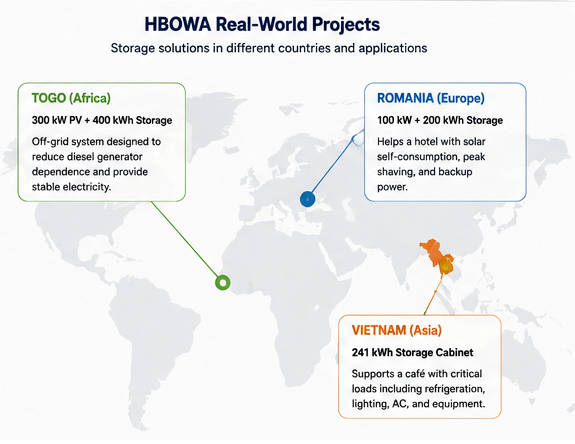
The project portfolio of HBOWA provides first-party examples of how an energy storage system can be used in different applications.
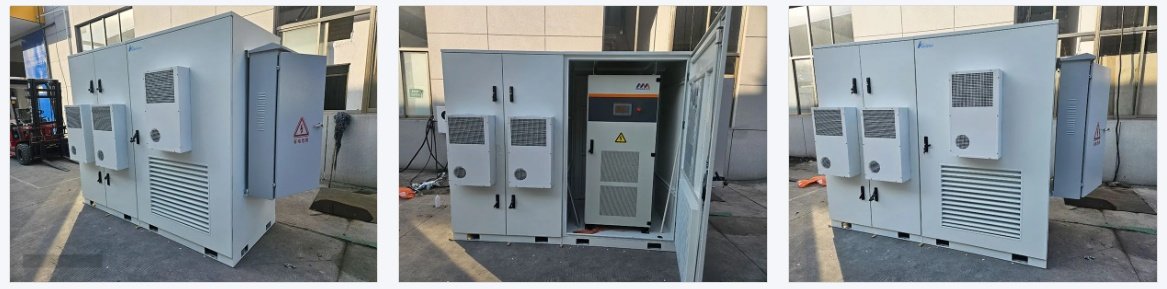
When a business needs solar-backed peak management or backup power, a commercial battery storage cabinet is one project format to evaluate using verified load and autonomy requirements.
Togo:
In Togo, HBOWA delivered a 300 kW PV system with 400 kWh of battery storage for an off-grid application. Solar supplies daytime loads, with excess energy being available for afternoon storage and nighttime and rainy periods. An off-grid solar battery backup decision in this application will depend on fuel cost, maintenance, noise, and logistics.
Romania:
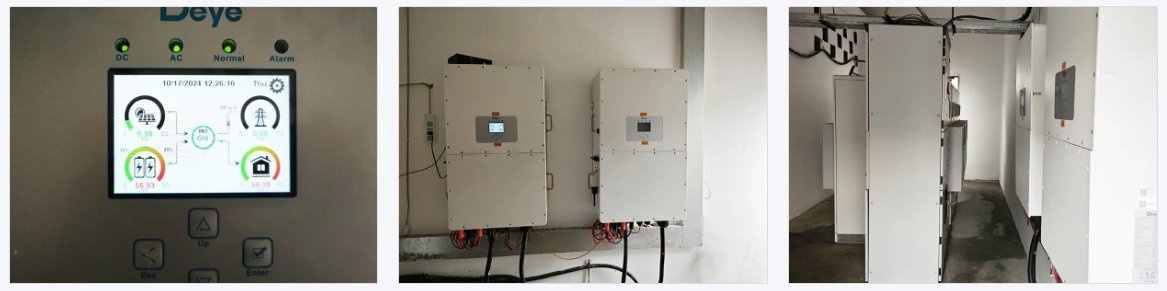
In Romania, HBOWA supplied a 100 KW Megarevo inverter along with a 200 kWh LiFePO₄ storage system to a hotel. It would be used for PV self-consumption as well as for peak shaving and supply backup power. The energy that is stored in Megarevo can be used to support key loads like lighting, the reception area, security, and pumps during short interruptions. Here, we demonstrate that the storage systems can provide value beyond backing up the power by managing the day-to-day uses of electricity.
Vietnam:
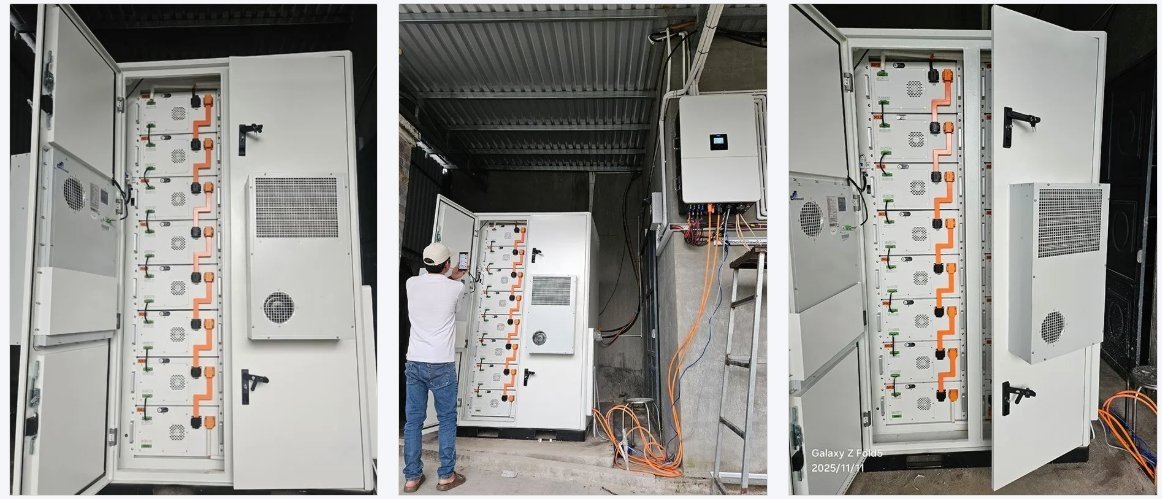
According to the supplier, HBOWA, they have delivered a 241 kWh battery cabinet along with an 80 kW Deye inverter to a café in Vietnam. It would be used to provide the load of AC, cooling systems, lighting, a coffee maker, and payment equipment. It illustrates an additional application of energy storage but does not necessarily indicate that solar plus storage is economical in all markets.
Solar Panel vs Generator: Which Is Better for Your Situation?
The right solar vs generator decision depends on the outage pattern, load profile, ability to access fuel, and requirement to generate electricity for everyday use. No single option is a winner. A short outage will favor solar plus battery because the stored energy can be accessed without firing up an engine. When the system is often used daily to connect to the solar energy, an outage can be stored in favour. In cases of long outages when fuel is reliably available, a generator may win.
A decision on solar panels or a generator may also be a joint system. According to the Department of Energy (DOE), distributed energy resources such as solar, battery storage, and emergency generators can work in coordination in microgrids. This methodology is beneficial for remote sites like hotels, telecom, and industrial sites, where different requirements arise for short interruptions and long outages.
The answer to your question, ‘if I have solar panels, do I need a generator,’ fully depends on the battery capacity, solar resource, critical loads, and autonomy required. Often existing solar can be paired with compatible storage, instead of replacement. Multi-day critical backup can be more flexible with solar, storage, and a generator than solar or a generator alone.
How to Choose Between Solar and a Generator
Before you choose a solar panel vs generator solution, consider the factors that dictate actual system requirements rather than just comparing equipment prices.
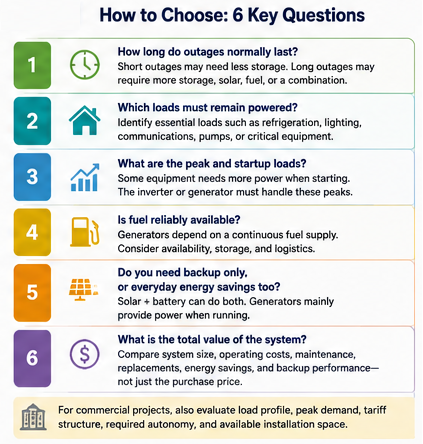
Also, check the load profile and peak demand, tariff structure, autonomy requirement, and installation area for commercial projects. The sizing of the system and the long-term value of solar, battery storage, a generator, or a combination thereof are significantly affected by this.
Conclusion
If backup power is just one goal and the system must produce electricity every day, solar plus battery becomes compelling. A generator can be more powerful for extended fuel-based backup. For applications with high demands, the proper design of a system that combines solar, storage, and a generator allows for greater flexibility. If you still have any questions, feel free to contact HBOWA to discuss your solar power requirements.
Frequently Asked Questions
Not required. Solar panels must have proper battery storage and inverter controls to operate during an outage. Having solar energy with battery storage can be quiet and rechargeable from sunlight because solar energy is plentiful. On the other hand, a generator can provide power for an extended time, while it has fuel available.
Not Necessarily. The answer depends on battery capacity, critical loads, outage duration, solar availability, and whether the system can function independently from the grid.
Various factors will determine the price of a project, including system cost and electricity prices, fuel cost, operating hours, maintenance, battery replacement, and local project conditions. A fair comparison requires realistic assumptions in regard to both technologies.
One battery size does not fit all homes. The storage required depends upon critical-load consumption, desired backup period, inverter capacity, usable battery energy, and starting loads of equipment.
Yes, there are systems that can join a generator with solar and battery. The inverter, generator controls, transfer equipment, electrical design, and installation requirements may not be compatible.