Formula:
DC: W = A × V
An A to W calculator is a calculator for amperage to wattage conversion. A means the electric current, given in amps, W means power, measured in watts, W = A x V, which V means voltage of the electricity system. The calculator helps you quickly determine how much real power a device takes or how much load it is safe to put on a circuit.
Formula & Variable Definitions
DC & Ideal AC System:
W = A x V
Used for: Battery systems, resistive loads, DC circuits
Example: 10A x 120V = 1200W
Single-Phase AC with PF
W = A x V x PF
Used for: Motors, air conditioners, refrigerators, power tools with electronic controls
Example: 10A x 230V x 0.85 = 1955W
Three-Phase AC System
W = √3 x A x V x PF
Used for: Industrial equipment, commercial HVAC, large machinery, data centers
Example: 1.732 x 20A x 400V x0.9 = 12470W
In practical electrical systems, these relationships are used to convert breaker ratings, appliance nameplates, and inverter ratings into working powers. According to the basic formula, direct current circuits and simple resistive loads are considered. Most AC systems, in particular those with motors, compressors, and electronics, need a power factor to avoid overstating the real power output.
Three-phase systems are used in commercial and industrial applications as they provide power more efficiently through three conductors. The calculation requires the √3 multiplier for this reason.
The wattages calculated from the above equations represent expected operating power, under normal operating conditions, by taking into account the power factor, the conditions of the system, and so on, instead of the ideal laboratory assumptions.
A to W Example Calculation
When applied to tangible electrical loads rather than abstract equations, an A to W conversion becomes much clearer.
A water transfer pump in a remote construction site draws a current of 8 amps from 220 volts during steady working conditions. Using the A to W formula and multiplying the current by the voltage shows the pump consumes about 1,760 watts. The wattage value is much more useful than amps alone, as the sizing of any system, like inverter capacity and battery output always based on power demand.
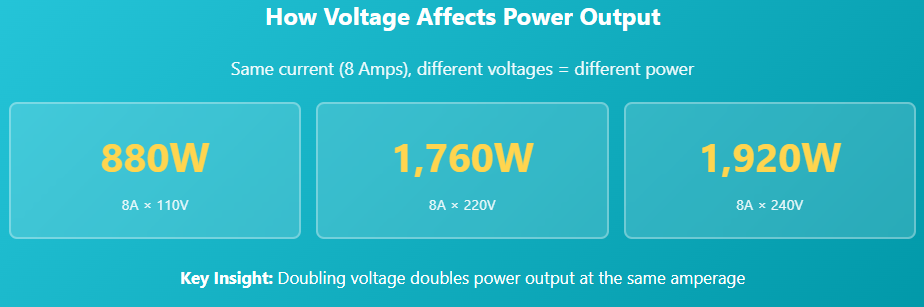
If the same pump operates on a 110-volt supply and continues to draw 8 amps, its power will be about 880 watts, and in this scenario, the current remains the same, but the usable power is reduced due to reduced voltage, so when matching loads with energy storage systems, this is a key consideration.
For an off-grid system, we combine an HBOWA LiFePO4 battery with a Growatt inverter to support these varying power conditions because LiFePO4 batteries support high currents with minimal voltage drop, while the Growatt inverter reliably transforms DC to DC.
When to Use This Calculator
This calculator can come in handy where actual power values instead of current ratings are used to make electrical decisions. Things like circuit breakers, extension cords, wiring sizes, generators, inverters, and battery systems are ultimately a function of watt capacity and not amps. The conversion of current and voltage into watts allows users to easily see if there is enough headroom in a circuit to safely run equipment for long periods.
It is often used for ensuring the proper functioning of heaters, compressors, or kitchen equipment without nuisance tripping on a 15-amp or 20-amp breaker. It is used by solar system planners to convert appliance current draw to inverter and battery load requirements.
Users of generators utilize them to avoid overload shutoffs by determining the total watt demand before attaching, and this calculation is also useful when upgrading workshops, RV electrical systems, or home panels when adding further tools or appliances, where the wiring limits must be respected.
How Many Watts in 15 Amps?
When pf is considered constant at a value of 1, at 12V, 15 amps equals 180 watts, at 120 V, 15 amps equals 1,800 watts, but at 240 V, it equals 3,600 watts.
Common A to W Conversion Table (Typical Values)
| Current (A) | 120 V (W) | 230 V (W) | 240 V (W) |
| 1 | 120 | 230 | 240 |
| 1.8 | 216 | 414 | 432 |
| 2.3 | 276 | 529 | 552 |
| 3.9 | 468 | 897 | 936 |
| 4.7 | 564 | 1081 | 1128 |
| 6 | 720 | 1380 | 1440 |
| 6.4 | 768 | 1472 | 1536 |
| 7.6 | 912 | 1748 | 1824 |
| 9.8 | 1176 | 2254 | 2352 |
| 10 | 1200 | 2300 | 2400 |
| 11.3 | 1356 | 2599 | 2712 |
| 12.6 | 1512 | 2898 | 3024 |
| 13 | 1560 | 2990 | 3120 |
| 14.1 | 1692 | 3243 | 3384 |
| 15 | 1800 | 3450 | 3600 |
| 15.2 | 1824 | 3496 | 3648 |
| 17.5 | 2100 | 4025 | 4200 |
| 18.9 | 2268 | 4347 | 4536 |
| 20 | 2400 | 4600 | 4800 |
| 21.4 | 2568 | 4922 | 5136 |
| 24.5 | 2940 | 5635 | 5880 |
| 27.8 | 3336 | 6394 | 6672 |
| 30 | 3600 | 6900 | 7200 |
| 32.2 | 3864 | 7406 | 7728 |
| 36.7 | 4404 | 8441 | 8808 |
| 50 | 6000 | 11500 | 12000 |
| 100 | 12000 | 23000 | 24000 |
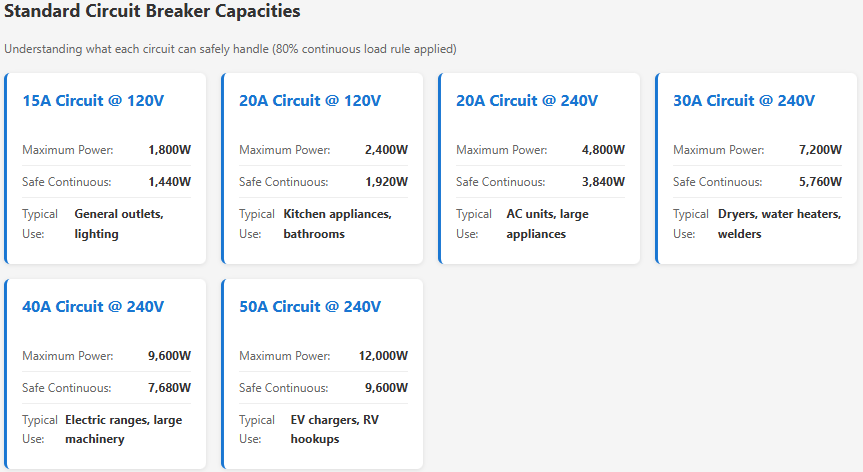
The values shown correspond with the actual operating currents that the equipment will draw. With the use of the table, quick estimations can be made without the need to do each calculation. Due to slight variations in real voltage above or below nominal voltage values, watt numbers should be regarded as approximate planning numbers.
Accuracy & Limitations
The calculator assumes a steady voltage with the appliance drawing constant power throughout its operation. In practice, due to long cable runs or supply conditions, actual voltage will sag slightly, and this affects the watt value. The temperature affects the resistance of a conductor, which in turn affects the current-carrying capacity of a wire.
Many devices, like refrigerators, pumps, air conditioners, power supplies, etc., are not purely resistive loads in ac systems. The internal electronics and motors affect the power factor, which reduces the amount of electrical power converted into useful power. The startup surge currents can be several times the running current and are not taken into account in this calculation. The outcome must be seen as a reliable estimate for planning purposes and not as a definitive measurement for diagnostic or compliance purposes.
Case Study: Field Power Setup in Dubai, UAE
A hybrid power system is used by the mobile food service at a temporary outdoor event in Dubai instead of a generator. This system includes a Growatt inverter and an HBOWA LiFePO4 battery for evening peak support. The setup also undergoes an electric renovation of the kitchen and grease trap installation. If only the amp ratings are considered, it would appear safe to operate each load at the same time.
An A to W conversion has revealed the real picture when the beverage chiller consumes 5.8A at 230V or about 1334 watts, but the hot food cabinet is rated at 13 amps, 240 volts, and about 3120 watts. The grinder consumes power at 4.6 amps 230 volts, which adds about 1058 watts, while other lighting & electronics consume around 250 watts.
Dubai Event Power Breakdown Case:
Beverage Chiller: 5.8A x 230V = 1334W
Hot Food Cabinet: 13A x 240V = 3120W
Espresso Grinder: 4.6Ax230V= 1058W
Lighting & POS = Combined load = 250W
Total system load: 1334W + 3120W + 1058W + 250W = 5762W (Peak Demand)
Without A to W conversion, amp rating appeared safe. The watt calculation revealed the system was operating near capacity, requiring load management strategies.
When the demand is converted to A from W, the total demand will increase to more than 5700w. At this time, the system will exceed the optimal capacity for a short term. If appliance use is staggered and some short peaks are shifted to battery support to compensate, the HBOWA LiFePO4 battery and Growatt inverter will be able to handle the high-current loads smoothly.
This Dubai-based example shows how A to W calculations facilitate smarter, location-aware power planning without equipment upgrades.
Conclusion
The A to W calculator is a convenient tool to convert amps and volts into a meaningful watt value for actual electrical systems. Understanding exactly what might happen when batteries are shorted helps designers to create safer circuits and better size equipment. It will also help in the proper planning of generators, inverters, batteries, and house wiring. Users can prevent any overloads by using the watt equivalent of current draw, which will also protect their equipment and help them use their electrical system safely and efficiently.
More Calculators for You
Solar Products for Your Project
 Solar Panels | 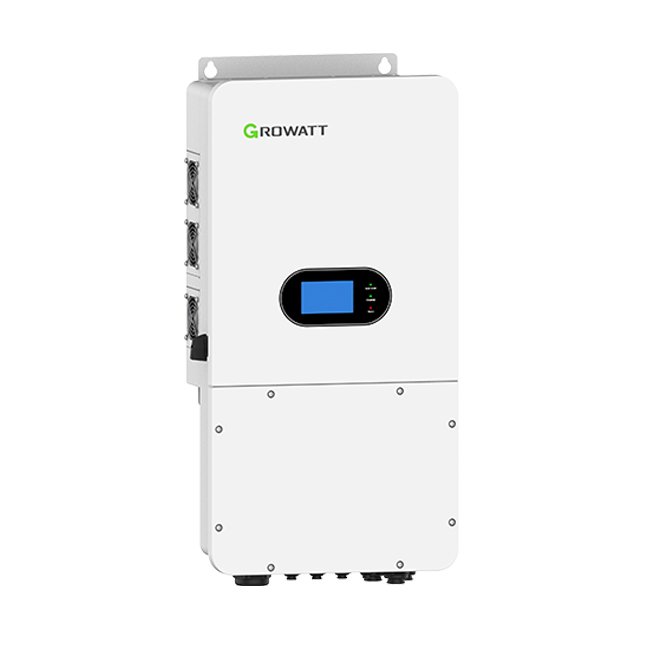 Solar Inverter |  C&I Battery Storage |
Frequently Asked Questions
At 120 V, 6 amps equals 720 watts, and at 230 V, it equals 1,380 watts, but if you want to see more conversions, please read the conversion chart above.
Watts cannot be converted to amps without knowing the voltage, and vice versa. And to understand better, read the formula section above.
Yes, for DC and simple AC systems, and complex AC loads may reduce usable power due to the power factor.
At 12 volts, 8 amps equals 96 watts. At 120 volts, 8 amps equals 960 watts. At 240V, 8 amps equals 1920 watts.