Solar Panels to Run an Air Conditioner Calculator
Use the running watts from the AC nameplate or from the table above (not the surge watts).
Number of panels needed: —
AC daily energy use: —
Estimated solar array size: —
*Calculation assumes 75% real-world system efficiency (temperature, wiring, and inverter losses).
How Many Solar Panels to Run an Air Conditioner? Panel Size, Inverter, and Battery Explained
As temperatures continue on an upward trend, demand for home cooling is also on the rise. Many homeowners are now looking to find out how many solar panels to run an air conditioner during the day reliably. The problem is that AC units require very different amounts of power, and improper sizing frequently shuts them down or drains the battery. These calculations should use verified wattage and not assumptions. This article will show how to run AC on solar using accurate BTU-to-watt conversions, climate-specific consumption figures, and standard engineering data. HBOWA delivers top-notch solar panels, inverters, and battery storage for solar systems.

How Much Power Does Your AC Use?
ACs are measured in BTU, while solar panels, inverters, and batteries are measured in watts/kilowatt-hours. The first step to correctly size a solar system is to get the cooling power of the AC converted into the electricity it needs. The standard formula is given below:
Power (W) = Cooling Capacity (BTU/h) ÷ 3.412
A window air conditioner with a power of five thousand British Thermal Units usually consumes range b/w 450-550W. Furthermore, it commonly matches the five thousand British Thermal Unit A/C wattage listings. A mini split that has a rating of 12k BTU will use almost 1k to 1.5k (W). Bigger window units or central ACs follow the same pattern, and the conversion is the same everywhere. Various tests show that the wattage can temporarily double when the compressor first starts, something many competitors don’t mention.
For example, a 10,000 British Thermal Units AC uses about 900 to 1200 watts while a 15,000 British Thermal Units(BTU) air conditioner can consume between 1500 to 2200 watts before adding the extra surge power. The following table uses standard wattages from ASHRAE and DOE data for typical home cooling systems. The average use of energy is based on running the AC for three hours, which is what we do under average conditions in moderate climates.
| AC Size | Running Watts | Surge Watts | Daily kWh (3hrs) | Recommended Panels (550W) |
|---|---|---|---|---|
| 5,000 BTU window | 450–550W | 900W | 1.5 kWh | 2–3 panels |
| 9,000 BTU mini-split | 700–900W | 1200W | 2.5–3 kWh | 3–4 panels |
| 12,000 BTU (1 ton) | 1000–1500W | 2000W | 3.5–4.5 kWh | 4–5 panels |
| 18,000 BTU (1.5 ton) | 1500–2200W | 3000W | 5–6.2 kWh | 5–6 panels |
| 24,000 BTU (2 ton) | 2500–3300W | 4500W | 8–10 kWh | 7–9 panels |
| 36,000 BTU (3 ton) | 3500–4500W | 6000W | 12–16 kWh | 9–11 panels |
| 48,000 BTU (4 ton) | 4500–6000W | 9000W | 15–22 kWh | 12–15 panels |
How Many Solar Panels Do You Need to Run an Air Conditioner?
How many solar panels to run air conditioner systems begins with knowing the Real Running Load and the sunlight at your place. Air conditioners draw a continuous load. Thus, your system should produce enough energy during peak hours of the sun to keep the unit running without any fault. A simple universal method to determine this is:
Number of Panels = AC Running Watts / Solar Panel Rated Output × Sun Hours Factor
The sun-hours factor tells how much solar power you can use. Hotter places with open skies give more output. India has an average sun hours factor of around 5.5, Africa gets up to 6.5, the US roughly 4.5, and Europe around 3 to 4.
A universal 1-ton AC (12,000 BTU) typically runs at nearly 1500W. A new panel with 550W of TOPCon module requires about 4 to 5 panels when calculated with a 0.75 real-world efficiency factor. A classic 1.5-ton Air Conditioner runs at about 2000W. That kind of AC needs 5 to 6 550W panels under consistent sunlight conditions. A 3-ton unit with a 3500W load, thus, requires approximately 9 to 11 modules. These values differ globally as panel output varies every second with heat, shade, and seasonal irradiance.

Higher efficiency panels need far fewer panels in total than the old 300 to 400W panels. Hence, it’s possible to use AC almost worldwide using solar panels for homes and small businesses in hot countries and places.
How Many kW of Solar to Run an Air Conditioner by Region
The output of the sun through its radiation varies significantly across countries, and correspondingly, the system size required for solar AC varies. Effectively, regions with higher irradiance require fewer solar panels to deliver the same energy in a day. For example, regions in some parts of the Middle East, most of Africa, and Arizona in the US experience some of the highest levels of sunlight in the world. On the contrary, there are areas with short effective solar windows, like solar panels in Rochester, NY, or northern Europe. This, as a result, influences the rows of how many kilowatts of solar a household’s air conditioning system needs.
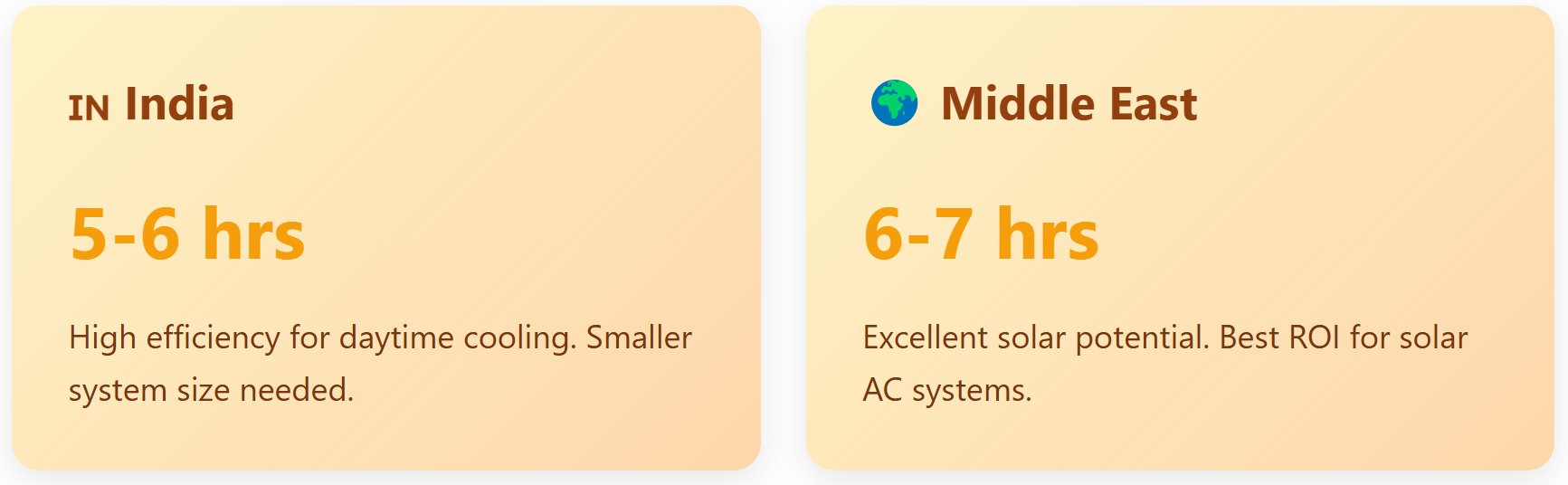
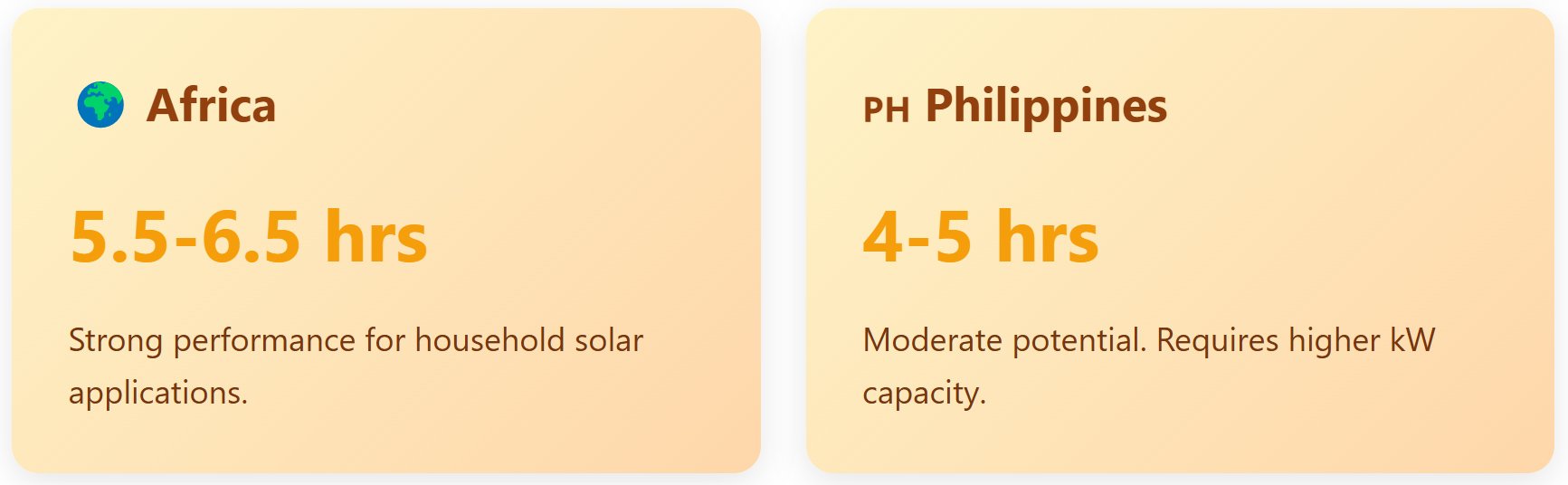
India basks in 5–6 light hours. Thus, a small setup suffices for running a solar AC in the daytime effectively. The Middle East reaches the upper limit of this bracket with 6–7 hours, which makes solar AC quite the workhorse in the region. The average number of hours of sun in African countries lies between 5.5–6.5, which gives a strong performance of solar energy for household uses. The average sun hours fall in the bracket 4–5 in the Philippines, which increases the capacity of kW required and hence the overall system cost, with the solar panel cost Philippines moving upwards due to the rise in import prices.


Homes in Florida experience long summer hours, making solar panels for homes in Florida a very efficient choice for solar cooling. Meanwhile, most of the countries in the northern part of the US fall under the bracket of 3–4 hours, which means that their homes’ solar cooling might be feasible but will be heavily dependent on higher output TOPCon panels. Some of these states might include New York.
Do You Need Batteries to Run Air Conditioners on Solar?
It relies on when you want to use an air conditioner run by solar power. If you need it at daytime, especially when the sun is shining ideally, the requirement for a battery diminishes. The solar panel with the right-sized inverter can run the air conditioner unit without interruption. It works fine for solar mini split kit combustion devices or window ACs, usually used during the peak sun hours.
But if you need the air conditioning in general all the time, that is, at night or during the evening, a battery is a must. The energy required to work at that time is supposed to be stored effectively only if left for the next day. Lithium Iron Phosphate Batteries(LiFePO4) are the ideal choice for the purpose. It offers a maximum cycle life with fast charge rates and reliable operation during the surge.
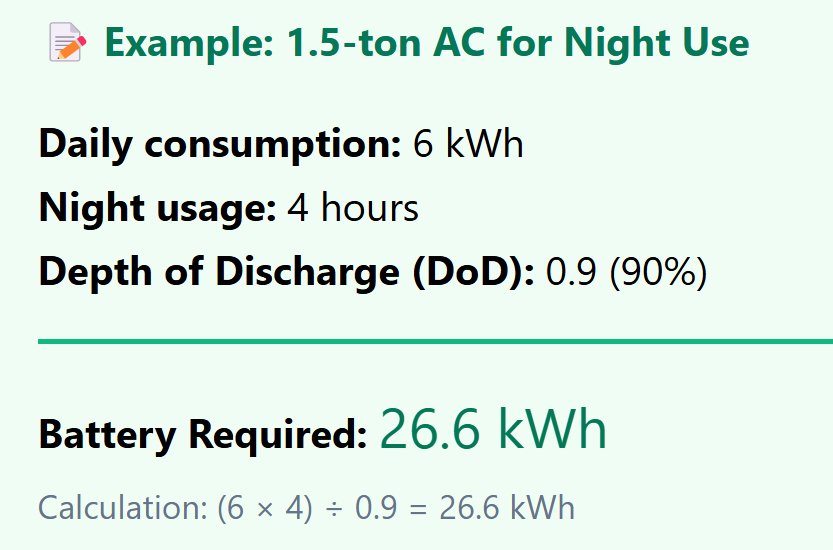
The capacity of the battery can be estimated as:

For example, the storage required for a 1.5-ton AC consuming 6KWh/day to be used during night hours(back-up of 4 hours) would be around 26.6kWh(i.e., 6 ×4/0.9). Modern industrial-grade LiFePO4 packs serve the purpose right. The industry-specific range of 5kWh to 15kWh modules from HBOWA with LiFePO4 packs is perfect for the job at hand. The commercial HVAC surge currents are safely handled by the pack without destruction of the pack, albeit giving a stable performance.
For off-grid systems, a battery is a must for a consistent power supply to the off-grid air conditioning unit. It offers stable performance without overloading as well as ensures the battery to not over-discharge. Proper sizing of the battery is a must to prevent over-discharging and extend the life of the battery to get all the seasons’ use properly.
What Size Inverter Do You Need for an AC?
Selecting the perfect solar panel with an AC inverter is crucial when you need a solar panel to safely power an air conditioner. The inverter must be fit to handle the continuous running load, as well as the initial surge that the Air Conditioner compressor has.
It is believed that with a small inverter, the solar generator will shut off the air conditioner quite often. Also, using such a small inverter might be liable to damage the equipment. There are standard rules available that help in determining the right sizes of solar inverters based on the running and surge watts of the AC.
For a 1-ton, i.e., 12,000 BTU air conditioner, the suitable running watts are 1200-1500W, with 2500W required. The solar inverter required is around 2.5-3 kW.

A 1.5-ton, which is equal to 18000 British thermal units, air conditioner requires 1600-2200W of watts. The solar inverter required is 4kW, along with a surge of 3000-3500W.

The 2-ton air conditioners with 24000 British Thermal Units and 3 tons are equal to 36000 British Thermal Units. Therefore, the inverters of size 5-6kW, along with 8 kW, are required.


For example, Growatt SPF5000 ES, or SPH600, can work efficiently for a 1.5 to 5-ton range of AC.

Can a Solar Generator power an Air Conditioner?
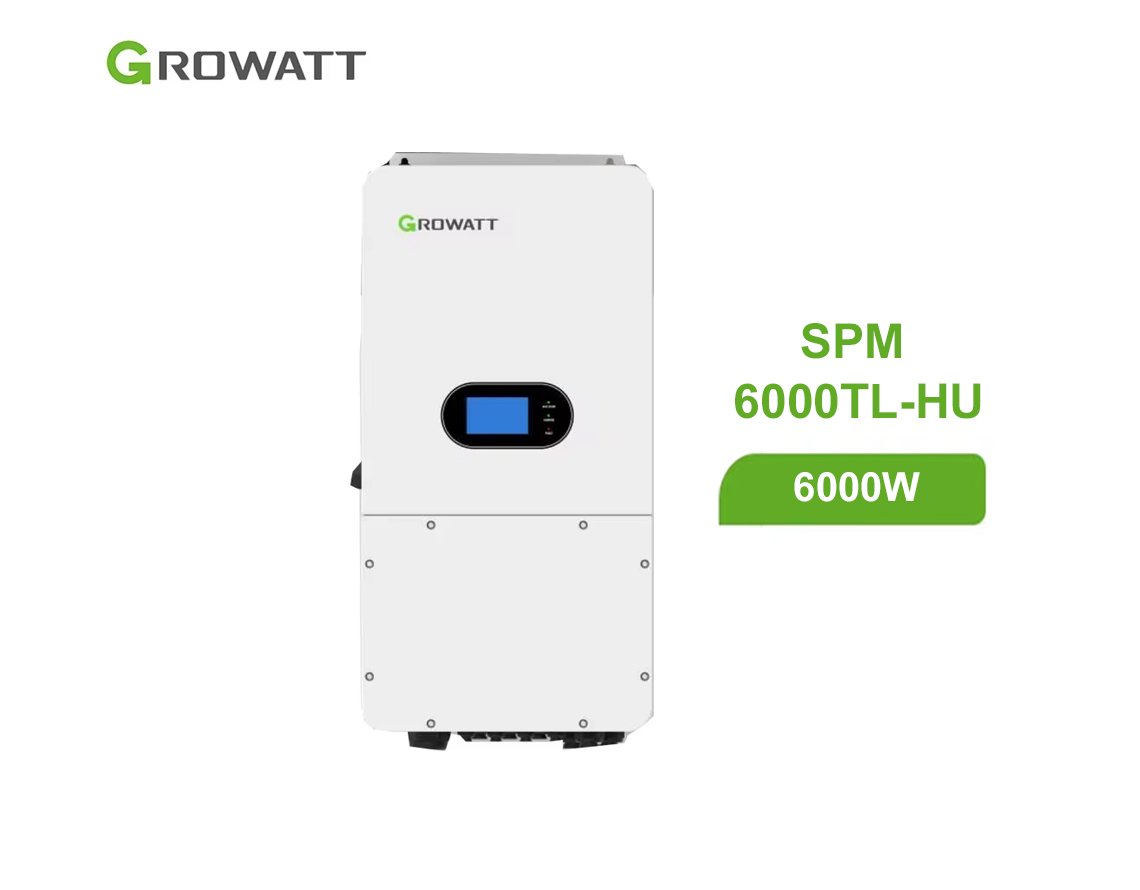
Anyone owner where there is a demand for a residential system should install a solar inverter and air conditioner with a hybrid configuration like Growatt SPF5000 or Growatt SPM6000.
Making sure to fit the inverter size as per the running and surge watts will make sure your inverter AC or solar inverter air conditioner. For an uninterrupted work output of these inverters, making sure it is well protected for the panels and batteries while increasing the system efficiency.
Solar Panel Sizes & How They Affect AC Sizing
Selecting the correct solar panel is essential when calculating the number of solar panels to run an air conditioner. The daily output of not all panels is the same. The size of the panel determines the number required to run an AC. Solar Air conditioner or AC-1.5 tons of capacity and around 2000W per day requires more panels if 300W modules are used, compared to 550W or 600W.
One 300-watt panel P(E)R cell gives an energy output of about 1.5 kW if the sun emits the greatest heat, which is a little less than 5 hours (sun). So in all, 8-10 panels are required to generate this 1.5 kW power to start the 1.5 ton AC.
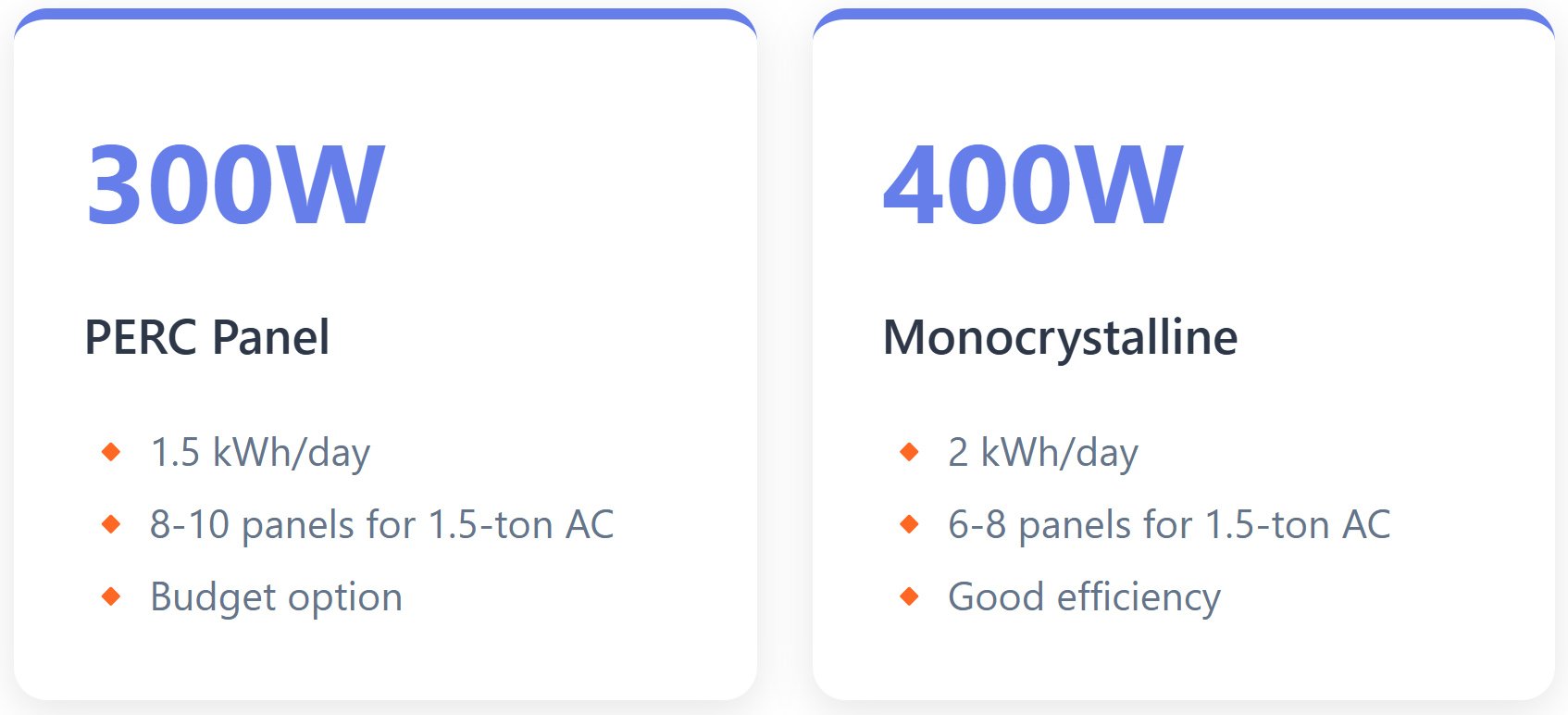
But if we change the panel to 400 watts [6 (400W)], the no. of panels required is changed to 6-8. Now, the new modules, the TOPCon module, 550 watts (2.75-3)kWh/day, generate enough power with 5-6 no. of panels set up. The N-type 600W high-efficiency panel [3-3.2]kWh/day gives out energy, which is the same air conditioner requires a minimum of the panel cells than 4-5.
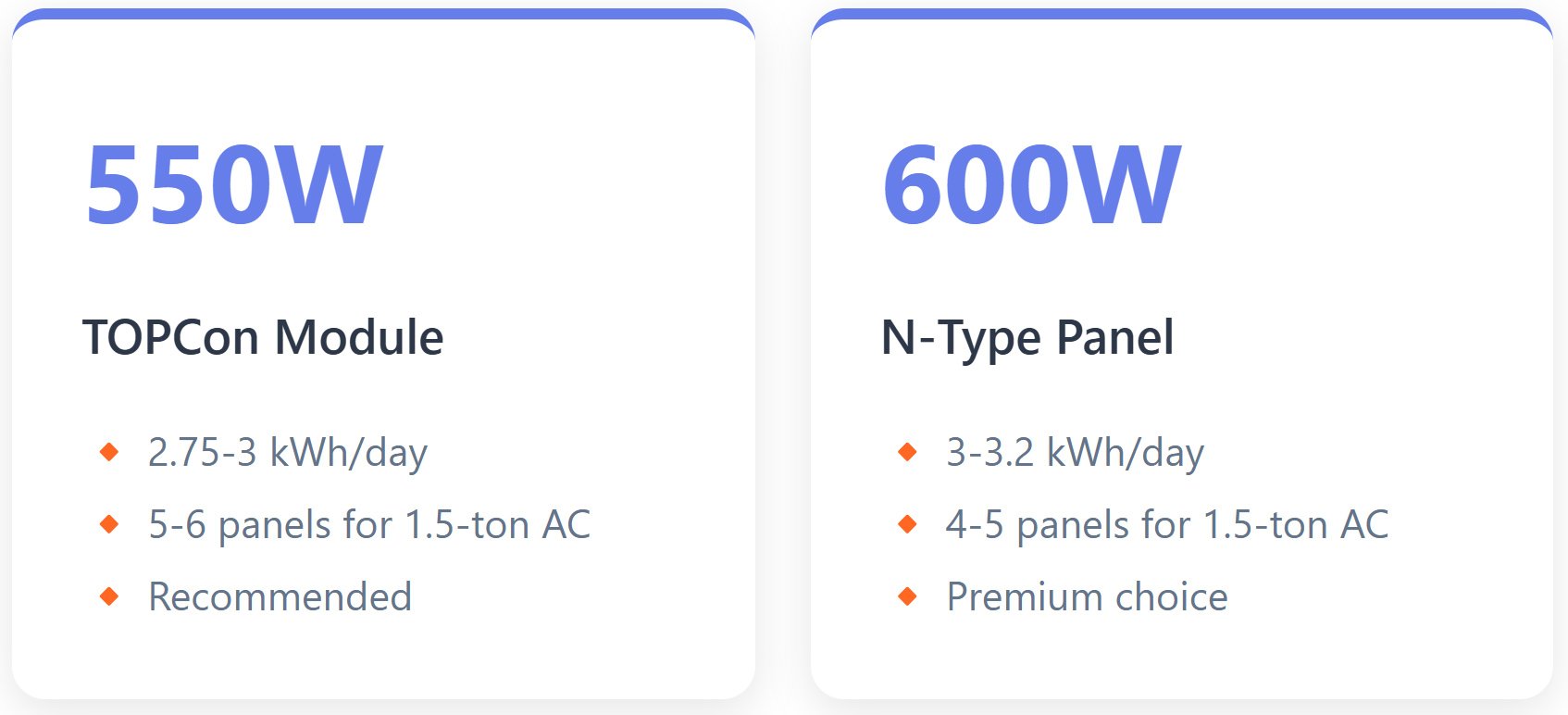
The difference can be drawn in the choice of panels and the benefit-cost trade-off. High-wattage panels are used, which require only a few installations, and then would take up less space on the roof. Additional costs are involved. A lower wattage panel is sufficient when a person has a portable AC with a solar panel setup or even a small air conditioner of 300W. The correct size of the panel will reduce installation complexity and roof space utilized, and even make the solar system efficient. It will also reduce the energy requirement and cost of setting up
Can Solar Generators Run AC Units?
The air conditioners with solar generators, but both the running and the running power should be matched. A small 5000 BTU air conditioner unit (~500W), then 1000W is a fine solar generator that can be used. So, it is suitable for a compact solar-powered air conditioner. A 1-ton air conditioning system (~1200-1500W running, 2500W surge), then the generator must have 3000W or more power generation. The portable units of solar generators of around 600W can effectively run the small air conditioners of 200-400W for a short time duration. generally used for temporary setups or RV use.
| AC Type | AC Watts | Surge Watts | Minimum Generator Size | Recommended Model Range |
|---|---|---|---|---|
| Portable AC (small) | 200–400W | 600W | 600–800W | Entry-level portable stations |
| 5,000 BTU window | 450–550W | 900W | 1000W | 1kW solar generators |
| 9,000 BTU mini-split | 700–900W | 1200W | 1500–2000W | Mid-range power stations |
| 1 Ton (12,000 BTU) | 1200–1500W | 2500W | 3000W+ | Heavy-duty generators |
| 1.5 Ton (18,000 BTU) | 1600–2200W | 3500W | 4000W+ | Professional-grade systems |
At startup, the generator must cover the surge current, even when the running dominant goes with the generator. The small-sized generator will lead to tripped circuits or the inverter shutting off. To know what size solar generators can power the window AC (air conditioner) will help the house holders to use the proper size and avoid overloading and underutilization of the system. A proper hand-generator sizing is a standard way to be portable yet powerful enough to run a 500 W air conditioner unit or any larger unit.
Real-Life Case Studies
You can see many examples of a properly shaped solar system, which runs the AC on solar effectively across the globe. In India, there is a family, and the family runs the 1.5-tonne AC on solar. They fixed six panels of 550W TOPCon solar panels along with a 5KW Growatt inverter. This system was efficient enough to run the AC properly for eight hours a day during day. Similarly, during the cloudy days, they used to use the regular inflow of sunlight. The sunlight Consistency changes due to the change in the climate. While planning for these kinds of solar power systems, we have to keep in mind the seasonal sunlight and battery storage.

Moreover, in the Philippines, a family manages the 1-ton mini-split along with eight panels of 400W during the daytime regularly. But as there is no sunlight during the nighttime, the family installed a 10Kwh of LiFePO4 battery. The theory of operation of the battery is to store the energy, which is produced during the daytime, and use it during the nighttime for cooling purposes. Similarly, in the UAE, a commercial property runs a 3-ton central AC along with eleven solar panels of power 600W N-type. There are many hours of sunlight per day, and thus, if there is enough solar power, then the people would operate the AC for a few hours a day. This would maintain the efficiency of the panels.
Thus, from the above case study, we came to know the important notes to use solar power for AC are the regional sunlight, the wattage of the panel, and the capacity of the inverter. Thus, by installing a proper power system, the people can run the AC efficiently. Also, having the right power system would provide the customer with regular cooling and make it easy for people who cannot stay without an AC. After that, a few months of usage of such a system make the panel a battery-free model, and you no longer have to spend electricity. For some people, the installation of the models may be a bit expensive, but it is essential to ensure their comfort while they are at home.
Conclusion
Running an Air Conditioner with solar is achievable with a proper design. The number of solar panels to run AC can be calculated using their wattage, the number of direct sunlight hours on the panel, and an optional battery storage. Which kind of panel to be used, panel rating, inverter rating, and daily cooling need are calculated to ensure efficiency and reliability. With the properly sized cooling system, homeowners can use solar power for cooling without overloading the system and home, maintaining sustainability and comfort while cutting down the load on the conventional grid.
Frequently Asked Questions
Yes, with proper calculated pv panels, an inverter, and optional batteries, you can power AC units both daytime and nighttime but for propert calculation consult HBOWA experts for best results.
Panel requirements depend on AC wattage, sunlight hours, and efficiency. A 1-ton AC typically needs 5–8 panels of 400–550W.
Yes, 1-ton (12,000 BTU) mini-splits require roughly 4–6 high-efficiency tier-1 panels such as longi, risen, or Canadian Solar Panel with a suitable but high-end branded inverter such as GrowSun, Growatt or LG.
A 5000 BTU window unit uses about 450–550W running watts, 900W surge.
Yes, both window and mini-split units can be powered directly via solar panels with proper inverter sizing.
yes (if the sustem is in hot region where ther is plenty of Sun) or hybrid systems with batteries or grid backup are recommended.
Yes, units under 500W work with generators rated 600–1000W.
High-efficiency TOPCon or N-type panels reduce panel count and optimize roof space and HBOWA provide best prices for tier-1 solar brands for bulk orders.