Formula: kWh = (A × V × Hours) ÷ 1000
An A to kWh converter calculates current in amps (A) to energy consumption in kilowatt-hours (kWh), but since amps only represent current flow, voltage, and the amount of time must also be included to calculate actual usage. This conversion is used generally in solar energy projects, battery storage systems, backup power applications, and load planning. The calculator takes current, voltage, and runtime as input and returns the total energy consumption in kWh. It helps homeowners, installers, distributors, and system designers to have better electricity demand, battery capacity, and inverter sizing estimates.
Formula and Variable Definitions
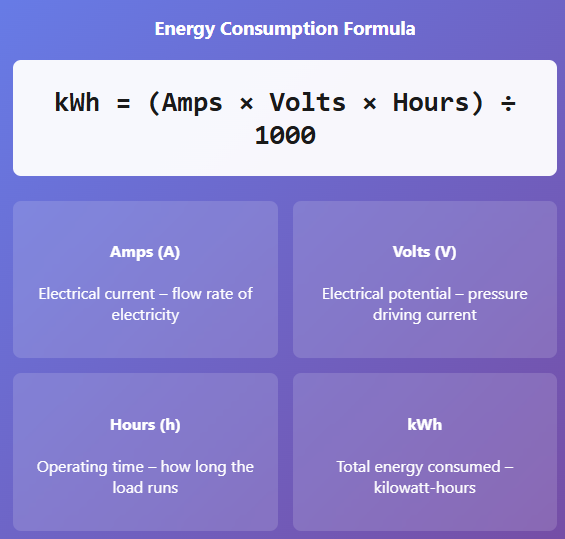
The amount of energy consumed depends on the current, the voltage of the system, and the run time. The electrical current flow of the circuit is called amps, and the potential that drives it till the flow is called voltage. The operating time is how long the load is active. In practical terms, if they draw more current, then they use more electricity. Similarly, when run for a longer duration, more total energy is demanded even if the current drawing remains constant.
This is the reason amp to kWh conversion is widely undertakes the planning of electrical in the field. Using watts instead of just amps gives more clearer information about how much power is actually used, and this is very useful in solar battery systems, backup power installations, and commercial electrical applications.
Example Calculation
Picture a commercial office that employs a solar energy backup system. The system provides power to networking devices, lighting equipment, and communication devices, consuming a continuous current of 28 amps at 230 volts. The equipment is on for nine hours while in use.
To calculate energy usage:
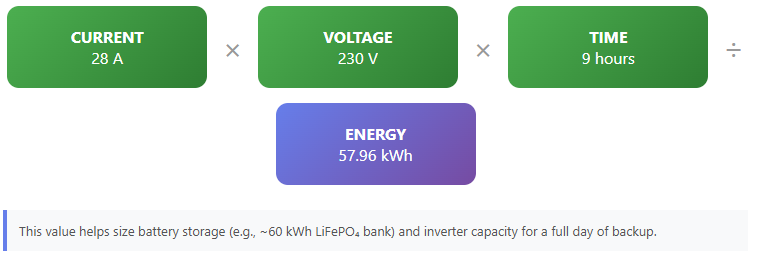
Approximating this value into real life helps determine battery storage size and inverter size. For instance, a backup system with a lithium battery bank whose rating is close to 60 kWh could manage one complete operational cycle with minimal reserve capacity. But, as is often the case with system designers, they designed an additional margin to cover inverter losses, battery inefficiency, and expansion load.
When to Use This Calculator
The most useful application of this calculator is for translating electrical current into energy consumption over time. In practical applications, when just specifying the amps alone does not indicate how much electricity a device or installation will consume. That’s because the operating voltage and runtime also influence the total use of electricity.
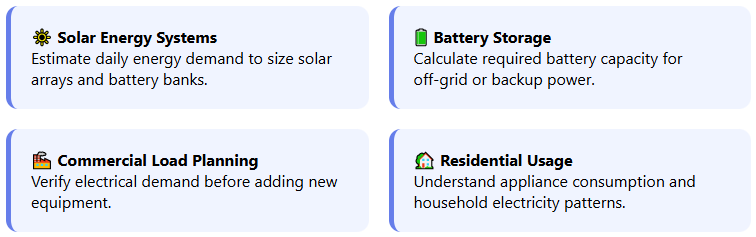
In solar energy systems, a conversion from amps to kWh is often done to estimate daily energy requirements. For instance, installers can establish the amount of electricity that communication equipment, refrigeration systems, or lighting circuits use during a typical operating cycle. This helps you understand the solar production and battery storage you need.
In battery-based systems, such as off-grid installations or backup power solutions, ampere to kilowatt-hour conversion helps correctly size the storage system. Engineers and distributors carry out these calculations to ensure batteries can support connected loads for the entire duration of outages or low solar generation.
This calculation is also handy in commercial and industrial situations where new equipment is to be added to electrical loads. By transforming current draw into energy usage, facilities operators can gain greater insight into operational demand and electricity costs while preventing overload on existing infrastructure.
Homeowners utilize amp to unit calculations in residential applications, so they can estimate the consumption of appliances and get a clearer picture of electricity usage in households.
Reference Table (Typical Values)
The table below gives real-world examples of amps to kWh computations under different operating modes. As per the current, voltage and run time describe how energy consumption changes.
| Current (A) | Voltage (V) | Time (h) | Energy (kWh) |
| 5 | 12 | 8 | 0.48 |
| 10 | 24 | 6 | 1.44 |
| 15 | 48 | 10 | 7.20 |
| 20 | 120 | 5 | 12.00 |
| 25 | 230 | 4 | 23.00 |
| 35 | 230 | 8 | 64.40 |
| 40 | 240 | 7 | 67.20 |
| 50 | 240 | 10 | 120.00 |
| 75 | 415 | 6 | 186.75 |
| 100 | 480 | 12 | 576.00 |

The total energy demand increases in proportion to both operating time and electrical current (or power demand). For large commercial systems, even a small increase in run time significantly increases the total electricity bill. That’s why accurate amps to kilowatts and energy calculations are important for proper system planning and load management.
Accuracy and Limitations
The calculator assumes stable operating conditions applying for the whole run duration, which do not always represent electrical behaviour. Many appliances or devices have variable loads, meaning the current draw may increase or decrease depending on the operating conditions, start-up cycles, and environmental factors.
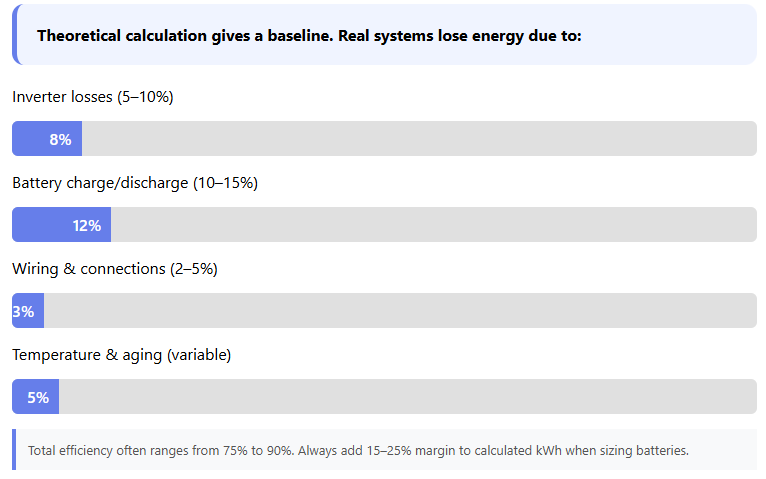
Moreover, this calculation omits any losses in the system, including inverter inefficiencies, efficiency degradation in battery charge and discharge, wired resistance, and power factor variations of AC systems. In real installations, such losses reduce usable energy output and raise total energy demand.
The overall performance of the system may also be affected due to temperature variations, the age of the equipment, and varying operating conditions. That’s why battery integrators and pro solar installers normally apply extra safety margins when doing the calculations for ampere-hour to kilowatt-hour and backup power.
Case Study
A telecom monitoring site in Lisbon operates a solar and battery storage hybrid operation designed to deliver continuous operation day and night. The equipment is drawing a constant current of 42 amps at 48 volts single phase 24/7.
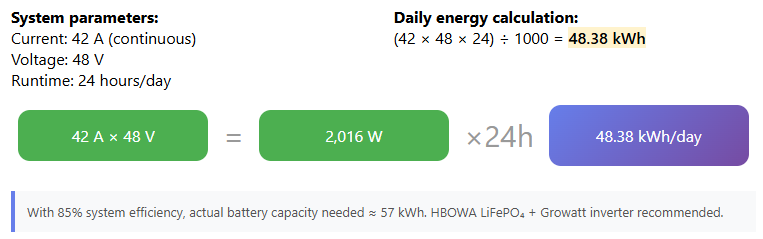
The required continuous operation is found from this value, which helps to size the solar array, inverter, and battery storage. With this installation, the engineers can integrate an HBOWA LiFePO4 battery storage system with a Growatt hybrid inverter for enhanced reliability and backup performance.
From an operational perspective, there must be a battery bank to meet operational demand and spare capacity to cover inverter losses, low solar production periods, and future equipment spare capacity. Taking into account around 85% overall system efficiency, the actual daily energy requirement increases from the previous final value.
In practical commercial solar projects, accurate amps to kWh calculations help distributors, installers, and facility operators avoid operational downtime due to insufficiently sized infrastructure and help them properly size battery storage systems.
Conclusion
The conversion from A to kWh allows a better understanding of how electrical current translates into energy consumption in real-time. Users will be able to measure the demand of electricity for residential, commercial, and industrial applications using current, voltage, and running duration. A critical calculation for solar system design, storage of batteries planning, backup power sizing, and verification of characteristics and loading.
More Calculators for You
Solar Products for Your Project
 Solar Panels |
Solar System |  C&I Battery Storage |